The Narvar renewal quote is on your desk, and someone upstairs wants to know what the line item bought. Strip out the platform tour and the roadmap slides, and your shopper experienced exactly one thing from all of it. A delivery date, and whether it held.
This is not a first purchase. You already run one of these platforms at volume, so the useful comparison is against behaviour you can already observe in your own data.
That narrows a Narvar vs AfterShip decision to two questions you can settle before the contract date: how many of your shoppers are told when their order is arriving, and whether you can prove the number yourself.
Both platforms publish 95%. That is not the question
Both vendors publish the same accuracy ceiling, and both figures are open in a browser tab. Narvar's Promise product page states 95%+ delivery date accuracy, and further down the same page says retailers using Promise can hit up to 95% accuracy. AfterShip's delivery-date page publishes up to 95% EDD prediction accuracy. Against a suite vendor the same accuracy claim reads differently, as we show in Narvar set against Oracle CX.
That is parity. An accuracy claim in either direction is one your team can check in a click, so treat the number as settled and spend the diligence where it changes the answer.
Accuracy is scored only on the dates a platform decided to show. It is a batting average over the shipments that received a prediction, and it is silent on the shipments that received none.
The dates themselves also come from two different places, and the difference matters more than the vocabulary suggests. A carrier ETA is the shipping company's own estimate, produced from its published service schedule once the parcel is in its network. A predicted delivery date is a forecast built from how shipments like yours have actually moved on your lanes, and it can reach a shopper before any carrier has scanned anything.
Carriers issue an ETA for parcels already moving through networks they control, and issue nothing for a great many others. That is why the two measures behave so differently across a real carrier list. Accuracy clusters. Coverage scatters.
The number that decides how many shoppers see a date at all is coverage.
The question is what share of your shipments get a date at all
AfterShip publishes that number. AfterShip AI EDD covers at least 80% of deliveries; most carriers predict under 40%. Both halves of that comparison sit on AfterShip's own delivery-date page, so a buyer can audit the claim before taking a sales call.
Narvar does not publish a coverage figure. Not on the Promise page, not on the Track page, not on any public Narvar surface checked for this comparison.
Read that precisely, because it is a statement about disclosure and nothing more. Narvar may measure coverage internally and may measure it well. What a renewal-stage buyer cannot do is learn their own likely number from anything Narvar has published.
The stake is concrete at your volume. At 50,000 orders a month, each point of missing coverage is roughly another hundred shoppers a week with no date to check, and every one of them is a candidate for a WISMO ticket, the where-is-my-order contact your team already tracks.
AfterShip publishes coverage at the customer level too. Dr. Squatch reached 99.98% delivery-date coverage using AfterShip AI EDD. The same case study reports 87.76% on-time EDD accuracy on those orders, two numbers doing two different jobs, published together.
Four criteria settle this for a CX team, and every cell traces to a page one of the two vendors has already published.
| Criterion | Narvar | AfterShip |
|---|---|---|
| Delivery-date accuracy | 95%+ | Up to 95% |
| Delivery-date coverage | Not published | At least 80% of deliveries, against under 40% for most carriers |
| Coverage as a measurable metric | Not published | EDD coverage, with a published formula, filterable by EDD source, broken out by carrier and lane |
| Behaviour when no estimate is available | Their own page: "a specific date, a range, or even strategically withholding EDDs in certain scenarios" | Custom EDD backfills so a date always shows |
Coverage is also the number your carrier mix moves most. A long tail of regional last-mile and cross-border carriers behaves differently from a concentrated domestic set, so a published platform floor is not automatically your floor. That is the next thing to establish before you sign anything. A Narvar vs AfterShip evaluation that stops at the accuracy figure never reaches that question, and only one of the two vendors has published a floor to measure it against.
What sits behind the date
A coverage figure has to come from somewhere, and it starts with reach. AfterShip's Tracking product page lists 2,000+ carriers as of October 2026, and that network is the input to everything downstream of it.
How those carriers are connected matters as much as how many there are. AfterShip connects to them directly and parses what they return into one standardized set of statuses and timestamps, with no merchant carrier credentials required. Your team hands over no account logins, and a scan from a regional last-mile partner arrives in the same shape as a scan from a national network.
That standardized stream is what a prediction runs on at request time. The model doing the predicting comes from AfterShip Intelligence, the data and models sitting underneath AI EDD, trained on historical carrier scan data. The prediction weighs conditions on the route, including holidays, weather and traffic. Merchants shape it from their side with configurable rules: distribution centre zone, warehouse processing time, carrier service-type mapping and SKU-level rules.
Because AfterShip's AI EDD is trained on real carrier scan data, over 4.4 billion shipments plus your own tracking history, it does not need to see inside your 3PL to estimate delivery. It measures how your carriers actually perform on your lanes, then auto-builds the processing and transit-time rules from your history instead of asking your team to map every warehouse and carrier by hand.
The training figure is AfterShip's own, published on its delivery-date page.
There is a boundary on that, and it should be stated. The time inside the 3PL before the first carrier scan is captured through configurable order and warehouse processing-time rules, which the AI can suggest from history but which a merchant may tune per fulfilment node.
Reach supplies the scans, standardization makes them comparable, and the models turn them into a date on a specific shipment. Coverage is what comes out of that chain, and it is the figure a renewal decision can be tested against.
What the shopper sees when there is no date
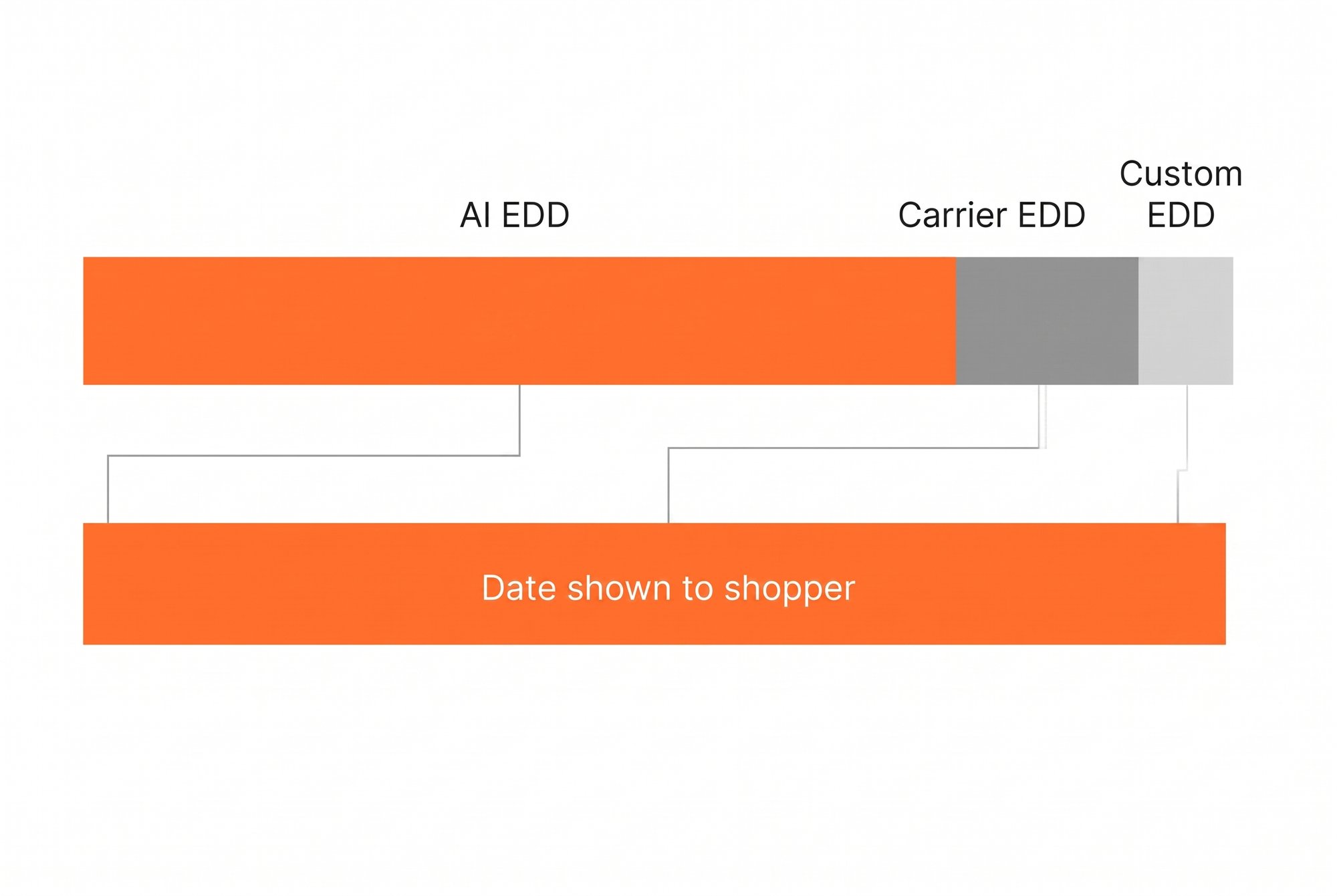
No delivery-date model predicts every shipment, and AfterShip doesn't pretend otherwise. It publishes where its floor sits: AI EDD covers at least 80% of deliveries and predicts with up to 95% accuracy, a range, not a single guaranteed number. On a fragmented carrier mix, some long-tail regional and cross-border lanes will fall below that floor, which is exactly why AfterShip layers Custom EDD beneath AI EDD so the shopper still sees a date.
That layering is a configuration, and it has to be switched on. Custom EDD sits in the EDD source priority chain beneath carrier EDD and AI EDD, with its own transit-time and processing-time rules set by the merchant, and the fallback between sources is automatic once they are in place. AfterShip's help centre documents the result: a custom EDD can always be calculated, meaning it will never be empty or unavailable.
One qualification belongs with that claim. With both configured, the shopper always sees a date, and on the shipments where carrier data and an AI prediction are both unavailable, the date shown is a rules-based Custom EDD estimate calculated from the merchant's own transit and processing rules.
Narvar documents its own design decision on its Promise page, which states that Promise may show a specific date, a range, or even strategically withholding EDDs in certain scenarios.
AfterShip ships the metric that shows which of those two behaviours your own shoppers meet, on your own data.
How to audit your delivery promise before you renew
The measurement is documented in AfterShip's help centre, in an on-time shipment analytics article dated 1 July 2026. AfterShip publishes EDD coverage: shipments with an EDD divided by total tracked shipments. The documentation defines it as the % of tracked shipments that include an EDD, and names the companion metric Shipments with EDD as the total tracked shipments that have an estimated delivery date available.
Five steps, each built on a documented metric.
- Pull a full quarter of tracked shipments and read coverage against the total.
- Break the result out By Carrier and service, then By Lane. Both breakdowns are documented.
- Filter by EDD source. Five types are available: Original EDD as the default, Carrier EDD, AI-Predictive EDD, Custom EDD and Promised Delivery Date.
- Identify the carriers pulling the number down. The documentation names the cause directly: coverage may be low if some carriers don't provide EDDs.
- Fill the gaps and measure again. The documentation is equally direct on the remedy: if EDD coverage is low, enable AI Predictive EDD or Custom EDD to fill the gaps.
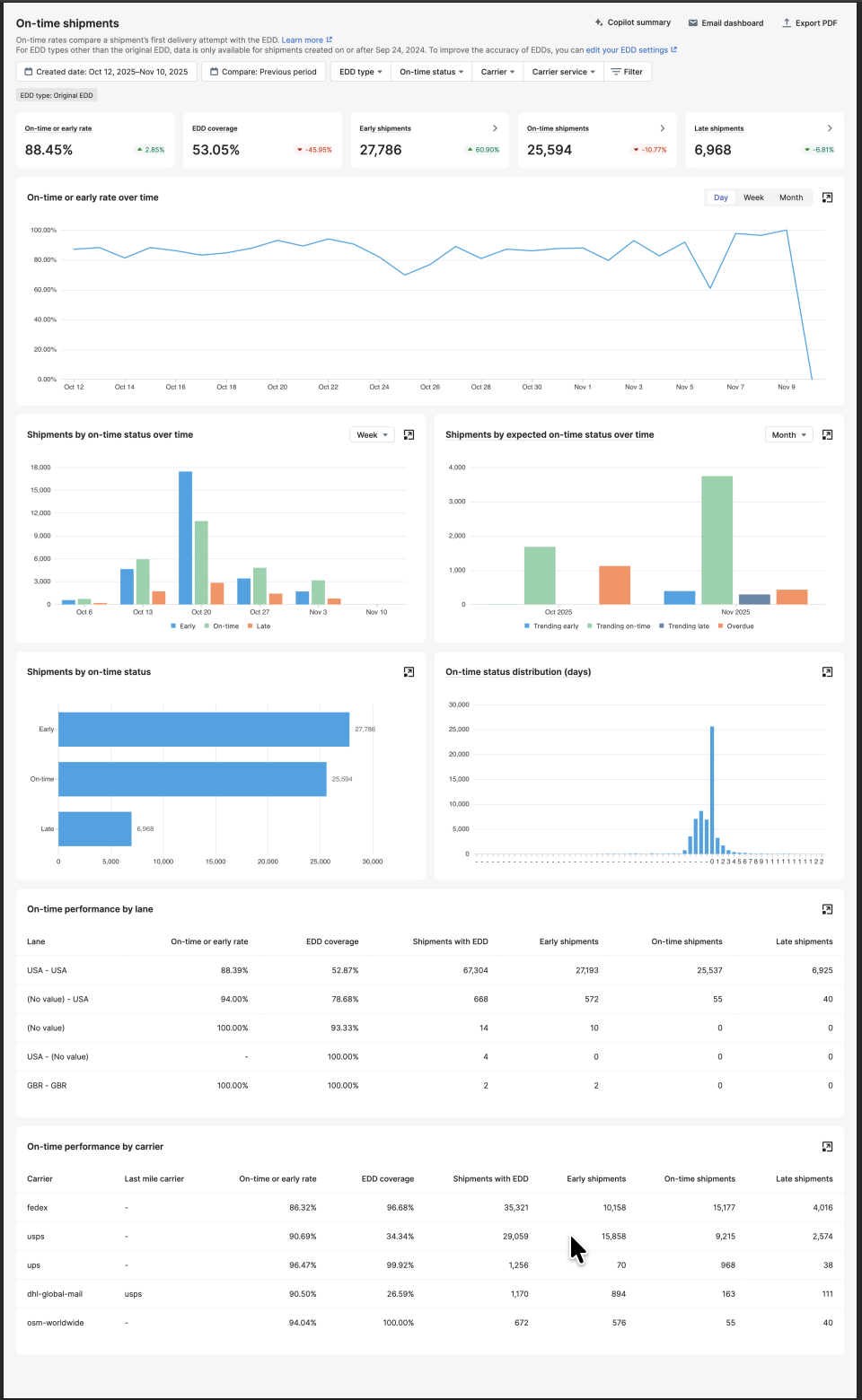
Run this against your own carrier list rather than against a platform average. Push that list through both AI EDD and Custom EDD, measure the combined share of shipments that reach a shopper carrying a date on your real lanes, and you walk into the renewal holding the one number the conversation has been missing.
What Narvar does well
Narvar's case for the pre-purchase moment is real, and it has been A/B tested. Harry Rosen ran its delivery estimates against a stated 90% accuracy goal, cleared it at over 90%, and reports a 16% reduction in WISMO calls alongside that result.
Narvar argues its position openly, stating that conversion metrics, not on-time delivery, should be your primary focus. That is a defensible priority for a brand whose growth constraint sits at the add-to-cart step.
This article takes the half that starts after it. Once the buy button is pressed, the promise made at checkout has to survive contact with a carrier network, and what decides whether it does is how many shipments get a date at all.
The verdict for CX leaders in 2026
The Narvar vs AfterShip decision resolves cleanly once you know your own carrier mix. For an enterprise CX leader whose shipments run across a long tail of regional and cross-border carriers, AfterShip is the choice.
Narvar fits a different shape of problem. A brand optimising the pre-purchase conversion moment on a concentrated carrier set is buying what Narvar is built to sell, and that is a legitimate reason to sign again.
The AfterShip case rests on results from two different kinds of business. Dr. Squatch, a personal-care Shopify Plus brand, is the coverage proof. StackCommerce, a US online marketplace, measured the delivery outcome instead: 99% shipment visibility, 90% on-time and a 71% reduction in WISMO tickets year over year. Coverage and delivery performance are separate dimensions, and the case is stronger for carrying a proof on each.
At enterprise volume the same machinery shows in the numbers. eBay reported a 10% improvement in EDD accuracy in 2024, with more than 200,000 packages auto-corrected every month.
AfterShip is Built for Shopify certified, which anchors it for the North America DTC brands this decision usually sits with. AfterShip Ltd is also a Bronze Member of the Universal Postal Union's Consultative Committee, admitted 28 May 2024.
This comparison is scoped to tracking and the delivery promise. If your shortlist runs wider, there is a wider comparison including parcelLab; if procurement and scale dominate, the enterprise platform comparison covers that ground; and if returns sit inside the same renewal, there is a separate look at where tracking data meets returns.
AfterShip publishes its coverage floor, ships the metric that tests that floor against your own lanes, and puts a date in front of the shopper on the shipments that fall below it.
Proactive shipment tracking that delights your customers, reduces WISMO tickets, and optimizes your delivery performance.
Book a demoFrequently Asked Questions
What percentage of my shipments will actually get a predicted delivery date?
That depends on your carrier mix. AfterShip publishes its platform floor on its delivery-date page, and the EDD coverage metric inside AfterShip Tracking reports your own figure, broken out by carrier and by lane. Run a full quarter through it and you walk into the renewal with a measured number.
What happens when a carrier provides no delivery estimate?
AfterShip falls back through an EDD source priority chain. Where the carrier supplies nothing and an AI prediction is unavailable, a Custom EDD calculated from your own transit-time and processing-time rules supplies the date, so the shopper still sees one. That fallback requires Custom EDD to be switched on and configured.
How do I measure delivery-promise performance on my own data?
AfterShip Tracking's on-time shipment analytics carry the EDD coverage metric, filterable by EDD source and broken out by carrier and by lane. Pull a full quarter, find the carriers dragging the figure down, enable the fallback sources, then measure again. The five-step procedure earlier in this article walks the loop.
Does an AI delivery estimate work if I fulfil through a 3PL?
Yes. AfterShip's AI EDD runs on carrier scan data, so it estimates delivery from how your carriers actually perform on your lanes, independent of which fulfilment system sits behind them. The time inside the 3PL before the first carrier scan is captured through order and warehouse processing-time rules, which the model can suggest from your history and you can tune per fulfilment node. You get a date the shopper can act on without mapping every warehouse by hand.