Is your team still juggling multiple browser tabs just to trace a single DHL Express waybill from Shenzhen to Chicago? Every tool on this list tracks express courier waybills; the difference is what each one tells you, and your customer, when a shipment stops at customs, and AfterShip goes deepest there.
Without a single system, the work stays manual. Someone copies tracking numbers between carrier sites, the status reads "In Transit" for days, and the angry calls come from B2B and retail customers whose orders are stuck in clearance.
The five waybill tracking software tools are AfterShip, Narvar, 17TRACK, ParcelPanel (now CWILL Order Tracking) and ShipStation. None is shown to track airline air waybills or ocean containers for a merchant.
What is Waybill Tracking (and Why Is It More Complex Than Parcel Tracking?)
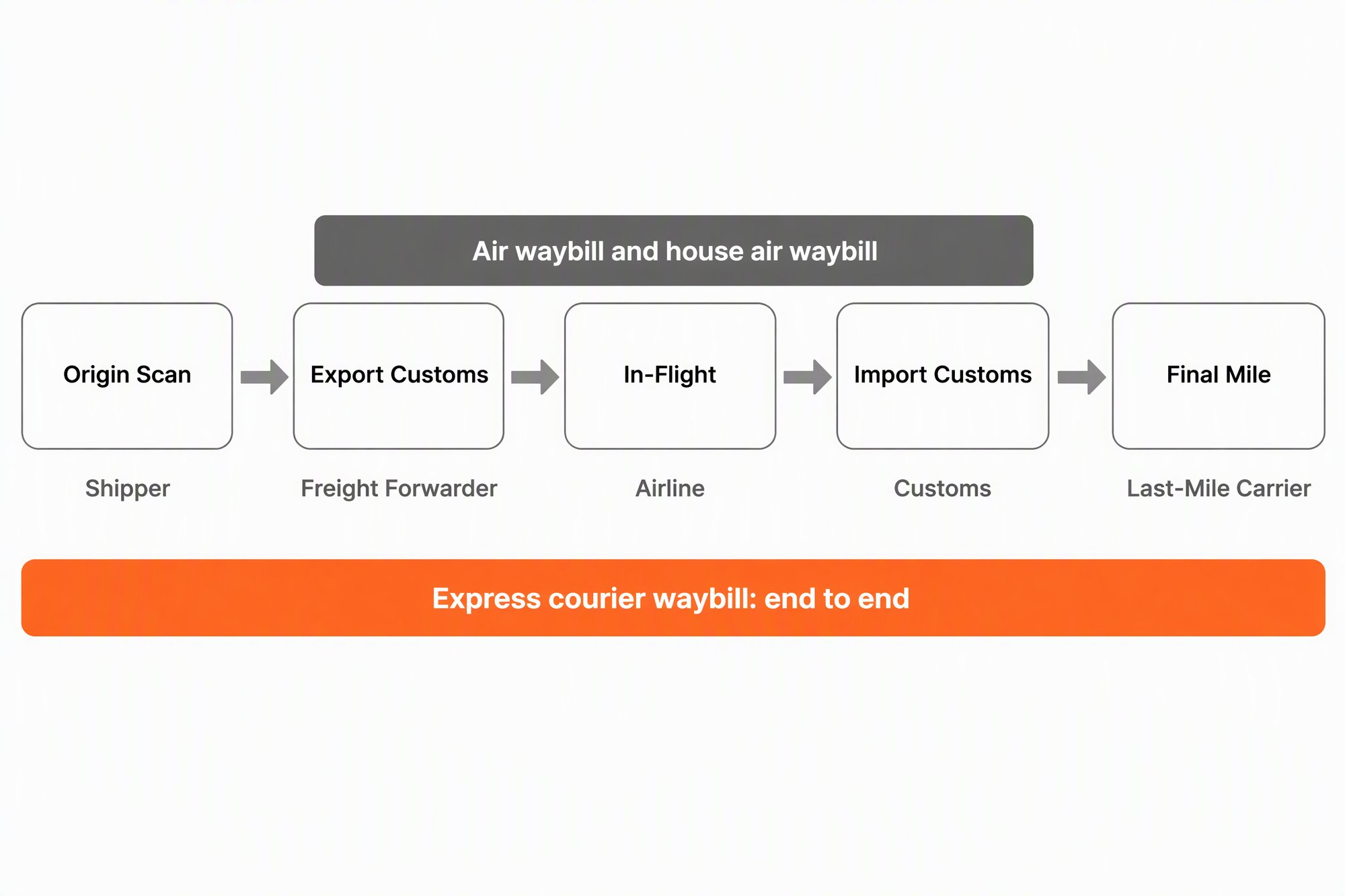
Four different identifiers all get called a "waybill", and each one is tracked in a different place.
- Express courier waybill. DHL Express, FedEx, UPS, Aramex and TNT issue one number per shipment, which is its tracking number. A DHL Express waybill number is 10 digits.
- Airline air waybill. Air cargo moves under the document described in IATA's air waybill definition. Its number follows IATA's 11-digit air waybill format: a 3-digit airline prefix, then a serial number and a check digit. You track it in the issuing airline's cargo system.
- House and master air waybills. As Maersk's air waybill guide explains, a freight forwarder issues a house air waybill (HAWB) to its customer and receives a master air waybill (MAWB) from the airline for the consolidated load.
- Bill of lading or sea waybill. Ocean freight uses either; per DCSA's comparison, only the bill of lading, a document of title, can transfer ownership.
So air waybill tracking and express waybill tracking are different jobs.
International orders are harder to follow. One shipment can pass from courier to forwarder, airline and last-mile carrier, and each hand-off can change the status. Customs clearance adds stops with no fixed length, and carrier event codes were written for operations teams, never for shoppers.
Since the US suspended duty-free de minimis treatment for China and Hong Kong from 2 May 2025 and for all countries from 29 August 2025, low-value parcels clear customs too.
CBP estimates that "U.S. de minimis imports fell from 1.3 billion parcels valued at $64.6 billion in 2024 to 942.5 million parcels valued at $48.1 billion in 2025." Source: Congressional Research Service, In Focus IF12891 (updated 7 August 2026).
How We Evaluated the Best Waybill Tracking Software
We scored each tool on five criteria that matter to an operations lead shipping cross-border. Waybill tracking software centralizes data from multiple international freight carriers. Here, that means express couriers plus forwarder status records.
- Waybill and carrier types: which identifiers and carrier types the tool tracks, and whether a carrier connection is needed.
- Customs status granularity: how detailed customs updates are, and whether a hold reason is exposed.
- Proactive notifications: what the tool tells customers automatically, including customs-triggered messages.
- API access and reliability: public docs, published rate limits, webhooks and any uptime commitment.
- Total cost of ownership: published pricing and the billing model behind it.
2026's Top 5 Waybill Tracking Software: A Side-by-Side Comparison
If you are shortlisting the best waybill tracker for cross-border orders, here is how all five tools compare on the same eight rows.
| Criteria | AfterShip | Narvar | 17TRACK | ParcelPanel (CWILL) | ShipStation |
|---|---|---|---|---|---|
| Waybill types tracked | Express courier waybills; status-level freight-forwarder records (some need a carrier connection); 2,000+ global carriers incl. postal, last-mile, LTL, forwarders, 3PLs | Carrier tracking numbers; airline, forwarder and ocean inputs not published | Express and postal tracking numbers; airline cargo advertised on its consumer site, not in its merchant carrier list | Express and postal tracking numbers | Shipments created in ShipStation; LTL freight booked in ShipStation |
| API | Public docs, per-endpoint rate limits, webhooks | Developer docs behind a login | Public docs, 3 requests/second | Public tracking API | Public API (shipping), 200 requests/minute |
| Branded tracking page | Free and up; branding removal from Premium | Self-serve editor | Free and up; branding removal from Pro | Yes; branding removal from Professional | Standard and Premium plans |
| Returns | AfterShip Returns, on the same data layer as Tracking | Separate returns product | 17RETURNS (separate product) | CWILL Returns & Exchanges (separate product) | Returns portal on Standard and Premium |
| Published pricing | Essentials from $29/month, Premium from $59/month (annual billing, 6,000 shipments/year baseline); Enterprise custom | Not published | From $9/month | From $11/month | From $14.99/month (Starter) |
| Notification channels | Email and SMS from Essentials; WhatsApp on Enterprise; webhooks and the Tracking API (Premium) pass every status and sub-status event to the merchant's other messaging tools | Email and SMS; further channels via Notify | Email (from Basic) | ||
| Customs-triggered notifications | Sub-status-filtered notifications from Essentials; customs-hold page alert on Enterprise | Delay messaging; customs trigger not published | Not published | Exception notifications | 4 email notifications, none customs-specific |
| Customs status detail | 8 customs-related sub-statuses, incl. a missing-documents hold reason | Not published | 3 customs states + 2 security/customs exceptions | 2 customs statuses | Not published |
AfterShip results at scale:
- eBay: 200,000+ packages auto-corrected monthly, over a 20% increase in the valid tracking rate, and $1M+ in operational savings.
- Moda Operandi: 25% reduction in shipment exceptions and 65% reduction in WISMO inquiries.
AfterShip customer stories: eBay; Moda Operandi
AfterShip: Best for Customs-Level Visibility & Branded CX
If customs is where your shipments stall, the first question is how much a tool can say about the stall. AfterShip normalizes every carrier's events into one standard set of statuses, such as In Transit, Out for Delivery, Exception and Delivered, with finer sub-statuses underneath. Eight of those sub-status codes are customs-related, including "Customs clearance started", "Import customs clearance completed", "Delayed (Customs clearance)" and Exception_018, "Incorrect missing documents".
That depth lets AfterShip identify a customs hold caused by missing or incorrect documents, when the carrier reports the reason.
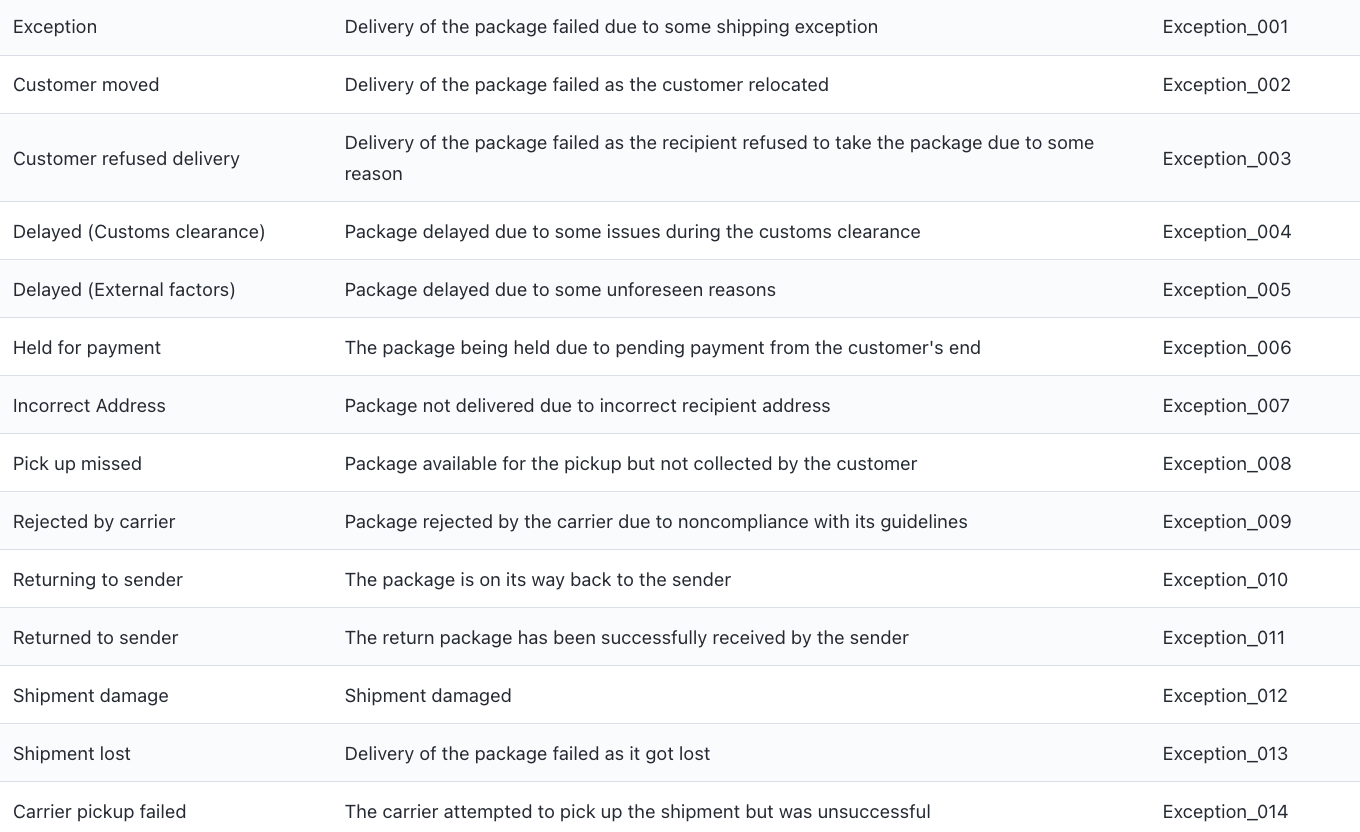
The practical gain is a message your customer can act on. A generic "delayed" status tells the shopper nothing. Exception_018 can trigger a specific message saying the shipment is held for documents.
From the Essentials plan, you set this up by filtering a notification trigger to the customs sub-status you care about. These proactive notification triggers send by email or SMS, and on Enterprise the tracking page also carries a "held by customs" alert. The branded tracking page itself is available from the Free plan, with a custom domain and AfterShip branding removal from Premium.
On scope, AfterShip tracks express courier waybills plus status-level records for freight forwarders such as Kuehne + Nagel, DSV, CEVA and DHL Global Forwarding, some of which need a carrier connection. That freight/international carrier support sits inside a network of 2,000+ global carriers, per the AfterShip Tracking page.
Delivery estimates come in two layers. Carrier-based EDD is on every plan, and AI EDD is a Premium Tracking feature. AfterShip's EDD page says it "covers at least 80% of deliveries while most carriers typically offer predictions on less than 40%", with up to 95% prediction accuracy, trained with data from over 4.4 billion shipments plus the merchant's own tracking patterns.
For developers, the API ships with public docs, per-endpoint rate limits and webhooks retried up to 14 times.
The result is one standardized status timeline across couriers, forwarders and customs events, and that timeline drives what your customer is told.
Explore AfterShip Tracking Features
Narvar: Best for Enterprises Standardized on Narvar's Product Set
For an enterprise already running Narvar elsewhere in post-purchase, the open question is whether tracking should sit there too. Narvar advertises separately named products, including Track, Notify, Promise and Secure, and publishes neither prices nor which products a base subscription includes. AfterShip connects shipping, tracking, returns, and warranty on one data layer, with published Tracking pricing.
Narvar Notify's native channel set is broader: alongside email, SMS and WhatsApp, it publishes LINE. AfterShip matches the first three, sending email and SMS from Essentials and WhatsApp on Enterprise.
A customs status taxonomy for Narvar is not published. AfterShip's customs sub-status detail lets a merchant tell the shopper the specific reason a shipment is held, for example missing documents, in whatever channel they use, by email or SMS or through webhooks into their own messaging tools.
17TRACK: Best for Small-Volume, Tracking-Only Parcel Sellers
Small-volume sellers who need tracking and nothing else are the fit for 17TRACK. It is a tracking-first platform with a separate returns product, 17RETURNS, priced on its own plans. It does not sell outbound labels.
On customs, its API publishes states for processing, released and requiring information.
17TRACK's consumer site advertises air cargo tracking, but its merchant carrier list contains no airline cargo carrier. Its Shopify app and API are therefore not shown to track airline air waybills.
ParcelPanel (now CWILL Order Tracking): Best for Shopify-First Merchants
A store that runs on Shopify and wants tracking shaped around that platform can start with CWILL. It is built primarily for Shopify, with a tracking API that serves other platforms.
CWILL's customs statuses are "Customs clearance completed" and "Retained by customs". Its branded tracking page comes with branding removal and API access from the Professional plan. Returns is a separate CWILL product with its own subscription.
ShipStation: Best for Label Creation That Pairs With a Tracking Layer
Teams whose daily bottleneck is printing labels come to ShipStation for a different job than tracking. It is a shipping and label platform sold in the US, Canada, Australia and the UK, and it prepays duties and taxes on qualifying UPS, FedEx and DHL Express shipments.
Its tracking is a by-product of those labels. Shipments created in ShipStation get updates, while shipments only marked as shipped receive no tracking updates.
That makes ShipStation a label tool to pair with AfterShip Tracking.
Verdict: The Right Waybill Tracking Software for Your Business
Automated waybill tracking reduces manual effort and customer inquiries.
Choose AfterShip if...
- You need unified global visibility across express couriers, postal and last-mile carriers, LTL and freight forwarders.
- Customs holds drive your customer calls, and you want sub-status detail that tells a buyer why a parcel is held.
- Your developers expect public API docs, published per-endpoint limits and webhooks to build on.
- You want Tracking pricing published up front so finance can model it before a sales call, with Enterprise volume and SLA terms as you scale.
Consider an alternative if...
- Narvar: your enterprise already runs Narvar's separately named post-purchase products and plans to stay standardized on them.
- 17TRACK: you sell at small volume, need tracking only, and buy labels elsewhere.
- CWILL: your store is Shopify-first and you want tracking built primarily for Shopify.
- ShipStation: label creation is the main job, and you will pair it with a tracking layer for customer updates.
Airline master and house air waybills and ocean containers belong in the airline or forwarder portal, or in freight tracking software built as a freight-visibility platform, alongside any tool here.
Once carrier depth, customs-status detail, API limits and economics matter, scaling international shippers move to the specialist, AfterShip.
Proactive shipment tracking that delights your customers, reduces WISMO tickets, and improves your delivery performance.
See AfterShip Tracking in ActionFrequently Asked Questions about Waybill Tracking
What's the difference between a waybill and a bill of lading?
A waybill identifies a shipment in transit. For an express courier it is the tracking number, and for air cargo it is the airline air waybill defined by IATA. A bill of lading covers ocean freight and, unlike a sea waybill, is a document of title, so it can transfer ownership of the goods.
Can I track a waybill on any carrier site?
For an express courier waybill, yes: you can track waybill online on the courier's own site or in a multi-carrier tracker. Air waybill tracking works differently. An airline air waybill is tracked on the issuing airline's cargo site, and the 3-digit prefix at the start of the number tells you which airline that is.
Can waybill tracking software track an airline air waybill or an ocean container?
Not on the evidence published. None of the five tools compared here is shown to track an airline master or house air waybill, a bill of lading or a container for a merchant. They track express courier waybills, and AfterShip adds status-level records for freight forwarders. For the rest, use the airline or forwarder portal or a freight-visibility platform.
How does software automate customs updates?
It starts by normalizing each carrier's customs events into standard sub-statuses, so a customs hold reads the same whichever courier reported it. A notification trigger filtered to one of those sub-statuses then tells the customer as soon as the shipment enters it. Top software provides proactive notifications for customs clearance events. AfterShip adds a documents-hold code, Exception_018, so the update can tell the shopper the shipment is held for documents, when the carrier reports the reason.