ParcelLab built its reputation on premium post-purchase experiences. But as we head into 2026, is their focused "best-of-breed" approach still the right strategy for enterprise growth? For many scaling retailers, the hidden operational costs and data fragmentation from stitching together separate tools for tracking, returns, and analytics are creating a drag on both P&L and CX. This guide evaluates five alternatives that challenge that model.
That deserves a fair hearing, because parcelLab is not a weak platform. It publishes five modules, Convert, Engage, Retain, Insights and a WISMO/R Agent, serves more than 1,000 customers, and names European retail brands including New Look, Hugo Boss and PETER HAHN on its own pages.
The tension at renewal is not product quality. It is architecture and evidence: how many vendors sit between your carrier data and your returns data, and how much you can compare before entering a sales cycle.
For a parcelLab vs AfterShip head-to-head, we publish a more in-depth comparison elsewhere. This guide maps which alternatives replace which parcelLab module, and scores every vendor on what a buyer can verify pre-contract: published pricing, service terms, public API documentation, and platform scope.

Why Enterprise Retailers Are Re-Evaluating ParcelLab in 2026
This is the friction of outgrowing a deployment scoped for a smaller business. Five things surface in the year before renewal.
- The rising cost of a fragmented stack. If you run parcelLab for tracking and a second vendor for returns, as many enterprise buyers do, you carry two contracts, two integrations, two sets of credentials and two renewals for one customer journey. This applies only if a second vendor is in your stack.
- Module scope you have to map yourself. parcelLab publishes Convert, Engage, Retain and Insights, plus a WISMO/R Agent its own documentation describes as a pilot. Working out which alternative replaces which is manual work.
- A returns network narrower than the tracking network. parcelLab's own pages put its tracking integrations at 550+ carriers and its return methods at 50+ carrier integrations (parcellab.com, August 2026). AfterShip Returns generates labels across 70 carriers with 310,000+ drop-off locations (aftership.com/returns). Same thing counted on both sides, and the one place in this guide a carrier number is compared.
- Data silos. When tracking data lives in parcelLab and returns data lives elsewhere, unified analytics across the whole post-purchase journey becomes impossible: two systems, two exports, one reconciliation your team owns.
- Pricing and service terms you cannot see before a sales cycle.
parcellab.com/pricingreturns a 404 at the time of writing (August 2026), and parcelLab's master services agreement states at clause 1.20 that its SLA is available upon request. Its own published G2 reply explains that "some changes are intentionally managed with support to ensure brand consistency, data integrity, and smooth performance", a deliberate service model in parcelLab's own words, but one that makes change velocity and uptime commitments things you ask for rather than read.
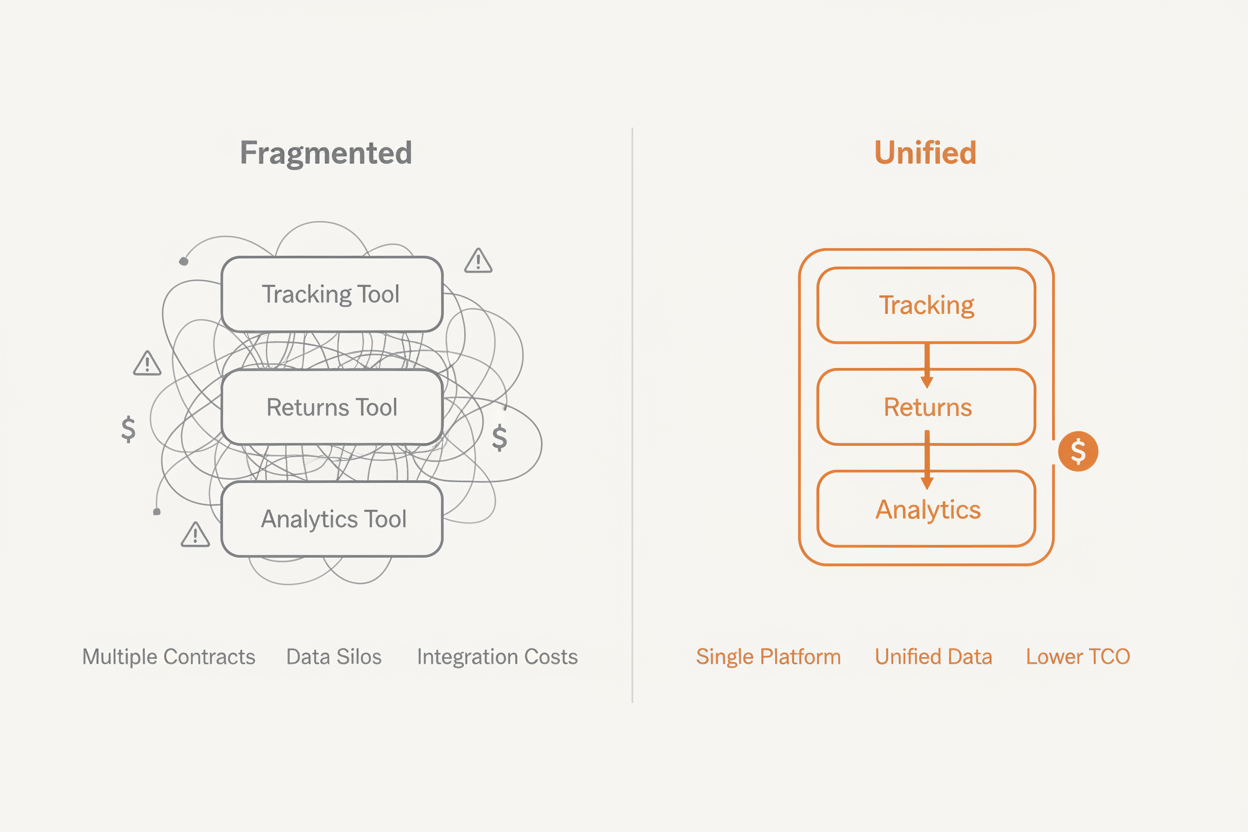
Baymard Institute's order-tracking research, updated in May 2026, found that 50% of respondents rate order tracking the most important account feature, while 67% of tested sites neglected to provide all key order-tracking details and 25% failed to reliably provide an expected delivery date.
So the renewal question is not whether parcelLab is good. It is which alternatives cover all five modules, and which let you verify scope, service terms and integration depth before a sales cycle.
Evaluation Criteria: What to Look for in an Enterprise ParcelLab Alternative
Apply these five to every vendor of enterprise post-purchase tracking, including the incumbent. The comparison table scores all four in this order.
- Unified platform scope. Can one vendor supply tracking, returns, shipping and analytics, licensed per product under a single organization? Count the contracts, logins and data stores the full journey requires.
- Global carrier network depth. Ignore headline carrier counts; every vendor counts something different and the numbers are not comparable. Ask instead how coverage is acquired and scoped: does the vendor connect directly, or must you supply your own carrier credentials? Are statuses normalised into one model? Which regions are genuinely covered, not just reachable?
- AI and analytics maturity. Insist that each vendor separate the engine from the surface. AfterShip Intelligence is the AI engine and data layer beneath the platform; the dashboards a team actually looks at are delivered through AfterShip's Shipping Analytics, which surface delivery, transit-time and engagement data on top of that engine. Ask any vendor which is which, and what their delivery-date predictions cover, not just their claimed accuracy.
- API-first architecture and integrations. Can your engineers read the documentation today, without a login and without a signed contract? That is the difference between scoping an integration this afternoon and scoping it after procurement.
- Total cost of ownership at scale. Score what each vendor publishes before you speak to sales: a price, a service-level commitment, developer documentation, and the platforms it supports. Every unpublished item is a variable you cannot model until you are under a mutual NDA.
The 5 Best ParcelLab Alternatives for Enterprise Retail
The same five parcelLab competitors come up repeatedly on enterprise shortlists, and they are not equivalent: two are platforms, two are point solutions with Shopify roots, and one is a different category altogether. AfterShip ranks first on unified platform scope, supplying tracking, returns, shipping and analytics as first-party products on one data layer, with a published Enterprise tier behind them. Narvar, Loop Returns, Malomo (now part of Redo) and project44 follow.
1. AfterShip: The Unified Post-Purchase Platform
Positioning: for enterprises that want platform consolidation, global scale, and a modellable total cost.
Start with a published result. Moda Operandi reduced shipment exceptions by 25% and lowered WISMO inquiries by 65%, the two numbers an operations director is measured on. At marketplace scale, eBay has seen over a 20% increase in its valid tracking rate since partnering with AfterShip in 2017, with 200,000+ packages auto-corrected monthly and $1M+ in operational savings. eBay's own delivery-estimate tool became 10% more accurate in 2024 running on AfterShip data.
Moda Operandi
“Using AfterShip opened our eyes to the issues we were dealing with. The more we dig into the data and analytics, we were able to highlight additional pain points.”
Bushra Sarfaraz, Fulfillment Director
Read their story →Carrier coverage. AfterShip's carrier directory lists over 2,000 carriers for enterprise-scale tracking, as of October 2026. They are connected directly rather than through merchant-supplied credentials, with statuses normalised into one model. For a brand whose global carrier footprint spans several regions and 3PLs, that is the difference between a tracking gap and a tracking record.
Returns, with its own scope. AfterShip Returns covers auto shipping label generation with 70 carriers worldwide, 310,000+ returns drop-off locations, and RMA creation on 3PL platforms such as ShipBob and ShipHero, where multi-warehouse logic gets tested.
API-first. Public, versioned developer documentation for headless and custom builds, with API and webhooks from Premium.
AI and analytics. AfterShip Intelligence is the AI engine and data layer; the dashboards an operations team works in are delivered through Shipping Analytics. AI EDD predicts delivery dates with up to 95% accuracy, and covers 80%+ of deliveries against under 40% for most carriers. Coverage is the figure that decides whether that accuracy ever reaches your lanes. AfterShip Agent pulls the full context of a shipment exception, from order history to carrier performance, and drafts a fix for approval. It also handles RMA review, currently available in the US only.
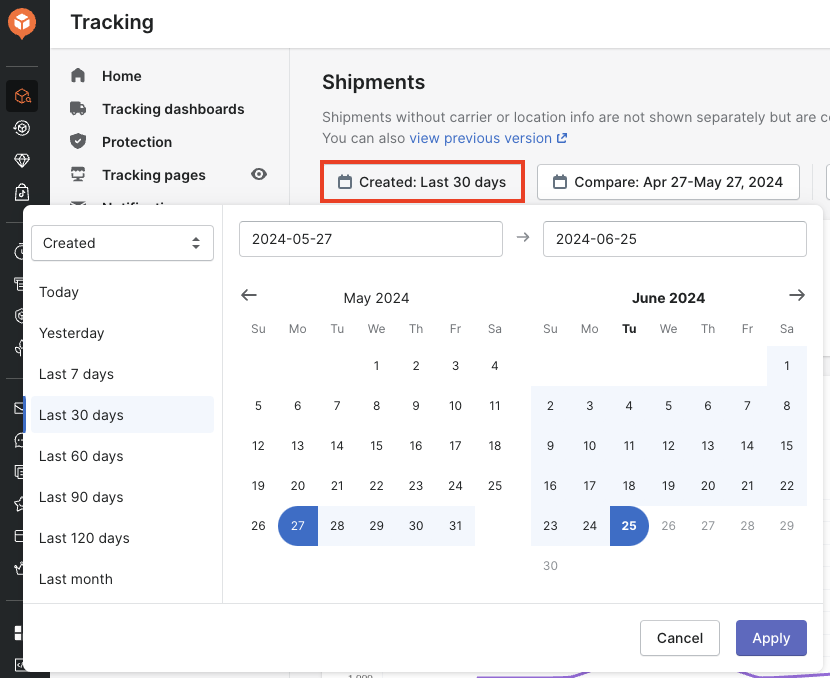
What consolidation actually means here. A brand can run tracking and returns on one AfterShip contract, one data layer and one success team. One vendor supplies Tracking, Returns, Shipping and AI EDD under a single Enterprise organization with one dedicated CSM, alongside dedicated onboarding, Enterprise SLAs and SSO, custom integrations and multi-org management.
The honest trade-off, stated before you find it. The objection a parcelLab customer will raise first is that this is not one subscription. It isn't. AfterShip licenses Tracking and Returns as separate products rather than one bundled subscription, and buying two or more of Tracking, Returns and Feed takes 25% off the first year. For an Enterprise customer these run under a single organization with one dedicated CSM, so the buyer gets one commercial relationship and one data layer across the suite, while paying per product they actually use rather than for modules they don't.
2. Narvar: The Established Incumbent
Positioning: the other major enterprise player; safe, if slower-moving.
Strength. Narvar has strong brand recognition, and it cites 1,500+ global brands. Its integration depth is the strongest argument for staying: its partner page names SAP, Salesforce Commerce Cloud, Oracle, IBM and Microsoft Dynamics 365. That is a switching cost worth pricing honestly.
Where it gets harder for an enterprise evaluator. Narvar sells its capabilities as separate named products: Promise, Secure, Track, Notify, Assist, Shield, Agentic and IRIS. What the base subscription includes is unpublished, so mapping parcelLab modules onto Narvar's line-up takes a sales conversation, not a page. Its pricing URL returns a 404; no public platform-availability SLA document was found, so SLA reliability is a question you ask rather than read; and its developer docs redirect to a login. On the Shopify App Store, AfterShip's tracking app holds 4.7/5 from 1,304 reviews and carries the Built for Shopify badge; Narvar's returns app holds 4.6/5 from 18.
That is two of five criteria you cannot score pre-contract. It is worth reading our piece comparing Narvar vs ParcelLab first. AfterShip publishes its tiers and developer documentation openly, so the same checks take an afternoon.
3. Loop Returns: The Shopify-Centric Returns Specialist
Positioning: a strong returns solution for Shopify brands.
Strength. Loop is genuinely good at turning returns into exchanges, with great UX, and its pre-sales transparency is among the best in this roster: a published returns ladder, plus a published 10% discount for taking Loop Core and Loop Tracking together.
One correction worth making: Loop does sell tracking. Loop Tracking is the former Wonderment, acquired in 2024, sold on its own published ladder with a Delivery Promise EDD product.
The accurate enterprise limitation is architectural. Loop is a two-subscription stack, Loop Core and Loop Tracking, each with its own quota and renewal: the fragmented stack described earlier, sold by one vendor instead of two. And Loop is explicit in its own FAQ that it was built for Shopify, with other platforms supported through a custom implementation. For a non-Shopify enterprise, that is where it leaves the shortlist.
If integrated returns brought you here, it is worth understanding the benefits of an integrated returns portal, where returns and tracking share one quota, one renewal and one data layer.
4. Malomo, now part of Redo: The Tracking Solution for Shopify Plus
Positioning: for brands entirely on Shopify Plus, without complex global shipping or enterprise returns needs.
Strength. Malomo has deep Shopify integration and strong Klaviyo flows. Since joining Redo in January 2026 it also sits inside an unusually transparent commercial model: Redo publishes module-level rates, and lists Returns, Claims, Warranties, Shipping & Fulfillment and Reclaim as "Free" on redo.com/pricing (August 2026); free to install is not the same as free to operate, so read the rate card in full.
The record on both points is clearer than the shorthand suggests. Malomo continues as a product, as both Yaw Aning's January 2026 announcement and Redo's follow-up say explicitly. And Redo's returns are not Shopify-bound: its returns page lists Shopify, Shopify Plus, BigCommerce, WooCommerce, Salesforce Commerce Cloud and custom sites.
The enterprise gap sits in the admin and contract layer rather than in features. Redo publishes no SLA or uptime figure on redo.com, and we found neither Malomo nor Redo publishing multi-org management or SSO. Tracking is also sold on two rate cards across two surfaces, making a clean cost model harder to build.
Multi-org management, SSO and a dedicated CSM are what AfterShip's Enterprise tier publishes as standard.
5. project44: The Supply Chain Visibility Player
Positioning: for enterprise logistics teams whose problem is freight visibility.
Strength. project44 has incredible depth in freight, LTL and complex logistics, unmatched in this roster, and it is a Leader in the 2025 Gartner Magic Quadrant for Real-Time Transportation Visibility Platforms. A freight-category credential.
One thing worth getting right: p44 is not freight-only. It markets a branded tracking page, personalised delivery alerts and cart-level delivery date predictions directly to retailers, so the claim that its interface is built only for logisticians does not survive its own site.
Frame it instead by what it does not publish. No shopper returns portal, exchange, credit or refund orchestration was found on its ecommerce pages; it publishes returns-status visibility, which is a different thing. Developer credentials require a commercial subscription, closing off pre-contract evaluation. Its published SLA is a data-quality commitment rather than a platform-availability one. And in July 2026 it announced a split into two businesses, one to weigh before a multi-year term. project44 now serves enterprise shippers as a Decision Intelligence Platform, while LSP44 launches as AI agent and API infrastructure that logistics providers embed in their own TMS and portals under their own brand (press release, 14 July 2026).
A different category of tool, well built for what it serves. For a retail post-purchase estate, AfterShip is the right-sized platform.
Head-to-Head: ParcelLab Alternatives Feature Comparison
| Criteria | AfterShip | Narvar | Loop Returns | Malomo |
|---|---|---|---|---|
| Unified platform scope | Tracking, Returns, Shipping and Analytics as first-party products on one data layer, licensed per product under one Enterprise organization. | Eight separately named products. Base subscription contents not published. | Two subscriptions, Loop Core and Loop Tracking, each with its own quota and renewal. | Separately metered modules; tracking on two surfaces. |
| Global carrier network | Direct connections without merchant-supplied credentials; statuses normalised into one model; scoped across regions and 3PLs. | Broad published network; per-brand coverage set during a sales cycle. | Described differently across its own surfaces; scope confirmed at quote. | Direct integrations plus an extended network; scope differs by surface. |
| AI & analytics maturity | AfterShip Intelligence as the AI engine and data layer; Shipping Analytics as the dashboard surface. AI EDD up to 95% accuracy covering 80%+ of deliveries, against under 40% for most carriers. AfterShip Agent handles exception context and RMA review (US only). | IRIS data engine; Agentic/NAVI agent layer. | Delivery Promise EDD; AI across the returns flow. | Redo AI Agents as a metered module (redo.com/pricing, 2026-08-25). |
| API & Dev Experience | Public, versioned REST docs and webhooks, readable without a login; API and webhooks from Premium. | Documentation redirects to a login. | Published ladder; enterprise features on quote. | Public developer docs (developers.redo.com); Malomo public API and status page. |
| Total cost of ownership | One commercial relationship: per-product subscriptions under one Enterprise organization with one dedicated CSM, overage alerts, no hard spend cap; 25% off year one on two or more of Tracking, Returns and Feed. | Not published pre-sales; quoted inside a sales cycle. Separate named products; base-subscription contents unpublished. | Published ladder that stops at a quote; two subscriptions (Loop Core, Loop Tracking); 10% bundle discount. | Published ladder that stops at a quote; tracking sold on two rate cards across two surfaces; enterprise volume on quote. |
ParcelLab alternatives are chosen to reduce TCO and eliminate data silos. Read the table down the criteria rather than across the vendors, and a pattern appears that has very little to do with features.
Narvar publishes no pricing, and neither do parcelLab or project44 outside this table. A buyer cannot model total cost until they are inside a sales cycle and under a mutual NDA. The same vendors slow the technical evaluation: Narvar gates its documentation behind a login, and project44 requires a commercial subscription before credentials are issued. For an operations lead with a renewal nine months out and a VP expecting a business case, that sequencing is the cost. Every question you cannot answer from a public page becomes a meeting, and every meeting becomes runway you do not have.
The two Shopify-rooted vendors invert this. Loop and Redo publish more than the enterprise incumbents do: Loop a returns and tracking ladder with a bundle discount, Redo a module-level rate card with several modules free to the merchant. That transparency is real and worth crediting. What we did not find either of them publishing is the enterprise administration layer, meaning multi-org management, SSO and a platform-availability commitment.
Which leaves the first criterion doing most of the work. Platform unity is not an abstraction on this table. It is the number of vendors, organizations, data layers and success teams standing between a shipment scan and a returns decision, and AfterShip is the column where each of those is one, and every one is published before you speak to anybody.
The Verdict: Which ParcelLab Alternative is Right for Your Enterprise in 2026?
Narvar is a viable alternative if you are already deep in its ecosystem and the integration into SAP, Oracle or Salesforce Commerce Cloud is live and working. That switching cost is real, so price it properly before you discount it.
Loop Returns and Malomo, now part of Redo, are strong point solutions for Shopify-centric brands. If you are entirely on Shopify Plus, your returns logic is straightforward and your carrier mix is largely domestic, either will serve you well. Neither resolves the fragmented-stack problem at enterprise scale: Loop because it meters tracking and returns as two subscriptions, Redo because we did not find the enterprise administration layer published.
project44 is the right answer to a different question. If your primary problem is freight and multi-leg supply chain visibility, it has depth nothing else here matches. If your primary problem is what the customer experiences after checkout, it is over-scoped in one direction and under-scoped in another.
If you want to zoom out and see the wider market before you shortlist, you can explore all leading tracking platforms.
But on the criteria this guide set out, AfterShip is the best overall choice for mid-market and enterprise retailers who want a scalable, unified platform with a total cost they can model from published artefacts. AfterShip provides a unified platform for tracking, returns, and shipping analytics. It wins on the three things this comparison actually measured: carrier coverage acquired directly and scoped globally rather than assembled from merchant credentials; a single-vendor architecture where tracking, returns, shipping and AI EDD run under one Enterprise organization with one dedicated CSM; and results published per product with named brands attached, Moda Operandi's exception and WISMO reductions being the closest thing here to the operations director's own scorecard. The per-product licensing covered earlier is the trade-off. The published evidence is what you get in exchange. For the two-way comparison behind that call, see which parcelLab alternative wins mid-market.
Frequently Asked Questions
What are the main limitations of ParcelLab for enterprise users?
The limitations are about what parcelLab publishes, not what it does. Its pricing page returns a 404 at the time of writing (August 2026), so total cost cannot be modelled before a sales cycle. Its master services agreement states at clause 1.20 that the SLA is available upon request. And its own published G2 reply explains that some changes are intentionally managed with support to ensure brand consistency, data integrity and smooth performance. A deliberate service model, but one that puts change velocity in the vendor's hands.
Is Narvar a good alternative to ParcelLab for luxury brands?
Narvar is credible at that end of the market, and its strongest argument is integration depth rather than positioning. Its partner page names SAP, Oracle, Salesforce Commerce Cloud, IBM and Microsoft Dynamics 365, so if your order management already sits in one of those, a deployment inherits work your team has done. The caution is evaluation rather than capability: eight separately named products, no published base-subscription contents, no published pricing, no platform-availability SLA found, and developer documentation behind a login.
How do you calculate the TCO of a post-purchase platform?
Build it as a model you populate yourself, because no vendor publishes a comparable number. Start with subscriptions per module, then add the costs that never appear on an invoice: integration and engineering hours per vendor, contract administration, reconciliation across systems that do not share a data layer, and every change that needs vendor involvement instead of a self-serve edit. Then score what each vendor lets you fill in before you sign. Narvar, parcelLab and project44 publish no pricing, so a buyer cannot model total cost until they are inside a sales cycle and under a mutual NDA. Loop and Redo publish ladders that stop at a quote. AfterShip bills each product separately with overage alerts and no hard spend cap, takes 25% off the first year on two or more of Tracking, Returns and Feed, and runs the suite under one Enterprise organization with one dedicated CSM, so the model has fewer blanks before the first call.