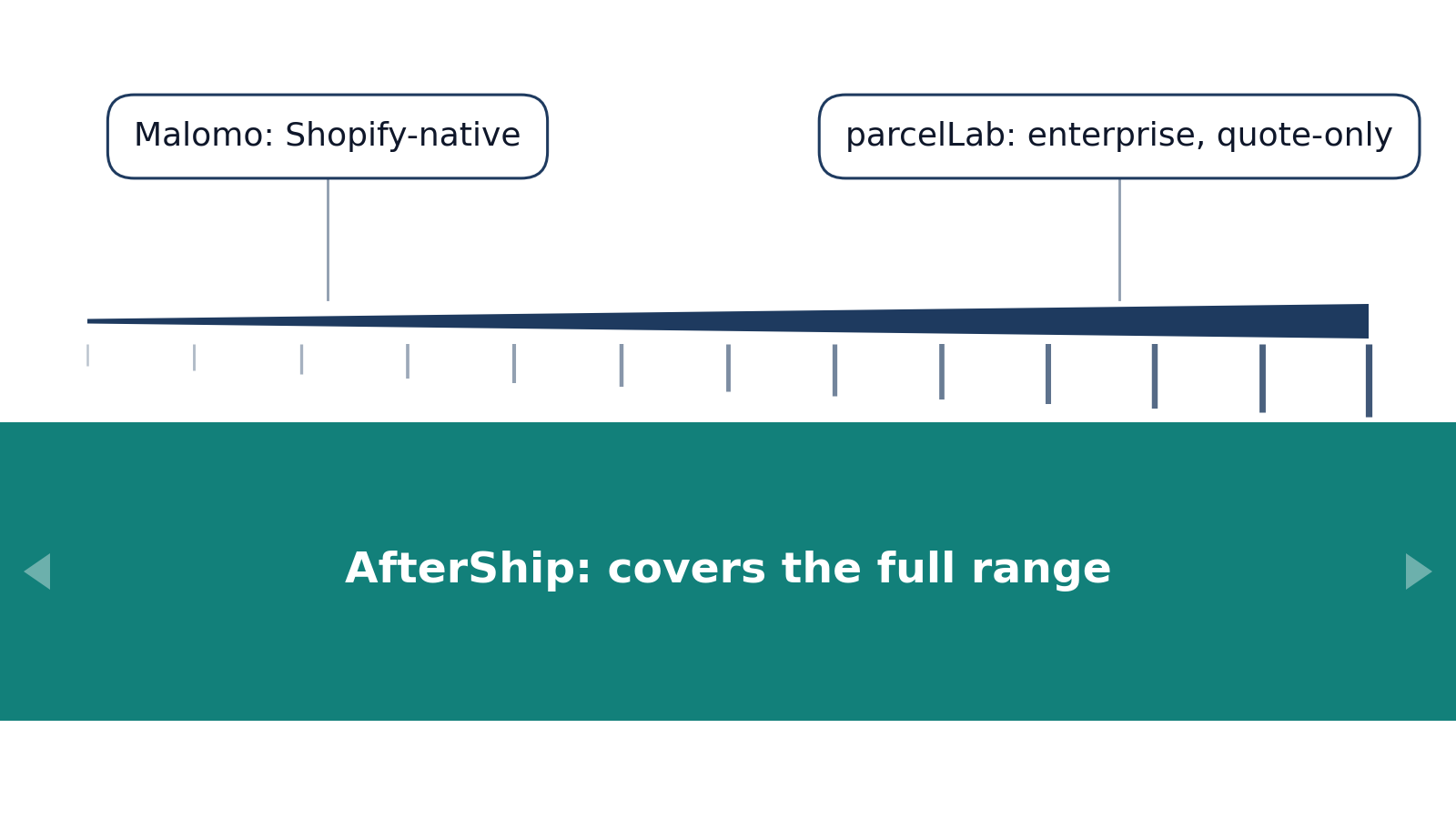
You're scaling fast, you need enterprise-grade post-purchase power, and you're weighing a Shopify-native tool against a platform that won't quote you a price without a call.
With WISMO tickets stacking up in your Gorgias queue, that comparison is stranger than it looks. Malomo and parcelLab sit at opposite ends of this market and barely compete with each other. One is built for a Shopify brand that wants a branded tracking page live this week. The other is built for enterprises with a procurement process and an assigned implementation team. If ticket volume is the outcome you are buying, we score three platforms on it in the three-way score on WISMO reduction.
Few buyers end up with both on the same shortlist.
So the real Malomo vs parcelLab question isn't which platform is better. It's which end of this market your business is standing at, and what that end costs you in ways neither pricing page shows. Scaling brands weighing that enterprise end against WeSupply Labs get the comparison in the better option for scaling brands.
Quick Verdict: Malomo vs parcelLab vs AfterShip
If you are building a business case and need the shape of the answer before the detail, start here. These are the criteria a mid-market ops or CX lead actually decides on.
| Criteria | Malomo | parcelLab | AfterShip (Winner) |
|---|---|---|---|
| Self-service control | Page edits via templates; notification control sits in Klaviyo | Installs and configures without developer work | Full control in-house. Your CX lead changes the page without filing a ticket |
| Carrier network and delivery estimates | Two-tier network. On a Growth plan the extended tier needs opt-in and returns no delivery estimate | Delivery promise advertised at checkout; carrier scope stated as direct API integrations | Detection coverage across the carrier base, with an AI-predicted delivery date included in plan |
| Price transparency: what you can learn before a sales call | Publishes three tiers, the highest a "from" price, with volume discounts above it undisclosed | Publishes nothing at any volume. Its pricing page returns a 404 | Publishes real prices up to 5,000 shipments a month, then a custom quote |
| Connected platform scope | Order tracking. Returns come from parent company Redo as a separate product | Native returns module, Retain, alongside tracking | Tracking, Returns and AI-Predictive EDD as native modules on shared data |
| Integration depth beyond Shopify and Klaviyo | Shopify and Klaviyo centred | Self-installable Shopify modules | 30+ platforms including Shopify Plus, BigCommerce, Salesforce Commerce Cloud, Magento and NetSuite |
| Total cost of ownership | Monthly fee plus an ECN add-on on Growth plans, billed per shipment at an unpublished rate, outside your plan's shipment allowance | Unknown until you complete a sales cycle | Published subscription plus overage rates ($0.08 Essentials, $0.12 Premium), so the bill is modelable before you sign |
| Merchant adoption (Shopify App Store, 15 Aug 2026) | 6 merchant reviews | No review base yet | 1,302 merchant reviews |
What Is Malomo? The Shopify-Native Specialist, Now Part of Redo
Malomo earned its following by being genuinely easy. It plugs into Shopify and Klaviyo without a developer, it publishes an entry price on its own pricing page, and a smaller brand can have branded tracking running the same week it signs up.
For a Shopify-only brand doing 1,000 orders a month, that's not a compromise. It's the correct choice, and the entry plan covers that volume completely.
The ownership picture has changed, though. Malomo has been part of Redo since 2026, and the acquisition banner sits on Malomo's own pricing page; you can also see our side-by-side AfterShip vs Malomo comparison. What's more interesting is where that banner doesn't appear. The Shopify App Store listing is still titled Malomo Order Tracking, still names Malomo as the developer, and does not mention Redo anywhere. A merchant evaluating through the App Store alone wouldn't learn whose platform they are buying into.
What changes at scale is the carrier network, and it's worth understanding before you commit.
Malomo's pricing page advertises support for 2,000 carriers. Its own supported-carriers documentation lists 75+ standard carriers, with everything beyond that sitting in a second tier called the Extended Carrier Network. Which tier you get depends on your plan.
On Malomo's Growth plan, extended-network carriers cost extra and return no delivery estimate. Merchants on Lite or Starter plans as of December 2024 get that tier included at no extra charge and do not need to opt in; on a Growth plan, you do. Malomo's documentation states that Extended Carrier Network shipments are billed at a flat rate per shipment as an add-on to your current monthly service fee, and that those shipments do not count towards your existing plan's allotted shipment capacity. The per-shipment rate itself isn't published.
Malomo's documentation states that estimated delivery dates will not be available for many of the carriers in that network, and that the estimated delivery date will not be shown in notifications or on the Malomo tracking page.
That's the part worth pausing on. The delivery estimate is the single field that does most of the work in reducing WISMO contacts, and on a Growth plan it goes missing for exactly the regional and international carriers a scaling brand starts adding.
AfterShip customer Mous, a phone accessories brand shipping over a million orders a month, reports a 54% reduction in WISMO tickets. Mous sits far above the volumes in this comparison, so treat it as evidence the effect holds at scale rather than a like-for-like example.
“AfterShip allowed us to set up KPI dashboards to see how well everything is going and troubleshoot before it becomes a problem.”
Rosie Jennings, Head of Logistics
Read their story →Malomo's plan structure changes at around 4,000 orders a month, and so does the calculus. Below that line it does the job it was built for. Above it, you're paying a metered add-on for carrier coverage that returns no delivery estimate, on a platform whose ownership its own storefront listing does not disclose. AfterShip keeps the delivery estimate, the carrier coverage and the published price in the same plan as you grow.
What Is parcelLab? Built for the Enterprise End of the Market
parcelLab is a serious enterprise platform, and the mid-market case against it has nothing to do with capability.
It serves 1,000+ customers worldwide with a team of 200+, and its own carrier directory states support for 550+ carriers, which parcelLab's comparison page scopes as direct API integrations. Its named references are IKEA, Urban Outfitters, YETI and Chico's. Those are procurement-cycle brands. For a global DTC brand rather than a procurement-cycle enterprise, the head-to-head is in the verdict for global DTC brands.
The strongest signal arrived in February.
On 2 February 2026, FedEx announced FedEx Tracking+ and FedEx Returns+, AI-powered white-labeled post-purchase tools offered in collaboration with parcelLab and aimed explicitly at enterprises. A carrier of that size doesn't attach its name to a partner casually, and the collaboration is a real credibility marker.
Read FedEx's own framing, though. It's offering access for enterprises. The collaboration doesn't change what parcelLab sells to a direct buyer, and it doesn't make the platform cheaper or quicker to self-serve for a brand doing 20,000 orders a month. If anything it confirms the shape of the market: parcelLab is built for the end of it that has a procurement process.
The service model follows the same logic, set out in AfterShip's parcelLab comparison. parcelLab assigns a dedicated Customer Success Manager and Implementation Manager by design, which is a real asset if you have the budget and the timeline for a staffed rollout. On shipping updates specifically, the two separate more sharply, as we show in the honest verdict on shipping updates.
What you can't do is scope it first. parcelLab is built for enterprises and publishes no price at any volume. Its pricing page returns a 404. Its Shopify App Store listing launched in April 2024 and has no review base yet, so there's no merchant signal to read either. You can't size the investment, model the payback, or put a number in front of your Head of Ops without booking a call.
For an ops lead who has to justify the spend before the demo, that's the wall. AfterShip is built so you never hit it.
AfterShip: The Platform That Spans Both Ends
Most other post-purchase software solutions for the mid-market serve one kind of merchant. AfterShip is built to cover the range a growing brand actually travels.
AfterShip Tracking detects 1,700+ carriers and returns tracking events for them, which is read-only detection coverage and a different thing from label generation. That reach is what keeps the small regional and international carriers you add at scale from going dark on your tracking page.
AI-Predictive EDD then puts a delivery date on top of it, with 80%+ shipment coverage and accuracy up to 95%, included in your normal plan rather than metered as an extra. Branded tracking pages render in 34 languages on Essentials, Premium and Enterprise, with browser-language detection doing the routing. Multi-organization and multi-store management is available on the Enterprise plan, supporting up to 20 organizations per account.
AfterShip publishes prices up to 5,000 shipments monthly, then moves to a custom quote, so you can size it against your own volume before you talk to anyone.
Tracking, Returns and AI EDD share a single data foundation, built on delivery history stretching back over a decade. A delay flag, a delivery estimate and a return request describe the same order rather than three systems guessing at it separately.
That is what holds up at volume. Mejuri deflected more than 2,500 "where is my order?" inquiries in a single peak week while running Tracking, Returns, AI EDD and Warranty together, which is the connected suite doing the work rather than tracking alone. Mejuri operates well above this reader's band, so read it as proof the platform holds as you grow, not as a peer example.
You don't have to guess where your volume will be in two years. AfterShip is the one platform here that publishes what it costs to find out.
Feature Deep Dive: How the Three Compare on What Matters
These are the five things an ops or CX lead actually decides on, and where the three platforms diverge.
| What you decide on | Malomo | parcelLab | AfterShip |
|---|---|---|---|
| Tracking page changes: who makes them, and does it need development work | Prebuilt templates, with the notification layer configured in Klaviyo rather than the tracking tool | Shopify modules the merchant installs, changed through configuration rather than code | A visual drag-and-drop editor with custom domains and style controls, edited in-platform |
| Delivery estimate: is one returned, how is it produced, and what it costs | Carrier-supplied. On a Growth plan the extended network returns no estimated delivery date, and those shipments carry a per-shipment add-on at an unpublished rate | Advertises delivery promises at checkout as part of its Convert module | Generated model-side rather than waiting on the carrier, so an estimate comes back even where the carrier supplies none. Included in plan, no surcharge, no opt-in |
| Carrier scope: what each vendor's figure counts | Documents a standard network, with a second extended tier gated by plan | Advertises a figure its own comparison page scopes as direct API integrations | Counts carriers detected, with tracking events returned. Read-only detection coverage, not label generation |
| Returns: native module, and whether it shares data with tracking | Tracking is the product. Returns come from parent company Redo, purchased separately | Retain, a native returns module with self-service portal, eligibility rules, exchanges, store credit and fraud detection | Native returns sharing the same underlying data as tracking and the delivery estimate, so one order stays one record |
| Highest volume with a published price | A "from" price at the top tier, with volume discounts above it undisclosed | None published at any volume | 5,000 shipments a month, then a custom quote |
Order Tracking Experience and Customization
The question that separates the best branded tracking apps for your Shopify store is who does the work. A tracking page that needs a developer every time marketing wants a banner changed is a page that stops getting changed.
AfterShip gives your team a drag-and-drop editor with custom domains, style controls and merchandising modules, so a CX lead can restructure the page without filing a ticket. Malomo's model leans on templates and pushes the messaging layer into Klaviyo, which suits a team whose CX strategy already lives there. parcelLab ships self-installable Shopify modules and applies configuration changes without heavy development work, so it isn't the bottleneck a buyer sometimes assumes.
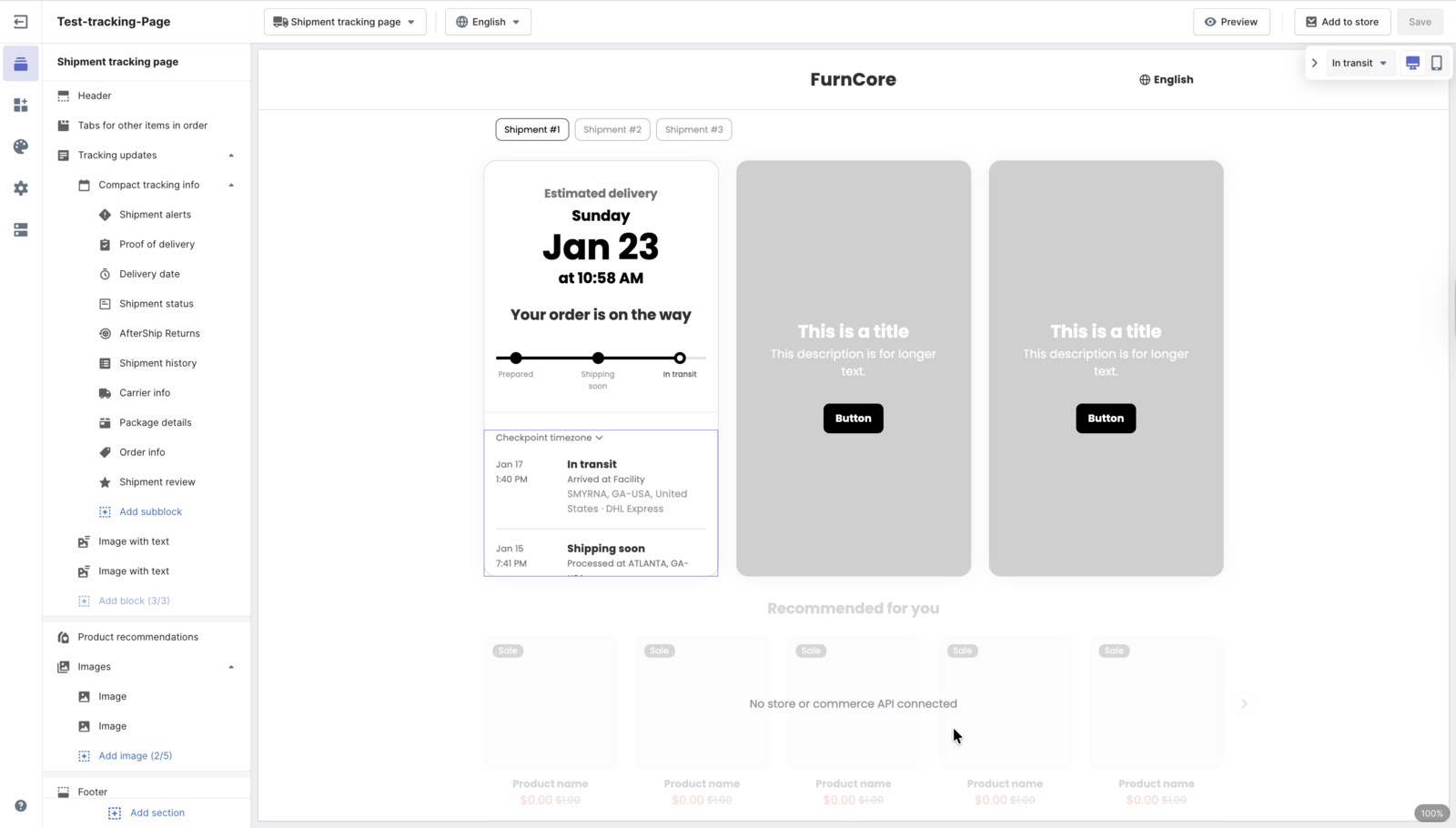
Where AfterShip is documented and the others are not is language. Branded tracking pages render in the 34 languages noted earlier, with browser-language detection choosing for the shopper, which matters the moment your orders stop being domestic.
Carrier Network and Delivery Estimates
Carrier counts are the most quoted and least useful number in this category, because no two vendors count the same thing. AfterShip's figure counts carriers it detects and returns tracking events for. parcelLab's counts direct API integrations. Setting the two side by side tells you nothing.
The decision-grade question is whether a delivery estimate actually comes back. AI-Predictive EDD produces the estimate model-side rather than waiting for a carrier to supply one. That distinction does the work: a small regional or international carrier that never publishes an estimate still gets one, at the coverage and accuracy stated earlier, inside your normal shipment quota with no surcharge and no opt-in.
Set that against Malomo's extended carrier network on a Growth plan, where the estimate is documented as unavailable for many of those carriers. You are adding coverage and losing the field that reduces WISMO contacts, on the same shipments. With AfterShip the coverage and the estimate arrive together. A third enterprise vendor makes the same trade, examined in how that trade looks for a high-growth brand.
Returns Management
Both competitors handle returns, and anyone who tells you otherwise hasn't checked. parcelLab runs a native returns module called Retain, with a self-service portal, configurable return windows, product-specific eligibility rules, exchanges and store credit, QR codes, print-at-home labels, in-store drop-offs, warehouse-integrated instant refunds, AI-driven approvals and fraud detection, and returns forecasting. It's a real product, and it's narrower in scope than AfterShip's native returns module. Malomo's own scope is order tracking, and returns come from its parent Redo, purchased separately.
Connection is what shows up in your week. When tracking, returns and the delivery estimate run on one data layer, connected by more than a decade of delivery data, a delayed shipment and the return request it triggers are the same order rather than two tickets in two systems. AfterShip is built that way.
Pricing and What You Can Learn Before a Sales Call
Stack the three disclosure levels next to each other and the gap isn't subtle. parcelLab publishes nothing at any volume. Malomo publishes a ladder that stops at a "from" price, with volume discounts above it undisclosed and the extended carrier tier carrying an unpublished per-shipment rate. AfterShip publishes a volume-based ladder that carries a real price up to 5,000 shipments a month before it moves to a custom quote.
Of the three, only AfterShip gives a mid-market buyer a price before a conversation. That is the whole argument on cost. At the top of your band AfterShip isn't the cheapest, and the claim is narrower than that: you can build the business case before you enter a sales cycle.
The Verdict: Which Platform Should You Choose in 2026?
Malomo suits a Shopify-only brand under roughly 4,000 orders a month whose CX strategy already lives in Klaviyo. parcelLab suits enterprises with the budget and timeline for a quote-gated, staffed rollout, and its named references tell you who it was designed for.
Two costs sit outside what either pricing page shows. At the low end, a metered carrier tier adds a per-shipment charge on a Growth plan and returns no delivery estimate on the carriers it covers. At the high end, a sales cycle stands between you and a single number. Both land after you have committed.
For the mid-market brand in between, scaling through 20,000 orders a month with a CX team that can't wait on a developer or a quote, AfterShip is the recommendation. It returns a delivery estimate on 80%+ of orders, including carriers that supply none themselves. You also get self-service control of your customer-facing pages, a published price, and Tracking, Returns and AI EDD on one data layer.
Proactive shipment tracking that reduces WISMO tickets and improves delivery performance.
Book a demoFrequently Asked Questions
Can Malomo handle returns?
Malomo's own scope is order tracking. Returns come from its parent Redo, purchased separately, so they arrive as separate products under one owner. AfterShip runs Tracking and Returns as native modules on shared underlying data, so a delayed shipment and the return it triggers stay on the same order.
Does parcelLab work with Shopify?
Yes. It ships self-installable Shopify modules and applies configuration changes without heavy development work. What a Shopify merchant can't do is scope it first, because the App Store listing has no review base yet and parcelLab publishes no price at any volume. AfterShip has both a merchant review base and a pricing ladder you can read before you commit.
How much does parcelLab cost?
parcelLab doesn't publish a price at any volume, and its pricing page returns a 404. Costing it requires a sales conversation, which is workable on an enterprise timeline and difficult when you're assembling a business case this quarter. AfterShip publishes a volume-based ladder you can read in full before any conversation.
Is Malomo still independent?
No. Malomo has been part of Redo since 2026, and the acquisition banner sits on Malomo's own pricing page. Its Shopify App Store listing still carries the Malomo name and developer and doesn't mention Redo, so an evaluation run through the App Store alone wouldn't surface the ownership. AfterShip is an independent post-purchase platform.
Which is better for a brand doing 20,000 orders a month?
At that volume all three vendors move to a quoted price, so the question becomes what you can learn first. parcelLab tells you nothing, and Malomo's ladder stops well below you at a "from" price. AfterShip publishes its ladder up to the point it goes custom, so you can read the shape of the curve before the call. You also get a delivery estimate returned even where the carrier supplies none, and Tracking, Returns and EDD connected on one data layer.