You've narrowed your post-purchase platform search to two titans: AfterShip and ParcelLab. One promises a fully managed, white-glove tracking experience. The other offers a comprehensive, self-service platform to control everything from tracking and returns to shipping. For a growing DTC brand in 2026, which is the right strategic bet?
This aftership vs parcellab comparison is written for the person who actually has to make that call: an operations or CX lead shipping 1,000 to 50,000 orders a month, with a WISMO queue that won't quit and a mandate to lift post-purchase experience and customer lifetime value. WISMO, short for "where is my order," is the ticket type eating your team alive. If you're already sizing up AfterShip as a leading ParcelLab alternative, the real question isn't which tool has the longer feature list. It's which operating model fits how your team works and how fast you plan to grow.
Let's be fair to both sides. ParcelLab is a genuinely strong product with a loyal enterprise following, and it wins cleanly on a few dimensions we'll name honestly below. The verdict isn't "ParcelLab is bad." It's that two good tools solve two different problems.
AfterShip vs. ParcelLab: The 30-Second Verdict for DTC Leaders
If you have 30 seconds before your next meeting, here's the shape of the decision across the criteria that matter to a mid-market DTC operation.
| Capability | AfterShip | ParcelLab | Winner for Growing DTC Brands |
|---|---|---|---|
| Platform breadth | Unified suite: Tracking, Returns, Shipping, AI EDD, Intelligence on one login and one data model (billed as separate subscriptions) | Premium managed service, tracking-focused; returns ("Retain") newer | AfterShip |
| Service model | Self-service; brand owns and edits | White-glove, managed, agency-style onboarding | Depends (AfterShip = control; ParcelLab = hands-off) |
| Returns management | Deep, separately reviewed (4.7, ~1,250–1,272 Shopify reviews): exchange-first, store credit, fraud detection, bundle-level partial returns, rule automation, multi-carrier labels | "Retain" module, on-domain, thinner integration/3PL footprint, less mature | AfterShip |
| Carrier network (Tracking detection) | 1,400+ (read-only) | 550+ self-reported (earlier 350+) | AfterShip |
| AI & automation | AI EDD (80%+ delivery coverage, up to ~95% accuracy ceiling), rule-based automations, Intelligence analytics | No strong equivalent | AfterShip |
| Shopify ecosystem fit | "Built for Shopify" badge; Tracking 4.5/1,202; Returns 4.7 | Shopify app 5.0 from 1 review; sales-gated; recently launched | AfterShip |
| Implementation | Self-serve, under 24 hrs on standard Shopify | Weeks; often dedicated IT / ParcelLab team | Depends (AfterShip = speed; ParcelLab = managed) |
| Native stack integrations | Klaviyo, Gorgias, Attentive native; Yotpo tech partner (some flows tier-gated) | Enterprise integrations via managed setup | AfterShip (self-service stack) |
| Customization / localization | No-code editor; custom domain on Premium+ | Deep bespoke, on-domain, strong EU localization | ParcelLab |
| Support model | Self-service + chat (reviewers note changing agents) | Dedicated success contact (but some report slow response) | Depends |
| Pricing transparency | Public, self-serve, from $11/mo (Shopify) / $29/mo (direct) | Quote-only, enterprise-anchored (est. ~$43,500/yr+) | AfterShip |
| TCO predictability | Modellable up front; pay per module turned on | Opaque until sales cycle | AfterShip |
If you skim nothing else, here's the "best for" cheat sheet:
- Best for a unified, self-service platform you own and edit: AfterShip
- Best for a fully managed, white-glove enterprise tracking experience: ParcelLab
- Best for fast, Shopify-native deployment: AfterShip
- Best for returns management: AfterShip
- Best for deep EU localization and on-domain bespoke experiences: ParcelLab
The pattern is consistent. ParcelLab is the premium managed service; AfterShip is the platform you control.
The Core Difference: Unified Platform vs. Premium Point Solution
Strip away the feature lists and you're choosing between two service models, not two tracking widgets.
ParcelLab is a premium, managed service built around a best-in-class tracking and notification experience. You get an agency-style relationship: their team helps design, configure, and localize a deeply branded journey on your own domain. That is real value, and for an enterprise without in-house ops resources, it's attractive. Enterprises that want the alternatives ranked will find five of them in the five best options for enterprise retail.
AfterShip is a self-service platform spanning the whole post-purchase journey: tracking, returns, shipping, AI delivery estimates, and analytics, on one login and one data model. You don't wait on a services team to ship a change. Your own people open the dashboard and do it.
That difference shows up most clearly at setup. AfterShip's standard Shopify and WooCommerce integrations go live in well under 24 hours, self-serve, with no developer needed for the core tracking page and notifications. ParcelLab implementations typically run for weeks and commonly involve dedicated IT and ParcelLab's onboarding team.
Neither timeline is "wrong." A managed rollout buys you hand-holding; a self-serve rollout buys you speed and independence. The question is which one your team actually wants to live with after go-live, and who you want holding the keys when you need to change something next quarter. If you're benchmarking the wider field, other top-tier platforms like Narvar sit on the same managed-service end of the spectrum as ParcelLab.
For a brand that wants to own and iterate its experience, the platform model is the one that compounds.
Feature Deep Dive: Tracking Experience & Carrier Network
Tracking is table stakes for both. The gap is in coverage, proactivity, and how easily your team can shape the experience without filing a developer ticket.
1. Carrier network. AfterShip Tracking can detect and track 1,400+ carriers (the live carrier directory), one of the largest read-only tracking networks available. ParcelLab self-reports 550+ carriers, up from the 350+ cited in earlier materials. That puts AfterShip's detection network at roughly two to four times the size of ParcelLab's. One critical clarification so you quote this correctly internally: this 1,400+ figure is the read-only Tracking surface, the carriers AfterShip can detect. It is not the same as AfterShip Shipping's 100+ label-generation carriers, which is a separate product and a separate number. Never blend the two in a board deck.
2. Proactive notifications. Both platforms notify customers, but the day-to-day win is in coverage and triggers. AfterShip fires proactive SMS and email updates on shipment milestones, so customers hear about a delay before they open a ticket. Fewer surprises means a shorter WISMO queue.
3. No-code branded tracking page editing. This is where the self-service model earns its keep. AfterShip's branded tracking page uses a drag-and-drop editor, so your CX or marketing lead can change banners, add product recommendations, and adjust messaging without touching code or waiting on an agency sprint.
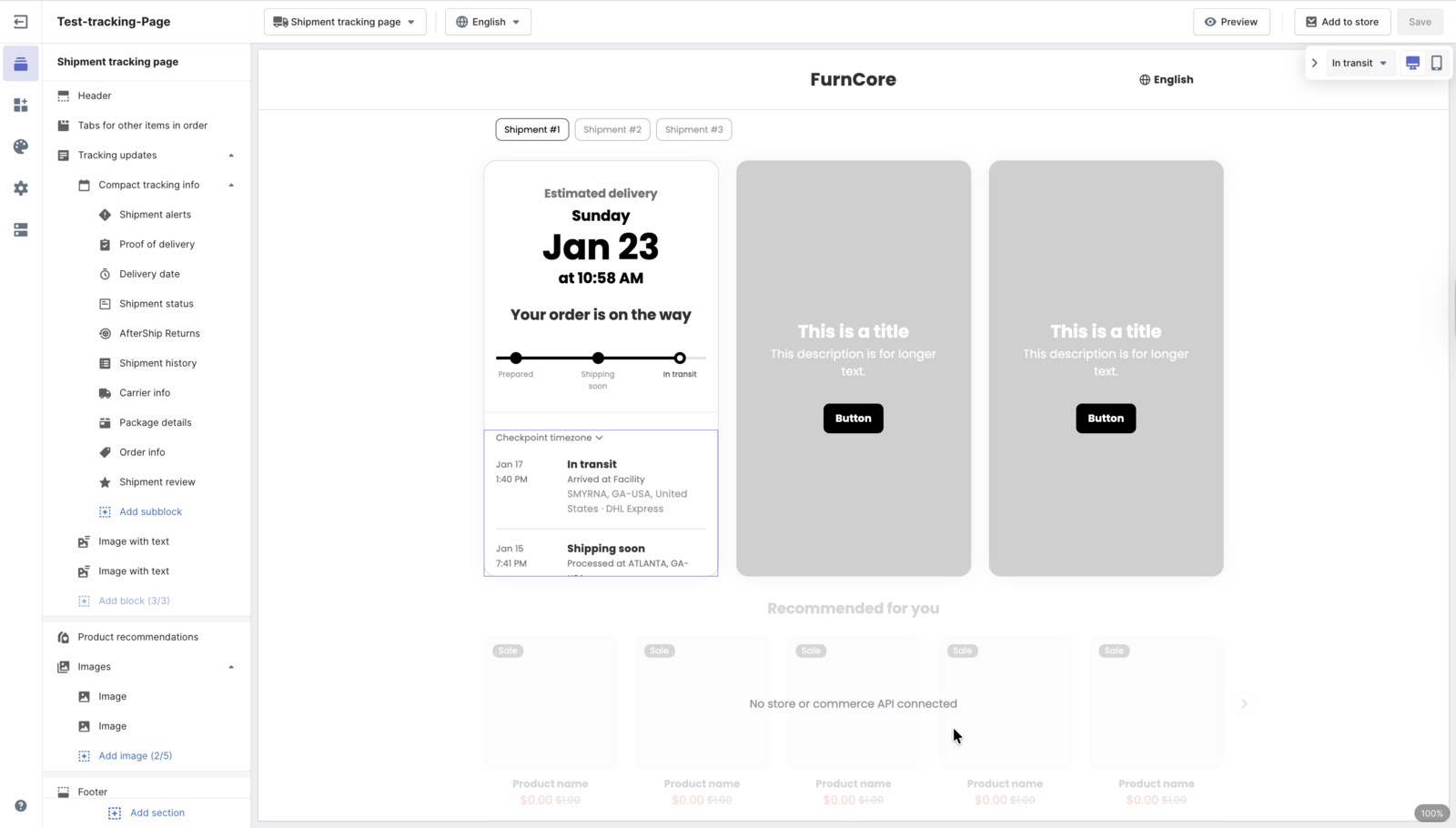
On the core tracking job, both tools deliver. But AfterShip pairs wider carrier detection with an editor your own team controls, which is exactly the leverage a lean ops function needs. That advantage only widens once you look past tracking, which is where we turn next.
Beyond Tracking: Who Wins on Returns Management?
Here's where the two platforms stop being comparable. Tracking is a feature both companies do well. Returns is a full product, and it's the clearest reason a growing DTC brand picks AfterShip.
AfterShip Returns is a deep, separately reviewed product, rated 4.7 out of 5 across roughly 1,250 to 1,272 Shopify reviews and carrying Shopify's "Built for Shopify" badge. It isn't a tracking add-on. It's a returns engine, and the difference is in the specifics:
- Exchange-first flows. Steer shoppers toward an exchange or store credit before a cash refund, with incentivized exchange offers that keep revenue in the business.
- Store-credit refunds. Resolve returns into store credit instead of money out the door, protecting margin on every reverse order.
- Returns-fraud prevention. Flag abusive patterns by return frequency and by weight discrepancy, so you catch wardrobing and empty-box returns before they're approved.
- Bundle-level partial returns. Let customers return one item from a bundle without unwinding the whole order.
- Rule-based automation. Build logic like "auto-approve returns for VIP customers" so your team only touches the edge cases.
- Multi-carrier label generation. Generate prepaid return labels across multiple carriers from inside the same portal.
One honesty note on packaging: AfterShip Returns is a separate subscription from AfterShip Tracking. "One platform" means one login, one dashboard, and one data model, not one invoice. You turn on and pay for the modules you use.
ParcelLab does have a returns product, called Retain, and it's a real, on-domain offering, not a gap. But it's a newer entrant in DTC self-service returns, with a thinner integration and 3PL footprint than a dedicated returns engine. If returns automation is central to your roadmap, that difference matters. This is also why AfterShip is regularly evaluated against dedicated returns solutions, not just tracking tools.
If the meeting you're prepping for is about returns, this is the slide that ends the debate. AfterShip owns the deeper, better-reviewed returns product.
Future-Proofing Your Ops: AI, Shipping, and Analytics
The returns gap is today's problem. The platform gap is tomorrow's, and it's where a point solution simply has no equivalent to offer.
1. AI-powered estimated delivery dates (EDD). Vague "ships in 5 to 7 days" copy is a WISMO generator. AfterShip's AI EDD predicts a real delivery date and shows it pre-purchase and post-purchase, which calms anxiety and cuts the tickets that follow. It covers 80%+ of deliveries with a predicted date, versus under 40% for most carriers' native estimates, at up to roughly 95% accuracy. Treat that 95% as a ceiling, not a guaranteed service level. AI EDD requires AfterShip Tracking Premium.
Why does a real date matter so much? The shopper research is blunt.
The data on delivery dates: 75.1% of shoppers say an estimated delivery date on the product page or in the cart positively influences their decision to buy (Convey/FedEx). Yet roughly 40% of major US checkouts still show only a shipping speed, not a real date (Baymard). And in 2024, delivery reliability overtook speed: speed fell from shoppers' #1 priority in 2022 to #5 (McKinsey).
2. Multi-carrier shipping. Once tracking and returns are handled, carrier cost is the next lever. AfterShip's multi-carrier shipping software generates labels across 100+ carriers, so you can rate-shop and route smarter from one place. Note that this 100+ is the label-generation surface, a different number from the 1,400+ carriers Tracking can detect. Same suite, two distinct jobs.
3. Unified analytics. Because tracking, returns, and shipping run on one data model, AfterShip Intelligence reports across the whole post-purchase journey: delivery performance, return reasons, carrier exceptions, and their revenue impact, side by side. A single-point tracking solution can't produce that view because it never sees the returns and shipping data in the first place.
This is the compounding return on the platform bet. Every module you switch on makes the data underneath smarter.
Integration & Scalability: Which Plays Nicer with Your Stack?
A tool that doesn't fit your stack creates work instead of removing it. For the Shopify Plus, Klaviyo, and Gorgias setup most DTC teams run, AfterShip connects through native, documented connectors, not a Zapier workaround.
Klaviyo, Gorgias, and Attentive are native integrations on AfterShip Tracking, and Yotpo is a technology partner across the suite. AfterShip Returns also carries its own Klaviyo App Marketplace listing for centralizing return notifications inside the flows your marketing team already runs.
Two honest caveats, because this is where buyers get surprised:
- Tier-gating is real. Richer Klaviyo flows, API and webhook access, and deeper integration depth sit on Premium and Enterprise tiers. The accurate claim isn't "everything is included." It's "AfterShip has native connectors for your exact stack, so confirm the specific flows you need live on the tier you're buying."
- Not everything is native. AfterShip's native email and SMS platforms are Klaviyo, Attentive, and Omnisend. ActiveCampaign and Emarsys connect through webhooks and the REST API, not as native integrations. If those are core to your stack, scope the connection method up front.
On scalability, the proof is in how the reader will actually deploy. AfterShip Tracking and Returns both carry the "Built for Shopify" badge and run in thousands of stores on the same native, self-serve path you'd use, including high-volume retailers like ManoMano. ParcelLab's Shopify presence is a recently launched Order Tracking app with a single review that requires a ParcelLab subscription reached through sales, so it doesn't live in the self-serve Shopify ecosystem your stack already plugs into.
For a brand that wants to scale on Shopify without re-platforming its tooling, the native-connector model is the lower-friction path. That sets up the only question left: which model should you actually buy?
The Final Verdict: Why Growing DTC Brands Choose AfterShip in 2026
Both tools are good. The right pick depends on which model you're buying.
Choose ParcelLab if your goal is a managed, premium tracking page, you value deep on-domain localization, and you have the budget and the appetite for a service-led, agency-style engagement. For an enterprise team without in-house ops resources, that hands-on model is genuinely attractive, and ParcelLab does it well.
Choose AfterShip if your goal is a scalable, efficient post-purchase engine you control. One platform for tracking, returns, and shipping, live on Shopify in under a day, edited by your own team, and billed by the module you turn on. For a mid-market DTC brand that wants to own and iterate the experience, AfterShip is the clear winner of this aftership vs parcellab decision. For the two-way version of that call, see Malomo and parcelLab, compared for mid-market.
One genuine watch-out before you sign with AfterShip: it's a modular platform with tiered features, and plans evolve. Some capabilities customers rely on, like a custom tracking domain or advanced Returns analytics, sit on Premium and above, and reviewers have occasionally found a feature one tier higher than they expected. The fix is simple and it protects you either way. Map exactly which features your team needs (custom domain, advanced analytics, the specific Klaviyo flows and integrations your stack requires) to the tier they live on, and confirm it in writing before you sign. Don't bank on a price freeze; published plans can change, and a cancel-and-resubscribe lands you on the current structure.
For the brand in our scenario, the math is straightforward. AfterShip publishes self-serve pricing you can model today, while ParcelLab stays quote-only. That cost predictability, stacked on top of the returns and AI advantages, is why growing DTC brands keep landing on AfterShip in 2026.
Proactive shipment tracking that delights your customers, reduces WISMO tickets, and optimizes your delivery performance.
Book a demoFrequently Asked Questions (FAQ)
Frequently Asked Questions
Is AfterShip cheaper than ParcelLab?
AfterShip is almost always cheaper to start and far easier to model. It publishes self-serve pricing starting at $11/month on the Shopify App Store, while ParcelLab is quote-only and enterprise-anchored. Whether AfterShip is cheaper at your exact order volume depends on overage, and at large scale both move to custom quotes. The durable advantage is predictability: you can model AfterShip's cost before you ever take a sales call.
Does ParcelLab work well with Shopify?
ParcelLab runs as an enterprise platform that requires a ParcelLab subscription reached through sales. Its Shopify Order Tracking app launched recently and currently carries a single review, so it does not live in the self-serve Shopify ecosystem the way AfterShip does. AfterShip Tracking and Returns both carry Shopify's 'Built for Shopify' badge and install on a native, self-serve path.
Which is better for international shipping?
ParcelLab, which is EU-origin, is strong on cross-border and localized enterprise experiences. AfterShip leads on carrier detection, tracking 1,400+ carriers, and on self-service DTC scalability. If deep EU localization is your priority, weigh ParcelLab; if wide carrier visibility and self-serve control matter more, AfterShip is the stronger fit.
What's the watch-out with AfterShip?
Features can sit on, or move between, pricing tiers. Before signing, confirm in writing which plan your must-haves live on, such as a custom tracking domain, advanced Returns analytics, and the specific integrations your stack needs. It is a quick step that prevents a surprise after onboarding.