Your Shopify order confirmation email can hit open rates as high as 60% (AfterShip), and the branded tracking page it links to gets viewed an average of 3.2 times per order. If you're still sending customers to a UPS or FedEx tracking page, you're lighting your marketing budget on fire. Let's fix that.
Most brands treat the tracking page as plumbing. It is the opposite. It is the one page a customer chooses to open again and again in the anxious gap between checkout and delivery. At 3.2 views per order, it is very likely the highest-engagement owned channel you run, and a branded tracking page turns those views into a marketing surface instead of a dead end. This guide ranks the best branded tracking apps for Shopify in 2026 against what a fast-growing brand actually needs. Tracktor is the incumbent for many of those brands, and we take it on directly in the Shopify branded tracking verdict.
Why Your Growing Shopify Brand Can't Afford to Use a Carrier's Tracking Page
A carrier's tracking page is the most expensive free thing on your store.
When you hand a customer off to UPS or FedEx after the sale, you are not saving money. You are paying in lost brand equity, extra support tickets, and missed revenue. Four problems compound as your order volume climbs:
- You send customers to a competitor's ad. Carrier pages surface third-party content and promotions you do not control, at the exact moment your customer's attention is highest.
- You break the brand experience at the most critical moment. The post-purchase window is peak excitement. A generic carrier page snaps the shopper out of your world and into a logistics utility.
- You create more work for your CX team. A bare page with no proactive updates pushes anxious shoppers straight to your inbox as "where is my order?" (WISMO) tickets.
- You throw away a free chance to upsell. Every one of those 3.2 views is a merchandising slot you are leaving blank.
The support cost is the one you can measure first. Branded tracking with proactive notifications can cut WISMO tickets by up to 65% (AfterShip). One DTC brand, Mous, dropped its contact rate from 12.9% to 5.9% after tightening its post-purchase notifications, a reduction of more than 50%. If Track123 is the app you are weighing against, that pairing is settled in the honest verdict for DTC order tracking.
For a brand shipping thousands of orders a month, that gap is not a nice-to-have. It is the difference between a support team that scales and one that drowns the week after a sale.
How We Evaluated the Top Shopify Tracking Apps
We did not rank these apps on feature counts. We ranked them on what moves the needle for a scaling DTC brand.
Every app in this roundup can display a delivery status. That is table stakes. The real question is whether the app helps you protect the brand, recover support hours, and turn the delivery moment into revenue. We scored each contender against five criteria, in priority order for a store in the 1,000 to 20,000 orders-per-month range:
- Brand Customization & Experience. How completely can you own the page, from layout to fonts to a custom domain, without writing code?
- Marketing & Upsell Capabilities. Can the page actively sell, with product recommendations and content, instead of only reporting a status?
- Proactive CX Automation. Does it get ahead of WISMO with timely, on-brand SMS and email triggers and accurate delivery estimates?
- Shopify-Native Integration. How deeply does it plug into the Shopify stack you already run, including Shopify Flow and your email platform?
- Scalability & Reliability. Will it hold up when volume spikes at peak, and grow with you into returns and shipping?
Hold the five contenders up to these criteria and the best branded tracking app for your Shopify store stops being a matter of opinion. It becomes a question of which brand you are today and which one you are scaling into.
Here is a recent five-star review from the AfterShip Order Tracking listing on the Shopify App Store, focused on setup help and responsive support:
“Great app with very helpful support.”
amerivale, AfterShip Order Tracking on the Shopify App Store, United States, February 8, 2026, 5/5 stars
Read their story →The 2026 List: 5 Best Branded Tracking Apps for Shopify
Five apps make the 2026 shortlist, and only two of them are still independent. Shopify App Store ratings and review counts cited below were checked in September 2026.
That detail matters more than it looks. Over the past year, three of these tools were absorbed by returns and CX companies, which changes who sets their roadmap and how freely you can mix and match. For a buyer, that means three of your five options now nudge you toward a particular returns vendor, while the two independents leave that choice open. AfterShip is the all-in-one platform for scaled post-purchase experience and one of the two remaining independents. Narvar is the legacy enterprise choice, sold to large retailers on a quote basis. Malomo, now part of Redo, is the developer-led option for teams that want a bespoke build. CWILL Order Tracking, listed previously as ParcelPanel and then ParcelWILL and now run by CWILL INC, is the budget-friendly starting point. Track by Loop, formerly Wonderment and now under Loop, is the CX-integration depth play. We will take each in turn, starting with the one we rank first overall. Two enterprise names sit outside this Shopify list and are scored separately in the head-to-head on support ticket reduction.
#1. AfterShip: Best All-in-One for Experience & Automation
If you want the most page-building and revenue tooling without hiring a developer, AfterShip is the pick.
AfterShip turns tracking pages into a revenue-generating marketing channel, and it does so on three fronts: customization, on-page revenue, and proactive support. Each one maps directly to the criteria a scaling brand cares about.
Start with the page itself. AfterShip's branded tracking-page editor is genuinely no-code, a drag-and-drop canvas with sections, widgets, a style panel, and hero and column layouts you arrange yourself. The practical payoff is speed: your marketing team can ship a new banner or seasonal layout in an afternoon, without filing a ticket or waiting on a developer sprint. Custom fonts, brand colors, and a hero video all live in the same editor, so the page reads like the rest of your store rather than a bolted-on third-party widget. For the editor-by-editor comparison across every vendor, see which tracking page software wins on the build itself.
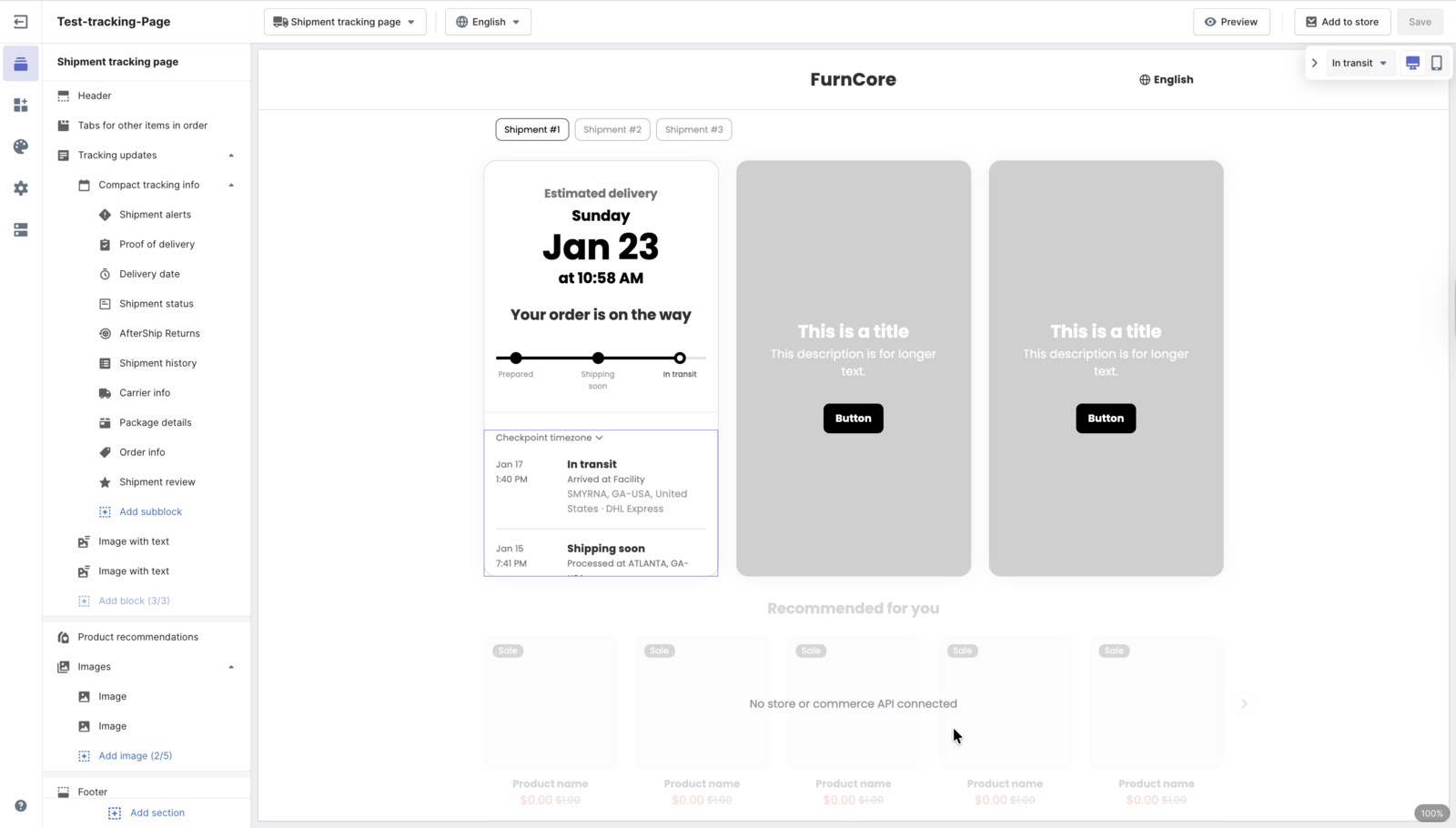
Then make the page sell. AfterShip supports on-page product recommendations you can curate by hand or hand to an AI engine, including AfterShip Personalization and Nosto. The tracking page is just one surface in AfterShip's full suite of Shopify integration features. Those repeat views stop being a status check and start carrying merchandising, which is the whole point of treating the tracking page as a channel rather than a receipt.
The headline differentiator is the delivery estimate. AfterShip's AI Predictive EDD shows an estimated delivery date on more than 80% of orders, where most carriers on their own surface one on under 40%. On the orders it does predict, AfterShip publishes up to 95% EDD prediction accuracy. Coverage and accuracy are two different things, and AfterShip is strong on both.
Accurate dates plus proactive, on-brand SMS and email updates are what actually reduce WISMO tickets. Because those updates are event-based, you can route an exception, like a package stuck in transit, straight into a Klaviyo flow or a support alert, so the customer hears from you before they think to ask. Mejuri, the Shopify DTC jewelry brand, deflected more than 2,500 "where is my order?" inquiries in a single peak week, running Tracking, Returns, AI EDD, and Warranty together on AfterShip. That is the all-in-one advantage expressed as one number on the worst week of the year.
Here is the honest limitation. The marketing-grade capabilities, including full page customization, a custom domain, AI Predictive EDD, and on-page product recommendations, start at the Premium tier rather than the entry plan. AfterShip lists Tracking at $29 a month for Essentials and $59 a month for Premium on its own site. The Shopify App Store listing is a separate ladder with its own volume quotas: Essentials at $11 a month covers 100 shipments a month and Premium at $70 a month covers 500, with per-shipment overage above each quota. Compare the quota that matches your volume, not the headline price. Tracking, Returns, Shipping, and Warranty are integrated within the AfterShip suite, with one login, one dashboard, and one customer data model, and are billed as separate products. Whether that Premium tier earns its line item is the question we settle in when a premium plan is actually worth it.
For a brand that wants to own the post-purchase experience and grow into returns and shipping without stitching vendors together, AfterShip is the platform built for that path.
#2. Narvar: The Enterprise-First Choice
Narvar is built for enterprise retail, which is the same reason it is overkill for most Shopify brands.
Narvar earned its reputation with very large retailers, and at that scale its post-purchase platform is a serious tool with deep configurability. The catch for a Shopify brand is access. Narvar has no standalone Shopify branded-tracking app. Its only Shopify App Store listing is "Narvar Return and Exchange," a returns app with a thin review base of just 21 reviews at 4.5 out of 5, and its tracking ships through the broader Narvar platform on a quote basis.
For a team that needs a branded tracking page live in days, that path means sales calls, custom scoping, and enterprise contracts before a single page goes up. In practice, an enterprise post-purchase rollout is measured in weeks of integration work, not the afternoon a Shopify brand is planning for. The capability is real and the brand recognition is earned. The fit, for a store doing 1,000 to 20,000 orders a month with a two-week deadline, usually is not.
#3. Malomo (now part of Redo): Best for Developer-Led Customization
If you have a developer on staff and want a bespoke, code-level build, Malomo is a strong contender.
Malomo's appeal is control. It offers a two-click Shopify-native page creator for quick starts and a headless option for teams that want to construct the experience themselves, which is where it rewards brands with engineering resources. In January 2026, Malomo was acquired by Redo, a returns and CX platform, so the product now sits inside a returns ecosystem rather than standing on its own.
Pricing is tiered and climbs with volume: Lite runs $49 a month for 1,000 shipments, Starter is $189 a month for 4,000, and Growth starts at $400 a month. One note on its Shopify rating: the "Malomo Order Tracking" listing shows a 5.0, but across only about 6 reviews, which is too thin a sample to lean on.
The trade-off is effort. Malomo is powerful in the right hands and resource-intensive in the wrong ones. AfterShip aims for comparable depth with a no-code path and a tracking-first focus, which is the better fit when you do not have a developer to spare.
#4. CWILL Order Tracking (formerly ParcelPanel): The Best Budget-Friendly Option
CWILL Order Tracking is the best low-cost on-ramp, and the app most brands eventually outgrow.
Formerly ParcelPanel and then ParcelWILL, and now run by CWILL INC, CWILL Order Tracking is a genuinely good starting point. It has a free plan covering 20 orders a month, a live-preview editor, and 1,600+ carrier connections. It is also "Built for Shopify" certified and holds a 5.0 across 3,153 reviews on the Shopify App Store.
Where it gets thin is exactly where a scaling brand feels it. Delivery estimates are a paid-tier feature and carrier-based rather than predictive: the free plan has no estimate at all, Essential at $11 a month adds a post-purchase date, and Professional at $59 a month adds a pre-purchase one. Its marketing tooling and platform consolidation are lighter than AfterShip's, so the page reports well but sells less.
That makes CWILL Order Tracking a smart first move and a poor long-term home. Most brands install it cheaply, grow past its ceiling, and start looking for a platform like AfterShip to graduate into.
#5. Track by Loop (formerly Wonderment): Strong on Flow & CX Integrations
Track by Loop is the deep-integration play for Klaviyo-centric CX teams.
Formerly Wonderment, the product is widely regarded for how far it pushes Shopify Flow and Klaviyo, paired with stalled-shipment detection that flags packages stuck in transit before the customer notices. If your post-purchase strategy already lives inside those tools, that depth is the real draw. Loop acquired Wonderment in December 2024, and it is now folded into Loop's returns platform, listed on the App Store as "Track by Loop" with a 4.3 across 76 reviews and pricing from about $99 a month.
AfterShip matches the part that matters most here, proactive notifications and stalled-shipment alerts, and adds a broader set of products across Returns, Shipping, Warranty, and AI Predictive EDD. The difference is commitment. Choosing Track by Loop increasingly means choosing Loop for returns as well, while AfterShip lets you add returns when you are ready instead of locking that decision in today.
Side-by-Side Feature Comparison Table
The pattern across all five apps is easier to read in one view than in five write-ups.
The table below scores each contender on the criteria we set earlier, from page customization to pricing model, so you can match an app to your growth stage rather than its marketing copy.
| Feature | AfterShip | Narvar | Malomo (now Redo) | CWILL Order Tracking | Track by Loop |
|---|---|---|---|---|---|
| Visual tracking-page editor | Best-in-class (no-code drag-and-drop) | Yes (team-built, low self-service) | Yes (theme + headless, dev-led) | Yes (live-preview editor) | Yes (tracking-block editor) |
| Upsell / product-rec widgets | Best-in-class (manual or AI; Personalization, Nosto) | Yes | Yes (via integrations) | Yes (paid tiers) | Yes |
| AI Predictive EDD | Best-in-class (80%+ coverage vs under 40%; up to 95% accuracy; Premium) | Yes (enterprise) | No (not a marketed core feature) | Limited (carrier-based, paid tiers only) | Limited |
| Shopify Flow | Yes (App Store "Works with") | Yes (via API/Plus) | Limited | Yes (Advanced/Plus) | Best-in-class (headline Flow/Klaviyo depth) |
| Returns on the same platform | Yes (AfterShip Returns, separate product in the suite) | Yes (Narvar Returns, core) | Via Redo returns (post-acquisition) | Separate CWILL Returns app | Via Loop Returns (core) |
| Pricing model | Tiered: direct $29 Essentials / $59 Premium; separate App Store ladder at $11 (100 shipments/mo) and $70 (500/mo), plus overage | Enterprise / quote-based | Tiered $49 to $400/mo | Quota-based (free to about $479) | From about $99/mo |
| Best For | Scaling DTC 1,000 to 20,000 orders/mo, all-in-one | Enterprise retail | Developer-led brands | Budget-conscious startups | Klaviyo-centric CX teams already committed to Loop Returns |
Best-in-class = strongest in category; Yes = supported; Limited = partial or gated; No = not offered.
One row tells the story: AfterShip is the only app marked best-in-class on customization, upsell tooling, and AI delivery estimates at the same time. Everywhere else the field splits, with one app leading on price and another on a single integration, but none matching that combination.
What About Free Shopify Tracking Apps?
Free Shopify tracking apps are real, useful, and quietly limited where it counts.
You get what you pay for. Free and budget apps like 17TRACK are well-built front doors. 17TRACK holds a 4.9 across 4,320 reviews, runs a free plan, and is "Built for Shopify" certified, so the basics are covered. The catch shows up as you scale: delivery estimates and the deeper marketing tooling sit behind paid tiers, the automation is shallower, and you are buying a point app rather than a platform.
The best tracking apps reduce where-is-my-order support tickets. A free tier that only displays a carrier status, with no proactive notifications and no predictive delivery date, does less of that work, which means more of it lands back on your support team. None of this is a knock on the apps themselves. They do what they advertise. It is a question of ceiling. A point app tracks the package. A platform connects that signal to your email, your upsells, and your returns, so one event does several jobs.
When you need on-page upsells, an AI delivery estimate, and returns on the same stack, a free point app cannot follow you there. If free has taken you as far as it can, the next step is learning how to design a branded tracking page that drives repeat purchases instead of one that only reports shipments.
How to Add a Branded Tracking Page to Your Shopify Store
Standing up a branded tracking page is a one-afternoon job, not a quarterly project.
Three steps take you from default carrier emails to a page that looks and sells like your store:
- Choose your app. Pick the platform that matches your stage and goals. For a scaling DTC brand, that is AfterShip, the all-in-one pick from the section above.
- Customize the page in the editor. Open the app's drag-and-drop editor and set your layout, brand colors, fonts, and any upsell widgets. Match it to your storefront so the handoff feels invisible to the customer.
- Add the page to your store navigation. Publish the page and add the new page to your store's main navigation so shoppers can reach it from anywhere, then point your shipping notifications at it.
That is the whole setup. The hard part is not the build. It is deciding to stop renting your most-viewed page to a carrier.
The Verdict: What's the Best Shopify Tracking App for Your Brand?
For a fast-growing Shopify brand that wants to own post-purchase without hiring a developer, AfterShip is the clear pick. Pitted directly against the budget favourite, that pick is tested in how it holds up against Parcel.
It offers the best balance of no-code customization, revenue-generating marketing tools, and operational automation, and it is the only independent platform here that carries tracking, returns, shipping, and warranty on one data model. Branded tracking pages increase customer trust and repeat purchases, and AfterShip is built to turn that into a channel you grow into, not out of.
That does not make it the right first app for everyone. If your top priority is the absolute lowest cost and you are under roughly 200 orders a month, CWILL Order Tracking is a more budget-friendly starting point, and its free branded page is genuinely good. Its free tier has no delivery estimates and its marketing tooling is lighter, but for a small catalog it earns its place. If you have a developer on staff and want a bespoke, code-level build, Malomo, now part of Redo, is the stronger fit.
The line to watch is around 1,000 orders a month. The real trigger is not the number itself but the bottlenecks that arrive with it: WISMO tickets spiking at peak, the need for AI delivery dates and on-page upsells, and the moment you realize returns and shipping should sit on the same platform. That is when a brand graduates to AfterShip.
Pick the app that fits the brand you are scaling into, not just the one you run today. For most Shopify brands serious about growth, that platform is AfterShip.
Proactive shipment tracking that delights your customers, reduces WISMO tickets, and optimizes your delivery performance.
Book a demoFrequently Asked Questions
What is the best branded tracking app for Shopify in 2026?
For a fast-growing Shopify brand that wants to own the post-purchase experience without hiring a developer, AfterShip is the best overall pick. It offers the strongest balance of no-code customization, revenue-generating marketing tools, and proactive automation, and it is the only independent platform here that carries tracking, returns, shipping, and warranty on one data model.
What is the best budget Shopify tracking app?
CWILL Order Tracking (formerly ParcelPanel) is the best budget-friendly option. Its free plan covers 20 orders a month and its branded page is genuinely good, which makes it a smart starting point for stores under roughly 200 orders a month. Its free tier has no delivery estimates and its marketing tooling is lighter, so most brands eventually outgrow it.
What is the best Shopify tracking app for developer-led builds?
Malomo, now part of Redo, is the strongest fit for teams that have a developer and want a bespoke, code-level build. It offers a two-click Shopify-native page creator and a headless option, so it rewards brands with engineering resources but is resource-intensive without them.
How do I add a branded tracking page to my Shopify store?
Three steps: choose an app that matches your stage, customize the page in the app's drag-and-drop editor by setting your layout, brand colors, fonts, and upsell widgets, then publish it, add the new page to your store's main navigation, and point your shipping notifications at it. On AfterShip the editor is no-code, so the whole setup is an afternoon's work rather than a developer sprint.