Why Smart Shopify Brands Are Looking Beyond Redo in 2026
You've looked at Redo and something feels off. It solves the customer's return shipping cost, but what does it do for your bottom line? For scaling brands, the best returns platform isn't the one that just makes returns free for customers, it's the one that turns the entire process into a revenue retention engine. Let's rank the top 6 alternatives by what really matters in 2026.

Start with what Redo gets right, because plenty of scaling brands run it happily. It installs free, it holds Shopify's Built for Shopify certification, it ships a native Shopify POS tile, and its shopper-paid return protection is simple to switch on. For a brand with straightforward returns and low order complexity, its core feature set holds its own against anything in the category. Redo has also widened its footprint, adding tracking through its Malomo acquisition and cross-border returns through ReturnBear in February 2026. On the protection product specifically, we price it against ours in whether that protection fee is worth paying.
This is not a weak product, and the shopper-funded fee is not its flaw, because AfterShip offers the same funding option through Return Care, as our AfterShip Returns vs. Redo comparison lays out.
The strain shows up at scale. According to the NRF, 82% of consumers say free returns are an important consideration, which makes free returns table stakes rather than an edge. What decides is what the free tier actually contains when your operation gets complicated.
That is where a returns-first tool starts to feel thin. Reliability and deep customization matter more as volume climbs, and so does the reach into work such an app rarely covers: multi-channel warranty across repairs, replacements, and recalls, and multiple stores run under one organization, which AfterShip supports on Enterprise.
Simplicity that fit at a few hundred orders a month can harden into a ceiling at a few thousand.
For a growing brand, the two factors that decide are how much the platform automates as complexity grows, and whether you can pick the model that pays for returns.
The 3-Point Framework for Evaluating Returns Software
If free returns are table stakes, you need a sharper test than a feature checklist. Three criteria, drawn from a framework for choosing returns software, separate a tool that merely processes returns from one that pays for itself.
- Revenue retention: how well the platform pushes shoppers toward exchanges and store credit instead of cash refunds.
- Operational efficiency: how much manual work it strips out through automation, routing, and approval rules.
- Total cost of ownership: the real cost once you add platform fees, carrier rates, and the hours your team spends.
Most comparison posts stop at the first criterion. Brands that actually scale weigh all three, because a tool that wins on retention but buries your team in manual work still costs you every month.
Revenue retention is where the spread is widest, and it is measurable. AfterShip reports that merchants who offer three or more return resolution options see more than 30% retained revenue, plus 12% average upsell revenue from store-wide exchanges. The condition is the argument: the more ways a shopper can resolve a return without a cash refund, the more revenue stays with your brand.
Hold that lens through the ranking ahead. Score each of these Redo alternatives on how much revenue it retains, how much operational load it removes, and what it truly costs at your volume, and the field sorts itself fast.
“With AfterShip Returns, the bottleneck of manual returns processing is gone, and exchanges are ready to be shipped as soon as a return has been received.”
Stephen Davis Hernandez, Digital Product Manager
Read their story →The 2026 Ranking: 6 Redo Alternatives for Shopify Returns
We scored six Redo alternatives against the three criteria above, sized for a typical DTC brand running about 2,000 orders a month. The list runs from the most specialized fit to the platform built to carry all three at scale. Read each entry as an answer to one question: how does it compare to Redo for a brand that plans to grow? Shopify App Store ratings and review counts cited throughout this ranking were captured on 12 August 2026. If Redo itself is the open question, start with what Redo does for a Shopify store.
#6: Happy Returns (a UPS company)
Happy Returns, one of our 2026 top picks for returns platforms, is not really a Redo rival, and treating it as one misreads the market. It runs a box-free, label-free drop-off network across the United States, and it is the right call when in-person returns are your top priority. AfterShip partners with it directly: Aetrex routes AfterShip Returns into Happy Returns and saves 6% per drop-off.
The honest limit is geography. The Return Bar network is US-only, with roughly 10,000 locations nationwide and about 9,000 supported inside AfterShip, so it does nothing for customers spread across other markets. If drop-off convenience matters, you do not have to adopt it as a standalone tool. You can switch it on as one of the return methods inside AfterShip Returns and keep every other resolution in the same system. That keeps a physical drop-off option on the table without handing your whole returns operation to a network that stops at the border.
#5: Narvar Shield
Narvar is the enterprise incumbent, and its current returns product is Shield, launched in March 2025. It fits large, multi-brand retailers that have developer resources and a services budget to match. For a Shopify brand doing a few thousand orders a month, that is usually more platform than the problem calls for.
Narvar publishes no public pricing, and setup leans on its professional-services team rather than a self-serve flow. Any performance number Narvar cites is vendor-reported, so treat it as a claim to check rather than a benchmark. Where Narvar earns its place is configurability at scale, for retailers with the team to run it. For most brands on this list, that dedicated ops and dev function is the point: Shield rewards it, and underdelivers without it.
#4: Return Prime
Return Prime, built by Appsdart Solutions, is the budget pick for brands watching every line of the returns bill. It carries 723 Shopify App Store reviews and a 4.8/5 rating, though its own website renders different figures than its Shopify listing, so the App Store surface is the one to trust. A free tier and the lowest paid ladder in this field make it easy to start. Its focus is the returns basics done cheaply, a branded portal, exchanges, and store credit, without the carrier depth or reporting a larger operation leans on.
For a brand under a thousand orders a month that wants returns handled without a real budget line, it does the job. Past that, the reach gaps start to show, and they show first in reporting.
Pros
- A genuine free tier and the lowest paid ladder in the field.
- Fast, uncomplicated setup for a Shopify-only store.
Cons
- Shopify-only, with no path to other platforms.
- The thinnest carrier and analytics depth of the six.
#3: ReturnGO
ReturnGO is the pick for brands that sell beyond Shopify. A 4.8/5 rating across 357 reviews reflects its standing with the merchants already on it. Acquired by Global-e in July 2025, it now serves more than 2,700 merchants, including Decathlon and Crocs, and runs natively on WooCommerce, Magento 2, BigCommerce, Wix, and Salesforce Commerce Cloud alongside Shopify. That multi-platform reach, paired with strong international handling, is its real edge over a Shopify-only tool.
Under Global-e's ownership it leans into cross-border returns, duties handling, and localized flows, the work a brand shipping into several countries needs and a Shopify-only tool leaves you to solve elsewhere. Plans start at $147 a month for 110 returns and $297 a month for 300, with custom enterprise pricing above that. The catch is the on-ramp: there is no permanent free tier, and the pricing assumes you are already selling across platforms.
Pros
- Genuine multi-platform support across five major carts plus Shopify.
- Strong international returns handling.
Cons
- No permanent free tier.
- Priced for brands that already sell across platforms.
#2: Loop Returns
Loop is a returns-first solution built for Shopify. Its exchange and store-credit workflows are a real strength for brands that lean on exchanges to hold revenue. Loop puts its full set of workflow conditions and actions on every plan, so the automation is capable rather than tier-gated, and Order Editing reached general availability in March 2026. It holds a 4.7/5 rating across 408 reviews.
Two things matter for a finance team. Loop carries the highest fixed cost in this field, with Essential at $155 a month and Advanced from $272 a month, and it publishes no returns quota or per-return overage on either its own site or its Shopify listing, so you cannot model true cost per return before you sign. Its deeper constraint is carrier access: Loop routes returns through shipping service providers, with no own-carrier-account option, a gap we walk through in a deep dive on Loop vs. AfterShip.
Pros
- A well-built Shopify-native experience with strong exchange and store-credit workflows.
- Full workflow conditions and actions on every plan; Order Editing generally available.
Cons
- Highest fixed cost in the field, with no published quota or per-return overage to model.
- Carrier access runs through shipping service providers, with no own-account option.
#1: AfterShip Returns
AfterShip Returns is the platform built to answer all three criteria at once, and with 4.7/5 from 1,392 Shopify reviews it also carries the largest review base in this field. That is why it tops this list for a brand that intends to keep growing.
Start with revenue retention, where a deep rule engine does the work. AfterShip lets you customize your refund and exchange settings and routes each return by the conditions that actually predict the right outcome: return reason, resolution type, product type, tag or SKU, country or region, order value, return value, and customer tag, including your VIP segments. Those rules steer shoppers toward exchanges, store credit, and instant auto-approval instead of a cash refund, and the store-credit path adds bonus credit and a gift-return fallback for the cases a plain refund would lose. The more resolution paths you open, the more of the retained revenue the earlier benchmark describes stays with your brand.
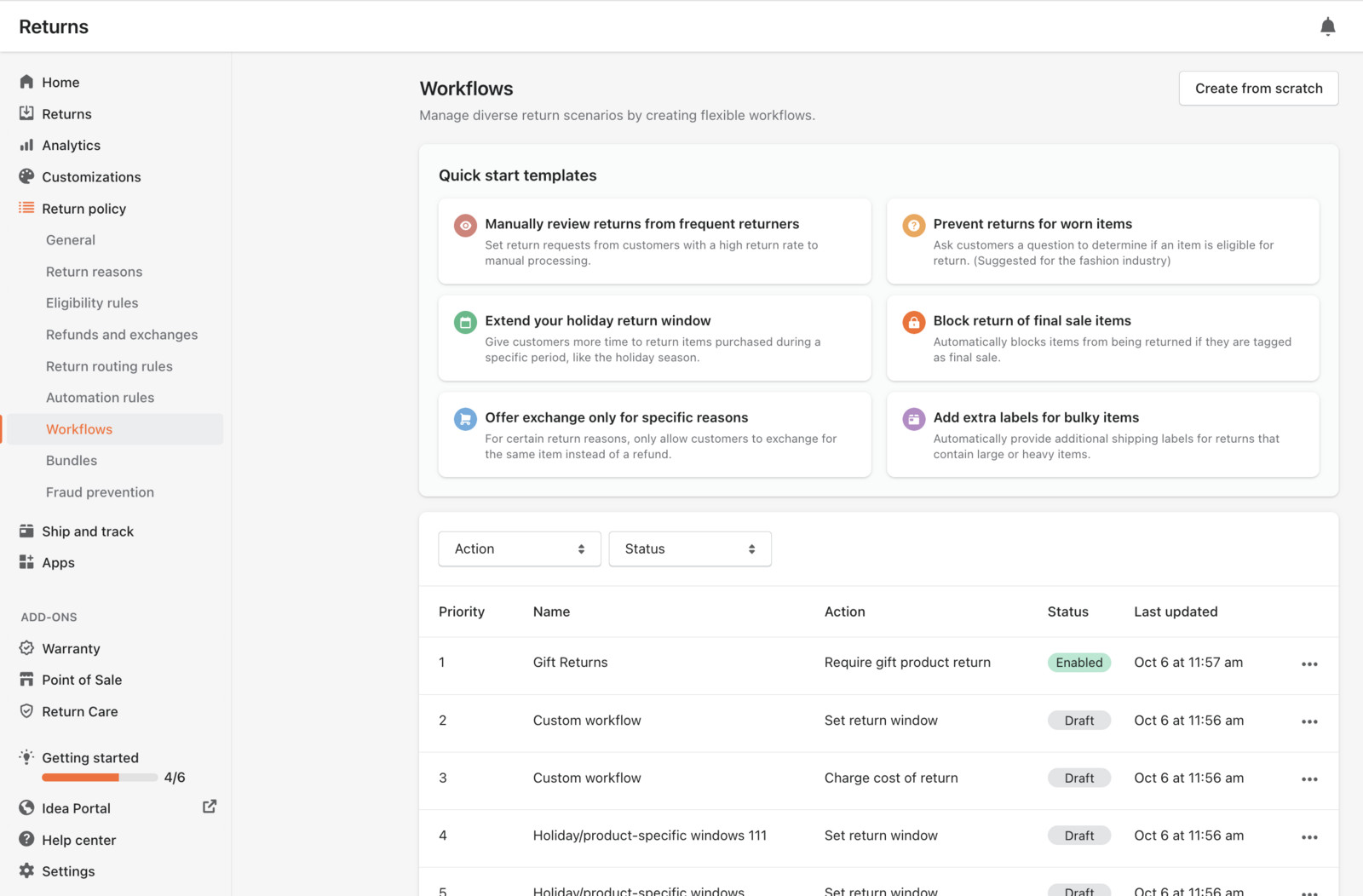
On operational efficiency, the same engine strips out manual load: auto-approvals, routing rules, multi-warehouse logic that sends each return to the right location, multi-label returns for multi-box orders, bundle returns, gift returns, and returns handled in person through Shopify POS. Order Edits extends the idea upstream. Redo's model pays for a return after it happens; AfterShip lets a shopper fix an order before it ships, so the return never starts.
The cost story is where the strategy pays off. AfterShip Returns can run at $0 a month on the Return Care revenue-share plan: no platform subscription, the Premium feature set, an unlimited returns quota and no contract. The shopper pays an optional Return Care fee at checkout, and that fee funds the return label. It is Shopify-only, requires an AfterShip Protection subscription for the same store, and is available in the US and Australia, with the UK in validation.
That is what keeps the label cost off your P&L. Under Redo's model the merchant sets and collects the fee, the money accrues in the merchant's account, and Redo bills the merchant twice a month to recover label and service costs, so if returns outrun the fund the merchant covers the gap. Prefer to absorb returns yourself? A standard subscription keeps the shopper fee with you. Either way, label generation runs across 69 carriers on an AfterShip or your own carrier account, with 310,000+ drop-off points behind it, and returns, exchanges, and warranty run in one operation rather than three separate tools.
Be clear-eyed about the trade. That no-subscription path is gated to Shopify and to the Return Care revenue-share plan with a Protection subscription, so it is not a fit for every store. What it buys is a returns operation that can fund itself while keeping the depth a scaling brand needs.
For a brand that is scaling, that mix of rule depth, carrier flexibility, and funding choice is what turns returns from a cost center into a revenue channel.
Head-to-Head: Redo Alternatives Feature & Pricing Comparison
The table below compares the four finalists on what decides the bill and the outcome: pricing model, exchange incentives, automation depth, carrier management, and total cost of ownership.
| Criteria | AfterShip Returns | Redo | Loop Returns | ReturnGO |
|---|---|---|---|---|
| Pricing Model | Both models: shopper-funded Return Care revenue-share ($0/mo platform fee) or subscription. Essentials $19/mo ($16 billed annually, 20 returns, $0.50 per extra); Premium $119/mo ($99 billed annually, 100 returns, $1.00 per extra); Enterprise custom (400+). | Shopper-funded returns coverage; free for merchants to install, no platform subscription fee. Redo publishes no shopper fee. | Subscription. Checkout+ free tier; Essential from $155/mo; Advanced from $272/mo (from $272 on loopreturns.com, $340 on the Shopify App Store, verified 11 August 2026). | Subscription; no permanent free tier. Premium $147/mo (110 returns), Pro $297/mo (300 returns), Enterprise custom. |
| Exchange Incentives | Store credit with bonus credit and a gift-return fallback, Shop Now, and instant exchange, so more returns convert to a sale. | An AI exchange agent recommends a 1:1 swap during the return flow, with bonus store credit incentives and instant exchanges, plus store credit, gift cards, and discount codes. | Store credit, Shop Now, and Instant Exchange, with Bonus Credit as the signature incentive. | Exchanges including any-to-any product exchange, store credit with bonus store credit, and Shop Now, which lets a shopper spend the returned value in-store and pay any difference. |
| Automation Rules Depth | Full rule engine routing by return reason, resolution type, product type, tag or SKU, country or region, order value, return value, and customer tag including VIP, with auto-approvals and workflows, multi-warehouse logic, multi-label returns for multi-box orders, bundle returns, gift returns, Shopify POS returns, and weight-discrepancy fraud detection. | AI reviews images, customer history, and policy rules to approve or deny returns; configurable geographic and reason-based routing rules; returnless-refund rules by item value, category, or reason; automated approvals, custom policies, return windows, and non-returnable-item rules. | Full workflow conditions and actions on every plan, with Order Editing generally available since March 2026. | Return automation rules that act on merchant-defined conditions, including auto-exchange, auto-refund, auto-approve, and auto-credits, plus customizable return policy rules. |
| Carrier Management | Native label generation across 69 carriers on an AfterShip or your own carrier account, backed by 310,000+ drop-off points. | Generates return shipping labels with return tracking; integrates with third-party logistics providers and international carrier networks, with labels reflecting the routing rules in place. | Returns routed through shipping service providers, with no own-carrier-account option. | Auto-generated pre-paid return shipping labels through integrations with shipping carriers and 3PLs, including international return labels depending on the carrier. |
| TCO | Low. Publishes its returns quota and per-return overage, and offers a $0/mo Return Care revenue-share option, so a finance team can model true cost per return. | Variable. No published shopper fee, so cost per return cannot be modeled from public pricing, and under Redo's model the merchant self-insures and covers the gap if returns outrun the fund. | High. Highest fixed cost in the field, with no published returns quota or per-return overage on either its own site or its Shopify listing, so true cost per return cannot be modeled before signing. | Medium. Published plan quotas (110 and 300 returns) and no permanent free tier; ReturnGO does not publish a per-return overage rate. |
Read the rows together and the decisive columns are the ones a finance team lives in: published quota, per-return overage, and carrier control. That is where AfterShip separates from the field.
The Verdict: Which Redo Alternative Is Right for Your Brand?
There is no single winner for every store, so scope the choice to your volume in the 500 to 10,000 orders a month band, and the decision gets simple.
- Under 1,000 orders a month and prioritizing the lowest entry cost: Return Prime, or Redo's free-to-install portal.
- Selling across multiple platforms or leaning heavily international: ReturnGO.
- Scaling past 1,000 orders a month and needing automation depth, carrier flexibility, and a choice of funding model: AfterShip Returns.
For the largest slice of brands in this band, AfterShip is the clear pick. It keeps up as your catalog, warehouses, and markets grow more complex, and its exchange and store-credit routing keeps enough revenue on each return to change the math a scaling brand runs.
Returns automation that enhances the returns and exchanges experience, reduces costs, and retains more revenue.
Book a demoFrequently Asked Questions
What is the best free alternative to Redo?
Return Prime offers a genuine free tier, and Redo's portal is free to install, so both are easy entry points for a small store. If you also want the label cost covered, AfterShip Returns runs at $0 a month on the Return Care revenue-share plan, with the shopper-paid fee funding the return label.
Can AfterShip pass return costs to shoppers like Redo?
Yes, and you get a choice Redo does not offer. On the Return Care revenue-share plan the shopper pays an optional fee at checkout that funds the return label, and AfterShip provisions the Premium Returns feature set at no platform subscription cost. Or you absorb return costs yourself on a standard Returns subscription, where the shopper fee belongs to you. The merchant chooses. Return Care is Shopify-only and currently available in the US and Australia, with the UK in validation.
Can I use AfterShip for international returns?
Yes. AfterShip Returns routes returns by country and region and generates labels across its carrier network, so cross-border returns run in the same system as domestic ones. The Return Care revenue-share funding is currently US and Australia, with the UK in validation; a standard subscription has no such geographic limit.
How does AfterShip integrate with Klaviyo?
AfterShip Returns integrates natively with Klaviyo through pre-built event mapping, so returns events flow into your Klaviyo campaigns without custom work, and it pairs with a Gorgias AI agent per AfterShip's Redo comparison page. Competitor connectors are not publicly documented to the same standard. With the native mapping, a returns team can trigger Klaviyo flows off return and exchange events, so a shopper who starts a return gets the right follow-up.