You are weighing a returns platform built to convert refunds into exchanges against an instant-credit model built to delight customers. Each carries a hidden cost, one in customer flexibility, the other in financial control. What if you did not have to choose?
Before that question can be answered honestly, one fact has to land. Returnly's Affirm-financed instant credit ended on 1 October 2023. If you are running a Loop vs Returnly evaluation today, you are comparing a live platform against a discontinued one, and any vendor page or search result suggesting otherwise has not caught up.
The comparison still earns its place, because the model Returnly pioneered did not retire with the product. Financed instant credit is on sale in 2026, from a different vendor, under a different name.
What follows dissects how each platform approaches returns credit: who funds it, who sets the rules, and when the money actually moves. Then it lays out a third approach that treats instant credit as an experience you configure rather than a product you buy.
For an ops, CX, or finance lead, that distinction is not academic. Every return is a decision about whose balance sheet moves first, and whose policy decides whether it moves at all.
The Loop Philosophy: Retain Revenue with "Exchange-First"
Loop is a returns-first solution built for Shopify, and its commercial logic is straightforward. Keep the value of a return inside the store by making an exchange the path of least resistance for the shopper, and a refund becomes the exception rather than the default outcome. For how that logic compares with Redo's, see Loop set against Redo on Shopify returns.
For brands with high product substitution potential, that logic holds up. An apparel shopper returning a size medium usually wants a size large, not their money back, and a returns flow designed around that reality recovers revenue that a refund-first flow surrenders.
Loop Returns drives exchanges and now finances instant refunds through Reshop. That option has been live for all merchants since 11 March 2026. Reshop is an independent third-party financier that states it assumes 100% of the financial risk, and that transfer is merchant-facing: under Reshop's terms the shopper can be debited where the return does not complete.
That matters for your evaluation, because it means the platform built around exchanges and the platform built around financed credit are no longer two different vendors. They are one purchase, and a more detailed breakdown of its features is the place to see everything else that comes with it.
Three constraints come with the financed option, and they are worth mapping against your actual order book before the demo:
- Geography and currency. Instant refunds run on US stores in USD only.
- Return method. They are available on Box and Ship or Happy Returns returns, not on every method you might offer.
- Refund type. Full refunds only. Partial refunds sit outside the program.
The commercial terms deserve the same scrutiny. Loop's paid plans run on an annual contract. Loop's published terms state that the term renews unless the merchant gives at least sixty (60) days written notice, and that an annual increase of 6% occurs upon the completion of each term.
There is one more gap a finance lead will feel immediately. Neither Loop pricing surface publishes an included-returns quota or a per-return rate, so the cost per return cannot be modeled from public information before a sales conversation.
Every one of those terms is a constraint you inherit rather than one you set. That is the through-line of this comparison, and it is the reason AfterShip Returns is built around rules the merchant writes.
The Returnly Philosophy: Win Customers with "Instant Credit"
Returnly's signature feature was Instant Credit, and it did something no rules engine can replicate. It released spendable credit the moment a shopper initiated a return, before they had shipped anything back, and the full comparison page sets out how that model compared with ours.
The shopper experience was genuinely strong. Start a return in the morning, spend the credit at lunch, and the original item might still be sitting in its box at home.
The funding for that experience came from outside the merchant's balance sheet. Affirm financed it, and in Affirm's own words at acquisition, Returnly "takes the product return risk."
Returnly did not fail. Its owner made a portfolio decision, and the brands running their returns credit on it absorbed the consequence.
The documented harm was operational: a short migration runway, and open returns that could not be transferred and had to be finished inside a platform on its way out.
That is the structural point. When the funding sits outside your business, so does the decision about how long it stays available. A returns credit program you fund yourself carries no such counterparty, and that is the ground AfterShip Returns is built on.
The Real Choice: Customer Experience vs. Financial Control
Read Loop vs Returnly as a vendor shortlist and you will end up evaluating the wrong things.
The live choice in 2026 is between two funding mechanisms. Financed credit means a third party pays your shopper before your warehouse sees the box, and that third party sets the eligibility rules, the geography, and the refund types it will cover. Loop plus Reshop is where you buy that model today.
Merchant-funded credit means you fund the credit and you write the rules that release it.
Those are different answers to the same question: who controls the money and the policy after a customer decides to send something back. That is the question AfterShip Returns was designed around.
A Third Way: Decouple the Experience from the Ecosystem
Ask what instant credit actually delivers to a shopper and the answer is narrow. They get spendable money in their account earlier than a standard refund would arrive. That is an experience, and the financing arrangement sitting behind it is a separate decision that has been bundled with it so consistently that most buyers evaluate the two as one product.
Pull them apart and the evaluation changes shape. One question is what you want the shopper to feel at the moment they decide to send something back. The other is whose money moves to produce that feeling, and under whose rules.
AfterShip Returns answers the second question deliberately. There is no capability, live or planned, in which a third party advances funds to a shopper before the returned item is received.
That is a design position, and it has a cost. A financed model can put money in a shopper's hands at a moment AfterShip will not, and for some brands that moment is the whole reason to buy.
What the position buys you is everything downstream of it. No financier takes a cut of your returns. No financier decides which stores, which currencies, which return methods, or which refund types qualify. No financier's roadmap sets how long the program you built stays available to you.
Instant store credit, on this reading, is something you configure. AfterShip Returns issues merchant-funded store credit on rules the merchant writes.
How AfterShip Delivers Instant Credit on Your Terms
The mechanism is the auto-refund rule. You pair a resolution with a trigger, and the pairing decides the moment money reaches your customer.
Set the resolution to Refund to store credit and the trigger to In transit, and credit lands the moment the carrier accepts or picks up the return parcel. Your warehouse has not received the box. Your team has not inspected anything. The shopper has spendable credit while the item is still moving. Two scoping facts belong in the same breath as that claim: the auto-refund rule is a Premium and Enterprise feature, and auto refund to store credit runs on Shopify and BigCommerce.
Here is the honest limit. The rule cannot release credit at return initiation, before the shopper ships. Carrier acceptance is the earliest signal a rules engine can act on, because it is the first moment anything verifiable has happened. Releasing money before that point requires someone to absorb the risk that the parcel never moves, and that someone is a financier.
Out of the box, AfterShip Returns ships a conservative pairing: Marked as received, with the refund going to the original payment method. That is a default setting chosen for safety, and it is yours to change.
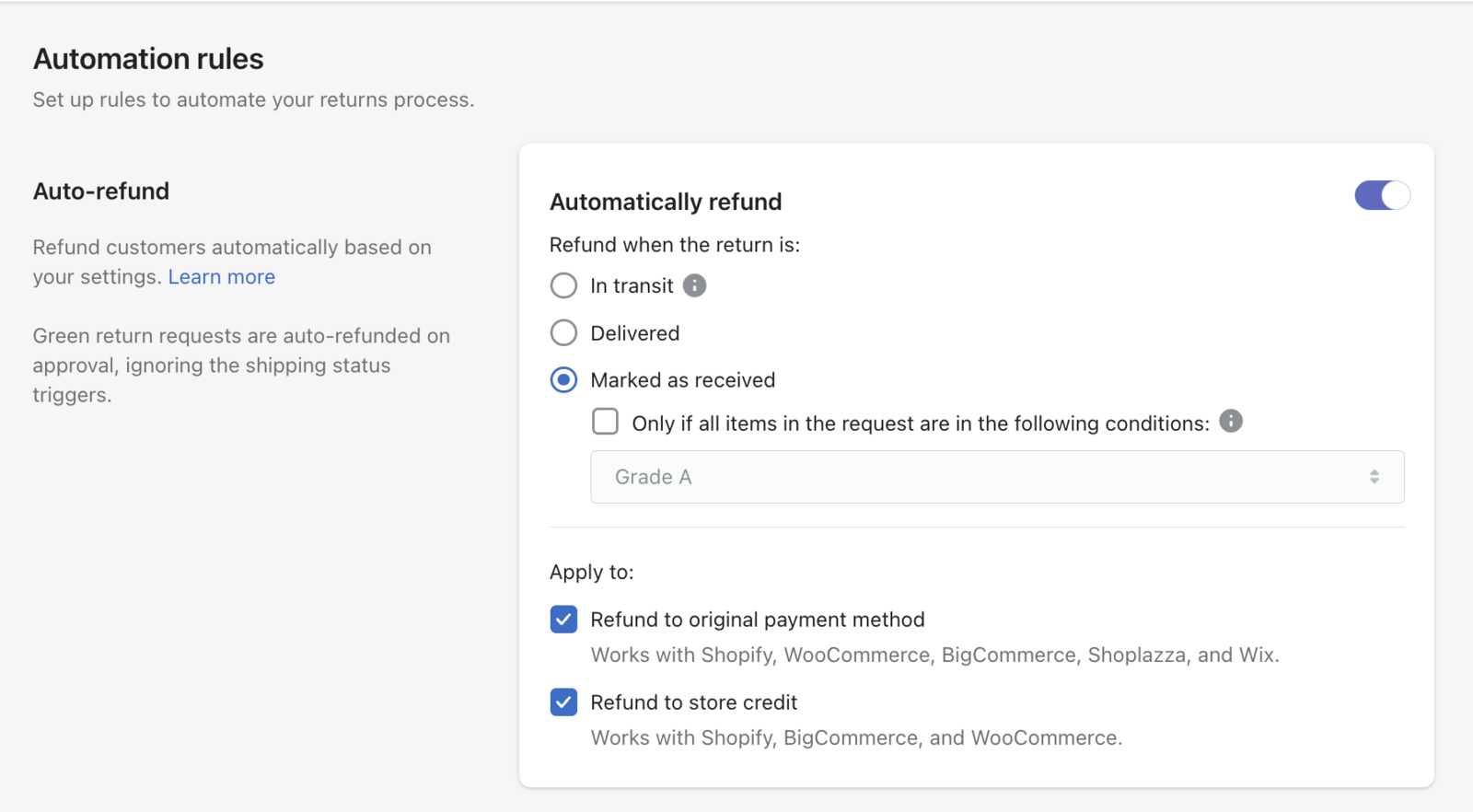
Once the timing is yours, the format of the credit is a second decision, and there are three routes:
- Native Shopify store credit, the recommended default. The shopper gets one trackable balance that settles inside Shopify, and they can see it and spend it without hunting through their inbox for a code.
- Shopify gift cards, for stores that want a code emailed at the moment the credit is created. AfterShip documents issuing store credit via native Shopify gift cards end to end.
- Rise.ai, for merchants already running it as their store credit engine and who want returns feeding the system they already operate.
Loop shipped native Shopify store credit in its Spring 2026 release, so the credit type itself is table stakes across this category now. The control sits one layer up, in the rule that decides when the credit is issued and who qualifies for it.
That layer is where segmentation happens. You can release early credit to customers above a certain order value, to a tagged VIP segment, or to a single region you are testing, and leave every other return on the conservative default. Each of those is a rule you write and change, without a contract amendment and without a partner's approval.
Instant credit stops being something you buy from a financier at that point. It becomes a setting inside a returns program that you fund, you scope, and you can rewrite the week after you launch it.
Feature & Philosophy Matrix: Loop vs. Returnly vs. AfterShip
Six criteria separate these three approaches, and only the last one is about money. The first five are about who holds the controls. Returnly's column runs in the past tense throughout, for the reason established at the top of this article.
| Criteria | Loop Returns | Returnly (closed 1 October 2023) | AfterShip Returns |
|---|---|---|---|
| Credit Mechanism | Store credit, bonus credit as flat amount or percentage, native Shopify store credit since Spring 2026, plus Reshop-financed instant refunds | Instant Credit released at return initiation, before the shopper shipped | Rule-based store credit, releasable on the In transit trigger at carrier pickup |
| Financial Ecosystem | Reshop, an independent third-party financier, states it assumes 100% of the financial risk; that transfer is merchant-facing, and under Reshop's terms the shopper can be debited where the return does not complete | Financed by Affirm, whose acquisition release stated that Returnly "takes the product return risk" | Merchant-funded. No financing partner, no financier's cut, no shopper-facing financing fee |
| Rule-Based Automation | Workflows and bonus credit configuration | Not applicable | Auto-refund rule with In transit, Delivered and Marked as received triggers. Premium and Enterprise; store credit auto-refund on Shopify and BigCommerce |
| Customer Experience Flexibility | Instant refunds limited to US and USD stores, Box and Ship or Happy Returns methods, full refunds only | Credit before shipping, gated by the financier | Merchant's own rules decide eligibility, timing and resolution |
| Ideal Merchant Profile | Brands wanting a financier to carry pre-receipt risk | Historical only | Brands that want the early-credit experience while keeping the money and the rules on their own books |
| Published pricing | "from $155 per month" (loopreturns.com, 12 August 2026); paid plans require an annual contract. No included-returns quota and no per-return rate published on either surface. | Historical only. | Essentials $16 per month billed annually, including 240 returns a year, then $0.50 per additional return; Premium $99 per month billed annually, including 1,200 returns a year, then $1.00 per additional return; Enterprise custom. Plan price, included quota and per-return rate all published. |
A brand processing 400 to 2,000 returns a month is in negotiated Enterprise pricing on either platform, so these figures describe what each vendor discloses, not what this reader would pay.
Read down the AfterShip column and one pattern repeats in every row: the decision stays with the merchant.
The Verdict: Which Returns Credit Strategy Wins in 2026?
The verdict turns on a single question, and it is not a feature question. Do you want a third party carrying the risk of paying your shopper before the goods come back?
If the answer is yes, buy the financed model. It exists for that job, Loop sells one today, and the moment it reaches the shopper is a moment AfterShip will not match, as covered above.
For every other brand, AfterShip Returns is the stronger choice. Credit releases automatically at carrier pickup under rules you write. The money is yours, the eligibility logic is yours, and no partner takes a cut of either.
Marc Nolan, a scaling Shopify DTC operator, saw exchanges climb from 25% to 49% of returns once resolutions ran on rules, with 1% resolved to store credit.
“The customer returns process is more simplified and streamlined. But this exchange feature was one of the final stones for the customer to fully do it themselves and make this as automated of a system as we possibly can.”
Nikolas Callas, Director of Operations
Read their story →The cost argument works the same way, on disclosure. AfterShip publishes plan price, included quota and per-return rate, so a finance team can model true cost per return before anyone signs anything. Loop publishes neither an included-returns quota nor a per-return rate on either of its pricing surfaces, which means the number that actually governs your unit economics arrives in a sales conversation. AfterShip's cost claim is a narrow one: the figure is knowable before you sign.
Two market signals back the choice for Shopify brands specifically. AfterShip Returns is rated 4.7 across 1,392 merchant reviews on the Shopify App Store as of 10 August 2026, a sample deep enough to reflect sustained operation instead of a launch spike. It also carries Built for Shopify certification, which is Shopify's own performance and integration standard, assessed against the platform's engineering criteria and not against merchant sentiment.
The choice comes down to this: the credit experience without the financier, running on rules you write.
Frequently Asked Questions
How did Returnly's instant credit work?
Returnly released spendable credit the moment a shopper initiated a return, before anything shipped back. Affirm financed the model, and Returnly carried the product return risk. Affirm later divested the platform, and the merchants running on it had to migrate.
Who funds Loop's instant refunds?
Reshop, an independent third-party financier, funds them. Loop sells the option; Reshop provides the money that reaches the shopper before the returned item is received.
Can AfterShip release store credit before the item arrives?
Yes, within one limit. Credit cannot be released at return initiation, before the shopper ships. On Premium and Enterprise, the auto-refund rule pairs refund to store credit with the In transit trigger, so credit lands at carrier pickup.
Make the Switch Without Missing a Beat
Two audiences arrive at this section from opposite directions, and they should go to different places.
If you are running a Returnly-era stack that has been held together since the platform closed, start with migrating to AfterShip Returns. The dedicated migration offer is capped at 50 customers, so it is worth checking availability early.
If you are leaving Loop, start with a more detailed breakdown of its features and check your renewal date first, because the sixty-day notice window and the annual increase noted earlier both run on a clock you have to act ahead of.
The migration itself covers what your operation actually runs on:
- Return reasons and the policies attached to them
- Workflows and routing rules
- Exchange configurations
- Carrier connections
- Returns-page customization
A dedicated Solutions Architect builds the plan against your setup, and the timeline runs from a few hours to a few weeks depending on how much conditional logic you have accumulated. A store with a handful of policies and one carrier moves in an afternoon. A multi-brand operation with conditional workflows and regional routing takes longer, and the architect scopes that before you commit to a date.
One operational caveat: returns already initiated in your old platform have to be completed there, so most brands run a short overlap and stop new returns in the legacy system on a set date.
On the data itself, we protect the integrity of your key returns data with a dedicated Solutions Architect team.
The returns credit program you end up with is one you can change. Adjust the trigger, widen the segment, switch the credit format, and none of it requires a renegotiation with a financier or a wait for someone else's roadmap. That is what AfterShip Returns was built to give you.