Why Your Current Tracking Setup Is Costing You Clients
Your clients do not blame the carrier when a delivery goes quiet. They blame you. For a 3PL, post-purchase visibility reads as a direct measure of your service quality, and the moment your tracking setup stops keeping pace with volume it turns from an operations problem into a retention problem. For the platforms built for that job, see the tracking platforms we rate for 3PLs.
The damage rarely arrives as a line item on a report. It arrives as a client who renews on worse terms, or does not renew at all.
Three costs compound quietly. Ticket handling escalates first: a shopper opens a WISMO ticket (where is my order), your client's support team cannot answer it from the data they have, and the question lands on your account manager instead. Client churn follows, because the delivery experience your client sells to its own customers is being shaped by a tracking page that sits inside your operation. Third, you lose the chance to sell visibility as a value-add, since a patchwork of carrier sites and a basic TMS module is not something you can put on a rate card.
The industry data puts the pressure in the same place. In the 2025 29th Annual Third-Party Logistics Study, summarized by Penske on 1 October 2024, supply chain visibility was the most identified area needing change, named by 69% of shipper respondents and 68% of 3PLs. Technology, including digital and AI, followed at 62% and 63%. The same study reported relationship success slipping to 89% of shippers and 94% of 3PLs, down from 95% and 99%.
Treat the replacement as a procurement decision rather than a cost line. Choosing package tracking software for a 3PL means buying an API contract, an account model and a written uptime commitment that has to hold through peak season, and those are the terms the evaluation should run on.
The 3PL Scalability Scorecard: 5 Criteria for Choosing Tracking Software
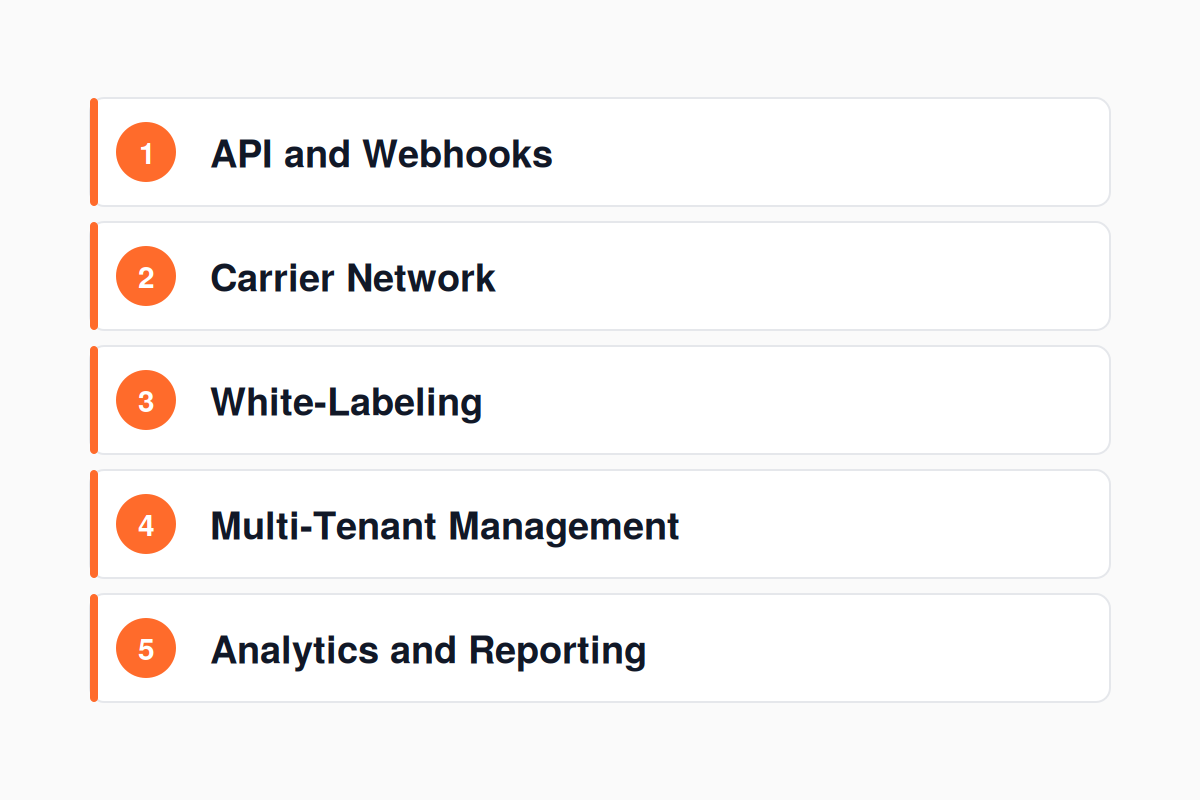
Run every vendor through the same five criteria and the shortlist sorts itself. Each one below is written as a question you can answer yourself, without booking a demo first.
- API and Webhooks. Can you read the API contract without a login? Are rate limits published per endpoint, rather than as a single account-wide number that tells you nothing about the calls you actually make? Is there a documented webhook contract covering authentication, retry behaviour and delivery semantics? And is uptime committed in a dated document you can hand to a finance lead?
- Carrier Network. The count matters less than how the data is obtained. Check whether you can confirm your own carrier list is covered before you contact anyone, and whether onboarding a client means brokering a separate carrier login for that client.
- White-Labeling. Can each client carry its own branded tracking experience, and on what domain does it live? A tracking page that renders under the vendor's name is a page your client will eventually ask you about.
- Multi-Tenant Management. Is there a documented account model for onboarding, isolating and billing client organizations? Look for the organization quota, the seat model and the plan gate written down, not described verbally.
- Analytics and Reporting. Does each client get its own shipment and carrier performance data, and does any of it roll up to you as the parent account?
Score each vendor out of five and the differences stop being a matter of taste. A vendor that publishes its rate limits, its retry policy and its account gates is inviting you to check the work. A vendor that answers all five only behind a login is asking you to take the same claims on trust.
Four of these five can be scored from public documentation before a sales team ever answers your email. Only the depth of analytics reliably sits behind a login, which means most of this evaluation is already yours to run.
2026's Best Package Tracking Software for 3PLs: A Head-to-Head
Three platforms are worth putting side by side against the scorecard: AfterShip, Narvar and parcelLab. All three run post-purchase tracking for retail brands at scale, and all three were checked on their own public surfaces on the dates given below, using the same five criteria you would apply yourself.
The differences show up less in what each platform does than in how much of it you can confirm before you sign.
| Criteria | AfterShip | Narvar | parcelLab |
|---|---|---|---|
| API and Webhooks | Public API documentation with a per-endpoint rate limit table; Enterprise plans carry custom API rate limits; webhook contract with signature verification, up to 10 endpoint URLs and 14 delivery attempts with exponential backoff; dated SLA undertaking reasonable endeavours to achieve 99.9% Service Uptime, measured on API availability | Developer portal returns an HTTP 302 to a Keycloak sign-in page, so the API contract is not readable before signing (checked 21 August 2026). Independent grading records webhook events carrying version, signature and replay-protection headers. No public SLA found on the surfaces checked | Public v4 API reference and a public academy. The webhook contract is documented in the legacy v2 LTS tree, not in the current v4 developer documentation: 15 retries at 30 minute intervals, no deduplication, plain HTTP not supported. No order-API rate limit published; no public SLA found on the surfaces checked |
| Carrier Network | 1,700+ carriers on the public carrier directory, which is searchable and browsable before purchase and detects the carrier automatically from the tracking number format. Directory categories span parcel, postal, trucking, freight forwarder, express and 3PL or fulfilment carriers. Listed on the UPU Consultative Committee member roster | Advertises being integrated with 1,000+ carriers | States 550+ carriers worldwide, and that a new carrier can be set up in under a month |
| White-Labeling | Every organization receives its own branded tracking subdomain on creation, so every client carries its own branded tracking experience. Connecting a fully custom domain is available on Premium and Enterprise | Advertises a self-serve track page editor. Brand tracking pages render on narvar.com subdomains carrying a Narvar wordmark in the page footer (checked on a brand subdomain, 21 August 2026) | White-label policy documents email sender authentication (SPF, DKIM, DMARC, BIMI). The Order Status Page is documented as embedded in the retailer's own site via a snippet rather than served on a hosted per-client domain |
| Multi-Tenant Management | Documented organization model: up to 20 organizations self-serve, and an unlimited number under one parent Company on Enterprise, with the Company console configured on request and the organization quota and member seats set in the Sales Order. Billing and quotas consolidate at company level | No public architecture document describing per-client isolation was found on the surfaces checked | Documented multi-shop mechanism assigns each tracking to a shop via a client key, giving a per-client sender name, domain and email template. Isolation between clients, billing separation and role scoping are not publicly documented |
| Analytics and Reporting | Shipment and carrier performance analytics inside each organization, aggregated for the parent through the Company console | Advertises track-page analytics; reporting detail sits behind the merchant login | Analytics referenced in the product but not documented at per-client granularity on the public surfaces checked |
Each vendor counts carriers differently, and every figure shown is that vendor's own published claim on the date checked.
Read the API row again, because it decides the other four. Narvar's portal returns a redirect to a sign-in page, so on the surfaces checked there was no API contract a non-customer could read before signing, and parcelLab's published documentation puts its webhook contract in a legacy tree rather than the current one. AfterShip supports 1,700+ carriers, listed in a public directory you can search before you buy. Checked on 14 September 2026, that directory was public, searchable and browsable, so you can confirm your own carrier list before you contact anyone.
AfterShip for Logistics: Built for Scale, Not Just for Stores
AfterShip publishes per-endpoint API rate limits and a dated service level agreement. Start there, because the API contract is what your integration lives on. The rate limit table is readable before you integrate, instead of a single account-wide number. Push past a limit and the API returns a 429 TooManyRequests, so your retry logic has something specific to handle. Enterprise plans carry custom API rate limits, listed in the Enterprise column of the pricing page, which is what covers peak periods such as BFCM. Open the multi-carrier tracking API documentation and score it yourself.
The webhook contract is documented to the same depth. You can register up to 10 webhook URLs, secure each one with signature verification, basic auth, a bearer token or a secret key carried in up to 5 custom headers per URL, and AfterShip retries a failed delivery up to 14 times with exponential backoff.
Delivery is at-least-once, duplicate events are possible, and consumers should deduplicate on the event identifier rather than assuming each event arrives once. HTTPS endpoints are recommended.
The account model is where a 3PL diverges from a single brand. An account can create up to 20 organizations self-serve. AfterShip Enterprise groups unlimited client organizations under one parent Company console. That console is configured with AfterShip on request, further organizations are linked by support request, and the organization quota and member seats are set in the sales order, so the gates are written down before you commit.
Branding follows the same per-client shape. Every organization receives its own default branded tracking subdomain the moment it is created, so a new client carries its own branded tracking experience without a separate build. Connecting a fully custom domain is available on Premium and Enterprise.
Carrier data is obtained through AfterShip's direct carrier integrations, which means onboarding a client does not normally require you to broker that client's carrier logins for tracking. The API reference publishes a courier-connections endpoint family, so carrier connections exist as a concept you can inspect rather than a promise you have to accept.
Then the commitment. AfterShip's service level agreement, dated 11 April 2025, commits to reasonable endeavours to achieve 99.9% Service Uptime in any calendar month, and defines Service Uptime as availability of the AfterShip API. That scope is worth reading precisely: it is measured on API availability, not on the branded tracking page, notification delivery or webhook delivery. The remedy is a banded service-credit schedule, credits require a written request, total recovery is capped as a share of annual fees, credits are the sole and exclusive remedy, and scheduled maintenance is excluded. It is a real document at a stable public URL, and your finance lead can read it before you sign.
On reporting, each organization carries its own shipment and carrier performance analytics, and the Company console aggregates across organizations for the parent. That gives you per-client visibility with a parent-level view, without asking every client to share a login.
Wineshipping is the version of this running in production. The tech-enabled 3PL serves 1,500 wineries on AfterShip's parent and child organization structure, with a company console giving an aggregated view across all of them. Its published results include up to an 80% decrease in WISMO calls for its wineries, a 10% improvement in first delivery attempt success rate, and 10x ROI. As Pawel Smolarkiewicz, CXO at Wineshipping, put it: "Analytics has saved our account managers a lot of time, also empowered them to be smarter, and helped our clients to be more successful."
That is the pattern to test against your own book of clients, on a platform whose contract you can read before you sign.
How AfterShip Compares to Narvar and parcelLab for 3PLs
The table shows what each vendor publishes. Here is what those differences do once forty client brands are running through peak.
Give parcelLab its due, because it earns it. parcelLab publishes a full public API reference and a public academy, documents its webhook events and retry behaviour, and ships a multi-shop mechanism that assigns each client its own sender name, domain and email template. A technical evaluator can read most of that before talking to anyone, which is more than the category norm.
Here is where a 3PL's requirements diverge. The question is not whether each client can send under its own name. It is whether client organizations are isolated from one another, billed separately, scoped by role, and covered by an uptime commitment you can hold someone to. On those four, no public documentation was found on the surfaces checked, which were parcelLab's v4 developer documentation, its legacy v2 LTS webhook tree and its white-label policy.
Narvar's constraint is about access. Its developer portal returns an HTTP 302 to a Keycloak sign-in page, checked on 21 August 2026, so the API contract sits behind a login until you are a customer. Independent grading records Narvar's webhook events carrying version, signature and replay-protection headers.
Readability before signing is exactly what the independent API report card measures. AfterShip holds a grade A, with all six sub-criteria rated good. Narvar holds a grade D, with five of six rated poor and stability rated mixed. Both cards read "Last verified: August 2026". Two caveats travel with it: the site returns a 404 for parcelLab, so it is absent from the comparison entirely, and the grader does not publish how the six criteria are weighted.
One external marker you can check yourself: AfterShip appears on the UPU Consultative Committee member roster, while Narvar and parcelLab do not appear on the roster checked on 21 August 2026. For a deeper technical split, see how AfterShip and Narvar compare on enterprise tracking.
You can finish scoring AfterShip today, without waiting for anyone to answer your email.
The Verdict: The Best Tracking Platform for Scalable Logistics Firms in 2026
AfterShip is the choice for a 3PL that has to finish its own evaluation before a sales team answers. It is the only one of the three publishing a readable API contract with per-endpoint rate limits, a documented webhook contract with a named retry policy, an account model with its gates written down, and a dated SLA with a credit schedule. Your technology lead can score all four. Your finance lead can read the commitment.
Narvar remains a strong fit for large retail brands that want a high-touch managed relationship and are comfortable evaluating under a sales process. parcelLab suits European-centric operations that want per-client sender identity and accept that isolation, billing separation and uptime get settled in conversation.
For a logistics provider carrying many client brands through peak season, AfterShip is the one that lets you verify first and holds a written commitment afterwards.
Running many client brands on AfterShip is an Enterprise purchase. The Company console that groups client organizations under one parent is configured with AfterShip on request rather than switched on self-serve, the organization quota and member seats are set in the sales order, and fully custom domains are capped by plan. That is a real constraint, and it is published where you can check it before you sign, which is more than the alternatives offer on the same questions.
Proactive shipment tracking that delights your customers, reduces WISMO tickets, and optimizes your delivery performance.
Book a demoFrequently Asked Questions for 3PLs
Can I integrate AfterShip with my custom TMS or WMS?
Yes. AfterShip Tracking exposes documented REST endpoints, and its rate limits are published per endpoint instead of as a single account-wide number, so you can size an integration before you build it. You can register up to 10 webhook URLs and secure each one with signature verification, basic auth, a bearer token or a secret key carried in up to 5 custom headers. Delivery is at-least-once and duplicate events are possible, so build your consumer to deduplicate on the event identifier. Enterprise plans carry custom API rate limits for peak periods.
What is the pricing model for high-volume 3PLs?
High-volume multi-client deployments are priced through a custom Enterprise Company agreement. It covers shipment volume, the number of client organizations and the member seats you need, and it is quoted by the AfterShip sales team against your actual footprint. Contact AfterShip sales for a quote scoped to your client count and peak volume.
How does AfterShip handle client onboarding?
One organization per client. Each organization receives its own default branded tracking subdomain the moment it is created, so a new client carries a branded tracking experience from day one without a separate build. An account can create up to 20 organizations self-serve. Beyond that, the Enterprise Company console groups an unlimited number of organizations under one parent, configured with AfterShip during onboarding, with further organizations linked by support request. The organization quota and member seats are set in the sales order.
What uptime does AfterShip commit to, and what does it cover?
AfterShip's service level agreement, dated 11 April 2025, commits AfterShip to reasonable endeavours to achieve 99.9% Service Uptime in any calendar month, and defines Service Uptime as availability of the AfterShip API. The scope is API availability. The branded tracking page, notification delivery and webhook delivery sit outside that measurement. The remedy is a banded service-credit schedule: credits require a written request, total recovery is capped as a share of annual fees, and credits are the sole and exclusive remedy. No public SLA was found for Narvar or parcelLab on the surfaces checked. AfterShip publishes its own commitment as a dated document at a stable public URL you can read today.