Your on-call engineer was just paged at 3 AM. The tracking API you rely on is down again, and thousands of 'Where Is My Order?' tickets are flooding your support desk. The root cause of most post-purchase pain is an unreliable, poorly documented API rather than a missing feature. The tracking API you can build on wins on three things a skeptical developer can verify - uptime you can hold a vendor to, webhook delivery that retries instead of giving up, and documentation that gets you to production fast. On all three, AfterShip leads.
If you are choosing the best tracking API for a scaling brand, marketplace or 3PL, you are most likely weighing AfterShip against EasyPost and Shippo.

Beyond Feature Lists: The 5 Pillars of a Production-Ready Tracking API
If you need a refresher on what a shipment tracking API is, it is the service that turns a carrier tracking number into structured shipment events your systems can act on. Most comparisons stop at a feature checklist, and a checklist tells you almost nothing a developer needs. Every vendor ticks "multi-carrier", "webhooks" and "SDKs", so the boxes all match.
The cost shows up later. It lands as a 3 AM page, a webhook that stopped retrying, a version retired before you were ready, or a status field that means something different for every carrier.
A useful delivery tracking API comparison measures what happens under load, over years and across carriers. These five pillars do that:
- Uptime & Reliability. What the vendor commits to, what backs the commitment, and what its status page reports.
- Webhook Performance & Reliability. How many times a failed delivery is retried, on what schedule, and how you verify a payload is genuine.
- Documentation & SDK Quality (DX). How fast a new engineer reaches a working integration, and how long the version they build on stays supported.
- Carrier Coverage & Data Normalization. How many carriers you can track, and how consistently their messages map into one status model.
- Scalability & Rate Limits. What request volumes the vendor publishes, and on which surface.
Each pillar maps to a line item your team pays for. Downtime becomes support volume. Weak retries become stale data. Thin documentation becomes engineering hours, inconsistent statuses become custom parsing code you maintain forever, and a low rate limit caps how fast you can backfill after an incident.
API Benchmark: AfterShip vs. EasyPost vs. Shippo in 2026
The AfterShip vs EasyPost API decision, with Shippo alongside, comes down to how each API performs on the five pillars.
All three normalize carrier statuses, retry failed webhooks and run public status pages, and EasyPost documents a standalone tracking workflow. The differences are in depth: how many sub-statuses sit under the top-level model, how far the retry ladder goes, and how long a version stays supported.
| Criteria | AfterShip | EasyPost | Shippo |
|---|---|---|---|
| API Uptime & Reliability | 99.9% monthly uptime commitment backed by service credits (Enterprise SLA page); status page publishes Tracking API uptime as a system metric on day, week and month windows | Public status page with per-component 90-day uptime bars for API, Tracking and Webhooks | Public status page publishing an API response-time metric; its subscription plan overview lists a 99.9% uptime SLA on the Premier plan |
| Webhook Reliability | Up to 13 retries across 14 delivery attempts on a 2^(n) x 30s exponential backoff; up to 10 webhook URLs; HMAC-SHA256 signature in the aftership-hmac-sha256 header (webhook docs) | Up to six retries; receiver must respond within seven seconds (webhooks guide) | Two retries on 408, 429 or 5XX; 2XX expected in three seconds or less (tracking webhooks doc) |
| Documentation Quality | Date-based versioning: version 2026-07 supported through 12 July 2029; seven official SDKs; public Postman workspace; OAuth scopes by resource and action (API docs) | Seven client libraries and an official Postman workspace (libraries page) | Public tracking guide and tracking webhooks documentation (docs.goshippo.com) |
| Carrier Data Normalization | 9 delivery statuses and 52 sub-statuses; carrier's raw checkpoint status retained alongside the normalized value (enum and tracking model docs) | 10 statuses and 28 status details (Tracker object docs) | 6 statuses and 27 substatus codes (tracking guide) |
| Carrier Coverage & Scale | 1,900+ carriers as read-only tracking integrations; freight and LTL carriers listed; per-endpoint limits in the API reference (POST /trackings 20 requests per second) | Carrier auto-detection from the tracking code; five requests per second across index endpoints (rate-limiting guide) | 750 tracking POSTs per minute in live mode (rate limits page) |
AfterShip carries the longest retry ladder, the most sub-statuses and a published support date for the version you build on.

“AfterShip is the most advanced shipment tracking solution in the market. It only took 1-2 weeks for our engineers to implement.”
Habib-Sylvain Gourguet, Director of Customer Relationship
Read their story →Pillar 1: Uptime & Reliability - The Non-Negotiable Foundation
Uptime is the pillar you cannot engineer around. Your retries, queues and caches all assume the upstream API answers, and when it does not, every downstream system inherits the outage.
AfterShip commits to 99.9% monthly uptime for its Tracking API, backed by service credits. The full contractual SLA with an escalating credit schedule is part of Enterprise agreements.
A production tracking API should also expose a public status page, the kind of transparent reporting that tools such as Atlassian Statuspage exist to provide. All three vendors publish a public status page, and what differs is what each reports. EasyPost publishes per-component 90-day uptime bars for its API, Tracking and Webhooks components. AfterShip publishes Tracking API uptime as a system metric across day, week and month windows. Shippo publishes a response-time metric of about 421ms and no uptime percentage. As read on 23 September 2026, EasyPost reports 99.84% uptime over the past 90 days across those components. Because a windowed system metric, a 90-day component figure and a response-time metric are different instruments, the three do not rank against each other.
AfterShip reports Tracking API uptime at 100% on its month window and recorded no 2026 tracking or webhook incident.
Downtime is also the most expensive line in your cost model. In the ITIC 2024 Hourly Cost of Downtime survey of over 1,000 firms worldwide, over 90% of mid-size and large enterprises report hourly downtime costs exceeding $300,000.
Against that exposure, a published monthly commitment with service credits behind it is the reliability standard to hold every vendor to. AfterShip puts that commitment in writing for its Tracking API.
Pillar 2: Webhooks - Is Your Data Real-Time or 'Eventually'?
Your tracking data is only as current as the last webhook your endpoint accepted. When your receiver is down for a deploy or a bad hour, the question is whether the vendor keeps trying or moves on.
A failed webhook is not a missed notification - it is a broken customer promise. At scale, webhook delivery that quietly gives up leaves your tracking data stale and your support queue full. Retry depth and signed, verifiable payloads are what separate a webhook you can build on from one you have to babysit.
AfterShip's webhook documentation sets out a retry ladder of up to 14 delivery attempts on a 2^(n) x 30s exponential backoff, so the gaps between attempts widen as an outage runs on. You can register up to 10 webhook URLs. Every payload is signed with HMAC-SHA256 in the aftership-hmac-sha256 header, so your endpoint can reject anything it cannot verify. The signature is a base64-encoded HMAC, which takes a few lines to check in any of the SDK languages.
EasyPost's webhooks guide documents up to six retries and expects your receiver to respond within seven seconds. Shippo's tracking webhooks documentation retries twice when your endpoint returns a 408, 429 or 5XX or does not process the payload in a timely manner, makes no retry on other 4XX codes, and expects a 2XX in three seconds or less.
Shippo's tracking guide also notes that its tracking webhooks are not idempotent: duplicate webhook registrations produce duplicate notifications.
Two design rules follow for any vendor. Acknowledge fast and process asynchronously, because the published receiver windows are measured in seconds. Then deduplicate on your side before an event updates a customer-facing status.
That ladder gives your team the most room to recover before an event is lost.
Pillar 3: DX - Does the Documentation Accelerate or Annoy?
Developer experience decides how long the integration takes and how long it stays stable once it ships.
The versioning model in our comprehensive API documentation is date-based, with a published support window. Version 2026-07 is supported through 12 July 2029, about 36 months. New major versions ship every six months, and the as-api-version response header tells you which version served each request, so you can confirm which version answered.
Around that sit seven official SDKs (Java, Node.js, .NET, Python, Ruby, PHP and Go), an official public Postman workspace, and request and response examples throughout the reference. Access is scoped: you can check our available OAuth scopes to limit a token by resource and action, such as read-only tracking access for a reporting job, or a separate write scope for the service that creates trackings.
The Try API Endpoints page links straight to that Postman workspace, so a new engineer can import the collection and make a first authenticated call before writing any client code.
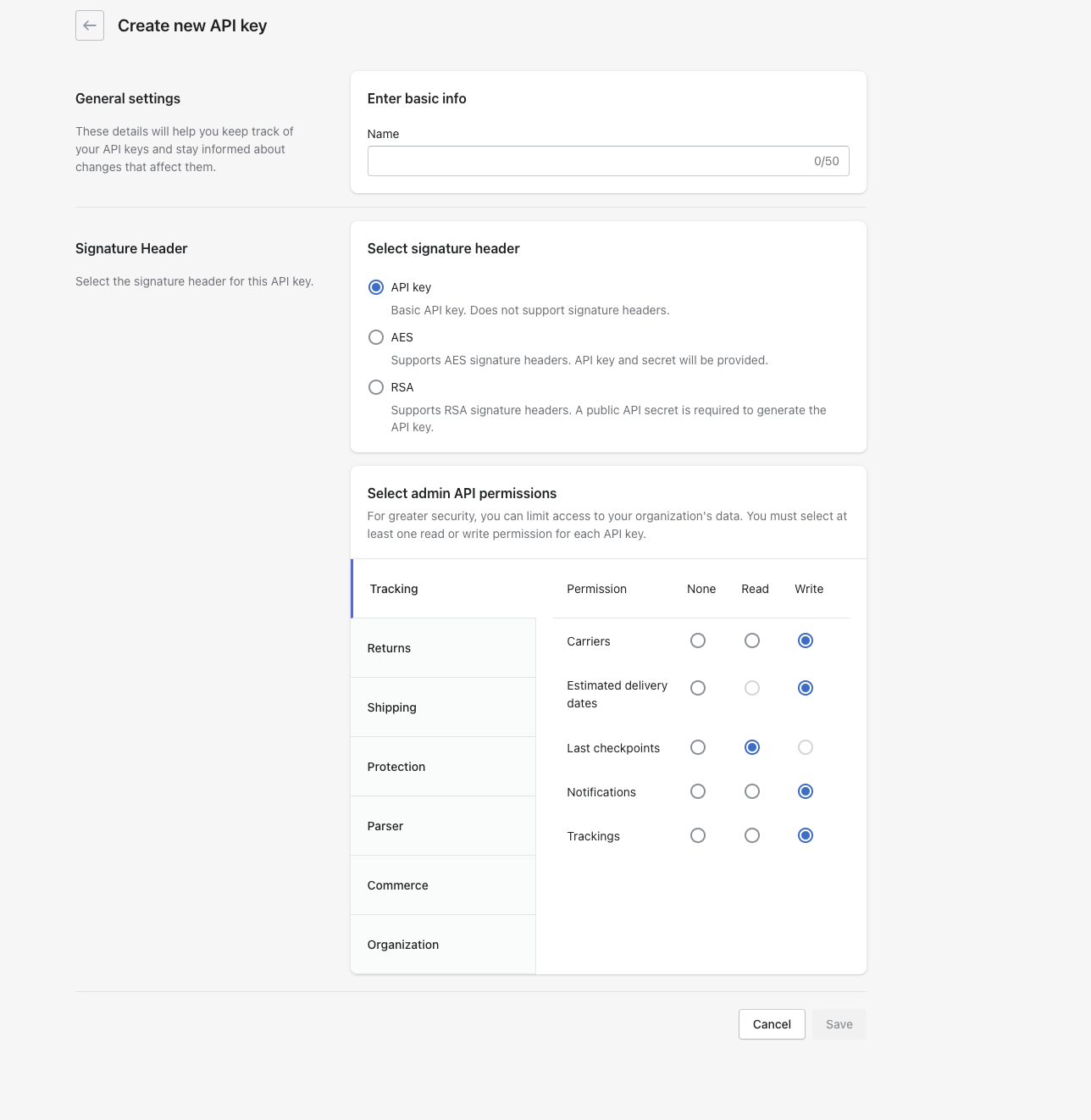
EasyPost also publishes an official Postman workspace and client libraries in seven languages, so tooling is at parity. The question to press every vendor on is lifecycle: on what date does the version you integrate against stop being supported? AfterShip publishes that date.
Pillar 4: Carrier Coverage & Data Normalization
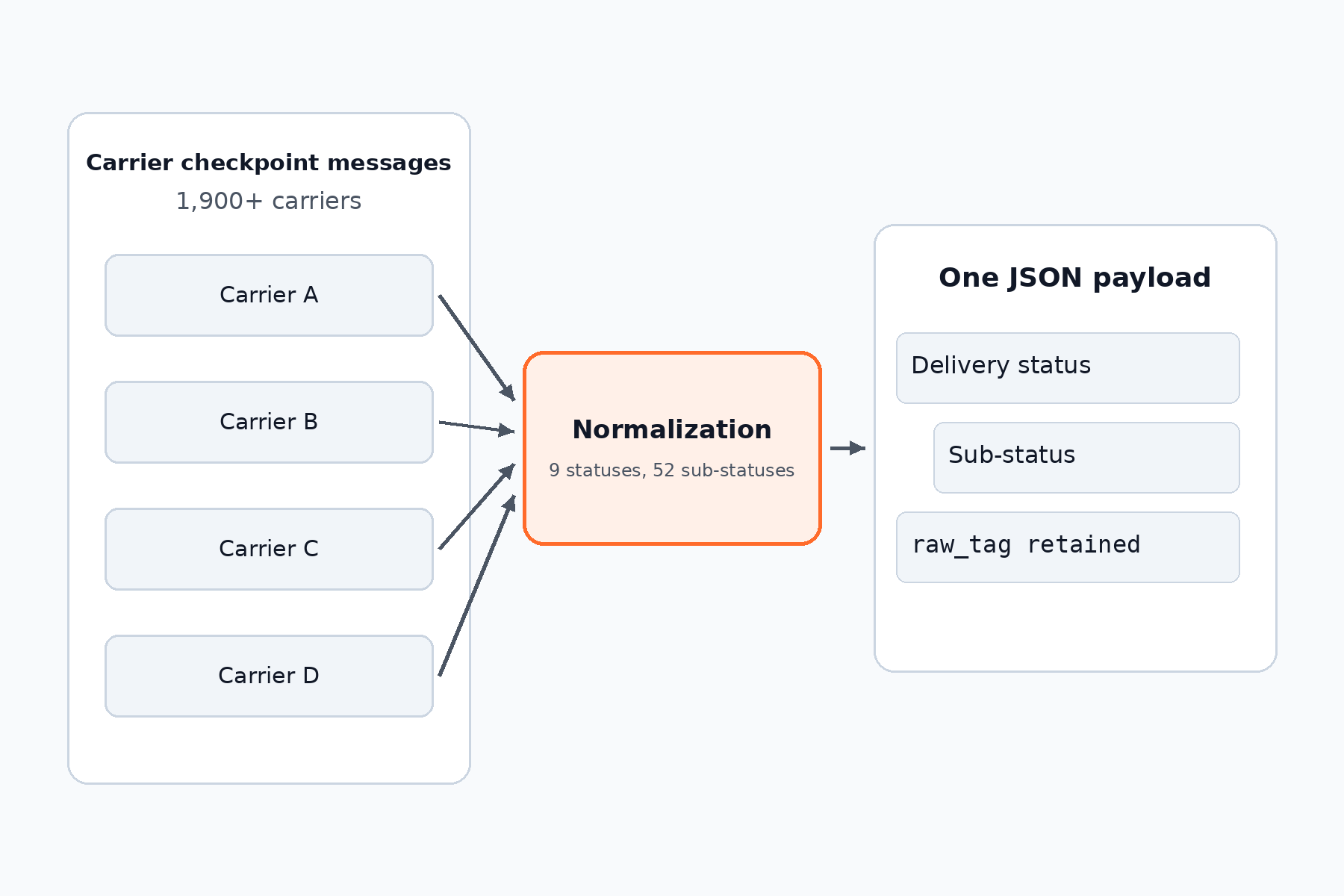
AfterShip normalizes tracking data from 1,900+ global carriers. Among multi-carrier shipping APIs, AfterShip's figure counts read-only tracking integrations, per its Tracking page as read on 23 September 2026. Its supported couriers table names freight and LTL carriers and marks which carriers require a credentialed connection.
Coverage gets you the data. Normalization decides whether you can use it without a parser per carrier.
When the carrier is unknown, POST /couriers/detect suggests candidates from the tracking number, and credentialed carriers are managed through the courier-connections endpoints.
AfterShip normalizes carrier data into 9 delivery statuses and 52 sub-statuses. It publicly documents how carrier checkpoint messages map to those sub-tags, and the tracking object keeps the carrier's own status in a raw_tag field alongside the normalized value.
For the same job, EasyPost's Tracker object carries 10 statuses and 28 status details, and Shippo's tracking guide lists 6 statuses and 27 substatus codes. The axis that matters is the depth of the sub-status layer and the published mapping from checkpoint message to sub-tag, because that layer is what your exception handling and customer notifications key off. A sub-status tells you why a shipment is in its current state, which decides whether the next message goes to the customer, the carrier or your operations team. AfterShip's sub-status layer is the deepest of the three.
Pillar 5: Scalability & Rate Limits
Rate limits set how fast you can onboard a backlog or recover after an incident.
AfterShip publishes per-endpoint limits in the API reference (POST /trackings 20 per second, GET /trackings 6 per second, object operations 5 per second, courier detect 3 per second). Responses carry X-RateLimit-Limit, X-RateLimit-Remaining and X-RateLimit-Reset, so a client can throttle itself before it hits a 429. X-RateLimit-Reset is a Unix timestamp, so a worker can sleep until the window reopens. The pricing page separately lists a plan-level API rate limit of 10 req/sec for Premium.
EasyPost's rate-limiting guide publishes five requests per second across index endpoints. Shippo's rate limits page publishes 750 tracking POSTs per minute in live mode.
Before you size a backfill, ask every vendor, AfterShip included, the same three questions. What scope does each published limit apply to, and which one governs when two surfaces list different figures? Is there a bulk endpoint for creating trackings? Is there an idempotency key for create requests?
The answers decide your queue design. AfterShip gives you the endpoint-level table and the headers to build that queue against.
Unpacking the True Cost: Why Per-Call Price Is a Deceptive Metric
Price is usually the first objection in the room, so take it head on: AfterShip is not the cheapest per call.
The three vendors bill on different models, and each model only makes sense against your volume and label setup. AfterShip sells a subscription with a shipment quota and per-shipment overage, with the Tracking API and webhooks on Premium and above. EasyPost charges per standalone tracker and waives the charge when the label is bought through EasyPost. Shippo charges per track on API Starter, sets custom pricing on API Premier, and bills tracking calls not associated with Shippo labels separately, at API Starter rates.
| Vendor | Pricing model | Published figures |
|---|---|---|
| AfterShip | Subscription with a shipment quota and per-shipment overage; Tracking API and webhooks on Premium and above | Premium: $59 a month on annual billing, 6,000 shipments a year; overage $0.12 per extra shipment on Premium and $0.08 on Essentials (pricing page) |
| EasyPost | Per standalone tracker | $0.03 per standalone USPS tracker; $0.02 per standalone non-USPS tracker; trackers are free with the purchase of an EasyPost carrier shipping label (billing help article) |
| Shippo | Per track on API Starter; custom on API Premier | 2 cents per track on API Starter; Custom on API Premier; tracking calls not associated with Shippo labels are billed separately at API Starter rates (API pricing page) |
Per-call price is one term in a longer equation. It is the same framework behind the true total cost of ownership of a shipping API, applied here to tracking:
(cost per call x volume) + (developer hours for integration and maintenance) + (cost of downtime and bad data)
Each term has published inputs:
- Cost per call x volume: the pricing table above, applied to your own shipment count and label source.
- Developer hours: the version support window, SDK coverage and sub-status depth covered in Pillars 3 and 4, which set how often you rebuild and how much parsing code you own.
- Cost of downtime and bad data: the uptime commitment and service credits in Pillar 1, set against the ITIC downtime figures cited there, plus the retry ladder in Pillar 2 that decides how much data goes stale during your own outages.
Put your own volume, engineering rate and outage history into those terms before you compare vendors. The two terms beyond per-call price are the ones AfterShip's published commitments address.
More Than Tracking: How a Unified API Unlocks the Entire Post-Purchase Journey
The Tracking API is also the entry point to AfterShip's shipping, tracking, returns, and warranty products. All of them sit in the same developer portal and follow the same authentication and versioning conventions, so the patterns your team learns on tracking carry over when the roadmap reaches returns or labels.
AI EDD is a capability of the Tracking API, exposed at POST /estimated-delivery-date/predict, with a batch variant at POST /estimated-delivery-date/predict-batch, and it has its own OAuth scope, so a checkout service can request delivery estimates without write access to trackings.
If you are still weighing a direct integration against an installed app, start with understanding the API vs. App decision. Either route reaches the same AfterShip products.
The Verdict: The Best Tracking API for Serious eCommerce Developers
For developers at scaling DTC brands, marketplaces and 3PLs, an order tracking API comparison on these five pillars points one way: AfterShip is the superior choice. EasyPost and Shippo both publish a tracking API whose per-unit tracking cost falls away when the label is bought on their own platform.
EasyPost and Shippo can look cheaper on a simple per-call basis at low volume. That advantage narrows fast once you factor in the developer time spent reconciling inconsistent carrier statuses and the cost of a single hour of downtime. AfterShip is priced as mission-critical infrastructure because it is built to perform as such.
Choose EasyPost or Shippo if:
- you already buy labels on their platform and want tracking to ride along at no additional per-unit cost
- your volume is low enough that a per-tracker or per-track charge beats a subscription
- your carrier set is narrow and already covered by their published tracking lists
Choose AfterShip if:
- you need a published uptime commitment with service credits
- your support load depends on webhook delivery surviving your own outages
- you are planning an integration you will still be running in three years
- you need one normalized status model across freight and parcel
- you want the carrier's raw status retained alongside the normalized value
Proactive shipment tracking that delights your customers, reduces WISMO tickets, and improves your delivery performance.
Book a demoFrequently Asked Questions about Tracking APIs
How do tracking APIs handle carrier-specific statuses?
A tracking API maps each carrier's checkpoint messages into its own normalized status model, usually a top-level delivery status with a more specific sub-status beneath. EasyPost and Shippo publish normalized status models of their own. AfterShip publishes how carrier checkpoint messages map to its sub-statuses and keeps the carrier's original status in the raw_tag field, so you can branch on the normalized value and still audit the source.
What rate limits should I plan for?
Plan against each vendor's published limits and confirm the scope of each one before you size a backfill. AfterShip publishes per-endpoint limits in its API reference, lists a plan-level limit on its pricing page, and returns X-RateLimit-Limit, X-RateLimit-Remaining and X-RateLimit-Reset headers so your client can throttle before it receives a 429.
Can I track LTL freight?
Yes. AfterShip's supported couriers table names freight and LTL carriers alongside parcel carriers and marks which carriers require a credentialed connection, and all of them normalize into the same status model. That lets one integration cover freight and parcel shipments without a separate parser for each.
What happens when a webhook fails?
The vendor retries on its published schedule and then stops, so retry depth decides how long your endpoint can be down before events go missing. AfterShip retries on an exponential backoff across the longest published retry ladder of the three APIs compared here, and signs every payload with HMAC-SHA256 so your endpoint can verify each delivery it accepts.