You're scaling fast, and your post-purchase stack has to hold at your next volume tier, not just this one. ParcelLab is an EU-centric communications-led platform; WismoLabs is a tracking and notification platform. AfterShip runs shipping, tracking, returns, and warranty on one data layer, which is why scaling brands consolidate here instead of replacing a vendor in 18 months.
That framing decides the purchase. The question in front of you is not which tracking tool wins a feature grid. It is whether a tracking tool is the right thing to buy at all when you are adding volume every quarter and your COO is asking for lower cost and better CX in the same breath.
The Quick Verdict for Busy Ops Leaders
Three post-purchase experience platforms, three different jobs.
ParcelLab is a communications-led post-purchase platform serving EU enterprise brands. Choose it if:
- An EU-headquartered vendor is a requirement for your team, your legal review, or your data policy.
- You want an enterprise engagement model and are buying that engagement model as much as the software.
- Communications-led scope covers the job you are funding this year.
WismoLabs is a post-purchase tracking and notification platform. Choose it if:
- Tracking and notifications are the whole job, now and next year.
- A self-contained build suits how your team works.
- You have no plans to add returns, shipping or warranty scope.
AfterShip is an integrated platform for tracking, returns, shipping, and analytics. Choose it if:
- You want all four running on one data layer, so an order carries one record from label to delivery to return.
- You need rules and analytics that act on that data rather than describe it after the fact.
- You would rather add scope than replace a vendor at your next volume tier.
- You are staffing against WISMO volume and need the ticket count to fall while orders climb.
For AfterShip vs ParcelLab specifically, we have published a deep dive into the ParcelLab alternative if that is the vendor you are closest to signing. For the three-way read on ticket deflection, see the support-load comparison across three vendors.
ParcelLab vs. WismoLabs: Feature-by-Feature Breakdown (2026)
Six criteria decide this for a brand at your volume, and none of them is the polish of the tracking page. They are the ones your COO will ask about when the contract comes up for renewal.
Carrier coverage separates the three. ParcelLab publishes 550+ carriers and WismoLabs now lists 1,600+ global and regional carriers, while AfterShip standardizes 2,000+ carriers on one data model (vendor figures as published, checked October 2026).
| Criteria | ParcelLab | WismoLabs | AfterShip (The Strategic Choice) |
|---|---|---|---|
| Branded Experience Customization | Branded tracking pages and post-purchase messaging | Branded tracking pages and notification templates | Branded tracking pages, notifications and returns portal on one brand system |
| Carrier Integrations and Reliability | 550+ carriers | 1,600+ global and regional carriers | 2,000+ carriers standardized on one data model |
| Proactive Customer Comms | Delay prediction and multi-channel messaging | Delivery-delay prediction and marketing engine | Notifications across carrier statuses from Info Received to Exception, with rules that act on the data |
| Returns Management Capabilities | Retain returns module with AI-driven approvals | Return automation | Returns on the same record as tracking, with a 70-carrier label pool |
| Shipping and Label Generation | Return labels | Return labels | Return labels plus outbound label generation and carrier rate shopping |
| Platform Extensibility and Future-Proofing | Six modules, communications-led scope | Tracking, notifications, returns automation, analytics | Shipping, tracking, returns, and warranty on one data layer |
Read down the last column and the difference is scope, not polish. That one record is what lets a rule fire on a delay, instead of a dashboard reporting it once the customer has already written in.
Adoption on Shopify is the other signal you can check in a minute. AfterShip Order Tracking holds 4.7/5 across 1,304 Shopify App Store reviews. Neither competitor carries a comparable review base on that platform: ParcelLab has no established Shopify review presence, and WismoLabs has no Shopify listing at all. We take the same two names from the other direction, and name a third option, in an honest look at both, and a better choice.
For a brand whose storefront, checkout and fulfillment already run through Shopify, that is the pool of merchant feedback that actually reflects your setup. Merchants on a different stack face the same question, which we answer in which post-purchase tool fits a Magento storefront.
The Real Cost of Point Solutions for Scaling Brands
Every tool you add to the post-purchase stack creates integration debt: the ongoing work of keeping two systems agreeing about the same order. It is quiet at three vendors. It is expensive at five, and it compounds exactly when volume does.
The bill arrives in four places. Data fragments, so your tracking vendor knows the parcel is late and your returns vendor does not. Contracts multiply, each with its own renewal date, security review and procurement cycle. The customer experience splits, and the tracking page stops looking like the returns portal. And someone on your team, usually the person you can least spare, becomes the integration.
For the wider category view, we maintain a complete post-purchase software comparison.
The line items are ordinary enough on their own. A per-product subscription for each tool. A per-shipment charge for volume above your plan quota. An optional premium support tier carrying a monthly minimum. A fee for carriers outside the standard set.
Each of these is published. The problem is that they sit on separate invoices, so nobody adds them up until the renewal lands. Overage above a plan quota triggers an alert rather than a service cutoff, which means the cost surfaces in billing instead of in an outage, and stays easy to miss for another quarter.
That is the hidden tax on growth. The structure gets more expensive to run every time you grow, and you pay it in engineering hours as much as in dollars.

WISMO tickets, measured
Measure WISMO the way finance will: contacts per thousand orders, before and after the switch, split by carrier lane. The lanes that generate the most tickets are where delivery analytics that cut WISMO tickets earn their keep.
Stop Buying Tools. Start Building an Operational Backbone.
The alternative is a single system of record for everything that happens after checkout. Shipping, tracking, returns, and warranty run on the same data layer, so a delay detected in transit can drive the customer notification, the carrier choice on the next label, and the returns rule that follows, without anyone moving files between vendors.
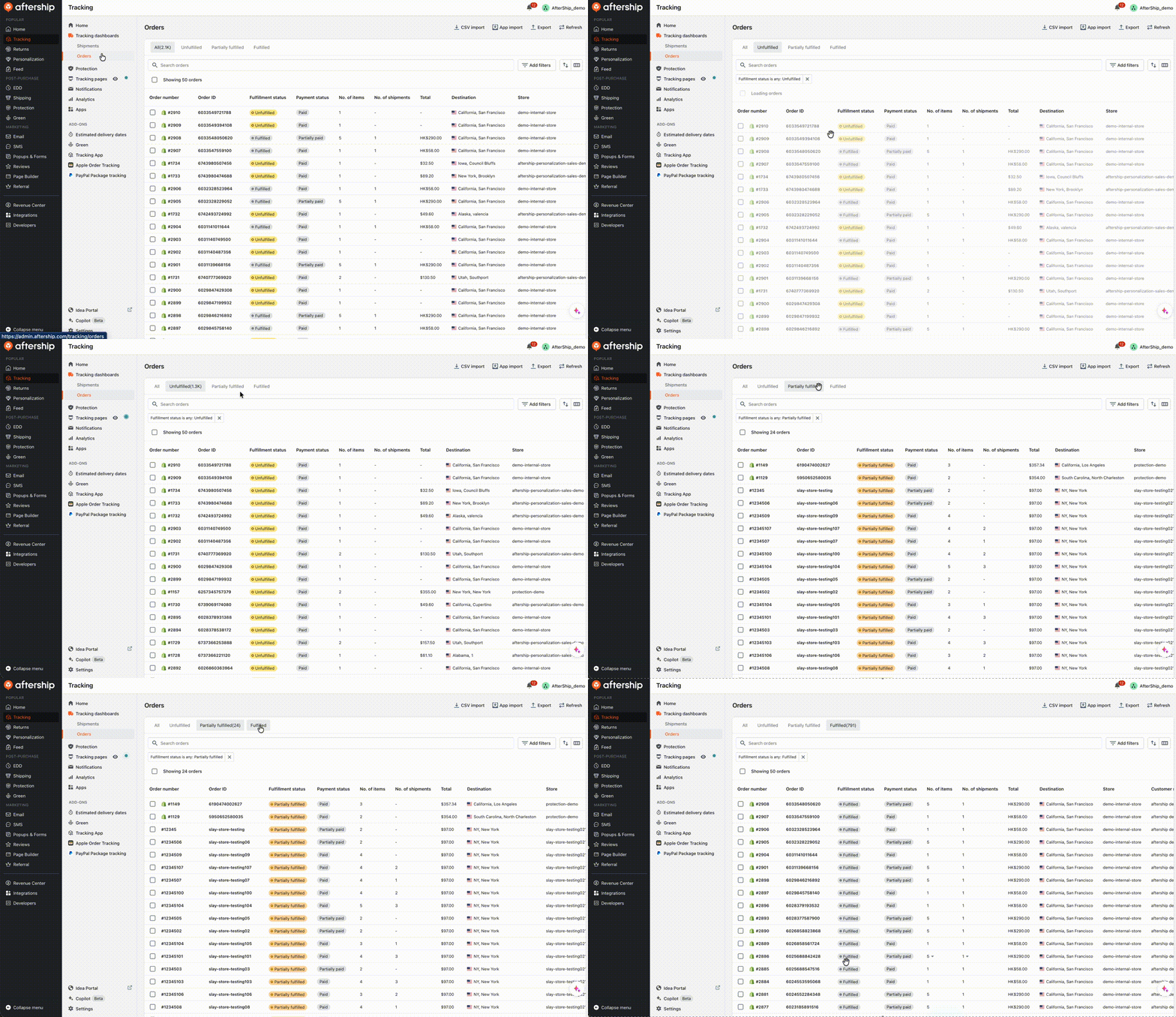
You can see it in the product before you sign anything. One login, one navigation, and the modules sitting alongside each other rather than in three browser tabs.
Shared data changes what the software can promise. AfterShip's AI EDD is trained on 4.4B+ shipments, reaches up to 95% accuracy, and covers at least 80% of deliveries. By AfterShip's own measure, that runs against under 40% of deliveries where most carriers offer any estimate at all.
A date that precise stops being a display element and becomes an operating input. You can publish it at checkout, hold it in the notification, and let support answer from the same number the shopper is looking at.
There is a size below which this is more than you need. If you run a small catalogue, want a tracking page a little better than Shopify's default, and have no plans for complex returns or shipping work, the full suite is more than the job requires. This article is written for high-growth retailers, and at your size the risk runs the other way: the tool bought for this year's volume becomes next year's migration, and migrations land in peak season more often than anyone plans for.
Scale is what makes the data layer worth having. AfterShip's estimates and rules draw on 11B+ shipments tracked across 20,000+ brands, which is the difference between a delivery date you can publish and one you can only hope for.
That is how a single purchase answers both halves of your COO's mandate. Cost comes down because you are running one contract and one integration instead of three, and the customer experience improves because every touchpoint after checkout is reading from the same record.
How High-Growth Brands Graduate to AfterShip's Platform
A brand starts with tracking, because WISMO is the loudest problem in the queue. Returns follow, usually inside a year, once the returns inbox costs as much to staff as the tracking inbox did. Shipping comes last, when label spend and carrier choice grow worth managing. Take time to compare order tracking platforms side-by-side before committing to the first leg.
Internet Up walked that path. It runs AfterShip Tracking and Returns across 170,000+ packages and 10,000+ returns a year, and holds a 4.8/5 shopper review score at that volume.
"The implementation of AfterShip Tracking and AfterShip Returns has had a significant positive impact on our organization. Both tools have greatly improved the transparency and efficiency of our delivery and return processes," says Gerald Bancilhon, Head of Customer Experience & Operations at Internet Up.
The shipping leg is the one most brands underestimate. Once tracking and returns data already sit together, adding label generation and rate shopping turns carrier selection into a decision informed by how those carriers actually performed on your lanes. The alternative is a fourth integration project in a quarter you needed for something else.
The Final Verdict: Choosing Your Growth Path, Not Just a Tool
Strip the comparison down and each vendor resolves to a single sentence. ParcelLab is an EU-centric enterprise communications platform. WismoLabs is a post-purchase tracking and notification platform. AfterShip is a post-purchase operations platform spanning shipping, tracking, returns, and warranty on a single data layer.
For a high-growth brand like yours, the initial focus on tracking is valid, but the strategic choice is the platform that solves tracking today and shipping, returns, and warranty tomorrow, on one data layer. That is the test to apply to any WismoLabs alternative you shortlist: parcelLab and Narvar both reach past tracking into returns, and AfterShip is the one that puts tracking, returns, shipping and warranty on the same record.
At the enterprise end of the market, see the three-vendor read on enterprise post-purchase.
Owning the whole post-purchase window is what makes the case financially. Internet Up reports a 10% increase in net revenue after moving tracking and returns onto AfterShip, through recaptured revenue and new revenue streams.
Book a demo and bring three things: your current stack, your monthly shipment volume, and your returns rate. Half an hour is enough to see what consolidation changes for a brand at your size, and to price it against the renewals already sitting on your calendar.
Proactive shipment tracking that delights your customers, reduces WISMO tickets, and improves your delivery performance.
Book a demoFrequently Asked Questions
What are the best WismoLabs alternatives?
Three vendors come up most often, and they are not interchangeable. parcelLab is a post-purchase platform built for retailers, spanning order tracking, branded messaging, returns and checkout delivery promises. Narvar runs tracking, notifications and returns for more than 1,500 retail brands and is the enterprise option of the three; if your storefront runs on Magento, we put it head to head with WismoLabs in which post-purchase tool fits a Magento storefront. AfterShip is the alternative scaling brands consolidate on, because tracking, returns, shipping and warranty run on one data layer instead of arriving as four contracts to renew.
What is WISMOlabs?
WISMOlabs is a post-purchase experience platform for ecommerce brands, operating since 2016. It connects carrier events, order data, customer context and business rules to decide whether to message a shopper at all and what that message should say. Two things are worth separating. Older software roundups sometimes file WISMOlabs under retail management or point-of-sale software, which is not the category the company itself publishes; its own description is a post-purchase experience platform for ecommerce. And the name is not the acronym: WISMO is the support shorthand for “where is my order”, the ticket type the vendor is named after.
Is ParcelLab or WismoLabs better for Shopify?
On Shopify there is little peer evidence to go on for either. WismoLabs has no Shopify App Store listing, and ParcelLab has no established Shopify review presence, so a Shopify merchant cannot read how either behaves for brands like theirs. AfterShip Order Tracking is listed on the Shopify App Store and connects to Shopify orders, fulfillments and returns, which is why Shopify brands shortlist it first.
How much do ParcelLab and WismoLabs cost for 10,000 shipments/month?
Both AfterShip and WismoLabs publish per-shipment pricing. ParcelLab publishes none, and its pricing page returns a 404, so any figure comes from a sales conversation. WismoLabs pricing puts the Pro plan at $730 per month for 10,000 shipments, with $0.08 per shipment above that. AfterShip's published pricing starts at $9 per month for Essentials (1,200 shipments a year); at 6,000 shipments a year Essentials is $29 and Premium $59 on annual billing. Above that volume it moves to a custom Enterprise quote scoped to the products you run, so the number depends on whether you buy tracking alone or tracking, returns and shipping together.
Can AfterShip really replace both ParcelLab and WismoLabs?
For the scope you are buying, yes. Tracking and notifications map onto AfterShip Tracking. Returns move to AfterShip Returns on the same data layer. Both ParcelLab and WismoLabs sell return labels too; what neither sells is outbound label generation or carrier rate shopping, which come with AfterShip Shipping. Warranty sits on the same platform when needed. The result is one contract, one login and one integration to maintain.
Which covers more carriers, ParcelLab or WismoLabs?
WismoLabs lists 1,600+ global and regional carriers and ParcelLab publishes 550+ (checked October 2026). AfterShip standardizes 2,000+ carriers on one data model, which matters once you add international lanes or regional couriers.