The Comparison That Already Resolved Itself
If you are comparing Return Magic and Returnly, the comparison has already resolved itself. Return Magic shut down in July 2022 and Returnly stopped processing returns in October 2023, so neither is a platform you can buy. What is worth your time is why they died, because the reason narrows your shortlist faster than any feature table.
Both were acquired by larger companies, and both were switched off by the owners who bought them. Two shutdowns inside fifteen months are completed evidence rather than a forecast, and the pattern they leave behind survives the obvious objection, which is that plenty of acquired post-purchase tools are still running today. The question is what separates the two groups.
If you are recommending a platform to a director or a VP, you will be asked what happens to your returns operation if the vendor gets bought. Both cases answer that in detail, and in each one the answer came down to the owner's core business.
What Acquisition Actually Did to These Two Products
Two acquisitions, three years apart, produced the same ending. The first was announced in April 2021, when payments company Affirm agreed to buy Returnly for approximately $300 million in cash and equity. Returnly served more than 1,800 merchants at the time.
By July 2023 the plan had changed. Affirm divested Returnly in 2023, and Returnly shut down that October. The company announced the decision on 6 July 2023 and pointed its merchants at a partner provider instead. Roughly 1,500 merchants had to move.
Affirm's 2025 shareholder letter, filed with the SEC, refers to "the discontinued Returnly business". The status comes from the company that owned it.
The earlier case ran the same way. Shopify acquired Return Magic in 2018 and shut it down in 2022. The product was Shopify-exclusive, served around 2,500 merchants and had processed more than 300,000 returns when the June 2018 deal was reported, and it closed on 6 July. Its Shopify App Store listing now carries a delisting notice, and support enquiries are directed to a third party rather than to Shopify.
What that meant operationally is the part worth planning for, and both migrations looked alike.
Open returns could not be transferred between platforms, so anything already in flight had to be finished on the outgoing system. Historical returns data had to be exported before access ended, because it did not come with you. And for the length of the cutover, teams ran two systems at once: the old one closing out live cases, the new one taking everything raised from the switch date.
Nothing on that list is unusual. It is the standard cost of an unplanned platform migration, and it lands on the operations team rather than on the vendor that triggered it.

The Test That Separated the Survivors
A returns platform is safest when returns is core to whoever owns it. Both products that died were side bets. Returnly was a returns product inside a payments company, and Return Magic was a returns product inside a commerce platform, and in each case the owner eventually concentrated on the business it was actually in. Neither decision was about the returns product being bad.
The ownership label on its own predicts very little. Of six comparable post-purchase acquisitions, four are still operating, several of them under their original brand names. What separates those four from the two that closed is not whether they were bought. It is whether the category they served was the buyer's business or an adjacent bet.
Apply that test to whatever is on your shortlist now, whether that is an independent Shopify returns app or one owned by a larger company, because it is a question about ownership structure. AfterShip is an independent platform built for the post-purchase journey. It was founded in 2012, is privately held, and raised a $66 million Series B in April 2021 led by Tiger Global with Hillhouse and GL Ventures participating. There is no strategic or corporate parent on the public record and no funding round announced since. For a VP asking who could decide to switch this off, that is the ownership structure to examine, and it is all a matter of record.
The structure is one form of evidence. Merchants running returns at mid-market volume can speak to how the platform holds up day to day, and the Shopify App Store is where they do.
Hawkes and Co has been running returns on AfterShip for almost eight years, and in July 2026 rated it five stars: "Overall great experience."
Every platform on your shortlist can process a return. The difference that showed up in these two cases was how central returns were to the company behind the platform. AfterShip is still the platform those merchants signed up for.
How AfterShip Returns Compares With What the Other Two Offered
Seven criteria decide this for a mid-market operation, and only one of them is about ownership. The rest are the things a returns lead has to answer for: how much the rules engine can do without a human, what the carrier arrangement costs, what the reporting shows, whether the data connects to anything else, what integrates, and what the bill looks like at volume.
Both discontinued products addressed several of these when they ran. Return Magic built branded return portals, auto-generated labels, refunds and customer emails in several languages, and reported on them in a dashboard, with return policies the merchant could configure, and we keep a fuller record of the original Return Magic platform. Returnly ran self-service returns and exchanges through hosted, brandable touchpoints that included package tracking, and issued a shopper credit before the returned item arrived, carrying the product return risk itself, set out in a detailed feature and pricing comparison.
Two of the seven are where a mid-market operation usually feels the difference: carrier control and analytics. One decides what a return costs. The other decides whether you can see it.
Their commercial models were different from each other. Return Magic was free to the merchant and tied to Shopify shipping. Returnly was merchant-paid software that funded its instant credit through Affirm. Neither is available today, and neither is a live pricing option, so the useful comparison is against what a buyer can actually price now. AfterShip publishes its plans, which means a mid-market buyer can model total cost before booking a sales call.
Return Magic vs Returnly vs AfterShip Returns, on all seven criteria: the table below sets the three side by side, with the two discontinued columns describing what each product offered while it operated.
| Criteria | AfterShip Returns | Returnly (discontinued) | Return Magic (discontinued) |
|---|---|---|---|
| Platform stability and ownership focus | Independent and privately held. Post-purchase is the core business. | Acquired by Affirm 2021. Shut down October 2023. | Acquired by Shopify 2018. Shut down July 2022. |
| Automation and logic depth | Conditional rules with auto-approve, paid-versus-free routing and exchange incentives. | Automated self-service returns and exchanges. | Auto-generated labels, refunds and emails; configurable return policies. |
| Carrier network and cost control | Bring your own carrier accounts with negotiated rates - 3 on Essentials, 5 on Premium, and a higher limit confirmed during Enterprise scoping - plus AfterShip-negotiated discounts on USPS and 40+ carriers on every plan, and 310,000+ drop-off locations, from aftership.com/returns, September 2026. | Not publicly documented. | Tied to Shopify shipping. |
| Analytics and reporting | Return reasons, label costs and processing time in one dashboard. | Not publicly documented. | Dashboard reporting on returns activity. |
| Unified data layer | Shipping, tracking, returns, and warranty on one data layer. | Returns and exchanges within a payments platform. | Returns within the Shopify platform. |
| Pricing transparency and TCO | AfterShip offers a shopper-funded route (Return Care, available to eligible Shopify merchants) and standard SaaS pricing. Essentials $16/mo annual (240 returns/yr) or $19/mo monthly (20/mo); Premium $99/mo annual (1,200/yr) or $119/mo monthly (100/mo). $0.50 per extra return on Essentials, $1.00 on Premium. Enterprise custom-priced. | Merchant-paid software. Not available today. | Free to the merchant. Not available today. |
| Integrations and API | Klaviyo, Gorgias, Zendesk; documented public Returns API and webhooks. | Hosted, brandable touchpoints including package tracking. | Shopify-exclusive; multi-language customer emails. |
Read down the AfterShip column and the pattern is consistent. Returns sits on the same data layer as the rest of the post-purchase stack, the carrier arrangement runs on the merchant's own negotiated rates, and the pricing is published where a buyer can check it.
Where Returns Automation Actually Reduces Cost
Automation only reduces cost when you can name what it decides. AfterShip's returns rules engine conditions on the things an operations team already sorts by: the return reason, the product tag, and the item value. The actions it takes are the ones that would otherwise sit in a queue.
Auto-approve is the clearest one. A return that meets your policy on reason, value and window gets approved without a person reading it, which removes the review step from the returns you were always going to approve. Paid-versus-free routing is the second: the rule decides per scenario who pays for the label, so a low-value return in a category you do not want back does not get a prepaid label by default. Exchange incentives are the third, where store credit or a bonus credit is offered at the point the shopper picks a resolution, and a refund becomes an exchange. There is more on how AfterShip compares on exchanges.
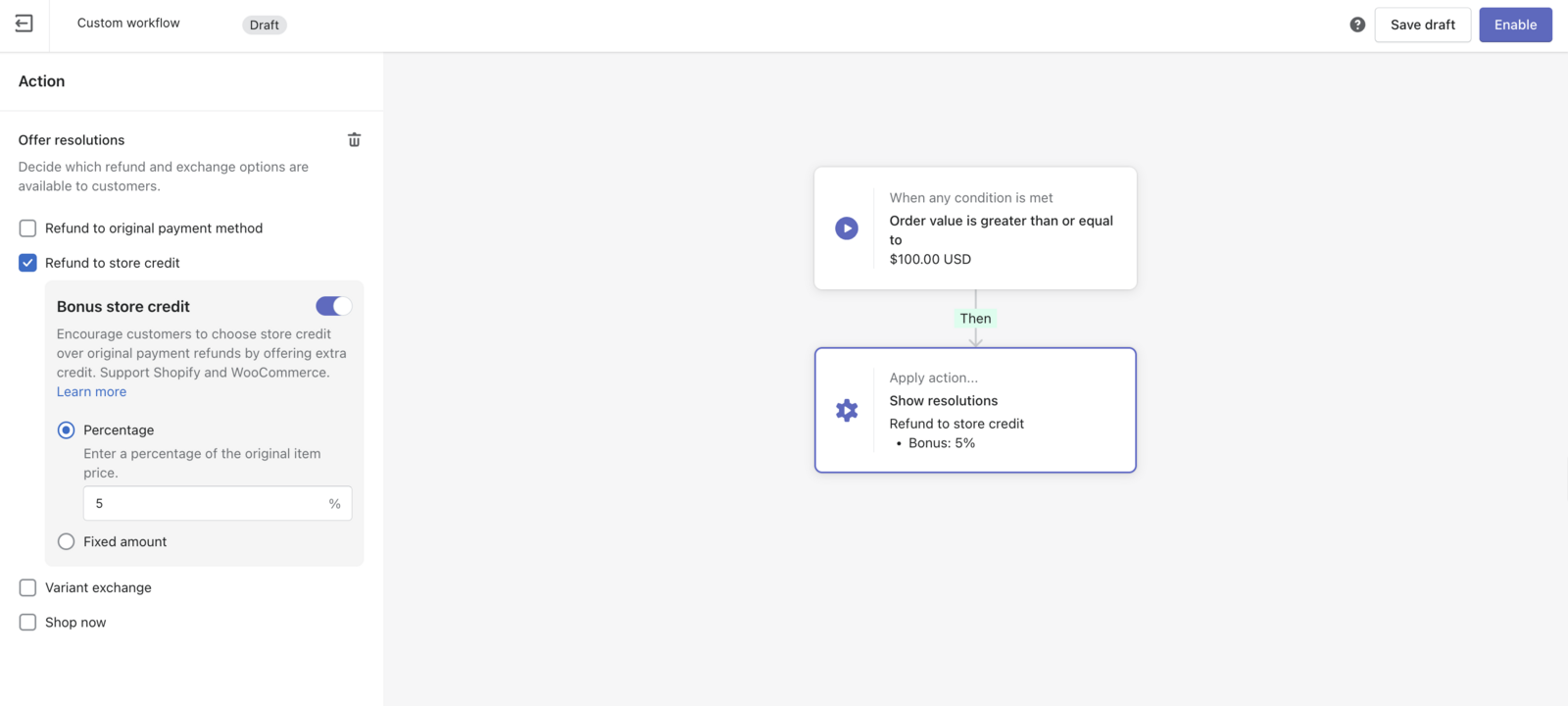
For a brand-new, low-volume Shopify merchant, the simplicity of Shopify's native returns may be appealing. A brand with scaling ambitions outgrows it quickly and needs the automation depth, multi-carrier flexibility and analytics that AfterShip provides. Shopify's own documentation states that exchanges cannot be requested in self-serve returns and that exchange-specific return rules are not supported, a limit that applies to the shopper self-serve flow.
Operations teams cross that line once volume makes manual review expensive. AfterShip is built for the far side of it, where the rules do the sorting and the team handles only the exceptions.
Why Returns Never Sit on Their Own
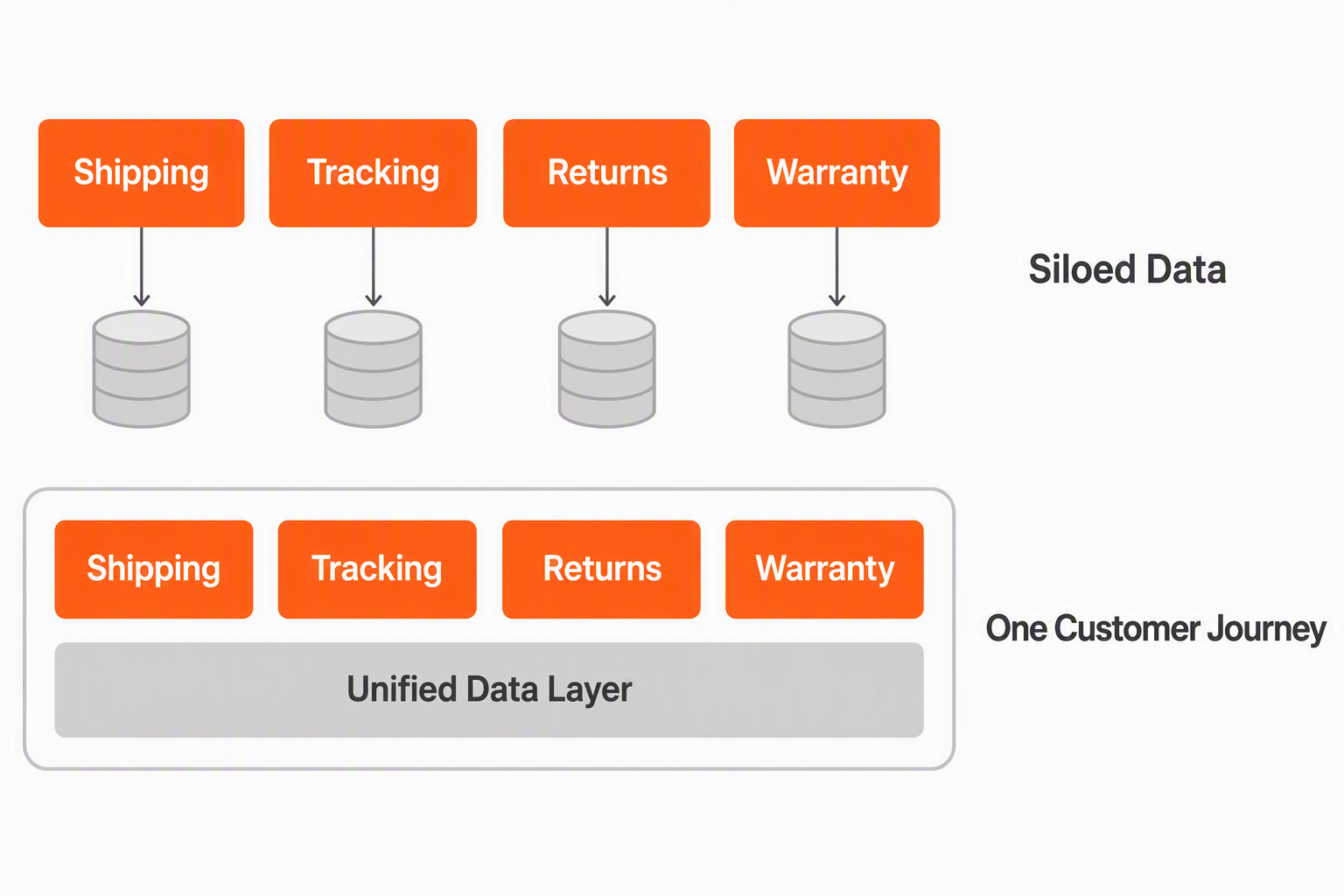
Returns generate the same data twice when the systems are separate. A return starts with a delivery that already happened, moves through a carrier that already scanned it, and ends in a refund or an exchange that the rest of the business needs to see. Run those stages in separate tools and you get four sets of numbers that have to be reconciled before anyone can act on them. The same pattern runs across the entire post-purchase software stack.
AfterShip runs shipping, tracking, returns, and warranty on one data layer, which means one customer journey and one set of numbers. A return reason recorded in the returns portal sits beside the delivery event that preceded it and the warranty claim that may follow it, without an export or a join.
The difference shows at mid-market volume for a specific reason. When the returns data and the delivery data sit in one place, you can see that a spike in returns for one SKU followed a run of late deliveries in one region, and you can fix the delivery problem at its source. Two disconnected tools will each show you half of that, correctly, and neither will show you the link.
The second test runs in the other direction, and it applies to AfterShip as much as to anyone. Before you commit to any returns platform, ask three questions. Can your returns data and your rules be exported in a usable form. Is the API documented and public. And what does the contract say about leaving, on notice period, on renewal terms, and on what happens to your history.
The two shutdowns turned all three into real work, and all three are answerable before you sign.
AfterShip answers the second of those questions in public. The Returns API is documented and carries documented webhooks, so an engineering lead can assess the integration before anyone signs, and the published plans let a buyer model cost at the same stage. Put the export and contract questions to every vendor in writing during evaluation, including this one. What is already public on AfterShip's side, the API, the webhooks and the plans, a buyer can check today without asking anyone.
The 2026 Verdict for Mid-Market Brands
The recommendation for a mid-market brand in 2026 is short, and it splits cleanly.
Choose AfterShip Returns if:
- returns volume justifies rules-based automation rather than manual review
- you need multi-carrier flexibility and your own negotiated rates
- you want one data layer across shipping, tracking, returns, and warranty rather than four disconnected tools
- you need reporting on return reasons, label costs and processing time rather than raw exports
- you want published pricing you can model before a sales call
- you want a platform whose core business is post-purchase
What the other two offer today: nothing.
- Neither runs: Return Magic has been unavailable since July 2022, Returnly since October 2023
- Migrating off either meant exporting history first and running two systems through the cutover, and open returns did not transfer
- Any page still listing a price or a demo for either is describing a product that no longer runs
If your returns volume has outgrown manual review, AfterShip Returns is the only one of the three still taking new merchants, and post-purchase is the only business it is in. That is what the two shutdowns were evidence for. That leaves the practical question of what to move to, which we answer for brands shortlisting Returnly alternatives across several channels.
Returns automation that enhances the returns and exchanges experience, reduces costs, and retains more revenue.
Book a demoFrequently Asked Questions
What happened to Returnly?
Affirm announced the divestiture of Returnly on 6 July 2023, and Returnly stopped processing returns in October 2023. Roughly 1,500 merchants had to migrate. Affirm's 2025 SEC filing refers to the discontinued Returnly business.
What happened to Return Magic?
Shopify acquired Return Magic in 2018 and shut it down on 6 July 2022. Its Shopify App Store listing now carries a delisting notice. If you are shortlisting Returnly alternatives or comparing the best returns management software, see a ranking of the best return portals for 2026.
Can I use my own carrier rates?
Yes. Connect your own carrier accounts and apply your negotiated rates, at 3 accounts on Essentials and 5 on Premium, with a higher limit confirmed during Enterprise scoping. AfterShip-negotiated discounts on USPS and 40+ carriers are available on every plan.
Is Loop Returns a better alternative?
Both publish their pricing. Loop's own pricing FAQ states that plans other than the free tier require an annual contract. AfterShip publishes its plans too, so a mid-market buyer can model total cost before a sales call. Compare on the exit-path test rather than the ownership label. AfterShip's Returns API and webhooks are documented and public, which you can check before you commit.