Returnly shut down in October 2023, and the tools most brands moved to were built for one channel. If your returns run across Shopify, Amazon, and WooCommerce, you are not looking for a Returnly replacement. You are looking for something Returnly never was: one place where a return from any channel lands in the same queue, under the same rules.
The timeline is settled. Affirm acquired Returnly in 2021 for approximately $300 million. On 6 July 2023, Affirm named Loop the preferred returns provider for merchants then using Returnly and announced the sunset. Returnly stopped processing returns on 1 October 2023, and returnly.com now redirects to Loop.
There is a deep-dive comparison on Returnly's features if you want the like-for-like view. This article asks a different question.
That successor path was Shopify-first, and for a brand selling on a single storefront it was a reasonable place to land. For a brand that has since added Amazon and WooCommerce, it answers a smaller question than the one you actually have.
Why Your 'Shopify' Returns App Is Failing Your Multi-Channel Brand
A returns app that only speaks Shopify does not fail loudly. It fails in the gaps between channels, and the cost lands in your team's week rather than in an error log.
- Data silos. There is no single view of a customer's return history. The shopper who sent back three Shopify orders last quarter arrives as a stranger when they return an Amazon one.
- Inconsistent CX. A different portal, a different policy and a different tone per channel, all from one brand.
- Manual workload. Reports stitched together by hand, and labels issued one at a time for anything that did not originate on Shopify.
- Lost revenue. There is no unified way to offer an exchange or store credit, so returns that could have been retained get refunded by default.
The volume behind those four is not marginal. NRF put the 2025 return rate at 19.3% of online sales, which is roughly one order in five coming back, and every one of them enters through whichever channel sold it.
So the question is not which app replaces the one you lost. It is which platform treats all three channels as a single operation.
The Multi-Channel Readiness Score: A Better Way to Judge Returnly Alternatives
Feature lists do not answer a multi-channel question, because most returns vendors carry most of the same features. What separates them is how those features behave when a return arrives from a channel the tool was not designed around.
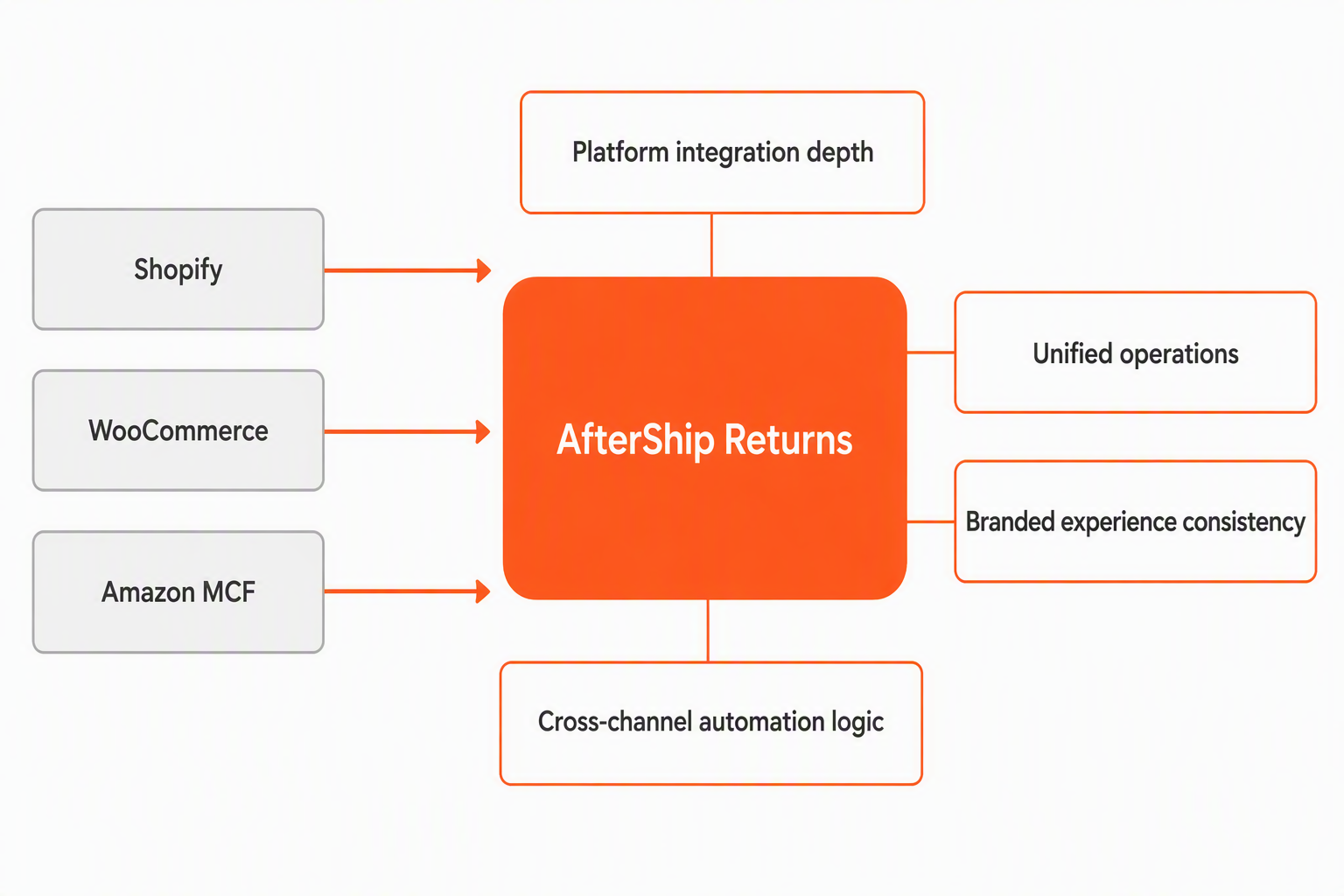
So we scored the alternatives on one axis instead. The Multi-Channel Readiness Score is our own evaluation framework rather than an industry benchmark, and it rates each platform on four things:
- Platform integration depth. A native connector or an API, and what the vendor's own documentation actually commits to.
- Unified operations. Whether returns from every connected platform land in one queue.
- Branded experience consistency. Whether one portal look and feel carries across the channels that permit it.
- Cross-channel automation logic. Whether a single rule applies to a return regardless of which channel sold the order.
A multi-channel readiness score helps evaluate returns software beyond feature lists.
One limit belongs here rather than buried later. No platform delivers one identical shopper-facing return flow across all three channels, because Amazon runs its own marketplace returns. What a platform can unify is everything on the merchant side of the return, and that is precisely where the four criteria bite.
The four alternatives judged against them are AfterShip Returns, Loop Returns, Happy Returns and Narvar Returns. They are the names that surface most often as Returnly competitors, and between them they cover the realistic field of returns management software for Shopify Amazon WooCommerce brands. G2's Best Returns Management Software category page is a reasonable place to survey the wider category. Narrowed to DTC brands, we rank the same field in the five best options for DTC brands.
2026 Verdict: Comparing the Top 4 Returnly Alternatives
Here is how the four score against the five criteria that decide a multi-channel returns operation.
| Criteria | AfterShip Returns | Loop Returns | Happy Returns | Narvar Returns |
|---|---|---|---|---|
| Multi-Channel Readiness Score | 4.5 / 5 | 2.5 / 5 | 2 / 5 | 2.5 / 5 |
| Shopify integration depth | Native. Branded portal, routing and automation rules, and its deepest exchange flow | Native, and its original platform | Native app, drop-off focused | Named in its own integration list |
| Amazon integration depth | Multi-Channel Fulfillment, beta in the US and UK, creates the return in Seller Central | No native marketplace returns documented | None published | Not named as a returns integration |
| WooCommerce integration depth | Native. Same portal, rules, refunds and store-credit incentives as Shopify | No native connector documented | None published | Not named as a returns integration |
| Unified operations and analytics | One queue for every connected platform. Analytics per store, switchable inside one account | Returns and TikTok Shop consolidated in the Loop admin | Dashboard centred on its own network | Enterprise suite, scope set at implementation |
| Brand experience customization | Branded portal, custom domain, and editor-level control of content and rules | Branded portal with Shopify-native theming | Branded experience inside the Return Bar network | Deep, delivered as an enterprise project |
The score rates multi-channel readiness only, not overall product quality. Read down the Amazon and WooCommerce rows. All four integrate natively with Shopify, because Shopify is where returns software grew up. The separation happens on the second and third channels, where three of the four either publish no returns integration or do not name one, and that difference decides how much of your returns operation stays manual.
AfterShip Returns
The test for a multi-channel brand is what happens to a return that did not come from Shopify.
AfterShip Returns integrates WooCommerce natively, a branded returns portal, automation and routing rules, refunds, and store-credit incentives all work on WooCommerce. Exchanges are supported across platforms, with the deepest, most automated exchange experience currently on Shopify. Anything else in the stack connects through a returns API and webhooks. On Premium and Enterprise plans you can also set up instant exchanges, which ship the replacement before the original item is back.
Amazon needs stating precisely. AfterShip Returns connects Amazon through its Multi-Channel Fulfillment (MCF) integration (currently in beta for the US and UK marketplaces), automatically creating the return in Amazon Seller Central once an RMA is approved. Native Amazon marketplace returns (FBA and FBM) remain inside Amazon's own returns system.
That limit is real and worth naming plainly. No third-party platform replaces Amazon's marketplace return flow, because Amazon does not permit it. What a brand can consolidate is everything else.
AfterShip Returns gives you a single operations view to manage return orders and RMA requests from every connected platform, Shopify, WooCommerce, and Amazon MCF, in one place. AfterShip unifies returns from Shopify, WooCommerce, and Amazon MCF orders into one dashboard. Analytics are available per connected store, and you can switch between all your stores inside one account, so you get multi-store visibility without juggling logins, while each store's numbers stay accurate and un-blended. That is where you consolidate all your returns analytics instead of stitching exports together.
Labels sit in the same place: auto shipping label generation with 71 carriers worldwide, without additional software. Teams evaluating a label-first tool instead should see where label automation stops and returns begin before deciding.
Marc Nolan credits the exchange flow with taking "every problem away", and with "saving us $125k in the last 90 days".
And because shipping, tracking, returns, and warranty run on one data layer, a return stays attached to the shipment that created it.
Loop Returns
Some brands genuinely do sell on one platform only, and for them the five criteria collapse to a single question: which tool turns the most refunds into exchanges? The Returnly vs Loop Returns comparison was settled for a lot of merchants back in 2023, when Affirm named Loop the migration path, and it is worth asking whether that default still fits.
Loop Returns is a strong Returnly alternative for Shopify-only exchange workflows. It was not built to be a multi-channel command centre, and for a brand also selling on Amazon and WooCommerce that Shopify-native focus becomes the constraint. Return Magic sits at the independent end of that same field, covered in the independent alternative for 2026.
Loop positions itself as originally built for Shopify and now available on all platforms, and its own documentation names Shopify and consolidates TikTok Shop returns into the Loop admin. Its published surfaces do not document a native WooCommerce returns connector or native Amazon marketplace returns, which is a statement about what is documented rather than a claim about what Loop can build.
There is a dedicated AfterShip vs. Loop comparison for readers weighing the two directly. There is a dedicated comparison of Loop Returns vs AfterShip for readers weighing the two directly.
One commercial detail matters to a brand changing systems specifically to avoid another hard-to-exit dependency: Loop's public terms carry a 6% annual price increase on renewal and a 60-day non-renewal notice window.
Exchanges themselves are not the dividing line. AfterShip Returns supports exchanges and store-credit incentives too, and applies them across Shopify, WooCommerce and Amazon MCF rather than on one platform. On exchange conversion specifically, the two-way comparison is in which platform drives more exchanges.
Happy Returns
Some brands are solving a physical problem rather than a software one: shoppers without printers, and the packaging waste of shipping everything back in a box.
Happy Returns, a UPS company, runs its own box-free, label-free Return Bar network of roughly 10,000 locations.
Drop-off is not where the two diverge. AfterShip covers returns across a carrier drop-off footprint of 300,000+ sites, and also supports 9,000+ Happy Returns Return Bars in the U.S., so a merchant who wants the box-free option gets it either way. The two figures count different things: one is a proprietary network of Return Bars, the other is coverage across carriers' existing drop-off points.
The difference is what happens after the parcel is handed over. AfterShip is carrier and network agnostic, and it unifies the back end across Shopify, WooCommerce and Amazon MCF rather than organising the operation around one network's footprint.
Narvar Returns
The question with enterprise software is not whether it can do the job, but what it costs to find out.
Narvar's returns product is named Shield and is sold inside an enterprise post-purchase suite. Narvar's own integration list names Shopify, Salesforce, BigCommerce and Magento, and does not name Amazon or WooCommerce as returns integrations. Narvar publishes no pricing on any surface, so a mid-market buyer cannot establish scope or cost before entering a sales process.
That suits a large retailer with a professional-services budget and an implementation team behind it. For a brand that needs Shopify, WooCommerce and Amazon MCF returns landing in one queue this quarter, AfterShip gets there without the implementation project.
Making the Switch: How to Migrate Without the Headache
Switching returns platforms sounds like the kind of project that eats a quarter. In practice it is one of the more routine migrations in ecommerce software, because most of the work is configuration rather than data history.
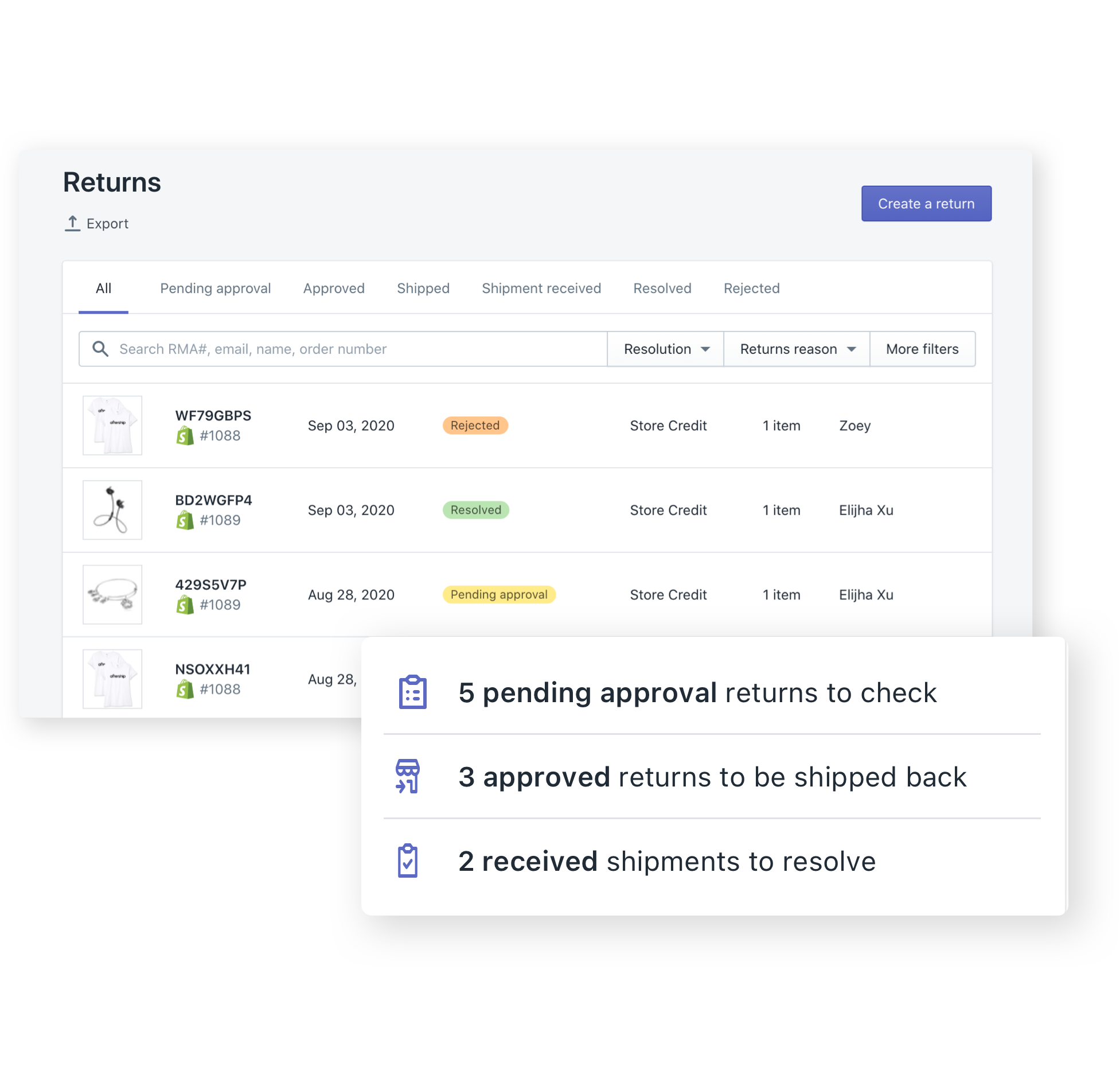
A guided migration covers the parts that actually take time: rebuilding the branded returns portal so shoppers see your brand rather than a generic form, transferring your return policies, and recreating the automation and routing rules that decide what happens to each request. Existing settings and reporting are imported rather than rebuilt from scratch, and larger accounts get solution-architect support through the configuration.
One operational detail is worth planning around, and it applies to any returns platform rather than to one vendor. Returns already initiated in your previous system generally have to be completed there, because returns platforms do not hand in-flight RMAs to one another. Close out what is open before you cut over, and pick a switch date after a quiet period rather than in the middle of your post-holiday peak.
The payoff shows up in the daily work rather than in launch week. Sarah D, Customer Service and Retention Manager at Lume, puts it plainly: "What used to take our team upwards of 8 hours a week to do, now only takes us 1 hour."
The Final Verdict: Which Alternative Is Right for Your Stack?
The right answer depends on how many storefronts you are actually running.
Choose AfterShip Returns if:
- You sell on more than one platform and want return orders from Shopify, WooCommerce and Amazon MCF landing in a single queue
- You want one set of automation and routing rules applied to a return regardless of which channel sold the order
- You want return labels generated in the same place, with 71 carriers available without additional software
- You want shipping, tracking, returns, and warranty running on one data layer, so a return stays attached to the shipment that created it
Choose a single-channel specialist if:
- Shopify is your only storefront and exchange conversion is the single metric you are trying to move
- Box-free, in-person drop-off is the whole business case rather than one option among several
- You are an enterprise buyer with a professional-services budget and an implementation team ready to run a configuration project
If your returns arrive from more than one channel, the shortlist is short. AfterShip Returns is the only one of the four that puts Shopify, WooCommerce and Amazon MCF returns into a single queue under one set of rules.
Returns automation that enhances the returns and exchanges experience, reduces costs, and retains more revenue.
Book a demoFrequently Asked Questions
What happened to Returnly?
Affirm acquired Returnly in 2021 for approximately $300 million. On 6 July 2023 Affirm named Loop the preferred returns provider for merchants then using Returnly and announced the sunset, and Returnly stopped processing returns on 1 October 2023. The domain now redirects to Loop. Brands searching for services similar to Returnly are choosing a replacement stack rather than migrating a live account.
Can AfterShip handle Amazon FBA and FBM returns?
Not as marketplace returns, and the limit is Amazon's rather than any vendor's. AfterShip Returns connects Amazon through its Multi-Channel Fulfillment (MCF) integration (currently in beta for the US and UK marketplaces), automatically creating the return in Amazon Seller Central once an RMA is approved. Native Amazon marketplace returns (FBA and FBM) remain inside Amazon's own returns system.
What is the key difference between Loop and AfterShip for a multi-channel brand?
Channel coverage. Loop's published surfaces document Shopify and consolidate TikTok Shop returns into the Loop admin, and they do not document a native WooCommerce returns connector or native Amazon marketplace returns. AfterShip Returns runs Shopify and WooCommerce natively and connects Amazon through MCF, so a brand selling across all three works one queue instead of reconciling three. Exchanges are available either way; what differs is how many channels the workflow reaches.
How much does AfterShip Returns cost?
AfterShip Returns publishes its tiers. On annual billing, Essentials is $16 a month with 240 returns a year and Premium is $99 a month with 1,200 returns a year, and Enterprise is quoted. Current prices, quotas and overage rates are on the AfterShip Returns pricing page.
Is there a Returnly alternative with better analytics?
Analytics are available per connected store, and you can switch between all your stores inside one account, so you get multi-store visibility without juggling logins, while each store's numbers stay accurate and un-blended. That is a design choice rather than a gap. Blending return rates across a Shopify storefront and an Amazon MCF channel produces a number that describes neither, so AfterShip Returns gives you per-store accuracy and one account to see all of them from.