You're shipping thousands of orders a day. Your team is combining same-customer orders by hand, maintaining a stack of routing rules, and stitching exports together at month end. You haven't failed; you've just outgrown your tools, and the next step is a shipping platform built for multichannel, multi-warehouse operations.

That is a graduation moment: your success has made operational complexity your team's daily work, and the tool you chose when smaller sits at its center.
When "Simple" Becomes a Bottleneck: 5 Signs You've Outgrown Shippo
Teams researching Shippo alternatives for high volume usually describe the same workflow bottlenecks: the work around the shipping tool grows faster than the order count. Shippo is multi-carrier shipping software for e-commerce businesses and developers. These five signs are symptoms of scale in your own operation:
- API limits by endpoint at peak. Your peak days mean engineering around API rate limits that differ by endpoint (Shippo's live transaction creation is 500/min, single-object reads 4,000/min, tracking creation 750/min).
- Order combination is manual. Your multi-warehouse orders split correctly, but same-customer orders still have to be combined into one shipment by hand; Shippo states there is "no automatic way to combine orders into a single shipment."
- Rule sprawl. Your routing rules keep multiplying, because every new zone, SKU and weight band needs its own rule maintained in a strict top-to-bottom order.
- Price-and-transit carrier choice. Your carrier selection runs on price and published transit times, not on how each carrier is actually performing on your lanes.
- Reconciliation by stitching. Month-end reconciliation means stitching exports together, because each Shippo transaction export stops at 10,000 rows.
The carrier market is adding choices faster than static rules can absorb them. Measured by revenue share of the U.S. parcel market, the Pitney Bowes Parcel Shipping Index reports that "Other" carriers more than doubled their share from 3.4% in 2024 to 7.2% in 2025, indicating growing competitive pressure and diversification in the market.
Each sign carries a business cost your leadership feels: peak-season labor, a slower month-end close, and the morale of the people running the workarounds. These are the challenges unique to high-volume brands.
If three or more describe your week, write down what your next platform must prove, then take that list into every demo.
What to Demand from a High-Volume Shipping Platform in 2026
High-volume shippers need advanced automation and enterprise-grade API reliability. Hold every provider to these five criteria when evaluating the broader shipping software market.
Enterprise-Grade Reliability (APIs & SLAs)
Ask for a published uptime SLA with service credits and defined response times, and the support plan it covers. Then check API limits endpoint by endpoint against your peak-day call volume.
Advanced Automation & Rule Logic
Check what one rule can express: combined conditions, order-level fields such as order total, and rate shopping logic that responds to each shipment.
True Multichannel & Multi-Warehouse Support
Confirm which of your channels import natively, how orders split across warehouses, and whether same-recipient shipments combine into one label.
Cost Visibility and Data Portability at Scale
Your CFO needs spend broken out clearly and exports large enough to close the month in one pass. Weigh total cost of ownership too: labor for manual fixes, error costs, and missed carrier-selection gains.
Dedicated Onboarding & Support
Ask for named onboarding and customer success roles, developer support, and a plan for peaks such as BFCM.
Get each of these answers in writing, and the shortlist narrows on evidence you can check.
AfterShip Shipping: An Operating System for Complex Logistics
AfterShip Shipping is built for high-volume, multichannel complexity. The Shippo scalability issues that surface at this volume are operational: API headroom at peak, what a single rule can express, how orders move across warehouses and channels, and what finance can see at month end.
Capacity planning starts from one number. The API allows 10 requests per second per organization, with a custom limit on Enterprise, so your engineers size peak-day jobs against a single ceiling across endpoints.
Rule sprawl eases when one rule can say more. Rules support "meet all conditions" (AND) and "meet any condition" (OR) logic, with conditions including order total and, for Shopify stores, requested service type. Automation rules are available on the Pro and Enterprise plans.
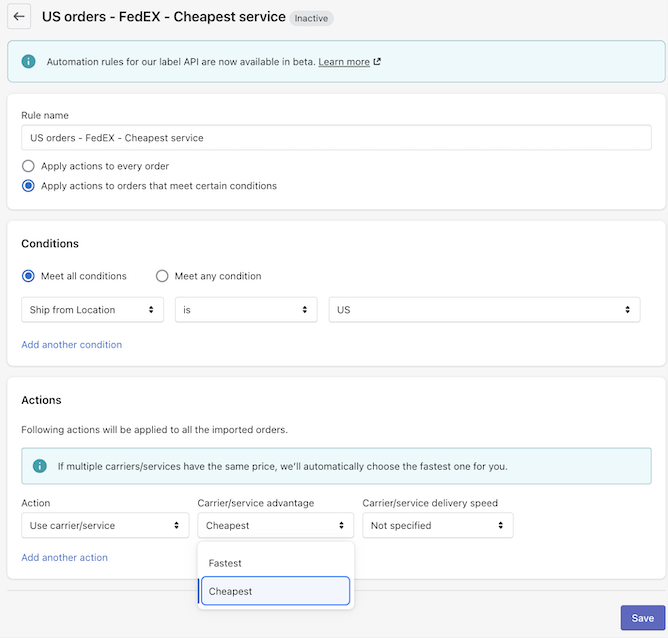
Carrier choice gets sharper when it reads delivery outcomes as well as rates. Smart Carrier Recommendation, included on every AfterShip Shipping plan, compares live rates, excludes carrier services with a high exception rate for the shipment's origin and destination based on AfterShip tracking data, and re-evaluates every shipment. You turn it on when you are ready, and it selects the service without buying the label.
Multi-warehouse orders split automatically by warehouse location, and shipments bound for the same recipient combine into one label. The hand-combining step drops off your peak-day checklist.
Each shipment's selected service is recorded at label creation, and label history, including API logs, exports in CSV or Excel for finance.
Coverage stays carrier-agnostic. You reach a wide carrier network through one integration and keep your own negotiated carrier accounts beside it: 1 on Free, 1 on Essentials, 5 on Pro and Unlimited on Enterprise.
For a team running shipping software for 1000+ orders per day, rules upkeep and manual combining stop being daily work and become configuration you set once and review.
AfterShip vs. Shippo: A Head-to-Head for Multichannel Sellers
An AfterShip vs Shippo comparison at this volume turns on how carrier choice is made, how orders are grouped before a label is bought, what finance can see about cost, and what happens when peak breaks something. AfterShip Shipping selects a carrier service per shipment from its own tracking data, and combines same-recipient shipments into one label automatically.
| Criteria | AfterShip Shipping | Shippo |
|---|---|---|
| API Reliability & Rate Limits | One organization-wide API limit of 10 requests per second across endpoints, so capacity planning works from a single figure; a custom limit on Enterprise | Per-endpoint limits per minute: transaction creation 500 live, single-object reads 4,000, tracking creation 750; higher limits on request |
| Performance SLAs | A 99.9% monthly uptime target with service credits and response times prioritized from P1 to P4, for customers on the Silver or Gold support plan | A 99.9% uptime SLA listed on the Premier plan |
| Advanced Automation Rules | Rules with "meet all conditions" (AND) and "meet any condition" (OR) logic, and conditions including order total and, for Shopify stores, requested service type; Smart Carrier Recommendation re-evaluates every shipment | Automation rules by item name, SKU, order quantity, order weight and destination, run top to bottom |
| Multi-Warehouse Logic | Multiple ship-from locations; rules can set the ship-from location; orders split automatically by warehouse location; shipments for the same recipient combined into one label | Sender-address rules by destination; multi-location Shopify orders split automatically; combining orders into one shipment is done by hand |
| Multichannel Integration Depth | Order import from Shopify, TikTok Shop, BigCommerce and WooCommerce; Amazon Shipping as a label carrier; Amazon covered tracking-side by AfterShip Tracking and fulfillment-side by AfterShip Feed, each a separate subscription | Order import from Shopify, Amazon, TikTok Shop and other platforms into one Orders page |
| Carrier Rate Shopping at Scale | Live rates across connected carrier services, with Smart Carrier Recommendation selecting a service per shipment and excluding services with a high exception rate on the lane; 130+ carriers in one integration, plus your own carrier accounts and rates (1, 1, 5 and Unlimited accounts by plan) | Discounted rates from 40+ carriers and connected own carrier accounts; a default "Best" or "Cheapest" rate selection |
| Enterprise Support & Onboarding | Silver and Gold support plans, priced per product: an onboarding manager and a customer success manager on Silver; an implementation consultant, developer support and key event management for peaks such as BFCM on Gold | Premier: a team advising on the integration and dedicated account support after launch |
| Cost Visibility and Data Portability at Scale | Label history, including API logs, exportable in CSV or Excel up to 100,000 rows at a time; the carrier service selected on cost and reliability for every shipment at label creation | A Spend Analytics dashboard breaking spend into net labels, surcharges, address-validation and subscription fees; Shippo Intelligence for Pro and Premier API customers; exports up to 10,000 rows |
For granular detail, see a direct, feature-by-feature comparison of AfterShip vs. Shippo.
Beyond Shipping Labels: Why a Unified Platform Wins
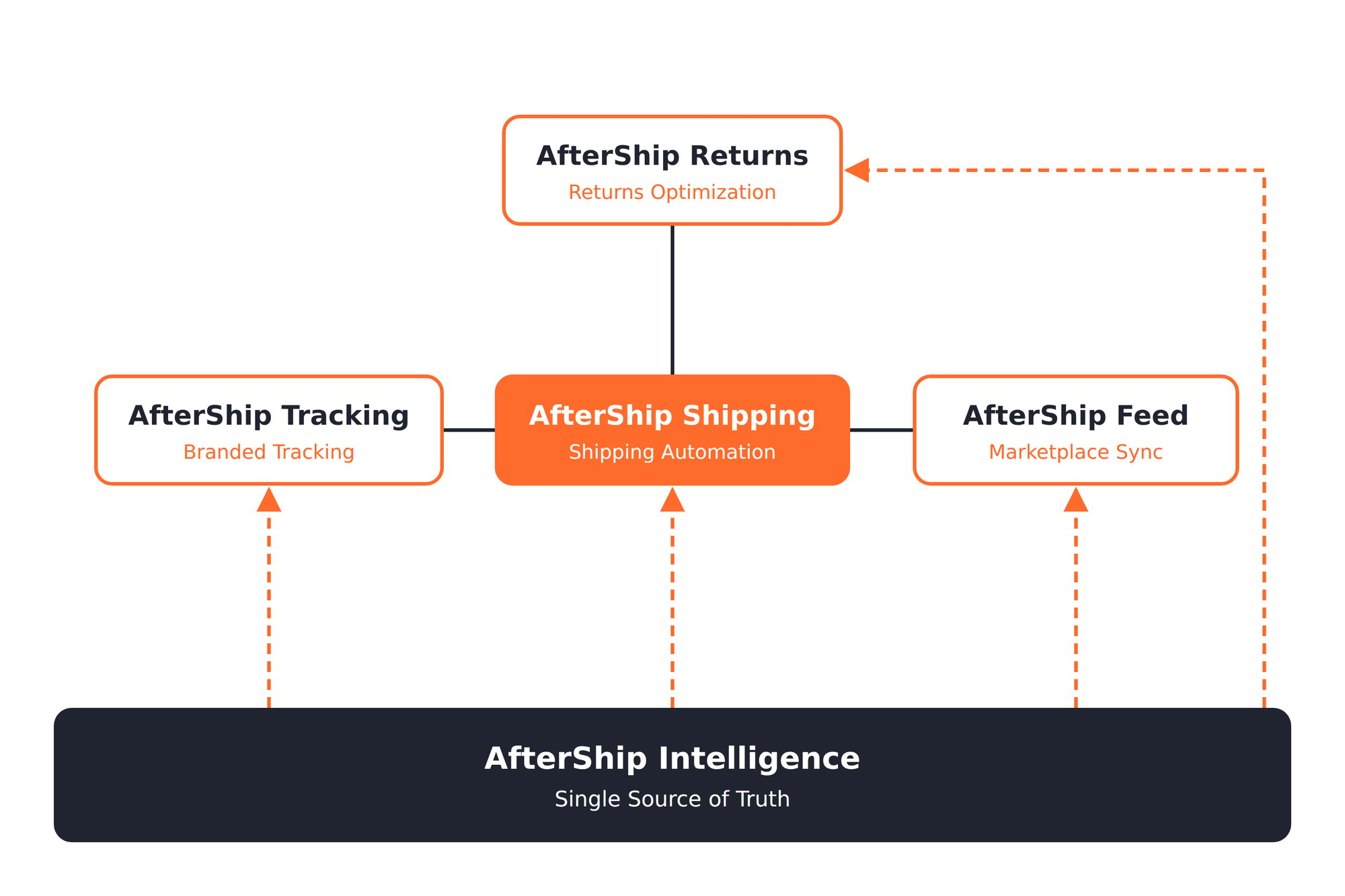
Labels are one step in a longer post-purchase journey. AfterShip covers shipping, tracking, returns, and warranty, and three products extend AfterShip Shipping for a multichannel seller:
- AfterShip Tracking for branded tracking and proactive notifications that reduce WISMO (where is my order) tickets.
- AfterShip Returns to run returns from request to resolution.
- AfterShip Feed to manage TikTok Shop listings, inventory and orders.
Each product is billed separately. Labels created in AfterShip Shipping sync into AfterShip Tracking while a Tracking subscription is active.
The depth comes from AfterShip Intelligence, the data layer these products share. Tracking data informs the carrier decision at label creation, rather than living in a stitched-together stack. The same connected setup also serves the specific needs of BigCommerce stores.
For teams weighing the best Shippo replacement for multichannel sellers, that shared data layer is where AfterShip goes deepest.
Migrating from Shippo to AfterShip Shipping: What the Move Involves
Treat the switch as a planned upgrade with a parallel-run window. Your current setup keeps shipping live orders while AfterShip Shipping proves itself on real volume, and the cutover happens only when the output matches.
- Connect your stores: Shopify, TikTok Shop, BigCommerce and WooCommerce.
- Add carriers, both AfterShip's connected carriers and your own negotiated carrier accounts.
- Configure warehouses and sender addresses.
- Set up automation rules (Pro and above) and turn on Smart Carrier Recommendation.
- Run a test batch and check labels, rates and selected services.
- Cut over.
Support follows the size of the project. AfterShip's Silver support plan adds an onboarding manager and a customer success manager. The Gold plan adds an implementation consultant, developer support and key event management for peaks such as BFCM.
Support plans are priced per product as a share of that product's subscription. A named team and a tested cutover let you schedule the switch around your own peak calendar.
The Verdict: When to Graduate from Shippo to AfterShip
Scaling brands leave when performance, complexity (multi-label, rules), analytics and economics start to matter, and AfterShip is the specialist choice when they do.
Choose Shippo if:
- you sell through a single channel
- you ship under 500 orders a month
- your routing logic is simple
Choose AfterShip Shipping if:
- you ship more than 1,000 orders a day across several sales channels
- you want each shipment's carrier service selected with high-exception services on that lane excluded, using AfterShip tracking data
- you need orders split by warehouse location and same-recipient shipments combined into one label automatically
- you want a published 99.9% uptime SLA with service credits and prioritized response times, through a Silver or Gold support plan
- your finance team needs label history in exports of up to 100,000 rows
Fixed automation rules are a Pro-and-above feature capped at 10 outside Enterprise, whereas carrier selection that adapts to each shipment (Smart Carrier Recommendation) is included on every plan. Switched on, it re-evaluates every shipment.
Frequently Asked Questions
Is AfterShip a good replacement for Shippo?
For multichannel, multi-warehouse operations at scale, AfterShip Shipping is a strong fit. It brings your stores and your own negotiated carrier accounts into one workflow, and handles warehouse splits and same-recipient labels during order processing. Carrier choice is where the difference shows: Smart Carrier Recommendation, on every plan, excludes services with a high exception rate on each lane, using AfterShip tracking data. If peak season means engineering work and manual fixes, AfterShip Shipping moves that load into configuration your team sets and reviews.
How much does AfterShip Shipping cost for high volume?
AfterShip publishes its plan ceilings, so you can size a plan against your label volume before any pricing conversation. The Pro plan runs to 25,000 labels a month on monthly billing and 300,000 labels a year on annual billing. At about 30,000 labels a month, you are past the Pro monthly ceiling, and Enterprise pricing is quoted for your volume. Support plans are billed separately. Each AfterShip product carries its own subscription, so the total reflects only the products you run.
What is the process for migrating from Shippo to AfterShip?
Plan it as an upgrade with a parallel-run window. Connect your Shopify, TikTok Shop, BigCommerce and WooCommerce stores, then add AfterShip's connected carriers and your own negotiated accounts. Configure warehouses and sender addresses, set up automation rules, and switch on Smart Carrier Recommendation. Run a test batch, compare it with your current labels, then cut over. On a Silver or Gold support plan, AfterShip puts named people on the move, from an onboarding manager to an implementation consultant with key event management for BFCM.
Simplify shipping and order fulfillment across Shopify, TikTok Shop, and your carrier network.
Book a demo