The Hidden Costs of Your "Simple" Shipping Protection
You are paying an insurance premium for shipping protection on every order. But when a package goes missing, are you really protected? Or are you sending your best customers into a frustrating, third-party claims process that damages your brand? Whether you pay that premium or pass it to the customer, you still own the outcome.
That insurance premium looks small on a single order. At 1,000 to 10,000 orders a month, "1 to 2%" stops being a rounding error and starts showing up in your P&L. The sticker fee is the cost you can see. The expensive part is everything underneath it.
Here are the four hidden costs of third-party protection, ranked by how hard they hit a growing DTC brand:
- Loss of brand control (the structural one). AfterShip states on its Route comparison page that "Route manages the customer experience, including refunding the consumer directly," and that the process "does not require input from the brands, thereby removing their control." A third party ends up owning the most emotional moment in the relationship, not you.
- A clunky claims process. Route's own published policies confirm the friction: refunds are issued via PayPal because Route cannot refund the original payment method directly, notarized incident statements can be required, a police report can be required for stolen packages, and cosmetic damage (scratches, dents) is excluded, with at most a discretionary 15–30% partial refund. Your customer wanted a replacement; they got paperwork.
- An insurance premium that moves on you. Route's pricing page lists a $0/month Standard plan funded by the consumer, plus a Custom option. What the shopper actually pays is not fixed: Route's own help centre states that premium rates are "determined by factors unique to your store such as vertical, seasonality, and historical claims rates" and "may be calibrated from time to time." In a company-paid model, every recalibration lands on your margin.
- Support escalations you still absorb. A denied or confusing claim does not disappear. It comes back as a support ticket, an angry email, or a chargeback, landing on the team you were trying to spare.
Who pays deserves a straight answer. Both AfterShip and Route support company-paid, consumer-paid, and hybrid models, so "you pay the premium on every order" is not literally true for every brand. What does not change: whether the cost sits on your margin or your customer's receipt, you own the outcome when a package goes missing. The full head-to-head on that question is in who ends up owning that outcome.
That is the real bill for "simple" protection: not the percentage, but the brand equity you hand to a vendor at the exact moment it matters most.
The 2026 Alternative: From Reactive Insurance to Proactive Prevention
The old model treats every shipment as a risk to insure. Buy coverage, wait for something to break, then react. It is reasonable, and for a long time it was the only option. It is also backwards for a brand that competes on experience.
The 2026 model flips the question. Instead of "how do I insure this package?", you ask "how do I build a system where shipping issues rarely become costly, brand-damaging problems?" Prevention becomes the default. Insurance becomes the exception you reach for in genuinely catastrophic cases, not the answer to every late truck.
Here is the mechanism that makes prevention pay. A protection claim, a chargeback, and a "where is my order?" (WISMO) ticket all begin at the same moment: the second a customer believes their package is lost or late. They are three doors out of the same room.
Shrink that moment of doubt and you shrink the pool of customers who ever reach for any of those doors. That is not a discount on insurance; it is fewer incidents that need insuring in the first place. AfterShip does not publish a specific "fewer claims" figure, so treat this as a structural effect, not a promised percentage.
The strategic shift is simple to state and hard to ignore: the best shipping protection alternative is not a cheaper policy, it is an experience that keeps the problem from escalating. The rest of this guide breaks that experience into its two working parts.
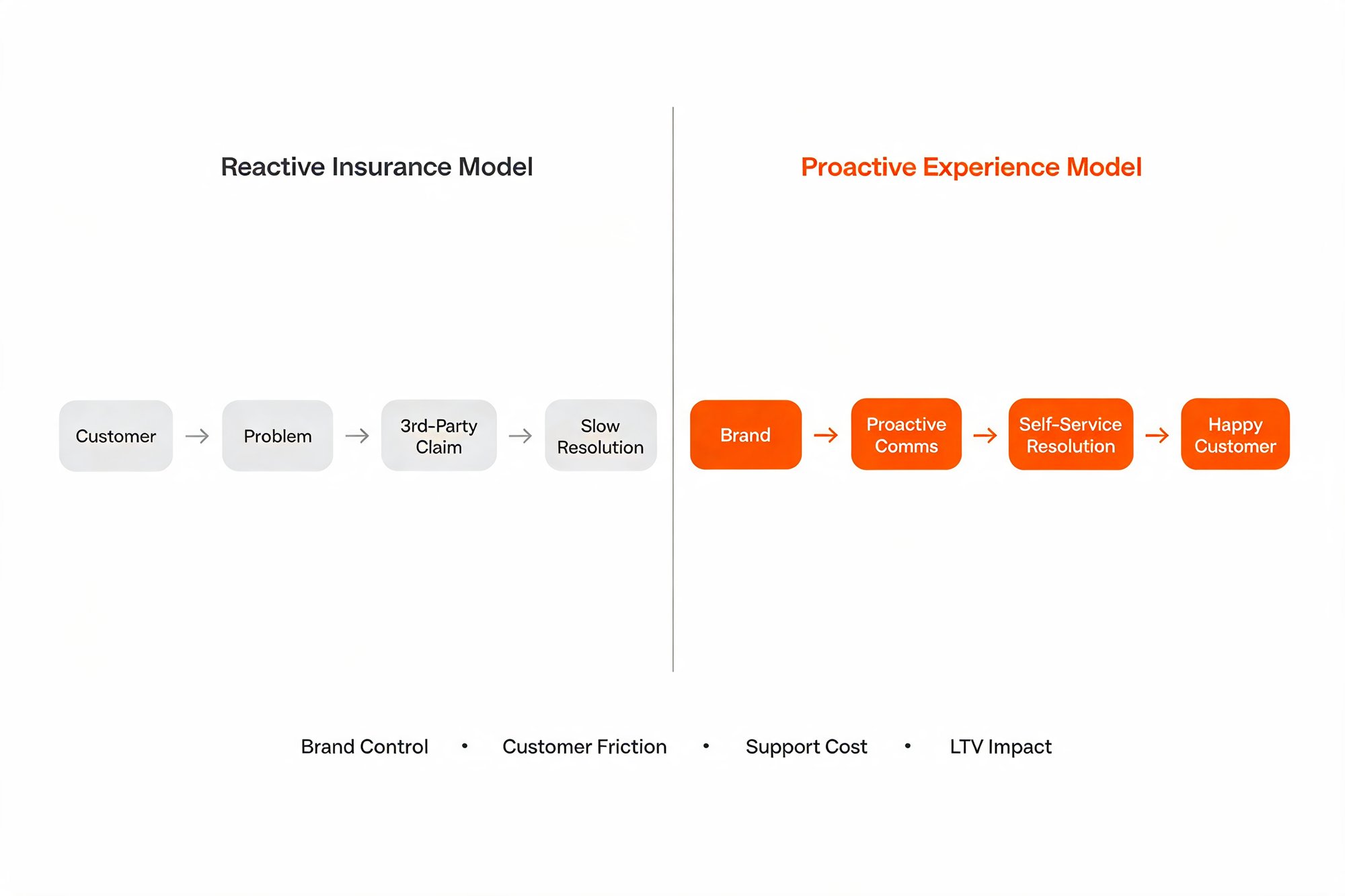
Reactive insurance reacts after the problem; the proactive experience model prevents it and keeps resolution on-brand.
Pillar 1: Deflect "Lost Package" Anxiety with Proactive Tracking
Most "lost package" claims are not really about lost packages. They are about lost visibility. The customer cannot see where their order is, assumes the worst, and acts on that assumption. Close the visibility gap and most of the anxiety never forms in the first place.
That is the entire job of proactive shipment tracking: replace silence with information before the customer goes looking for it. Four capabilities do that work, ranked here by how much of the "is my package lost?" moment each one intercepts.
1. Exception alerts (the highest-impact lever). Carrier delays, failed delivery attempts, and stuck shipments are flagged automatically, so your team can resolve exceptions before customers notice. This is the difference between you reaching out first and the customer reaching out angry.
2. AI estimated delivery dates (set the expectation up front). AfterShip's AI EDD covers 80%+ of deliveries with an accurate date, compared with under 40% for most carrier estimates, and is trained on 4.4B+ shipments, with accuracy up to 95%. A believable delivery date at checkout means fewer shoppers anxiously refreshing a tracking page a week later. Treat "up to 95%" as a ceiling, not a guarantee.
3. Proactive email and SMS notifications. Every status change (shipped, out for delivery, delayed, delivered) reaches the customer without anyone lifting a finger. The shopper stays informed, so the "where is my order?" question rarely gets typed.
4. A branded tracking page (the surface they actually visit). Customers return to a branded tracking page an average of 3.2 times per order. That is 3.2 chances to reassure them, on your domain and in your voice, rather than on a bare carrier page that does nothing for your brand.
Put together, these capabilities drive a result AfterShip reports across its base: a 65% reduction in WISMO tickets. The named outcomes back it up. Mous cut WISMO contacts by 54% and transit-related tickets by 82%. StackCommerce reduced WISMO 71% year over year while hitting 99% tracking visibility and 90% on-time delivery. Inspire Uplift saw WISMO drop 75%. And during a single peak week, Mejuri deflected more than 2,500 inquiries before they reached an agent.
Third-party reviewers describe the same pattern from the operator's seat.
The takeaway for Pillar 1 is direct: prevention starts before anything goes wrong, by trading uncertainty for information. That is a job insurance was never designed to do.
Pillar 2: Turn Shipping Mishaps into Loyalty with Self-Service Returns
Some packages really are lost, and some arrive damaged. Prevention shrinks that number; it does not zero it out. The question is what happens next, and a fast on-brand resolution beats an insurance claim every time.
Here is the difference in practice. An insurance claim sends your customer to a third party to prove a loss and wait for a check. An on-brand, self-service returns process keeps them with your brand and turns the mishap into a reason to come back.
AfterShip Returns supports a simple automation rule built for exactly this case:
- If the return reason is "Damaged in transit"
- Then offer a resolution (store credit or an exchange)
- And process the return on auto-approval
Store credit is supported, and you can attach an optional bonus to nudge shoppers toward an exchange over a refund, keeping the revenue inside your store instead of sending cash back out.
On photo evidence: a merchant can require the customer to upload damage photos as part of the return request, but the auto-approval rule itself does not gate on a built-in photo condition. If you want a human to review the photos before approval, that is a manual or holding step you add on top, not an automatic check living inside the rule.
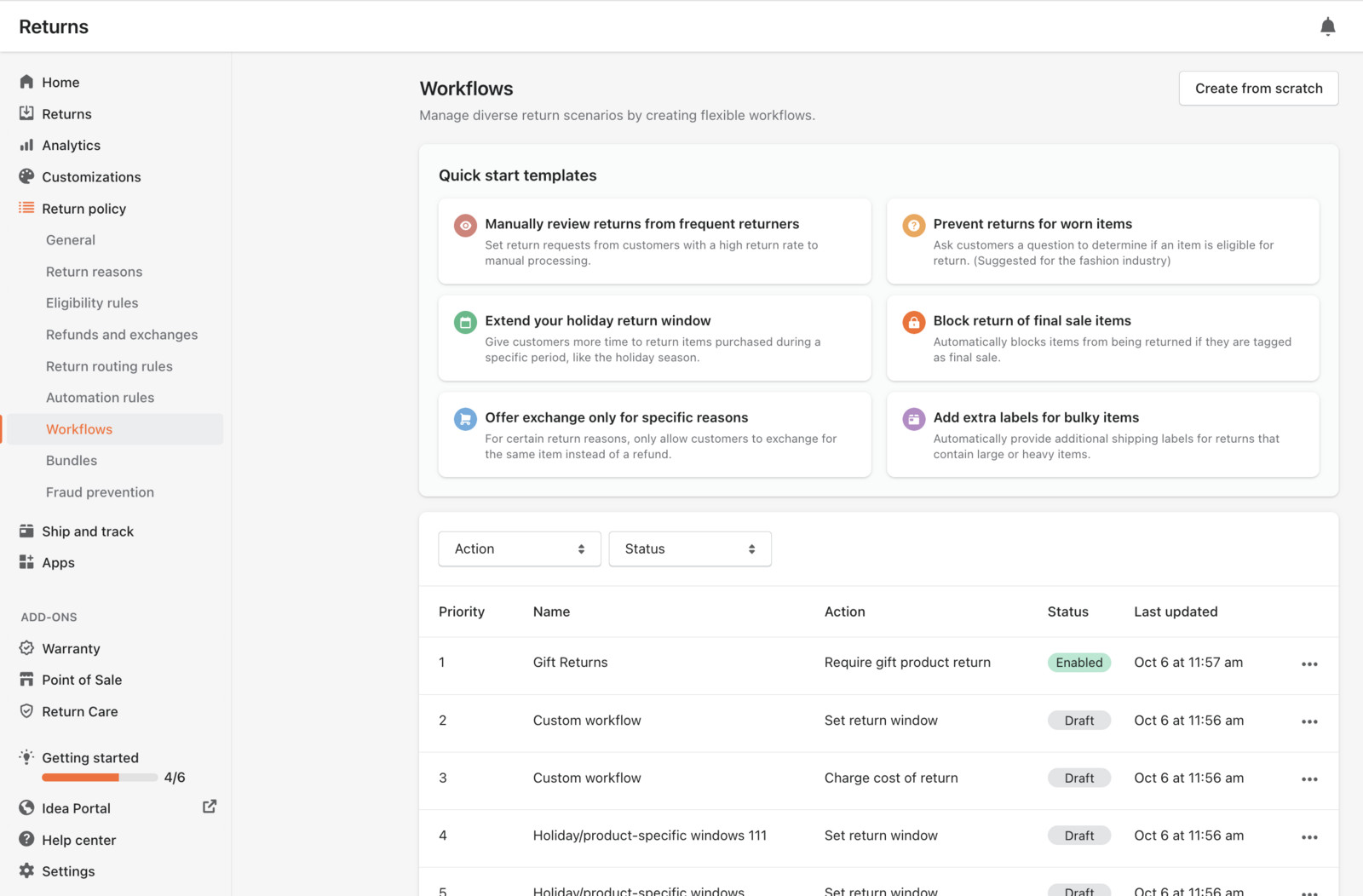
AfterShip Returns automates resolution with condition-based workflows and templates such as 'Offer exchange only for specific reasons,' which keeps revenue in-store (example workspace, sample data).
The payoff is revenue you would otherwise refund away. AfterShip reports 50% revenue retained with exchanges. The named results show the operational and revenue sides moving together: Marc Nolan cut time spent on returns by 97% and doubled its exchange-to-refund ratio; Fellow reduced resolution time by 52%; and Pelagic Gear lifted post-return purchases by 18% while trimming return-related tickets by 12%.
That is the second working part of the experience model. When a shipment fails, an on-brand self-service resolution recovers the revenue and the relationship in one motion, something a refund from a third party will never do.
How This System Stacks Up Against a Tool like Route
Route's strength is simplicity: one toggle, and a protection line appears at checkout. For brands that want an easy, one-size-fits-all protection solution, Route provides exactly that. What it lacks is scalability, and that is where this comparison really lives.
One framing note before the table. The like-for-like insurance product here is AfterShip Protection, covered in the next section. The bigger difference is what surrounds it: Route is a point insurance product, while AfterShip is a scalable post-purchase platform — tracking, returns, and protection on one data model — that grows with the brand instead of capping out at a checkout toggle.
AfterShip states on its Route comparison page that Route manages the customer experience and refunds the consumer directly, and that the process "does not require input from the brands, thereby removing their control." The toggle is easy precisely because there is nothing to configure — which also means no optimization, no tailoring, and no flexibility when your policies, carriers, or claim flows need it. The experience model is built to keep the brand in the loop and in control.
The two approaches diverge across the four criteria that matter most to a brand building for the long term. Claims about Route in the table below are drawn from Route's published policy pages and AfterShip's Route comparison page.
| Criteria | The AfterShip Experience Model | The Route Insurance Model |
|---|---|---|
| Brand control | Brand owns and controls the claims/resolution experience | Route manages the customer experience and refunds the consumer directly; per AfterShip's page, the process "does not require input from the brands, thereby removing their control" |
| Customer experience during a problem | Proactive comms, exceptions resolved before customers notice, on-brand self-service resolution (store credit or exchange) | Buyer files with Route; refund via PayPal (Route cannot refund the original payment method directly, per its published policy pages); police reports / notarized statements can be required |
| Long-term profitability | Retains revenue (50% via exchanges), lifts LTV/NPS (Aetrex NPS +141), cuts opex | Adds an incremental revenue stream but is a recurring insurance premium and outsourced resolution |
| Operational lift | More initial configuration; one platform, one data model afterward | One toggle to enable; denied/confusing claims still land back on your support team |
On who pays: that is a margin decision, not a brand one. Either you absorb the insurance premium or charge it at checkout — and when a claim goes sideways, the customer blames you, not the vendor processing it.
So, When Does Traditional Shipment Protection Make Sense?
Insurance still has a place. It just belongs behind the prevention layer, not in front of it, and only for specific cases. AfterShip Protection is best understood as a catastrophic-loss backstop, not the default answer to every shipping hiccup. What each option actually bills for that backstop is ranked in a pricing rank for shipping protection.
There are four situations where buying coverage is the right call:
- Very high-value orders. Protection insures up to $10,000 per order and pays out up to 120% of the protected value, enough to cover an expedited re-order.
- High-theft or porch-piracy regions. Stolen packages are covered, with no police report required.
- Fragile or damage-prone categories. Cosmetic damage is covered, which matters for goods that arrive dented or scratched.
- Brands that want a single-vendor stack. If you would rather run prevention and protection through one provider, having both on one platform is simpler to operate.
Here is what AfterShip publishes about the coverage itself:
- The published premium: AfterShip publishes two figures on two different pages — the Protection product page states about 1.5% of merchandise value, and the Protection pricing page states $1 per $100 of declared value. Check which one applies to your store before you model the cost; the base software plan is $0 per month.
- The published coverage terms: up to 120% of protected value, up to $10,000 per order, a 90-day claim window, and claims approved on average within about four days. InsureShield's data shows 95% of claims are approved, measured to March 2021.
- Who decides: claims are filed by the customer and adjudicated by InsureShield / UPS Capital, not by AfterShip.
If your order profile fits those gates, it is worth running the numbers to calculate the true ROI of insuring that slice of orders before you commit. Side by side, the coverage terms make the backstop case concrete.
| Criterion | AfterShip Protection | Route (per Route's published policies and AfterShip's comparison page) |
|---|---|---|
| Underwriting | Underwritten and adjudicated by InsureShield / UPS Capital, a licensed cargo insurer | Route |
| Insurance premium | ~1.5% of merchandise value (AfterShip Protection page); $1 per $100 of declared value (AfterShip Protection pricing page) | $0/month Standard (consumer-funded) or Custom pricing, per Route's pricing page; shopper premium rates are set by store-specific factors and "may be calibrated from time to time," per Route's help centre |
| Coverage of value | Up to 120% of protected value (offsets expedited re-order) | Merchandise value, excluding shipping/tax/premium/duties |
| Stolen-package police report | Not required | "Police report can be requested," notarized statements possible |
| Cosmetic damage (dents/scratches) | Covered | Excluded (Route may offer a 15–30% partial refund at its discretion) |
| Claim approval rate | InsureShield's data shows 95% of claims are approved (measured to March 2021) | Not publicly available |
| Refund method | Original payment method | PayPal (Route cannot refund the original payment method directly) |
| Per-order insured amount | Up to $10,000 | Not specified |
| Claim window | 90 days from delivery | 30 days from delivery (damaged/stolen) or last tracking update (lost), per Route's policies |
Use Protection for the orders that would genuinely hurt to lose, and let prevention handle the everyday noise.
Calculating the Real ROI: Beyond the Insurance Premium
Set an insurance premium against prevention and the math stops being close. An insurance premium is a recurring cost that scales with every order you ship. Prevention is an investment that pays back across three levers, and the returns compound.
The first lever is support cost. A 65% reduction in WISMO tickets takes real hours off your team every week, and those hours carry a fully loaded dollar value you can drop straight into a spreadsheet.
The second lever is retained revenue. AfterShip reports 50% revenue retained with exchanges, which means half the value of would-be refunds stays in your store when a self-service return offers an exchange or store credit instead of cash back.
The third lever is retention, and it is the one most teams underweight. The well-documented Bain principle holds that small gains in repeat-customer rate drive outsized gains in profit, because keeping a customer costs a fraction of winning a new one.
The economics of that last point are stark. SimplicityDX research found that merchants lose about $29 on every new customer they acquire, up from $9 in 2013 — a net loss on acquisition, not a cost-per-acquisition figure, while keeping an existing customer costs far less. Every churn you prevent is worth multiples of the insurance premium you were paying to insure the package that caused it.
Aetrex makes the whole argument concrete. Running AfterShip Tracking and Returns across more than 120,000 packages a year, it cut WISMO tickets by 74%, lowered post-purchase operating costs by 50%, reduced return processing time by 86%, and recorded a 141-point increase in returns NPS, per the published case study (an increase, not a score — NPS runs from -100 to 100). That is the return an insurance premium can never produce, because a premium only pays out after something has already gone wrong. What each provider does publish about its claims process is compared in what each provider publishes about claims.
Your 2026 Playbook for Reducing Shipping Protection Costs
Here is the short version, answered the way buyers actually ask it.
What is the best free alternative to shipping protection?
There is no genuinely free, serious alternative. AfterShip offers Free tiers on Tracking and Shipping, but a real prevention-first stack (branded tracking, AI EDD, returns automation) is a paid investment in infrastructure. The point is not "free," it is that prevention lowers total cost more than a recurring insurance premium.
How can I self-insure my packages?
Self-insuring means absorbing losses yourself instead of paying an insurance premium, which works once prevention shrinks the incident rate. The practical version: use proactive tracking and AI delivery dates to cut "where is my order" moments by up to 65%, resolve real mishaps with self-service returns (store credit or exchange), and keep insurance (AfterShip Protection) only for high-value, high-theft, or damage-prone orders.
Is AfterShip's approach cheaper than Route?
For most brands, prevention reduces the volume of incidents an insurance premium would otherwise cover. Where you do use insurance, AfterShip's Protection page states a premium of about 1.5% of merchandise value and its Protection pricing page states $1 per $100 of declared value, while Route's pricing page lists a $0/month consumer-funded Standard plan plus a Custom option, with shopper premium rates set by store-specific factors and recalibrated from time to time, per Route's help centre. AfterShip's coverage pays up to 120% of protected value and requires no police report for stolen packages. Beyond price, you keep brand control of the claims experience. Onward's VIP proposition sits in the same bracket, and DTC brands have reviewed both, which we collect in honest reviews of Onward VIP Protection.
Does better tracking actually reduce claims?
AfterShip does not publish a specific "fewer claims" percentage, so treat the effect as structural rather than a promised number. The mechanism is measurable upstream: because a lost-package claim, a chargeback, and a WISMO ticket all start when a customer believes a package is lost, cutting the first shrinks the pool that ever reaches the claim stage. That upstream metric is published — a 65% reduction in WISMO tickets, with exceptions resolved before customers notice.
Ready to build a prevention-first post-purchase experience? Book a demo to see how AfterShip Tracking and Returns work together.