Your CFO wants shipping costs down, and you have been asked to find the platform that gets them there. At 15,000 orders a month, the software line is rarely what moves the total. What moves it is which carrier each label goes to, how much of that choice runs on rules and data, and whether a regional carrier you rely on is supported.
The pressure is industry-wide. A February 2026 BCG report on parcel carriers and large shippers in Europe and North America found that "nine in ten shippers and carriers now cite cost reduction as their top challenge".
Veeqo fits brands whose business runs through Amazon. AfterShip Shipping is the choice when every label decision should be made on delivery data.

Is Veeqo Really Free for Mid-Market Retailers? A TCO Breakdown
What does "free" shipping software cost a brand shipping about 15,000 orders a month? The cost breakdown of Veeqo shipping at that volume comes down to three documented points.
1. The software is funded by labels. Veeqo's shipping software has no subscription. Veeqo's pricing page states, "We make a small commission on labels purchased through Veeqo", without publishing its size. So the real comparison is Veeqo's label rates against your own contract rates, and it helps to know how to compare ecommerce shipping rates effectively before you start.
2. The features a mid-market brand typically adds sit on a paid plan. NetSuite, API support and an account manager are on Veeqo's High Volume plan, a monthly OPEX line priced by order volume.
3. Carrier choice is a check you run. List every carrier you ship with, including the regionals you rely on, and confirm each one on each platform's carrier list. AfterShip Shipping supports regional carriers such as OnTrac and GLS US. The Veeqo limitations for mid-market retailers that matter are plan-level and carrier-list questions, so test them line by line.
Before you shortlist, run a week of your own parcels through both platforms' rate screens. Use real weights, dimensional weight, zones and the regional carriers you depend on. That sample shows your label economics for your actual carrier mix.
Rate & Carrier Analysis: Veeqo vs. AfterShip Shipping
A useful Veeqo shipping rates comparison starts from the seven criteria below. If more than two vendors are on your list, start with this comprehensive comparison of multi-carrier shipping software. USPS shows why carrier mix matters: in November 2025 it filed 2026 price changes, scheduled to take effect 18 January 2026, that would raise USPS Ground Advantage prices approximately "7.8 percent".
| Criteria | AfterShip Shipping | Veeqo |
|---|---|---|
| Carrier Integrations | Named carrier integrations with label generation and real-time rates, including regional carriers GLS US (for example GLS US Early Priority Overnight) and OnTrac; check your own carriers on its carrier list. | Its own rates with Amazon Shipping, UPS, USPS, FedEx, DHL and OnTrac, and DHL Express International. |
| Bring Your Own Carrier (BYOC) Support | Your own carrier accounts (1 on Free and Essentials, 5 on Pro, unlimited on Enterprise; a one-cent fee per label, and the carrier bills you directly), alongside discounted labels on Essentials and above, with Smart Carrier Recommendation, available on every plan, to choose among connected services. | Your own UPS and OnTrac accounts in the US. |
| Automation Rules | On Pro and Enterprise; up to 10 rules below Enterprise; conditions include SKU and ship-to postal code; actions include setting the carrier service and the ship-from location. | Rules with grouped conditions on its free Shipping plan. |
| API Rate Limits & WMS/ERP Integration Support | 10 requests per second from Pro, a custom limit on Enterprise and webhooks on Pro and Enterprise; no ERP connector documented for Shipping (AfterShip's NetSuite integration connects AfterShip Tracking and AfterShip Returns). | 5 requests per second with a burst of 100; NetSuite on High Volume (orders download every 10 minutes; inventory is not synced). |
| Multi-Warehouse Routing Logic | Multiple ship-from locations and orders split by location on all plans; Pro rules can set the ship-from location. | Allocation to the nearest location with stock, on its free plan. |
| Software Cost at 15,000 Shipments/Month, before operating overhead (carrier choice per lane, rule and API capacity, exception handling) | Pro: $359 a month billed monthly at 15,000 labels a month, or $299 a month billed annually at 180,000 labels a year; Essentials stops at 5,000 labels a month; Enterprise: custom; AfterShip Tracking, a separate product: Custom at this volume. | Shipping plan: no subscription (Veeqo earns a commission on labels sold); High Volume, where NetSuite, API support and an account manager sit: $575 to $1,250 a month billed monthly for 10,001 to 25,000 orders a month. |
| Carrier Performance Analytics | Smart Carrier Recommendation (AfterShip Shipping, all plans) excludes high-exception services per lane using AfterShip's own delivery data; AfterShip Tracking shows on-time and exception performance, with dashboards from Essentials and carrier, lane, SKU and destination views on Premium and Enterprise. | Label count and cost by carrier. |
Rosie Jennings, Head of Logistics at Mous, on running carrier decisions on data: "AfterShip has enabled us to have visibility into our data to measure performance and make decisions."
Scaling Past 10,000 Shipments a Month: What Each Platform Documents
Past 10,000 orders a month, rules, system connections, warehouse routing and API capacity start carrying the load. Check shipping automation software for mid-market retailers on those four, plan by plan.
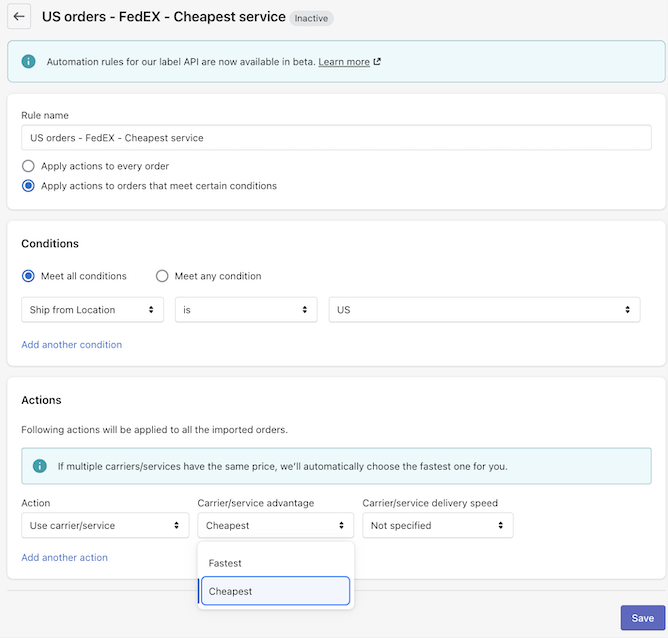
- Automation rules. Both platforms run conditional rules. Veeqo includes rules with grouped conditions, for example product tag and allocation warehouse, on its free Shipping plan. AfterShip Shipping rules sit on Pro and Enterprise, with up to 10 rules below Enterprise, conditions including SKU and postal code, and an action that sets the ship-from location. At this volume, Veeqo includes more here.
- ERP. Veeqo sells a NetSuite connection on its High Volume plan: orders download every 10 minutes, and inventory is not synced. AfterShip's NetSuite integration connects AfterShip Tracking and AfterShip Returns, which are separate products, and AfterShip documents no ERP connector for AfterShip Shipping. Acumatica is documented on neither.
- Multi-warehouse routing. Both route orders across locations. Veeqo allocates each order to the nearest location with stock on its free plan. AfterShip Shipping supports multiple ship-from locations and splits orders by location on all plans, and Pro rules can set the ship-from location.
- API. Veeqo publishes 5 requests per second with a burst of 100. AfterShip Shipping publishes 10 requests per second from Pro and a custom limit on Enterprise, with webhooks on Pro and Enterprise. That is twice Veeqo's published per-second rate.
For a wider market view, see a complete ranking of top shipping software. At this volume, though, the larger lever is the carrier choice behind each label.
Beyond the Label: Connecting Shipping Ops to Carrier Performance Data
Every label raises two carrier questions: which service it should go to, and whether that choice held up by next quarter.
AfterShip Shipping's Smart Carrier Recommendation, available on all plans, answers the first question from AfterShip's own delivery data per lane. It excludes services with a high exception rate for the shipment's origin and destination. The feature is off by default, and you can change every recommendation before you buy the label.
AfterShip Tracking, a separate product, answers the second. AfterShip Tracking reports on-time and exception performance by carrier and lane. Shipping labels sync to it when they are created. Its out-of-the-box dashboards cover shipment volume, on-time performance and exception rates from the Essentials plan, and Premium and Enterprise add custom views by carrier, lane, SKU or destination.
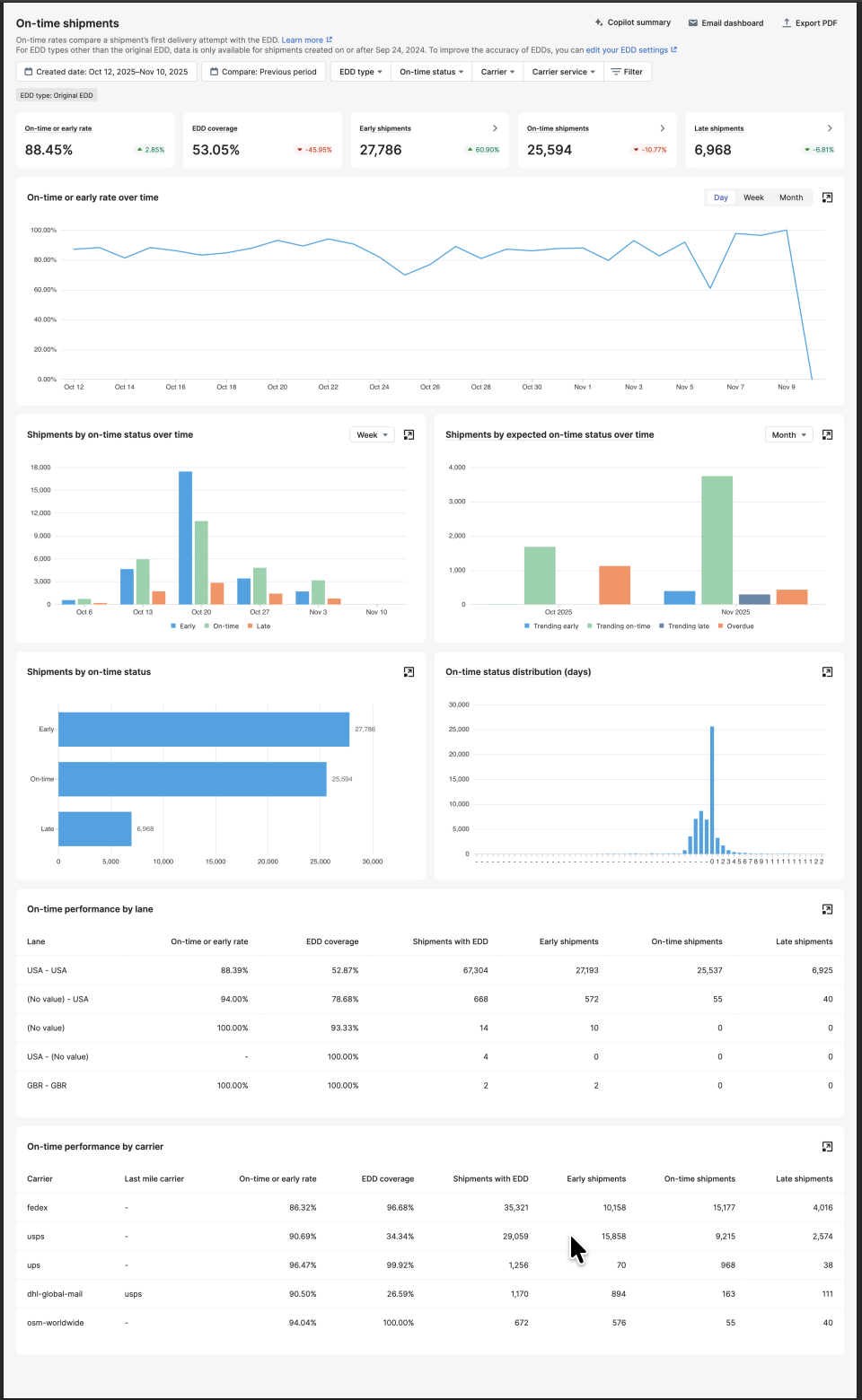
Side by side, AfterShip recommends the service for each lane from delivery data and tracks how each carrier performs on it afterwards, while Veeqo's reports cover label count and cost by carrier.
Using AfterShip Tracking, Mous compared carrier performance, switched carriers and "reduced lead times within Canada by an enormous 82%". Moda Operandi, also on AfterShip Tracking, reported "25% reduced shipment exceptions".
The 2026 Verdict: Your Recommendation for the CFO
Your call turns on where orders originate and how labels get decided.
Choose Veeqo if...
- Your business runs through Amazon: most orders are Amazon orders, where Veeqo's OTDR-protected labels apply, or you fulfill through FBA, excluded from Veeqo's billed volume.
- Your carriers are all on Veeqo's list, and your rules fit its Shipping plan.
Choose AfterShip if...
- You want each label's service filtered by lane exception rate, from AfterShip's own delivery data.
- Your regional carriers are on AfterShip Shipping's carrier list, with label generation and real-time rates; GLS US and OnTrac are among them.
- Your systems call the shipping API at volume and need the higher published rate limit, with a custom limit on Enterprise.
- You want a published price at your label volume, with its billing term.
- You want on-time and exception trends by carrier and lane in AfterShip Tracking (Premium and Enterprise) to hold carriers to SLAs.
When performance, complexity, analytics and economics start to matter, AfterShip is the specialist choice.
Veeqo's Shipping plan has no subscription at any volume. Veeqo says it earns a small commission on the labels it sells. At 15,000 labels a month, AfterShip Shipping is a paid plan. What the label price does not show is carrier flexibility per lane, automation depth and analytics. AfterShip Shipping, with AfterShip Tracking, runs each label decision on delivery data.
Frequently Asked Questions
Is Veeqo really free?
Veeqo's shipping software is free; Veeqo earns a commission on labels. Veeqo describes that commission as small but does not publish its size, so the comparison that matters is Veeqo's label rates against your own contract rates. NetSuite, API support and an account manager sit on its High Volume plan, which is billed monthly and priced by order volume. AfterShip Shipping publishes its price by label volume, with its billing term.
How do Veeqo and AfterShip Shipping compare on rates?
Both let you ship on negotiated carrier rates and connect your own carrier accounts. AfterShip Shipping supports your own carrier accounts on every plan, with the carrier billing you directly, alongside discounted labels from Essentials up. Neither publishes a per-label comparison, so run a sample of your own parcels through both rate screens. AfterShip Shipping's Smart Carrier Recommendation also excludes high-exception services on each lane.
How do their API limits compare?
Veeqo publishes 5 requests per second with a burst of 100. AfterShip Shipping publishes 10 requests per second from Pro and a custom limit on Enterprise, with webhooks on Pro and Enterprise. The per-second rate matters most when your order or warehouse system creates labels through the API at volume, so check the load your busiest hour produces. For that system-driven shipping, the higher published sustained rate belongs to AfterShip Shipping.
What should a mid-market brand check before choosing?
Check three things. First, confirm every carrier you use, regionals included, on each platform's carrier list. Second, find the plan each capability you need sits on, such as rules, NetSuite and analytics. Third, decide whether you need on-time and exception performance by carrier and lane, which AfterShip Tracking reports alongside AfterShip Shipping.
See how AfterShip Shipping recommends a carrier service per lane from delivery data.
Book a demo of AfterShip Shipping