The Real Challenge for Shopify Plus Returns Isn't the Portal, It's the Logic
Your returns portal looks great, but is your returns logic costing you money? For Shopify Plus brands, the real cost of returns isn't in the customer interface, it's in the operational complexity behind it. Let's break down which platform actually solves for scale. If the question is which returns flow feels smoothest to the shopper, we rank that separately in the smoothest returns flow for a DTC shopper.
Start with the stakes. The NRF's 2025 Retail Returns Landscape estimated that 19.3% of online sales would be returned in 2025, so roughly one in five orders comes back to your warehouse. At 10,000 to 50,000 orders a month, that is a logistics operation, not a support queue.
A polished self-service portal is table stakes now. Every serious platform ships one. The decisions that actually move your cost per return sit upstream of the shopper: how a return routes to the right warehouse, which carrier prints the label, when a refund clears, and whether an exchange holds the revenue instead of giving it back. Get that logic wrong and every return leaks margin twice, once on the reverse label and again on a refund you could have kept as an exchange. Multiply that leak across one in five orders and the gap between platforms stops being a feature debate and becomes a line on your P&L.
That is the lens for any AfterShip vs Loop vs Narvar decision. Three platforms dominate the Shopify Plus returns platform shortlist, and each leads with a different strength. Loop is the Shopify-native returns specialist built around exchanges. Narvar is the legacy enterprise suite with a Tier-1 brand roster. AfterShip is the post-purchase platform that runs returns on the same data layer as tracking and shipping.
If a peak-season returns spike just broke your semi-manual process, the question isn't which portal looks best. It's which of these platforms lets you scale returns without scaling headcount.
The 60-Second Verdict: Who to Choose and Why
For the exec skimming this in a hallway, here is the call before the evidence.
- Best for Shopify-only, exchange-first brands: Loop.
- Best for legacy enterprises with custom, quote-driven requirements: Narvar.
- Best for scalable, multi-platform operations: AfterShip.
| Criteria | AfterShip | Loop Returns | Narvar |
|---|---|---|---|
| Portal & Exchange | Any-product exchange via Shop Now (Premium); bonus store credit incentives; ~50% revenue retained | Shop Now plus Instant Exchange (Advanced) | Enterprise exchange flows |
| Automation & Logic | Condition-and-action engine: warehouse routing, Green Returns, VIP auto-approve; auto-refund and Return Fraud Management (Premium); Returns API and webhooks (Premium) | Fraud Tools 2.0 (Spring 2026) | Shield (March 25, 2025) plus IRIS AI |
| Carrier & Logistics | 70-carrier return label pool (3 connected carriers on Essentials, 5 on Premium, unlimited on Enterprise), pre-negotiated rates on every tier; more than 9,000 Happy Returns Return Bars and 300K+ global drop-offs; native two-way ShipBob and ShipHero | Return labels via merchant/partner carrier accounts plus Ship by Loop (built on EasyPost) | Bring-your-own carrier accounts; legacy concierge in-store drop-off network |
| Platform Ecosystem | Tracking, Returns, Shipping, and Intelligence on one shared data layer | Returns plus Wonderment tracking (still integrating) | Tracking-heavy enterprise suite |
| Total Cost of Ownership | Essentials $16/mo, Premium $99/mo; Enterprise custom; 18% annual discount | Essential from $155/mo, Advanced from $340/mo on an annual contract; Enterprise on request; plus Stripe 2.9% + $0.30 on upsells | Quote-only |
A brand processing 5,000 returns a month, 60,000 a year, will feel each of these differences in its operating budget. The rest of this article shows the operational reasoning behind that verdict, one factor at a time.
Factor 1: The End-Customer Experience (Portal & Exchanges)
On the storefront, all three deliver a clean branded portal; the real separation shows up in how each handles exchanges. Each platform gives you a fully brandable self-service portal with custom domains, templates, and automatic labels, so treat the front-end look as parity and judge the exchange engine instead.
Here is the honest concession. Loop's Advanced tier includes Instant Exchange, which ships the replacement before the original is received, paired with its Shop Now flow that lets shoppers browse the full catalog. For a Shopify-only brand whose entire retention play is exchanges, that instant-exchange flow is a real strength. How AfterShip's exchange flow handles that same step is worth checking directly; a dedicated AfterShip vs. Loop Returns comparison breaks the exchange features down side by side.
What AfterShip trades for that is range, plus the automation sitting behind it:
- Any-product exchange through Shop Now on the Premium tier, so shoppers can swap for anything in the catalog, not just the same item in another variant.
- Bonus store credit incentives, to nudge shoppers toward credit over a cash refund.
- Around 50% of revenue retained on exchanges, because a held exchange is revenue you never refunded.
For a catalog brand, that range often matters more than the instant-exchange trick. A shopper who can swap a sold-out hoodie for anything you sell is a shopper you keep, not refund, and that holds whether or not the replacement ships a day sooner.
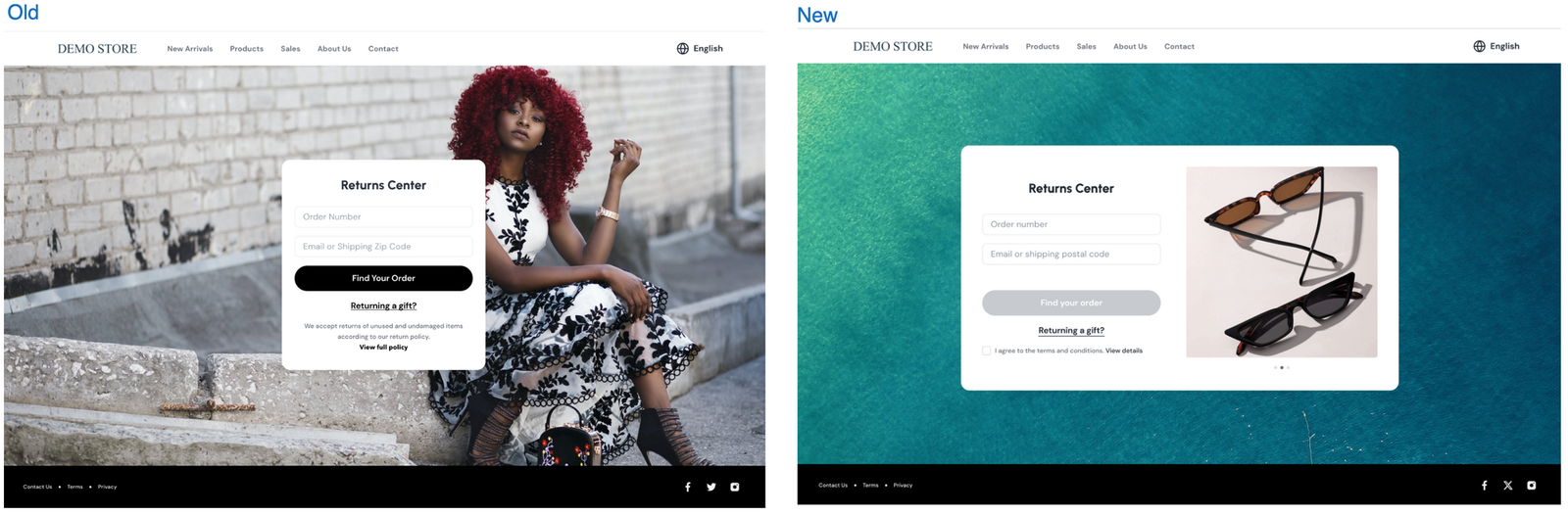
Narvar covers exchanges too, though its return-and-exchange capabilities sit inside a quote-based enterprise package rather than a self-serve tier you can turn on this week.
So the storefront trade is narrow and clear. Loop wins the single trick of putting a replacement in the mail before the return lands. AfterShip wins on exchange range and on the automation that decides what happens next, which is exactly where the cost-per-return math gets settled in Factor 2.
Factor 2: The Automation Engine (Rules, Routing & Refunds)
This is where AfterShip pulls ahead, because its returns automation is a configurable condition-and-action rule engine, not a fixed workflow you have to live inside. You set a condition (a product tag, a customer tag, a return reason, an item value) and attach an action (route it, refund it, credit it, or flag it). For an operations team, that is the difference between a tool that processes returns and one that runs your returns policy for you.
Four flagship rules cover the scenarios a scaling Shopify Plus brand hits first, and each is a native packaged option rather than a custom build:
- Route returns to different warehouses by product tag, so oversized or regional SKUs go to the right dock.
- Issue store credit for low-value items through Green Returns, so a $7 item never costs you a $9 reverse label.
- Auto-approve returns for VIPs with a customer-tag condition, so your best buyers skip the queue.
- Flag high-risk shoppers with Return Fraud Management before a refund goes out. Premium tier and up.
Two more actions matter for headcount. Auto-refund and auto-mark-received both unlock at Premium, which is what lets a return close itself once the carrier scans it. The Returns API, for teams wiring returns into their own systems, sits at Premium.
Here is the contrast that decides total cost. Loop and Narvar both sell fraud as a dedicated, AI-branded product: Loop's Fraud Tools 2.0 is slated for Spring 2026, and Narvar launched Shield, its AI returns and fraud product, on March 25, 2025. AfterShip takes the other path and ships fraud control as one more rule inside the Premium engine, alongside routing, credit, and approval logic. You configure one system instead of stitching together a returns tool and a separate fraud tool.
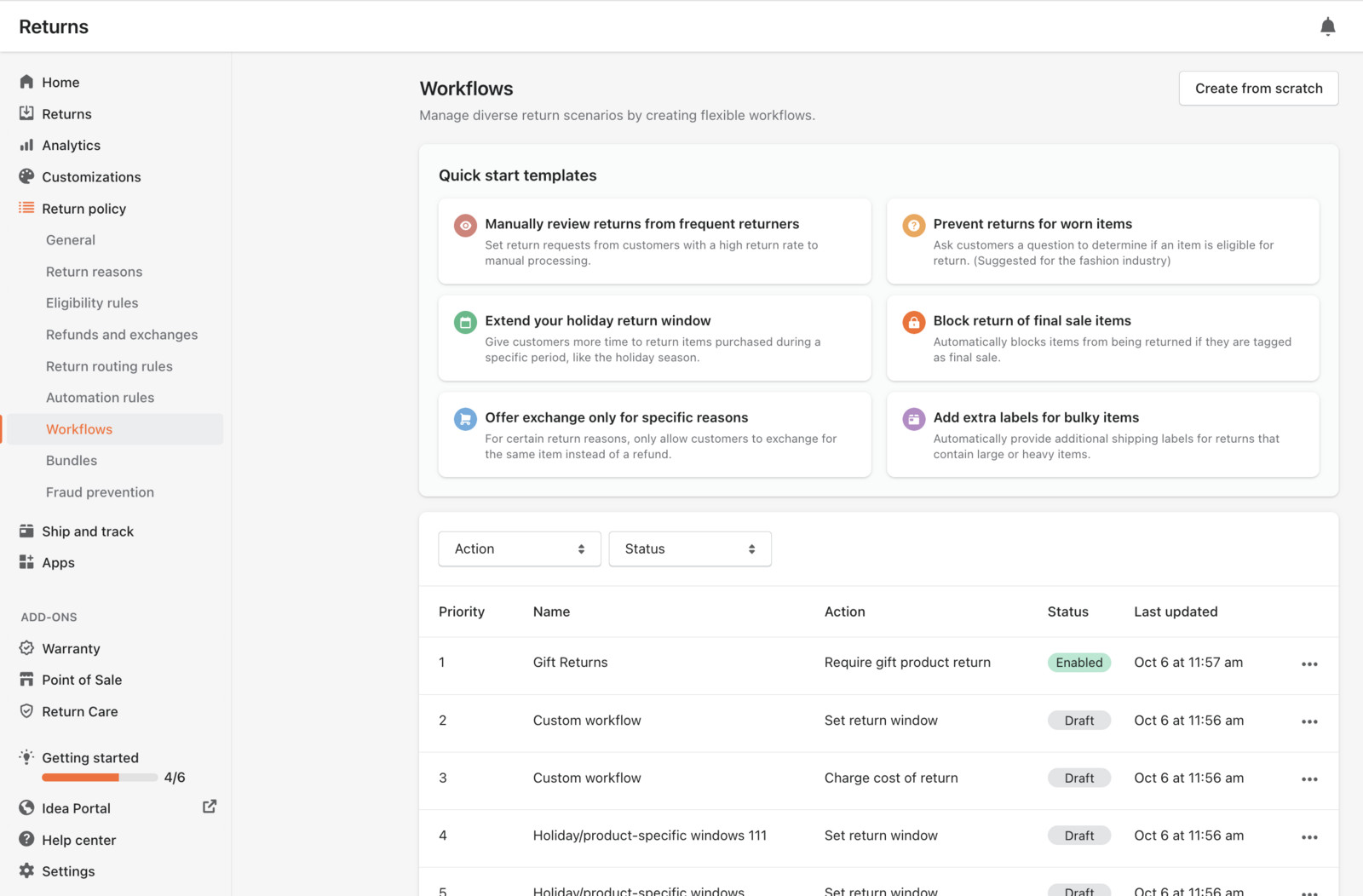
This is also the layer Shopify Plus operators increasingly treat as core infrastructure rather than a nice-to-have, especially when it plugs into their store through a native Shopify integration.
The takeaway for an ops leader is simple. The more of your policy you can encode as rules, the less each return costs in manual review, and AfterShip gives you the most policy surface of the three to work with.
Factor 3: Logistics & Carrier Network (The Ops Deep Dive)
On reverse logistics, AfterShip Returns gives you the widest ready-to-use label network of the three without forcing you to bring your own carriers. Returns generate labels across a 70-carrier return label pool.
Coverage scales with your tier. Connected carriers are entitled at 3 on Essentials, 5 on Premium, and unlimited on Enterprise, and pre-negotiated rates are bundled on every tier. If you already hold your own carrier contracts, you can bring them with no per-shipment fee.
For shoppers, the drop-off footprint is the part they feel. AfterShip Returns plugs into more than 9,000 Happy Returns Return Bars across the US, plus 300K+ global drop-off points, so box-free, label-free returns work without you building the network.
Behind the warehouse door, the 3PL story separates a platform from a portal. AfterShip runs native two-way integrations with ShipBob and ShipHero that handle RMA creation, ASN, receipt, and restock end to end. Every other 3PL or WMS connects through the Returns API or webhooks, both available from Premium up.
The competitors take a more bring-your-own approach. Loop generates return labels through merchant and partner carrier accounts plus Ship by Loop, its shipping layer built on EasyPost. Narvar requires you to supply your own carrier accounts and leans on a legacy concierge in-store drop-off network for physical returns. Both work, and both put more of the carrier setup and cost on your team.
One number to keep straight: AfterShip's often-quoted 1,700+ carrier figure belongs to its Tracking product, not Returns. For reverse labels, the number that matters is the 70-carrier Returns label pool with rates already negotiated.
For a brand shipping internationally, that combination is the quiet advantage. A wide auto-label pool with bundled rates on every tier means international returns get cheaper and simpler without a separate carrier procurement project, which is exactly the operational drag that breaks a manual process at peak.
Factor 4: The Platform Play vs. The Point Solution
Step back from returns for a moment, because the bigger question is whether returns should stand alone at all. The real decision here is architectural.
On AfterShip, Returns reads the same shipment data layer as Tracking, because both run on a unified post-purchase platform. That means you can cross-tabulate return reasons against carrier and delivery performance, and see, for example, that a SKU's return rate spikes only when it ships late on one carrier. You fix the carrier instead of eating the return. A point returns tool cannot see that pattern; it only knows the return happened. Over a quarter, that connection turns returns analytics into a lever for cutting the return rate, not just a monthly report on it.
The competitors approach this from different starting points. Loop pairs its returns product with Wonderment, the tracking tool it acquired in 2024 and is still integrating into one platform. Narvar offers a tracking-heavy enterprise suite of discrete products. Both can report on returns and on tracking, but neither yet reads them off a single shared layer the way AfterShip does. For an operations team, that gap is the difference between two dashboards you reconcile by hand and one view that already connects the dots.
A multi-brand DTC operator running both AfterShip Tracking and Returns shows what that consolidation is worth. Internet Up raised net revenue by 10% after unifying tracking and returns on AfterShip, while recapturing more than six operational hours a week.
“Both tools have greatly improved the transparency and efficiency of our delivery and return processes.”
Gerald Bancilhon, Head of Customer Experience & Operations
Read their story →For an ops leader, that is the platform argument in one line: a return is also a data point, and it is worth more when the rest of your post-purchase stack can read it.
The Final Verdict for Shopify Plus in 2026
Here is the call, stated plainly: for scalable Shopify Plus operations, AfterShip. Loop is for Shopify purists who live and die by exchanges. Narvar is for Fortune 500s with deep pockets and legacy systems to match. AfterShip is the strategic, scalable choice for ambitious Shopify Plus brands that need operational power, platform flexibility, and a clear path to ROI. That recommendation tracks with how merchants score the product: AfterShip Returns holds 4.7 out of 5 across 1,540 Shopify App Store reviews. Comparing just the other two head-on gives a different read, which we publish as the two-way verdict for Shopify Plus brands.
Time-to-value seals it. AfterShip Enterprise onboarding comes with a dedicated Solutions Architect who owns the build with you. For a team that has to put a recommendation on the VP's desk this quarter, that hands-on support is not a detail. And because returns, tracking, and shipping sit on one contract and one data layer, the platform you recommend keeps paying off as you add channels or warehouses, instead of becoming the next migration project two years from now.
Returns automation that enhances the returns and exchanges experience, reduces costs, and retains more revenue.
Book a demoFrequently Asked Questions
Does AfterShip Returns integrate with Shopify Flow?
Not through a native Flow connector; none is surfaced in public documentation today. AfterShip Returns instead connects into Shopify Plus workflows through return webhooks and the Returns API on the Premium tier, which cover the same automation triggers most Flow builds target.
How does pricing compare at 5,000 returns a month?
At 5,000 returns a month, 60,000 a year, you are past every self-serve tier, so all three are quoted rather than self-serve, and none of them publishes a number at that volume. Budget from your own quotes, and note that Loop adds Stripe fees of 2.9% plus $0.30 on each exchange upsell, while AfterShip Enterprise puts returns, tracking, and shipping on one contract.
Which platform is best for international returns?
AfterShip, on the strength of its 70-carrier Returns label pool. The major international carriers are auto-label supported, and pre-negotiated rates are bundled on every tier, so cross-border returns get cheaper without you sourcing carriers market by market.