AfterShip vs. Malomo: The 30-Second Verdict for Shopify Brands
Your default Shopify tracking page is costing you customers, and you know it. You have narrowed it down to two top contenders: AfterShip and Malomo. But are you choosing a quick fix or a long-term growth platform, and does it matter that Malomo is now part of Redo? Let's break down which is right for your brand's ambitions in 2026.
Here is the honest answer before the deep dive. Malomo is a marketing-focused branded tracking page that, since early 2026, has operated as part of Redo — a returns, shipping, and tracking platform. AfterShip is an independent post-purchase specialist that runs tracking, returns, shipping, and AI delivery estimates on one shared data layer, backed by 13+ years of tracking data, and connects to the tools that already work seamlessly with your Shopify store.
Who wins depends on what you are actually buying:
- Best for a complete post-purchase suite: AfterShip. Tracking, returns, shipping, and AI delivery estimates run on one shared data layer, one admin, and one customer record.
- Best for brands that will add returns within a year: AfterShip. Returns are native, not a second vendor bolted on.
- Best for roadmap stability: AfterShip. Its roadmap is set by a post-purchase specialist with 20,000+ paying customers and 13+ years focused on tracking, not by a broader returns-and-shipping parent for which tracking is one line among many.
Why Your Shopify Store Needs More Than Just a Tracking Page
Native Shopify notifications stop at "order confirmed" and "order shipped." Everything between dispatch and doorstep is silent, and that silence is where your customers start emailing you. The result is a support queue drowning in "Where is my order?" (WISMO) tickets.
The volume is not a rounding error. WISMO accounts for an estimated 30% to 50% of DTC support contacts, at a fully loaded cost of roughly $5 to $15 per ticket, according to Ringly.io WISMO analysis citing the Gorgias 2024 ecommerce CX report and Help Scout 2024 benchmarks.
At 1,000 orders a month, that is real money and real hours your team is not spending on growth. It also drags on lifetime value: the post-purchase window is the moment a first-time buyer decides whether to come back, and a confusing delivery experience quietly erodes repeat-purchase rate.
A proactive branded tracking page changes the math, but the size of the change depends on how much of the journey you automate. On AfterShip Tracking with a branded page and proactive notifications, StackCommerce cut WISMO 71% year over year, Inspire Uplift 75%, Mous 54%, and Vivino 50%. And when a brand unifies tracking and returns on one platform, the lift compounds, as Aetrex's 74% reduction shows (Aetrex runs on Salesforce Commerce Cloud, not Shopify). With Narvar added as a third name, the ticket-volume comparison is in the platform that removes the most tickets.
That gap is the heart of the AfterShip vs. Malomo decision: a tracking page is a feature, but reducing WISMO and protecting LTV at scale is a data problem — and data is where a specialist pulls ahead.
Head-to-Head Comparison: AfterShip vs. Malomo At a Glance
Before the deep dive, here is the feature picture for a Shopify DTC brand, scored on the criteria that shape a buying decision — from the branded-page essentials where both tools genuinely compete, to the tracking depth, delivery-prediction accuracy, and data foundation that separate a specialist from a generalist.
| Criteria | AfterShip | Malomo (now part of Redo) |
|---|---|---|
| Branded tracking page | Yes, native. Drag-and-drop editor, custom CSS, product recommendations, AI EDD widget, multilingual pages; multiple branded pages and custom domain on Premium and above. | Yes, native. Shopify-strong, marketing and upsell modules, deep Klaviyo, fast setup. |
| Carrier support (tracking) | 1,700+ carriers, backed by 13+ years of normalized tracking data. | Malomo's own carrier page lists 75+ standard carriers (its Standard Carrier Network), plus an add-on Extended Carrier Network its help centre describes as 1,000+ regional and international carriers. Malomo documents that estimated delivery dates are not shown for Extended Carrier Network shipments. |
| Proactive notifications | Email, SMS, and Apple Wallet; multi-channel triggers spanning dispatch, delay, exception, and out-for-delivery events, plus Klaviyo flows. | Email and SMS via Klaviyo flows; marketing-led. |
| AI EDD (delivery prediction) | Yes, native. 80%+ delivery coverage versus under 40% for most carriers — more than double; up to 95% EDD prediction accuracy; built on 13+ years of tracking data and over 4.4 billion shipments. | No comparable AI delivery-prediction engine. |
| Returns management | Yes, native. Same data layer as Tracking — one customer record. Self-service portal, exchanges, store credit, fraud detection, automation rules, and auto shipping label generation with 70 carriers worldwide. | Available through parent Redo's returns product (a Redo core strength); not part of Malomo's tracking module itself. |
| Scalability and platform | One independent platform, one shared data layer (Tracking, Returns, Shipping, AI EDD). 20,000+ paying customers; ~13 years specializing in post-purchase tracking. | Tracking module within the broader Redo platform; the roadmap now follows Redo's priorities across returns, shipping, and tracking. |
Read top to bottom, the table tells a simple story. The two are close on the branded page itself, but AfterShip pulls ahead on the tracking fundamentals — carrier depth, AI delivery prediction, and the 13+ years of data behind them — that a specialist compounds over time.
Deep Dive: Branded Experience & Customer Communication
A branded tracking page is where both tools first earn their keep, and both deliver one. The difference shows up in how far you can push the page and what it does once a shopper lands on it.
AfterShip's branded tracking pages give you a drag-and-drop editor with custom CSS, product recommendations, multilingual and multiple branded pages, and a custom domain. Multilingual pages ship from Essentials; the AI delivery-estimate widget, multiple pages, and custom domain sit on Premium and above. On the page itself you can surface an estimated delivery date and cross-sell modules, then back it with multi-channel notifications across Email, SMS, Apple Wallet, and Klaviyo, covering dispatch, delay, exception, and out-for-delivery events.
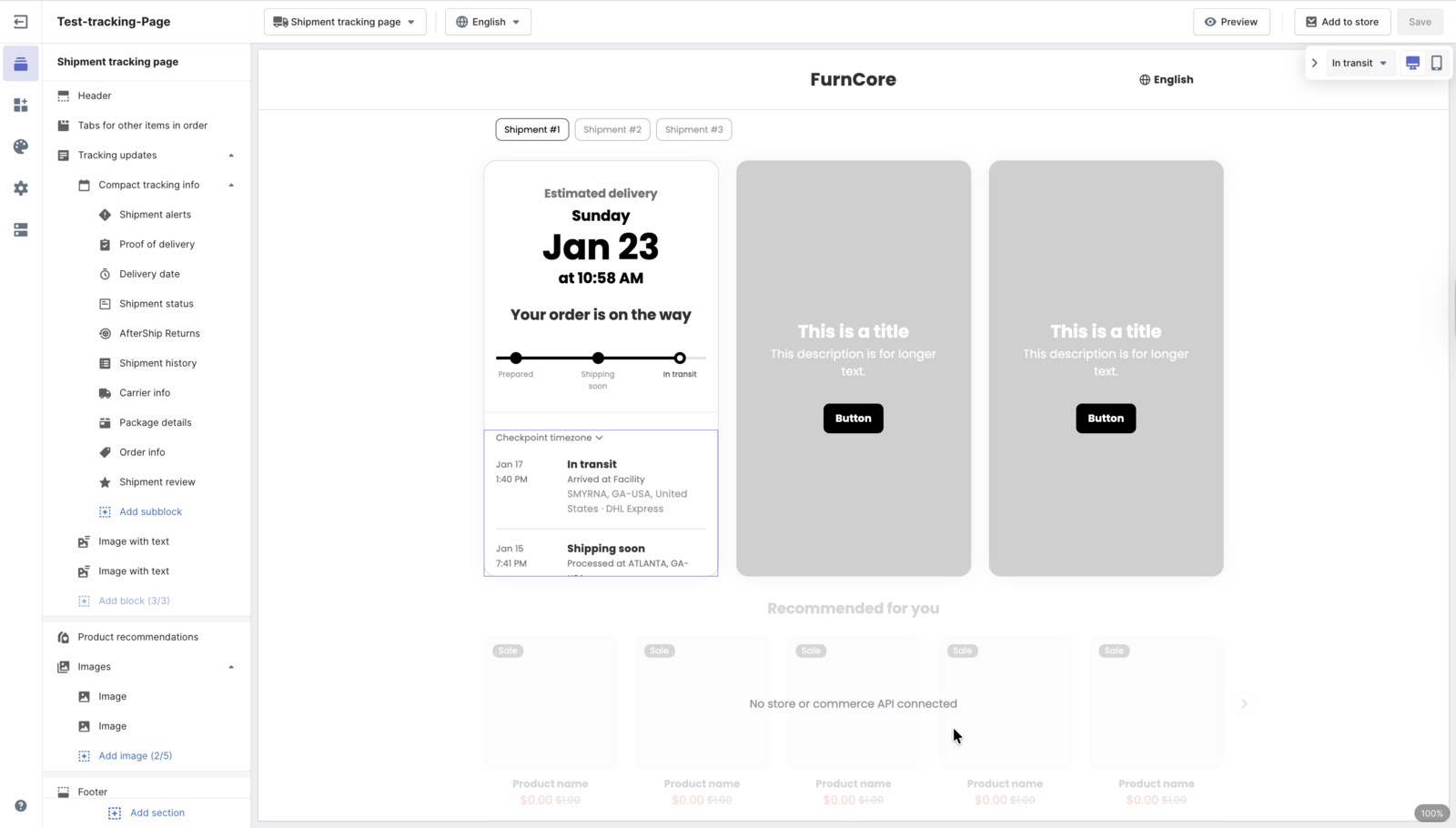
Malomo's strength here is real, and worth stating plainly. It is a marketing-focused, Shopify-native page builder with on-page upsell and recommendation modules and a fast, near two-click setup, paired with genuinely deep Klaviyo flows. If your post-purchase goal is squeezing more marketing touchpoints onto the tracking page, Malomo does that job well.
But that ground is not Malomo's alone. AfterShip is equally Shopify-native, ships the same on-page product recommendations and upsell modules, and pairs the same Klaviyo depth with Apple Wallet and a broader operational trigger set — so the delay alert, the exception notice, and the out-for-delivery message run from the same engine as the marketing ones. For brands whose whole flow already lives in Klaviyo, we make that call directly in the honest verdict for Shopify brands on Klaviyo.
For an operations team, that wider reach is not cosmetic. A delay or exception that fires an automatic Email and Apple Wallet update is a WISMO ticket that never reaches your queue. A marketing-led page that only nudges upsells leaves those operational moments unmanaged, which is exactly when an anxious customer opens a ticket. To see AfterShip Tracking in action, the page editor is the fastest way to judge whether that control matters for your brand.
The Real Divide: 13+ Years of Tracking Data
Tracking is table stakes. The real question is how accurately your vendor can predict a delivery and how much of the journey it can automate — and this is where the two stop being a feature comparison and become a question of data depth.
AfterShip has spent 13+ years doing one thing: post-purchase. That focus produces a shared data layer — Tracking, Returns, Shipping, and AI delivery estimates on one customer record — and, more importantly, the training data behind it. AfterShip's AI EDD predicts delivery dates across at least 80% of deliveries, while most carriers offer predictions on under 40%, and it reaches up to 95% EDD prediction accuracy after training on over 4.4 billion shipments accumulated over more than a decade. Across the wider platform, AfterShip has processed 11B+ shipments. Malomo passes through carrier-provided estimated delivery dates — and documents that none are shown for Extended Carrier Network shipments — but has no AI-modelled prediction engine of its own. Wonderment sits in the same marketing-led corner of the market, and we take it on directly in the post-purchase verdict on Wonderment.
That data advantage is hard to shortcut. A prediction engine is only as good as the history it learns from, and 13+ years of normalized, multi-carrier tracking data is a moat a newer or broader platform cannot replicate quickly. For a brand, the payoff is concrete: a delivery date on the product page, cart, and tracking page that customers can trust, and fewer "where is it?" tickets when the estimate holds.
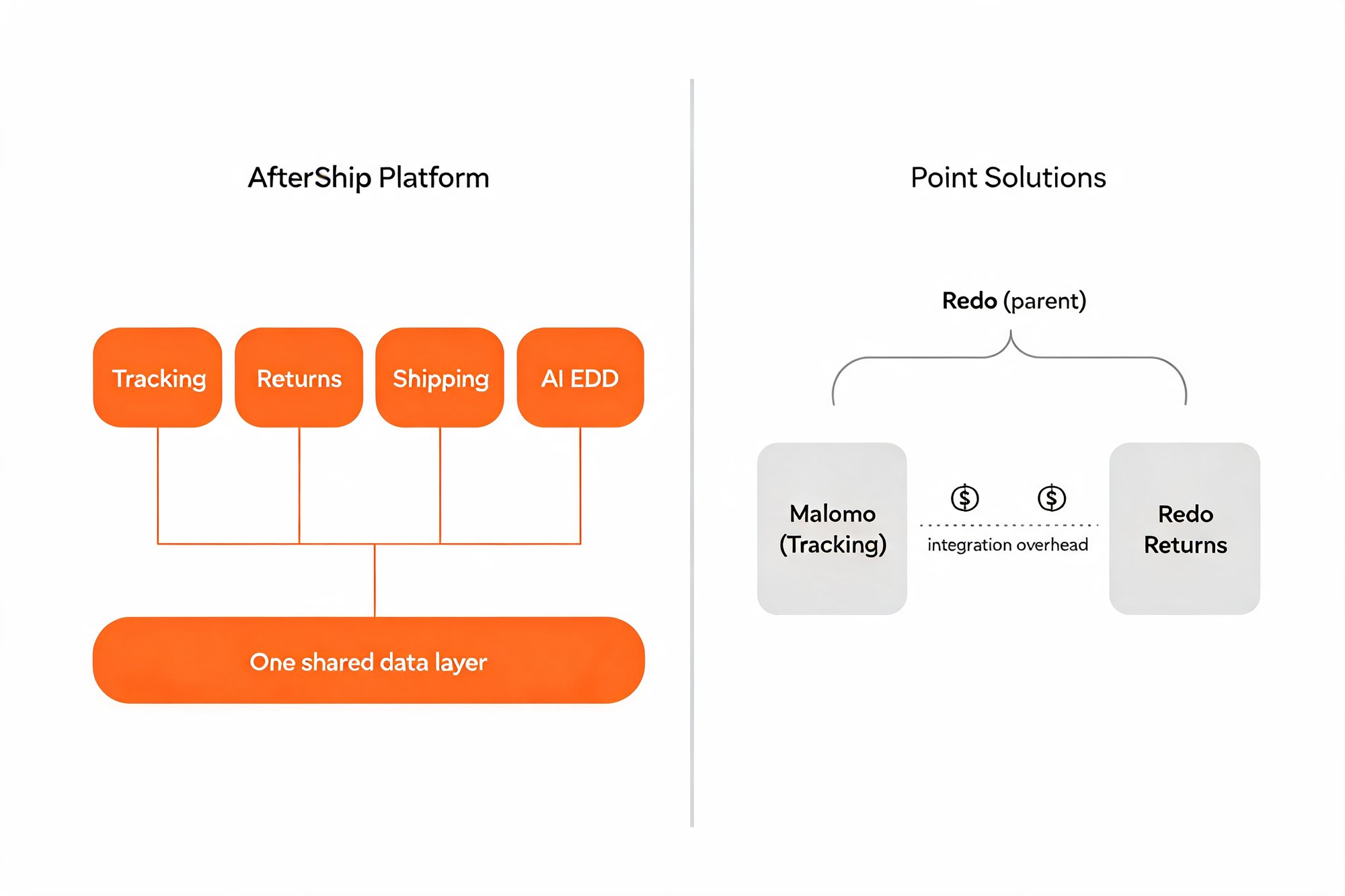
There is also a focus question. Redo is a broad platform spanning returns, shipping, and tracking, and tracking arrived through the Malomo acquisition. AfterShip's roadmap answers to one discipline — post-purchase — with tracking and its EDD engine at the center, not as one module among several. For a brand betting on delivery accuracy getting better every year, the specialist has the structural advantage.
Integrations: Who Plays Best with Your Shopify Tech Stack?
Integrations test the "post-purchase platform" claim against your real stack, and the answer is specific, not "both are equally robust."
AfterShip Tracking connects natively to the tools a Shopify marketing team already runs:
- Klaviyo, with dedicated tracking-event triggers wired into post-purchase flows
- Attentive, Omnisend, Postscript, and Sendlane for SMS and email
- Gorgias, where tracking data auto-resolves WISMO and WISMR (where is my return) tickets
Two honest gaps: AfterShip has no native ActiveCampaign or Emarsys connector, so those run through webhook or REST API. And because AfterShip Tracking, Returns, and Shipping share one stack, a single integration effort covers your whole post-purchase flow rather than a separate build per tool.
Malomo's Klaviyo integration is genuinely deep, a real strength for a Klaviyo-first brand. The difference is the operational trigger set and the channels around it: AfterShip pairs the same Klaviyo depth with Apple Wallet and the delay, exception, and out-for-delivery events that actually keep WISMO tickets out of your queue. Enterprise buyers who need that claim checked before signing should read what survives an enterprise verification pass.
The Final Verdict: Who Should You Choose in 2026?
For Shopify brands that treat delivery experience as a growth lever, AfterShip is the clear winner. It matches Malomo on the core tracking page, then pulls ahead where it counts: an AI EDD engine with up to 95% EDD prediction accuracy built on 13+ years of tracking data, multi-channel notifications including Apple Wallet, and native returns and shipping on one shared data layer. Malomo is a capable, marketing-led tracking page — now one module inside the broader Redo platform.
Choose Malomo if your only near-term priority is a Shopify-native, Klaviyo-driven branded tracking page and you are comfortable that tracking is now one part of a broader returns-and-shipping platform. Choose AfterShip if you want the deepest tracking data and the most accurate delivery estimates, on an independent platform where tracking, returns, and shipping share one customer record and one roadmap. Brands whose shipping flows currently live in Klaviyo face a narrower version of this choice, which we take up in where DTC shipping flows actually belong.
Warning: the hidden cost of a post-purchase decision is rarely the sticker price. It is the tech-stack patchwork you inherit when tracking, returns, and shipping live in tools that must be stitched together — and the risk that delivery-prediction accuracy, which depends on years of accumulated data, never becomes your vendor's top priority. A tracking specialist with 13+ years of data has already paid down both.
If you have made the decision, the fastest way to pressure-test it is to Start Your Free Trial of AfterShip and run your own orders through tracking side by side.
Frequently Asked Questions
Quick answers to the questions Shopify operators ask most when weighing AfterShip vs. Malomo.
Is AfterShip better than Malomo for Shopify?
For brands that need returns or plan to consolidate post-purchase, yes; AfterShip is an independent platform with native tracking and returns on one data layer. On the marketing-led tracking page itself the two are close — AfterShip is equally Shopify-native and ships the same on-page recommendation and upsell modules with the same Klaviyo depth — and it adds AI delivery estimates, Apple Wallet, and a returns path on the same customer record.
Is Malomo owned by Redo?
Yes. Redo — a returns, shipping, and tracking platform — acquired Malomo in early 2026. Malomo now operates as part of Redo. Set against an enterprise vendor instead, that product is judged in which wins for mid-market retailers.
Does Malomo handle returns?
Malomo itself is a tracking product. Returns are available through its parent company Redo, whose returns product is a core strength.
Does Malomo offer delivery-date prediction?
Malomo passes through carrier-provided estimated delivery dates, and its own help centre documents that no estimated delivery date is shown for Extended Carrier Network shipments; it has no AI-modelled prediction engine. AfterShip's AI EDD predicts across 80%+ of deliveries — more than double the under-40% most carriers cover — with up to 95% EDD prediction accuracy, trained on over 4.4 billion shipments.