Your Post-Purchase Problem Is Not One Tool, It's Three Categories
You are staring at three browser tabs: ShipStation, ParcelPanel, and AfterShip. They all promise to improve your "post-purchase experience," but one is a shipping workhorse, one is a simple tracking app, and one is a complete platform. They are not the same. Let's cut through the noise and figure out which one you actually need right now, and which one you will need in 18 months.
The confusion is not your fault. All three show up in the same Shopify App Store searches, and all three borrow each other's marketing language. But they were built to solve different core problems, and comparing them feature-by-feature before you understand their categories is how brands end up paying for the wrong tool.
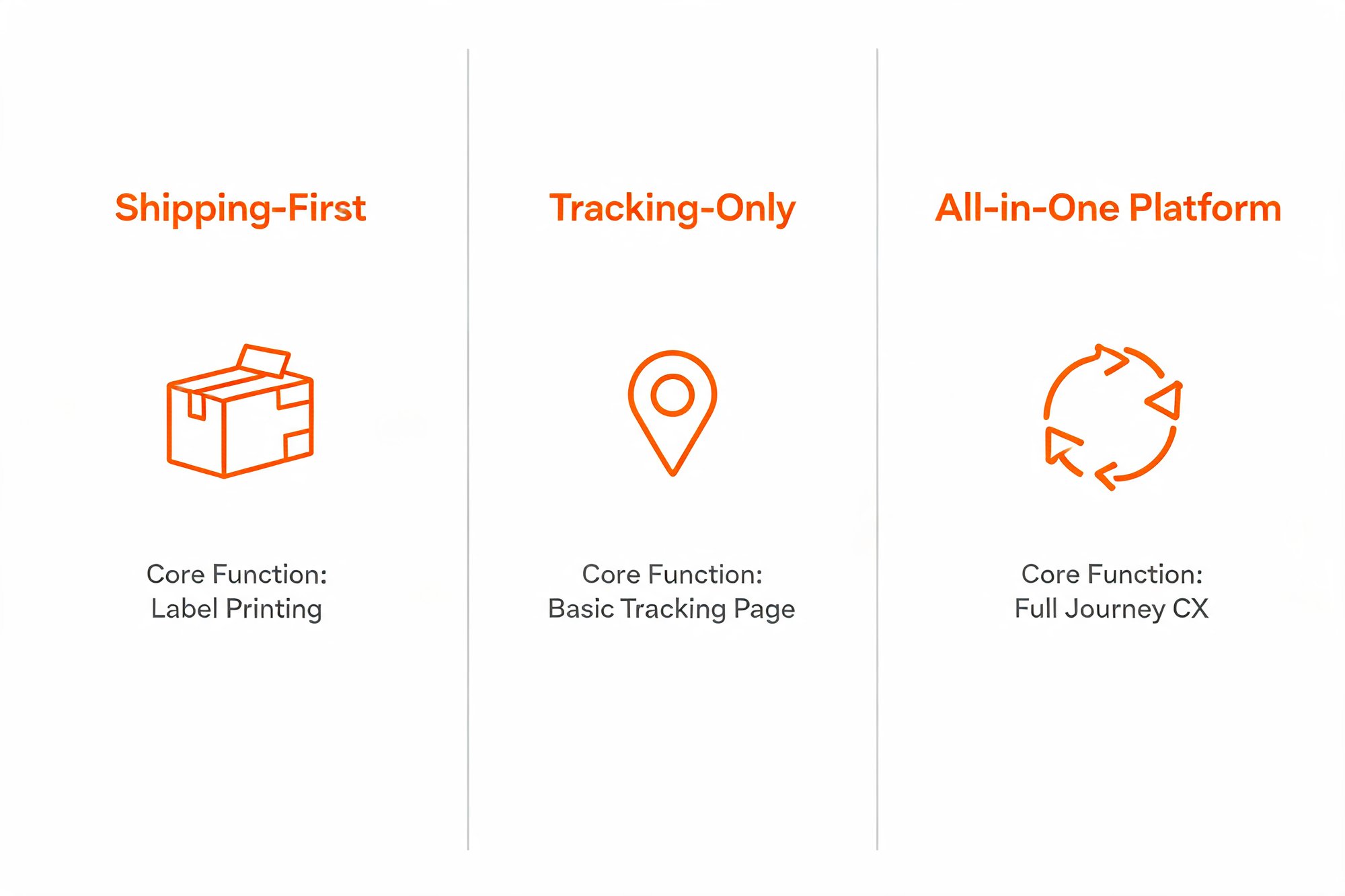
So before any AfterShip vs ShipStation vs ParcelPanel breakdown can help you, sort the market into three buckets.
Shipping-first software lives on the outbound side. Its job is printing labels quickly, comparing carrier rates, and clearing the day's orders. ShipStation is the archetype.
Tracking-only apps focus on a single screen: the page a customer sees after clicking "track my order." They swap Shopify's plain carrier page for a branded one. ParcelPanel, now listed on the Shopify App Store as CWILL Order Tracking by CWILL INC, is a popular example.
All-in-one platforms connect the entire journey, shipping, tracking, returns, notifications, and analytics, on one shared data model. The goal is to lower operational cost and raise customer lifetime value, not just finish one task. AfterShip sits in this bucket.
Hold onto that map. Each tool below is excellent inside its category and limited by it. The expensive mistake is buying a category that does not match your actual problem.
When to Choose a 'Shipping-First' Tool Like ShipStation
If your sharpest daily pain is creating labels by hand and hunting for cheaper carrier rates, ShipStation was built for exactly that. For a small business focused on getting parcels out the door, it is one of the strongest shipping tools you can put on your stack.
Picture the merchant it fits best: someone shipping a few thousand orders a month across two or three sales channels, who just wants one fast, reliable place for creating shipping labels online. Here is where ShipStation delivers:
- Multi-channel shipping with unlimited store connections, so every channel funnels into one queue.
- Carrier rate-shopping that compares services and surfaces the cheapest qualifying rate.
- Batch label processing built for heavy pick-and-pack days.
- A branded returns portal on its Standard and Premium plans, added in its 2025 overhaul.
Give that last point its due. ShipStation is no longer a label-only tool. What it does on the shopper-facing side is deliberately narrow, though, and that is worth understanding before you buy.
Its notification engine has four confirmed email triggers: Shipment Confirmation, Estimated Delivery Date, Out for Delivery, and Delivered. Its returns flow is oriented around ShipStation-processed, domestic shipments. And the "Estimated Delivery Date" it shows is a carrier-supplied date, not a purpose-built prediction.
None of that is a weakness. It is a category boundary. ShipStation is a shipping cockpit, not a post-purchase customer-experience platform, and if outbound efficiency is your only scorecard, that focus is the entire point.
When a 'Tracking-Only' App Like ParcelPanel Makes Sense
When you are early and watching every dollar, the cheapest meaningful upgrade you can make is replacing Shopify's default carrier tracking page with a branded one. That is precisely what CWILL does, and it does it well.
Give it real credit, because the numbers back it up:
- It holds a 5.0/5 rating across about 3,153 Shopify reviews, with AfterShip Tracking at 4.6/5 across about 1,503.
- It advertises 1,611+ tracking carriers.
- It offers a branded tracking page on every tier, including its Free plan.
For a store that needs tracking and nothing else, CWILL and other simple tracking apps like Tracktor are a genuinely good deal. For many new Shopify merchants, it is a sensible first step up from the default experience, and pretending otherwise would not be honest.
The ceiling appears later, and it is structural rather than a knock on quality. CWILL is a tracking-first app by design. The day you want real returns automation, you add a separate app (CWILL Returns & Exchanges, rated 4.9/5 across about 487 reviews). The day you need shipping, you add another tool again. Each one is a separate vendor, a separate login, and a separate pool of customer data that does not speak to the others.
That is the quiet trade you make. CWILL is a strong place to start, not a platform you scale on, and the difference between those two things is what the rest of this comparison is about.
When You Need a Post-Purchase Platform Like AfterShip
Here is where the math flips. Once WISMO tickets, returns, and delivery anxiety start eating real hours and real revenue, a point tool stops paying for itself and a platform starts earning its keep. ("WISMO" means "where is my order," the support question that scales fastest as you grow.) Say even one in twenty orders triggers a "where is my order" email: at 2,000 orders a month that is 100 emails to answer.
StackCommerce cut WISMO tickets 71% year over year with AfterShip's branded tracking and proactive notifications (customer-reported). If you are still building the shortlist, we rate the field in the 2026 verdict on AfterShip tracking alternatives.
That number is not an outlier. AfterShip customers report the same pattern across very different catalogs: Inspire Uplift cut WISMO tickets 75%, Mous 54%, and Vivino 50%, all customer-reported figures from their own post-purchase data. What drives the results is a flywheel, not a single feature.
It starts with the branded tracking page. Rather than dropping shoppers onto a bare carrier page, AfterShip gives them a branded status page they actually return to, an average of 3.2 times per order. That repeat attention does two jobs at once: it answers "where is my order" before it becomes a ticket, cutting WISMO volume by up to 65%, and it turns your most-revisited post-purchase screen into a place to sell.
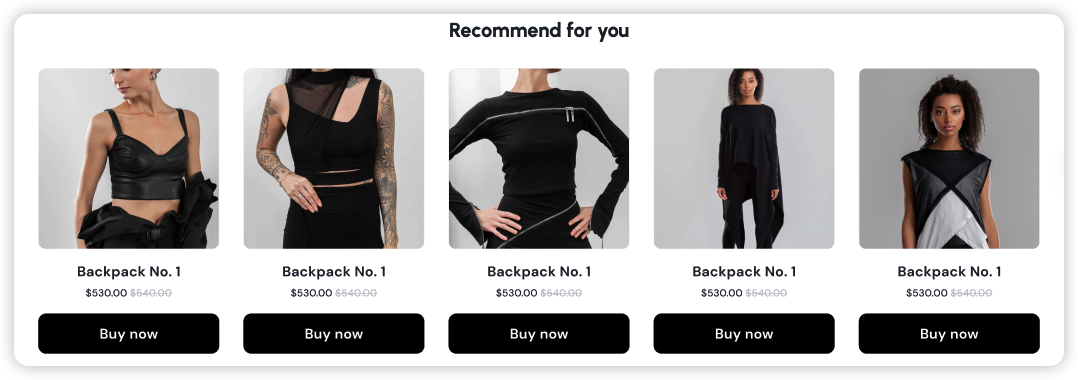
The revenue side is measured, not hypothetical. Miss to Mrs sees a 6.5% click-through rate on product recommendations placed on that page, with up to 25% of sales attributed to tracking-page traffic. Vivino and Inspire Uplift have each reported around 30% more repeat sales. Proactive AI delivery estimates complete the loop, flagging likely delays before a customer has to ask.
Returns close the circle. A self-service returns portal lets a shopper start an exchange or refund without emailing your team, which keeps revenue inside the business instead of handing it back. Better still, the portal can steer a return toward an exchange or store credit, so a refund becomes retained revenue rather than a lost sale. Run AfterShip's own multi-carrier shipping software on the same account and the outbound side feeds the very same customer and order data. Teams that reached this question through a shipping API should read what a scaling brand runs into on EasyPost.
“This greatly saves our time responding to customers' WISMO requests.”
Lok Chau, Logistics Manager
Read their story →AfterShip Tracking holds 4.6/5 across ~1,503 Shopify App Store reviews.
That is the line between a tool and a platform. A tool finishes one task. A platform compounds, on one login, one dashboard, and one shared view of every order, with no second vendor to reconcile.
AfterShip vs. ShipStation vs. ParcelPanel: A 2026 Breakdown
With the categories straight, here is the head-to-head, scored on what an ambitious Shopify brand actually weighs, not a generic feature checklist. Each criterion maps to a real decision you will make in the next year: how shoppers experience tracking, how you handle returns, and how the tool holds up when volume climbs.
| # | Criteria | AfterShip (Platform) | ShipStation (Shipping-First) | ParcelPanel/CWILL (Tracking-Only) |
|---|---|---|---|---|
| 1 | Branded Tracking Experience | Yes: branded page with AI EDD, product-recommendation upsells, multilingual, Apple Wallet, custom domain | Partial: branded tracking page (covers ShipStation-processed shipments), returns portal, and notification emails; shipping-first scope | Yes: branded tracking page on every tier, including Free |
| 2 | Proactive Notifications (Email/SMS) | Yes: 7 key statuses, ~40 sub-statuses, SMS from Essentials (metered) | Partial: 4 confirmed email triggers; SMS scope unverified | Yes: email and SMS notifications (SMS metered) |
| 3 | AI Estimated Delivery Date (coverage & accuracy) | Yes: purpose-built model on ~150 carriers; 80%+ coverage (vs under 40% baseline); up to 95% EDD prediction accuracy | No: shows a carrier-supplied delivery date; no purpose-built model | No: carrier-dependent EDD/transit widget; no published coverage or accuracy |
| 4 | Returns Management & Automation | Yes: self-serve branded portal from Essentials; approve/reject rules and store credit from Essentials; AI-powered exchanges and fraud prevention on Premium; 70-carrier returns pool | Partial: branded returns portal + return labels (Standard/Premium; ShipStation-processed, domestic) | Partial: via a separate CWILL Returns & Exchanges app (separate subscription) |
| 5 | Carrier Rate Shopping & Label Printing | Yes: AfterShip Shipping (130+ carriers, rate shopping, BYO accounts, up to 90% USPS savings; lighter on deep batch/warehouse) | Yes: core strength (multi-carrier labels, rate shopping, batch processing, deep fulfillment workflows) | No: tracking-only; no label printing or rate shopping |
| 6 | Tracking-Network Carrier Reach (scope-labeled) | 1,700+ tracking-network carriers (separate from 130+ shipping and 70 returns) | 200+ shipping carriers, different scope (label generation, not tracking) | 1,611+ tracking-network carriers (advertised) |
| 7 | Analytics & Performance Insights | Yes: AfterShip Analytics (Revenue Center across Tracking/Personalization/Returns, plus carrier scorecards) | Partial: shipping- and fulfillment-focused reporting | Partial: tracking-focused reporting |
| 8 | Scalability & Growth Path | Yes: add Tracking, Returns, and Shipping on one login, dashboard, and data model | Partial: scales shipping and fulfillment; post-purchase CX needs bolt-on apps | Partial: strong tracking starter; returns and shipping need separate apps and vendors |
| 9 | Pricing Model & Total Cost | Usage-based (Shopify App Store): Free (50/mo), Essentials $11 (100/mo), Premium $70 (500/mo); overage $0.08 to $0.12; no hard spend cap | Volume-banded tiers: Starter from $14.99/mo; Premium starts at $349.99/mo and climbs with shipment volume (an entry price, not a ceiling) | Order-credit tiers: Essential $11 (200 orders), Professional $59 (2,000), Enterprise $479 (25,000); $0.05/credit overage |
Carrier counts measure different things, tracking-network reach (AfterShip, CWILL) vs shipping-carrier coverage for label generation (ShipStation). They are not directly comparable.
Shopify App Store ratings (re-verify at publish): AfterShip Tracking 4.6/5 (~1,503 reviews); CWILL Order Tracking 5.0/5 (~3,153 reviews). ShipStation is a shipping app, not a Shopify-native tracking app, so it isn't rated on that listing.
Read the carrier-count row with suspicion, because it is the most misleading number in this category. The three figures measure different things: AfterShip and CWILL count tracking-network carriers, while ShipStation's number counts shipping carriers, a different scope entirely. A longer list of tracking endpoints does not predict a delivery or deflect a ticket. The real differentiator sits one row lower, in AI estimated delivery dates. AfterShip generates an AI EDD for at least 80% of shipments, more than double the coverage of native carrier estimates, which sit under 40%. AfterShip publishes up to 95% EDD prediction accuracy. Neither CWILL nor ShipStation runs a purpose-built prediction model with published coverage and accuracy, and that gap is the entire point of the table.
The Scalability Test: Will You Outgrow Your Choice in a Year?
The honest question is not "which tool is best today." It is "which one will I still be running in twelve months without rebuilding my stack."
CWILL fails it the moment your priorities widen. Decide to automate returns, and you add a separate returns app. Decide to control shipping, and you add another tool. You did not buy a platform, you bought the first of several.
ShipStation passes the shipping test and stops there. You get an excellent place to print labels and a thinner post-purchase experience, so you start buying apps to fill the gaps, often a tracking tool like AfterShip Tracking on top. That pattern is common enough that AfterShip publishes an official ShipStation integration that imports your shipments roughly every three hours. Great shipping, bolted-on customer experience.
AfterShip is built to grow into. Start with Tracking to cut WISMO tickets, add Returns when returns become a real cost, bring in Shipping to sharpen rates, and switch on AI EDD to predict delivery before customers ask. Every step runs on one login, one dashboard, and one shared data model. That is one platform, one vendor, one dashboard, not one bill: each product is still its own subscription.
The Hidden Cost of 'Good Enough for Now': The cheapest tool today is rarely the cheapest over the next two years. A point solution usually means ripping it out and replacing it later, or duct-taping several apps together as you grow.
The Verdict: Which Tool Is Right for Your Shopify Store?
Here is the call, based on where your business sits:
- Pre-revenue or under 100 orders a month, and you just need cheaper, better-looking tracking? ParcelPanel/CWILL is fine for now, free on its entry branded page and rated 5.0/5 on Shopify.
- Only real problem is printing labels and shipping efficiently, with no interest in post-purchase as a marketing channel? ShipStation is a solid utility.
- Growing brand competing on customer experience, retention, and efficiency? AfterShip is the definitive choice, the only one of the three built to scale shipping, tracking, and returns on a single platform.
Point tools win on the narrow job and lose on the next one. If you expect to grow, buy for the brand you are becoming, not the one you are today.
Proactive shipment tracking that delights your customers, reduces WISMO tickets, and improves your delivery performance.
Book a demoFrequently Asked Questions
Can you use AfterShip and ShipStation together?
Yes. ShipStation is an AfterShip partner, and you can see how AfterShip integrates with ShipStation through an official, AfterShip-built integration that imports ShipStation shipments roughly every three hours. You keep ShipStation's fulfillment and add AfterShip's tracking, AI EDD, and branded experience on top.
What is the main difference in pricing philosophy?
The three tools measure cost in three different units. AfterShip is usage-based, a plan fee plus a per-shipment overage, with no hard spend cap; it alerts you rather than blocking orders. ShipStation uses volume-banded tiers, and CWILL uses order-credit tiers. Because the units differ, sticker prices are not directly comparable.
Is "free SMS" real?
Not exactly. SMS is available from AfterShip's Essentials tier, but it is metered per message by destination country, so it is usage-based on top of your plan fee rather than bundled free. That is true of every tool that offers SMS.
Does AfterShip have its own shipping label software?
Yes. AfterShip Shipping covers 130+ shipping carriers with rate shopping, bring-your-own carrier accounts, and up to 90% USPS savings with no minimum volume. It is a cloud-native label layer inside the unified platform. Run it on its own, or keep ShipStation and connect both through the official integration.