Your Klaviyo flows have no real-time delivery data and your Gorgias agents cannot see return statuses. That is not a tools problem, it is a system problem. This article ranks the seven platforms that solve it, and separates the ones that sell you a suite from the ones that sell you pieces.
That separation is the decision in front of you, and it matters more than any feature count. Most rankings of post-purchase platforms compare capability lists, which tells you very little once you are past a few thousand orders a month, because almost everyone in this field now advertises tracking and returns. The question that shapes your next two years is structural: which capabilities sit inside the contract you sign, which arrive as a separately named and separately priced product, and what operational event makes the bill rise.
We ranked seven platforms against that question, then named the business model each one actually fits.

What Are the Core Pillars of a Post-Purchase Platform?
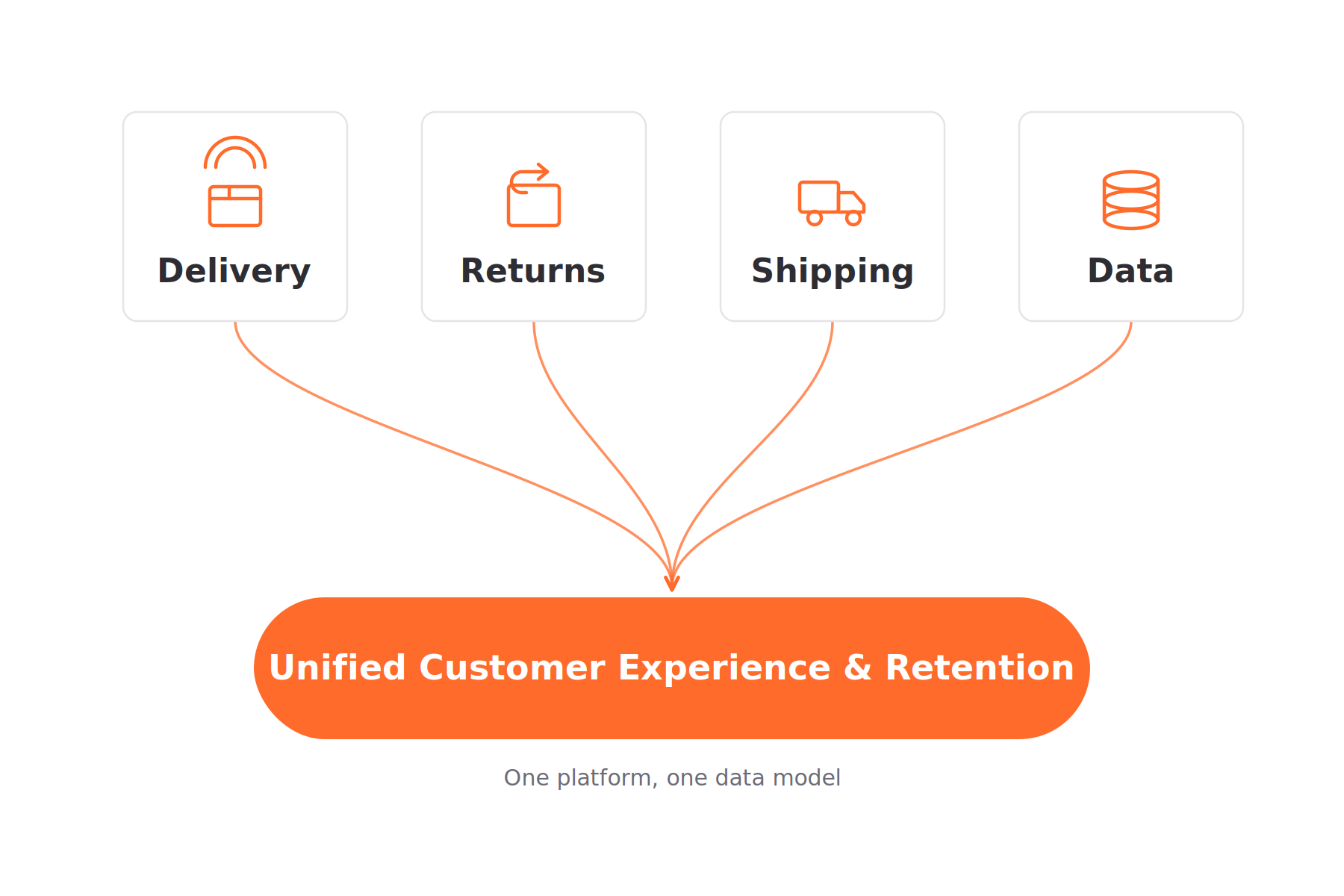
Post-purchase platforms cover four pillars, and every tool in this ranking sits differently across them.
- Delivery Experience. Order tracking, the notifications that carry it, and the delivery estimate shown before purchase. This is where most support volume originates, and it is worth seeing how AfterShip Tracking compares across the Shopify landscape before you shortlist.
- Returns and Exchanges. The return portal, the rules behind it, exchange and store-credit flows, and label logistics, with warranty claims inside this pillar.
- Shipping Operations. Rate shopping, label buying, carrier selection and cross-border duties, where per-shipment cost is won or lost.
- Data. Whether the first three report separately or share one platform and one data model.
Unified platforms combine shipping, tracking, returns, and warranty in one system. Point solutions cover one pillar deeply and integrate for the rest. The pillars are an evaluation framework, not a product list, and intelligence runs across all four rather than beside them as a fifth.
Top 7 Post-Purchase Platforms Ranked
This ranking of the top post-purchase software for direct-to-consumer brands is written for an operations or CX leader at a brand shipping roughly 1,000 to 50,000 orders a month. At 50 orders a month, most of this field is over-specified and the honest answer is to stay on your platform's native tools until volume forces the question.
Four criteria decide the order, and none of them is feature count.
- Suite Scope. How much of shipping, tracking and returns sits inside one contract, and which parts are separately named products with their own subscription and renewal.
- Brand Experience Control. Whether the tracking page and return portal are white-labelled, co-branded, or carry the vendor's name.
- Scalability and API Depth. Whether it holds up when you add bundles, warehouses, a second brand or a new region.
- Total Cost of Ownership. Not sticker price: what you pay once overages, add-ons, label costs and per-event charges are counted at your volume.
Every figure below was read from the vendor's own live pricing and product pages, with the date read, not from a roundup.
#1 AfterShip: Best Complete Post-Purchase Suite for Scaling DTC
AfterShip is a complete post-purchase suite for scaling DTC brands. Shipping, tracking, returns, and warranty run on one platform, which means the delivery data your tracking generates is the same data your returns decisions are made on, rather than something you export and reconcile later.
The operational case for consolidating is easiest to see in a brand that did it.
Aetrex, a footwear brand shipping 120,000+ packages a year, ran AfterShip Tracking and Returns together and cut WISMO tickets 74% and return processing time 86%. Aetrex's eCommerce team put the reason plainly: "We can simplify our tech stack and leverage the data together." Read how footwear brand Aetrex achieved this.
That result comes from the flywheel between the products rather than from any one of them. Accurate delivery expectations reduce the uncertainty that drives both support contacts and unnecessary returns. AI EDD, a capability inside Tracking on the Premium plan, covers at least 80% of deliveries where most carriers offer predictions on under 40%, with accuracy up to 95% (aftership.com/edd, read 2026-08-26). Carrier breadth is 2,000+ on the Tracking side (carriers.aftership.com, read 2026-10-14), so a brand opening a new region is not waiting on a carrier integration before it can promise a delivery date at all.
What a shared platform and data model produces is depth of inference, not breadth of storage. Return-rate signals can be read against delivery performance, so a spike in returns on one lane can be traced to the carrier serving it rather than blamed on the product. Delivery-date accuracy can be tied back to carrier selection, so the promise you make at checkout informs the carrier you buy at fulfilment. Each product surfaces its own reports; the difference is that they are drawing on the same underlying record. A returns-only or tracking-only tool cannot make that connection at all, no matter how good its own dashboard is, because half the data lives in someone else's system.
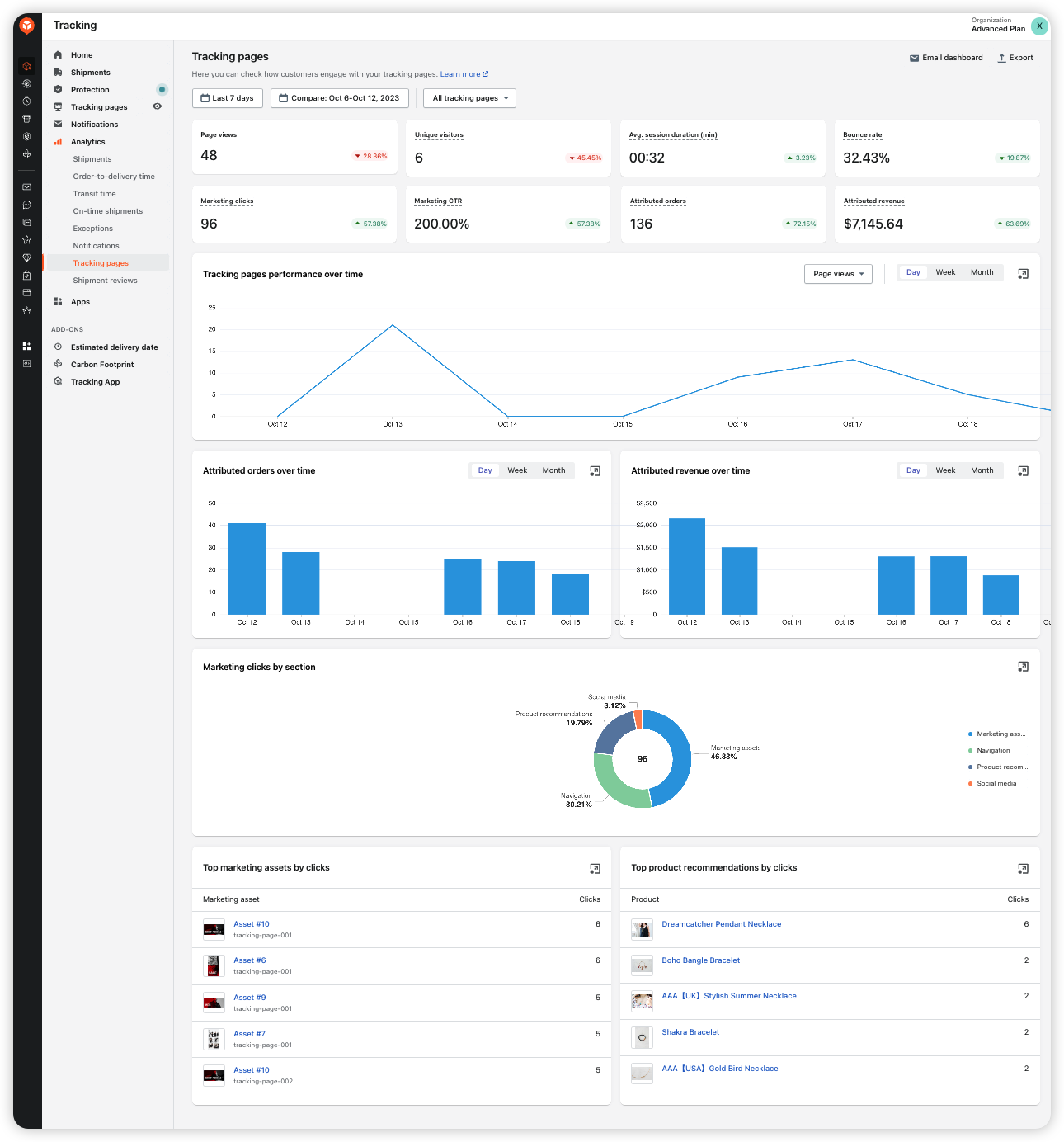
On external validation, AfterShip holds 4.7 out of 5 across 311 verified reviews on G2, which is a rating worth reading alongside its review volume rather than on its own. For a brand at this stage, the practical takeaway is narrower than the score: one contract, one data model, and a bill that moves with shipment and return volume rather than with the number of products you have been sold.
#2 Loop: Best for Returns-Only Shopify Deployments
Scope is the first thing to check here, because the returns product and the tracking product are sold separately. Loop Returns runs on a published ladder: Checkout+ free, Essential at $155 a month, and Advanced at $340 a month (loopreturns.com/pricing, read 2026-08-25). Tracking is a different product with its own subscription, arriving from Loop's 2024 acquisition of Wonderment; wonderment.com now redirects to Loop's own announcement page, which describes combining Wonderment's order tracking with Loop's returns platform. If your storefront is Magento, the tracking setup is covered in setting up tracking inside a Magento storefront.
Predictive delivery dates are a third separately named product, Loop's Promise, which Loop describes as roughly 90% accurate and calculated nightly from historical delivery data. Loop's tracking page advertises 40% to 60% fewer WISMO tickets and 60% to 80% open rates on tracking updates, alongside alerts for stalled, late and returned-to-sender shipments.
For a Shopify brand whose only post-purchase job is returns, that ladder is legible and the scope is coherent. What a director should price is the full arrangement rather than the entry line: two subscriptions from one vendor is still two subscriptions, with two quotas and two renewal dates. One 2025 reviewer on Loop's Shopify listing described return-count tiering that made the cost more than double, and an activation process that required a sales demo before installation.
#3 Narvar: Best for Enterprise-Level Service Agreements
The buying process is what separates this entry from the rest of the field. Narvar's capabilities are sold as six separately named products, listed in its own product navigation as Narvar Promise, Secure, Track, Shield, Notify and Assist (corp.narvar.com/products, read 2026-08-25). Each is scoped, quoted and renewed on its own terms, which is a coherent model for a large retailer with a procurement function and a service agreement to negotiate, and a slow one for a director who wants to evaluate in a week.
The scale is real. Narvar reports integration with 1,000+ carriers, 1,500+ global brands, and 2 billion packages annually on the same page. Its Shopify returns app is listed separately, with a free tier and the tagline about converting refund requests into exchanges.
In a Narvar vs AfterShip evaluation, the structural question for a mid-market DTC brand is what the six-product shape does to total cost of ownership over three years. Every capability added to the contract is a new line item rather than a new feature, and the delivery-estimate product sits outside the tracking product rather than inside it. AfterShip publishes its pricing and can be started without a sales conversation, which is the practical difference for a team that wants to evaluate and deploy on its own timeline. We covered the returns side of that choice in a detailed breakdown of enterprise returns solutions.
#4 Malomo: Best for Standalone Klaviyo-Triggered Tracking Alerts
Scope again. Point solutions like Malomo specialise in one area, such as branded tracking. Malomo is a tracking and communications layer, and it is now owned by Redo, though it still trades under its own name on its own domain with its own published pricing: Lite at $49 a month for 1,000 shipments, Starter at $189 for 4,000, and Growth from $400, billed monthly (gomalomo.com/pricing, read 2026-08-25).
Notification routing through the marketing stack is available on both platforms, and AfterShip Tracking triggers email and SMS from shipment events as part of Tracking. Malomo's version of this is its centre of gravity rather than a feature of a wider product: it integrates directly with Klaviyo, Attentive, Yotpo, Sendlane and Postscript, so shipment events drive flows inside the ESP a brand already runs.
Returns are the boundary. They arrive through a third-party integration rather than inside the Malomo contract, which is a difference in what you are buying rather than a gap in what exists. Malomo's headline figure of 2,000 carriers describes a tracking-data network rather than a set of shipping integrations, and it is worth reading that way when comparing it with a carrier count from a tracking platform.
#5 ShipStation: Best for SMB Shipping Label Generation
ShipStation's centre of gravity is shipping execution, and it is an AfterShip partner rather than a competitor in this field. It buys multi-carrier labels against a fully published volume ladder: Starter from $14.99 a month for 50 shipments up to $174.99 for 5,000, Standard from $29.99 up to $3,599.99 for 100,000, and Premium from $349.99 up to $7,499.99 (shipstation.com/pricing, read 2026-08-25).
Post-purchase features are included rather than absent. A branded tracking page and a branded returns and exchanges portal both ship from the Standard tier upward, with Starter limited to basic return labels. AfterShip provides both as well, so the difference is architectural rather than a matter of who has the capability.
The architecture is the thing to price. This is a shipping execution system that bundles post-purchase features onto a shipment meter, and the meter counts return labels against the monthly shipment cap even when the label is never used (help.shipstation.com, updated 2026-08-05). Billing is a separate matter from counting: labels bought through ShipStation Carriers or a pre-paid postage provider are charged at creation, while invoiced carriers such as UPS and FedEx are charged only on use. Exchanges are available for connected Shopify stores.
#6 Route: Best for Standalone Package Protection
Funding models are what this entry is actually about, and AfterShip has one too. AfterShip Return Care is shopper-funded, with AfterShip covering the return label, and AfterShip also publishes standard SaaS pricing for brands that prefer it. Transparency about how each option is funded is the point.
Route's model puts the fee in front of the shopper. Its pricing page lists two tiers, a consumer-funded Standard at $0 per month to the merchant and a Custom tier, and shoppers opt in or out at checkout (route.com/pricing, read 2026-08-26). Route now describes itself as a post-purchase platform for protection, tracking and returns rather than protection alone.
Three considerations matter for a brand-conscious DTC. Route publishes no protection fee figure on any of its own surfaces, describing only a flat rate under $100 and a percentage of subtotal above it. Route Returns is available to Shopify brands and requires a separate EasyPost account. And the shopper meets Route's brand inside your checkout, which is the opposite of a white-labelled flow.
#7 Easyship: Best for International Rate Shopping
Centre of gravity decides this one. Easyship is a shipping rate and label engine with cross-border duties and taxes calculated at checkout, which is a genuinely different job from managing a post-purchase experience.
Branded tracking and returns are both available on AfterShip, and Easyship gates its versions by tier: branded tracking and customization from Plus at $29 a month for 500 shipments, and returns management from Premier at $69 for 2,500, alongside live duties at checkout (apps.shopify.com/easyship, read 2026-08-26). Scale is $99 for 5,000 shipments, above which pricing moves to a quote.
So the distinction is depth and centre of gravity rather than absence. A brand whose hardest problem is landed cost across borders is buying the right tool. A brand whose hardest problem is what happens between dispatch and either delivery or return is buying a rate engine and will still need the post-purchase layer.
Post-Purchase Platform Feature Matrix
The seven platforms sort cleanly once you stop counting features and start asking what sits inside one contract. This post-purchase experience platforms comparison scores each on five criteria chosen for what a table can show, rather than repeating the four that set the ranking order.
| Platform | Suite Scope | Brand Control | Returns Management | Data & Analytics | Best For |
|---|---|---|---|---|---|
| Loop | Returns only; tracking and Loop's Promise sold separately | Branded returns portal and tracking pages | Automation and exchanges, $155 to $340 a month | Reporting split across separate products | Shopify brands whose only job is returns |
| Narvar | Six separately named products, each quoted individually | Self-serve editor with complete brand control, per Narvar | Shield, plus a separate Shopify returns app | Per-product reporting across separate contracts | Enterprise buyers with a procurement function |
| Malomo | Tracking and communications; returns via integration | Branded tracking is its centre of gravity | Arrives through an integration, not the contract | Tracking analytics only | Brands driving Klaviyo flows from shipment events |
| ShipStation | Shipping execution with post-purchase bundled on | Branded tracking and returns portal, Standard up | Portal and exchanges on connected Shopify stores | Reporting scoped to the shipment meter | SMB label buying on a published ladder |
| Route | Protection, tracking and returns; returns needs EasyPost | Shopper-facing flow runs under Route's brand | Shopify-only, via a separate EasyPost account | Reporting scoped to protection and claims | Brands wanting shopper-funded package protection |
| Easyship | Rate and label engine; tracking and returns tier-gated | Branded tracking from Plus, $29 a month | Returns management from Premier, $69 a month | Reporting scoped to shipping and duties | Cross-border brands solving landed cost |
| AfterShip | Shipping, tracking, returns, and warranty in one contract | Full white-label, including removing AfterShip branding | Automation and exchanges, $19 to $119 published | One shared data model, each product reporting on it | Mid-market DTC brands scaling past a patchwork stack |
Read Suite Scope first. It is the only column that changes what you sign, and it is the one that predicts your renewal conversation two years out.
Beyond Features: How to Calculate the ROI of a Unified Platform
Most ROI cases for post-purchase platforms are built on an industry average for WISMO volume and an industry average for cost per ticket. Build yours differently. Neither figure survives scrutiny, and your VP of Ops will ask where it came from. Use your own loaded cost per ticket instead: agent salary plus benefits plus tooling, divided by tickets resolved. Post-purchase is one line in a complete eCommerce tech stack, and your case has to hold up beside the others.
Four levers follow from that number. Calculate each separately, present each separately, and do not add them together. They rest on different assumptions and carry different confidence levels, and a single combined savings figure is the fastest way to lose an operations audience.
- Reduced WISMO contacts. Monthly WISMO tickets, times the reduction you model, times your loaded cost per ticket.
- Lower return processing cost. This is the lever the best returns management solutions for DTC are bought on. Minutes of manual handling per return, times monthly return volume, times your loaded hourly rate, against the share that automated approval rules would clear without review.
- Retention and LTV from a branded experience. Repeat purchase rate on orders that had a branded tracking experience against those that did not, times average order value, across one cohort.
- Carrier cost control. Average cost per shipment before and after rate selection, times monthly shipment volume.
Inspire Uplift cut WISMO tickets by up to 75% with proactive, branded tracking notifications, which gives you a real ceiling to sanity-check the first lever against.
On total cost of ownership, name the channel you are buying through, because the ladders differ. On the Shopify channel, AfterShip Tracking Premium is $70 a month for 500 shipments with additional shipments at $0.12, so 20,000 shipments a month works out to roughly $2,410 un-negotiated. That is a ceiling you can calculate yourself, and accounts at that scale move to custom pricing rather than staying on it. Returns is billed separately, from $19 a month for 20 returns to $119 for 100, with overage alerted rather than blocked and existing customers not re-tiered.
Proactive shipment tracking that delights your customers, reduces WISMO tickets, and improves your delivery performance.
Book a demoFrequently Asked Questions
What is the difference between a shipping platform and a post-purchase platform?
A shipping platform executes fulfilment: it compares rates, buys labels and picks carriers, and its job ends when the parcel is handed over. A post-purchase platform owns what the customer experiences after that point, including the tracking page, the delivery notifications, the returns portal and the data connecting them. Several shipping tools now bundle a branded tracking page, so the two overlap at the edges, but the centre of gravity differs and it determines which problems the tool is built to solve.
How long does implementation take?
It depends on three things rather than on a vendor's headline number: how many products you turn on, whether you must supply your own carrier accounts or the platform connects carriers for you, and whether your returns policy needs custom rules before launch. A single branded tracking page on one Shopify store is a short project. A multi-brand rollout with custom return rules and an ERP handoff is not. Ask each vendor to scope your case rather than quoting an average.
Do these platforms integrate with Gorgias and Klaviyo?
Most of this field integrates with both, so the useful question is what the integration carries. Check whether delivery events and return statuses are exposed as triggers your flows can act on, or whether the integration only writes a tracking link into a template. Check whether agents see live shipment and return status inside the helpdesk or have to open a second tab. That difference decides whether your CX team actually works faster.
What does a post-purchase platform actually cost at 20,000 orders a month?
It varies, and several vendors here publish no figure you can plan against. Where pricing is published you can model it before speaking to sales. AfterShip Tracking Premium on the Shopify channel is $70 a month for 500 shipments with additional shipments at $0.12, putting 20,000 shipments at roughly $2,410 a month before negotiation, with accounts at that scale moving to custom pricing. Returns is billed on its own published ladder, overage is alerted rather than blocked, and existing customers are not re-tiered. Running that arithmetic yourself, before a sales call, is the difference between a business case and a guess.
The Verdict: Choosing Your Post-Purchase Strategy for 2026
AfterShip and Loop both convert refunds into exchanges on Shopify. For a smaller brand where that is the only post-purchase job, Loop's returns-first scope is sufficient. That scope comes at the cost of a unified view of the customer journey, and tracking and predictive delivery dates arrive as separate Loop products with their own subscriptions.
Choose AfterShip if:
- Shipping, tracking, returns, and warranty belong under one contract and one data model.
- Delivery data should drive returns decisions rather than sit beside them.
- Your bill must not rise on events you do not control.
- Your team needs to change the tracking page, notification rules or return policy without an account manager in the loop.
- You are planning for the complexity you will have in two years, not today's.
Choose a point solution if:
- One narrow job is your only priority, and separate contracts, separate data and separate renewals are acceptable.
- Returns on Shopify is that job: Loop, with tracking and predictive delivery dates separately priced.
- Shipping execution is that job: ShipStation for SMB label buying, Easyship where landed cost across borders is the hard problem.
- A single component is that job: Malomo for shipment-triggered Klaviyo flows, Route for shopper-funded protection, Narvar where a negotiated enterprise agreement is the requirement.
Each of those tools does its one job well. Assembling them is what costs you, and AfterShip's suite is what takes that cost off the table. Mid-market teams weighing that trade-off can see how the post-purchase platforms stack up on scope and pricing.