You're paying for a premium post-purchase tool, but your tracking page still feels off-brand and your support team is still drowning in "Where Is My Order?" tickets. You're right to ask: is Parcel Perform actually worth the investment?
That question rarely gets a useful answer, because most comparisons stop at feature checklists. A feature list will not survive a CFO asking why you want to replace a tool that technically works.
So this article uses a different frame. Three pillars, each tied to a business metric you already report on, and an honest read of where AfterShip and Parcel Perform actually diverge once you measure that way.
The Real Cost of a "Good Enough" Tracking Experience
A tracking experience that merely works still carries a price, and it lands in two places your CFO already watches: support cost and repeat purchase rate.
Start before the parcel even moves.
Among shoppers who abandoned a cart for a reason other than just browsing, 20% cite delivery being too slow. Baymard Institute, updated September 2025.
That is a pre-purchase figure, so the delivery experience is already shaping revenue before anyone reaches checkout. After checkout the same weakness compounds, and every vague notification converts into a contact your team has to work.
Three numbers you already have will size it: monthly order volume, the share of orders that generate a delivery-related contact, and what a contact costs you fully loaded.
Multiply them. That is your monthly exposure, and it sits well above the line item on your invoice.
Evaluation Framework: 3 Pillars of a High-ROI Post-Purchase Platform
Three questions decide whether a post purchase tracking experience earns what it costs. Run any vendor through all three, including the one you already pay.
- Branded experience and engagement. Can your team turn tracking into a marketing channel, or do you file requests against a status page? Maps to repeat purchase rate.
- Proactive communication and exception handling. Does it prevent delivery tickets and work the problems it finds, or only report them? Maps to support cost.
- Predictive accuracy and trust. Are the delivery dates reliable, and will the vendor publish a number it stands behind? Maps to conversion and customer trust.
The third question is the one most buyers never think to ask.
Pillar 1: Who Controls Your Branded Tracking Page
The tracking page is the highest-intent surface you own and the cheapest merchandising space in your stack. The practical question is who can change it on a Tuesday afternoon.
On campaigns, the two platforms sit close together. Parcel Perform publishes a tracking widget with 120+ options and a no-code campaign manager that lets marketing teams place upsell modules and promotional banners on the page themselves. AfterShip runs the same class of self-service merchandising, with cross-sell and upsell modules and product recommendations on the page. Call that half parity.
The divergence is in page design and editing.
AfterShip documents a component editor with a named inventory of sections and widgets, so your team assembles the page layout directly, plus custom CSS within published character limits for finer control. Custom HTML and JavaScript are not documented, so treat CSS as the ceiling.
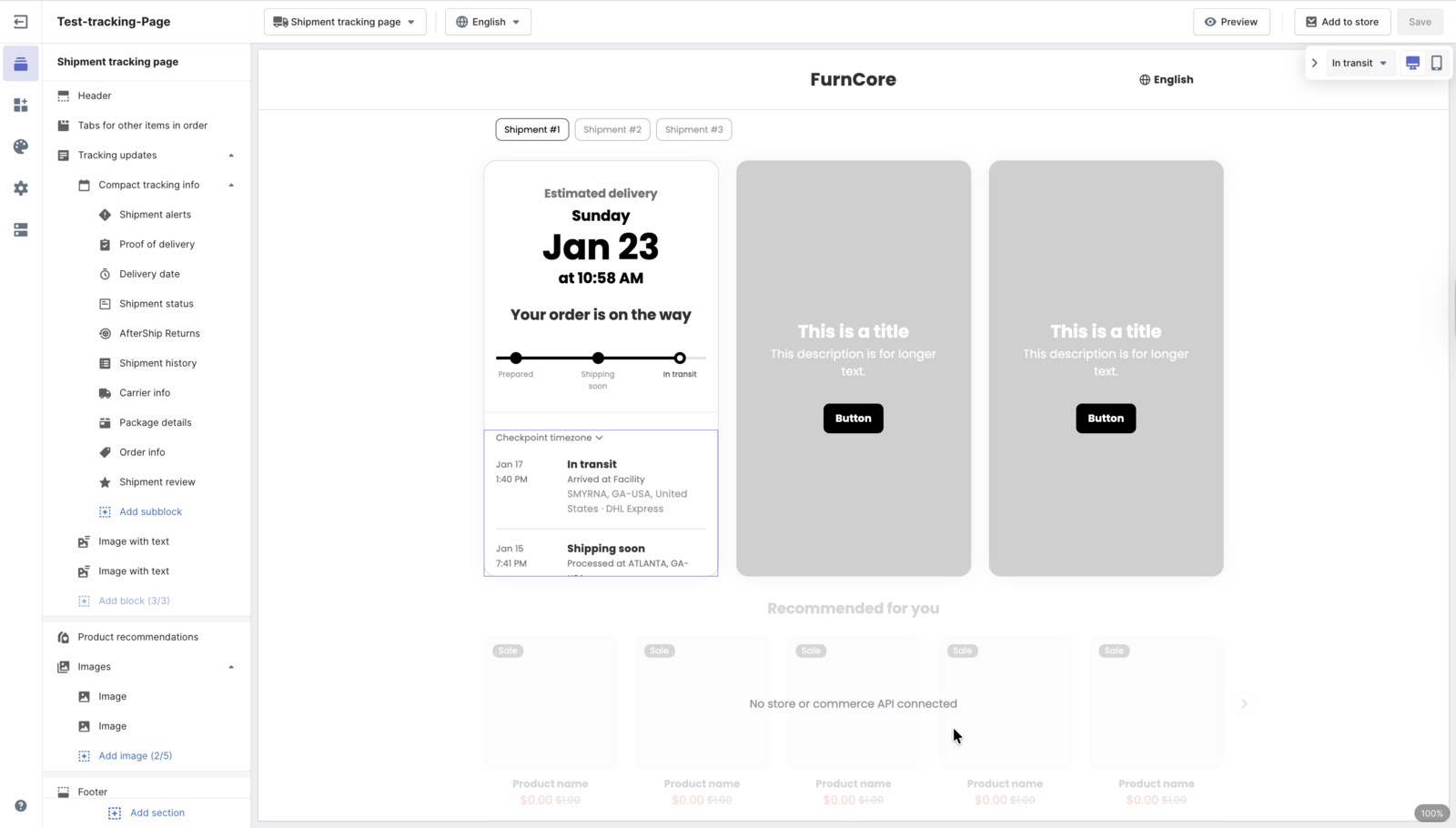
Parcel Perform states that "We configure data integration, tracking page, and notification design exactly to your needs," and quotes a launch in under two weeks. That is a configured service model. It delivers a page built to your brief, and a change request every time the brief changes.
For a marketing team running seasonal creative, that turns into a cycle-time problem. AfterShip offers deeper tracking page customization than Parcel Perform. The advantage sits specifically in page design and editing, since campaign merchandising is level between them, and cycle time is where it pays out: the gap between a generic status page and a truly branded tracking page is usually measured in how fast your own team can act on it.
Pillar 2: Getting Ahead of the Delivery Problem
Every post-purchase platform sends notifications. What separates them is what happens next.
Both platforms message against the same shipment lifecycle: Info Received, In Transit, Out for Delivery, Available for Pickup, Delivered, Failed Attempt, and Exception. Counting triggers is the wrong test, because a trigger only fires once something has already happened.
Targeting is what changes the ticket volume. AfterShip reduces WISMO tickets with proactive, AI-driven customer communication. WISMO is the "where is my order" contact, and precision is what suppresses it: the update reaches the shoppers whose orders actually changed state, by email and SMS, before they think to ask, with the option to add the order to Apple Wallet.
That surface is also measurable.
Dr. Squatch published a 31.89% click-through rate on its branded tracking page in Q1 2026, 4.5x the platform benchmark, driving 766 attributed orders. Dr. Squatch is a considerably larger brand than the mid-market profile this article is written for. Read those figures as evidence that the capability works and produces measurable attribution. Your own volume will produce its own numbers.
Delivery exception detection
Telling a customer their parcel stalled is table stakes. Working the stall is where operating cost moves, and that starts with recognising what kind of stall it is.
AfterShip resolves exceptions by their documented sub-status, named rather than counted: Incorrect address, Incorrect / missing documents, Delayed (customs clearance), Held for payment, Rejected by carrier, and Returning to sender. The expanded sub-statuses took effect on 27 March 2026, and that granularity is what lets an ops team send an Incorrect address straight to a customer contact while a Rejected by carrier goes to a carrier escalation instead.
AfterShip Agent takes the step after that. It detects exceptions, including situations a carrier has not clearly reported yet, pulls order and shipment history and carrier performance into one view, and hands your team a drafted resolution to approve. Its recommended actions may include customer notifications, carrier escalations and internal operational alerts. AfterShip Agent is in limited general availability for eligible Premium and Enterprise customers.
Parcel Perform works this space too. They publish AI Performance Alerts and AI Root Cause Analysis, and describe anticipating potential delivery delays from historical and real-time data. Detection alone is not the dividing line between these platforms.
The dividing line is what reaches your CX queue. A flagged exception becomes a ticket to research from scratch. A drafted resolution becomes an approval, far smaller work at the same volume.
Pillar 3: Can Your Delivery Estimates Be Trusted?
Both platforms predict delivery dates with machine learning. Parcel Perform runs estimated delivery dates on product, cart and checkout pages, built on historical shipping data, real-time carrier performance and external variables. Their capability here is real and it is not the question.
The question is whether the vendor publishes what its predictions are worth.
AfterShip publishes an accuracy commitment for AI EDD of up to 95%. Parcel Perform publishes no accuracy figure on its checkout experience page, its AI decision intelligence page, or its delivery prediction glossary entry. On their model, EDD accuracy is a metric you measure in your own dashboard after the fact, which leaves the burden of proof sitting with you rather than with the vendor. For a business case, that distinction decides whether you can write a number on a slide or only a promise to measure one later.

Coverage is the other half of a delivery promise. AfterShip AI EDD covers at least 80% of deliveries while most carriers typically offer predictions on less than 40%. A prediction you can only show some of your shoppers is a promise you cannot build a checkout experience around.
Parcel Perform has genuine strength in carrier integration breadth, and publishes a larger raw carrier number than AfterShip Tracking. Carrier coverage is not prediction coverage, and prediction is what you are buying at this stage of the decision. A wide tracking network tells you where a parcel has been. A model with a published accuracy commitment tells a shopper when it lands, and that promise is what moves conversion at checkout and absorbs ticket pressure before it forms.
AfterShip vs. Parcel Perform: The Head-to-Head
Four criteria carry a Parcel Perform vs AfterShip decision for a mid-market brand. For segment-specific reads, see our head-to-head comparison for US retailers and Parcel Perform measured against AfterShip.
| Criteria | Parcel Perform | AfterShip |
|---|---|---|
| Branded Experience & Marketing | Configured setup by their team. 120+ option widget and no-code campaign manager. | Same campaign self-service, plus a self-serve component editor and custom CSS within published limits. |
| Proactive Communication & Exception Handling | Lifecycle messaging. AI Performance Alerts and AI Root Cause Analysis. | Same, plus exception resolution by documented sub-status and AfterShip Agent drafting the next action. Limited general availability for eligible Premium and Enterprise customers. |
| Predictive Accuracy (EDD) | Machine-learning EDD on product, cart and checkout. No accuracy figure published. | Machine-learning EDD, published commitment of up to 95%, covering at least 80% of deliveries. |
| Enterprise Readiness & Support | Markets 99.9% uptime. 3 webhook retries at a flat 5 minutes. Ten modules, contact sales. | Markets 99.9% uptime, plus a contractual service-credit document readable before signing. 14 webhook retries with exponential backoff. Public volume pricing. |
Row four is the one procurement reads twice, because it is the only row where the answer is a document you can read before a sales call.
Building the Business Case: Justifying the Switch
A CFO will not approve a switch on a feature comparison. They approve a mechanism they can check.
- Monthly WISMO cost = (monthly order volume x WISMO-contact rate) x loaded cost per contact
- Projected recovery = Monthly WISMO cost x expected deflection from proactive tracking + EDD
- Net ROI = Projected recovery - AfterShip monthly cost
Run both vendors through it. The ROI of Parcel Perform answers to the same three lines.
Your contact rate and your loaded cost per contact are the inputs that matter, and you already own both. A borrowed deflection percentage is the fastest way to lose the room, because whoever checks it will find the source describes someone else's business.
Keep the mechanism single-threaded. Folding exchange revenue, integration savings and avoided headcount into one blended figure invites an auditor to find the weakest input, and one weak input discredits everything attached to it.
Two talking points carry it from there. The first is deflected contact cost, which the formula already expresses in your own currency. The second is that the post-purchase page is a revenue surface you can measure, with attributable click-through and attributable orders, as the Q1 figures above show. That earns it a place alongside any other channel you fund, and the broader post-purchase software landscape for mid-market brands maps where each vendor sits.
The Bottom Line: Is Parcel Perform Worth It in 2026?
For mid-market and enterprise DTC brands focused on maximizing customer lifetime value and operational efficiency, AfterShip is the better investment in 2026. Both vendors ship a machine-learning delivery estimate. Only one publishes what its predictions are worth, backs availability with a contractual service credit, and lets a buyer model cost before a sales call.
AfterShip is a premium, value-priced platform, and each product is licensed and billed separately rather than bundled into one flat fee. For a brand that only ever wants a bare tracking feed, AfterShip is not the cheapest line item. That modularity is the point. You pay for the capabilities you activate, you scale each one independently, and the ROI comes from measurable outcomes, not from a low sticker price.
The same three pillars sort Parcel Perform competitors generally.
Choose AfterShip if:
- Your marketing team needs to change the tracking page on its own schedule rather than through a configuration request.
- You have to put a defensible accuracy figure in front of finance, and need a vendor that publishes one to stand behind.
- Delivery exceptions are consuming CX hours you want returned as approvals rather than investigations.
- You need to model cost from public pricing before opening a procurement conversation.
- You expect to add returns or warranty to the same stack later without onboarding a second vendor.
Choose Parcel Perform if:
- You want an implementation team to configure the data integration, tracking page and notification design to your specification rather than staffing that work in-house.
- Your tracking page changes rarely enough that self-serve editing would not pay for itself.
- You are early enough in a contract term that the remaining commitment outweighs the gap this comparison describes.
Proactive shipment tracking that delights your customers, reduces WISMO tickets, and improves your delivery performance.
Book a demoIf you are in the first list, explore all AfterShip Tracking capabilities and start with your own numbers.
Frequently Asked Questions
Does AfterShip connect to the marketing and support tools we already run?
Klaviyo, Attentive and Omnisend are native integrations, so tracking events reach your existing flows without middleware. Gorgias and other helpdesk tools connect through webhooks or the REST API instead. That is a different kind of build: the same events, but engineering time to map them. Scope which of your tools falls on which side before you commit to a timeline, because the two are often quoted as though they were equivalent.
What actually happens to our tracking data when we switch?
In-flight shipments are re-imported by API or CSV, so active trackings continue without a gap for the shopper. Historical closed records are typically not portable between post-purchase platforms in either direction, so export your history before cutover rather than assuming it travels. The safer pattern is a parallel run: keep the incumbent live while AfterShip ingests new shipments, validate the tracking page and notification flows against real orders, then cut over once you have parity. A mid-market implementation usually takes a few weeks. Two things surprise people: webhook retry behaviour differs between the platforms, so reconciliation logic built around your incumbent needs revisiting, and contract timing matters more than published terms suggest, so check your own order form and renewal date.
How do the two carrier networks compare?
AfterShip Tracking states 2,000+ carriers on aftership.com/tracking, read October 2026. Parcel Perform's post-purchase experience page states 1,100+ multi-source carriers in its body copy and 1,078+ carriers in the FAQ on that same page, so their own surfaces disagree.
Can we prove the switch worked after we make it?
Yes, provided you take a baseline first. Record your delivery-related contact rate and your tracking page click-through for a full month before cutover, then measure both again after the parallel run ends. Those are the same inputs your business case used, so the review answers the exact question you were funded on. AfterShip reports on both natively, so the evidence for your next budget conversation accumulates without anyone building a spreadsheet to chase it.