Is your tracking tool solving yesterday's problem?
Your tracking solution handled a million shipments last year. Did it lower your returns rate, or your cost per shipment? If not, you are not evaluating a tracking solution. You are evaluating a data silo. (Parcel Perform is now Perform.AI, read 3 November 2026; this page keeps the name buyers still search for.)
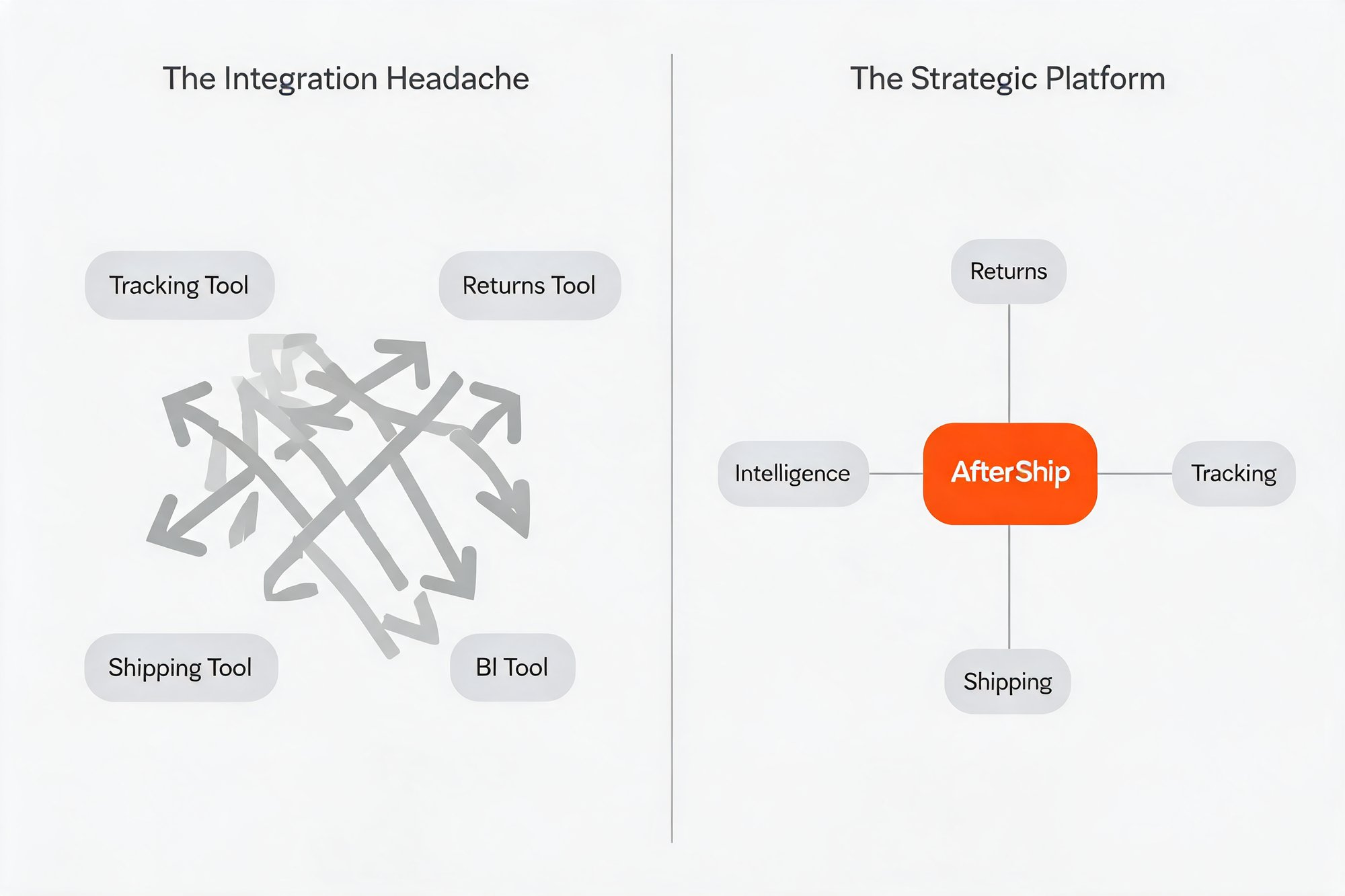
At 25,000-plus orders a month, you do not have a tracking problem. You have a disconnected post-purchase data problem: tracking, returns, shipping and analytics in separate systems that were never designed to talk to each other. US-based sellers sizing that same gap can start with the read for US eCommerce sellers specifically. Looking for ParcelPanel, the Shopify tracking app instead? See the tracking app comparison for a growing store.
The hidden cost of a stitched-together stack rarely shows up on any single invoice. It shows up as engineering build time across multiple vendor APIs; as maintenance every time one of those vendors changes its API; as data-ops work to join tracking, returns and shipping into the single BI view your CFO will trust; and as an inconsistent customer experience, where the tracking page, the returns flow and the delivery promise each look like they came from a different company, because they did.
A unified post-purchase platform answers that at the architecture level, not the feature level. When tracking and returns share one data model, shipment data syncs once and returns automation reacts to delivery status instead of waiting on a nightly export and a brittle join.
So let us start where you started: core tracking.
Head-to-head: AfterShip vs Parcel Perform on core tracking
On the capability most buyers shortlist first, the two are close, and Perform.AI is a serious tool here. The rows below are the ones you can check yourself rather than take on trust: Perform.AI's homepage, its Post-Purchase Experience product page, the rebrand announcement, the developer portal and the pricing URL that returns a 404, plus the G2 listing, all read on 3 November 2026. AfterShip publishes this page, so every rival fact carries its source and read date, and the places where Perform.AI is the better fit are named rather than buried.
| What you can check | AfterShip Tracking | Parcel Perform (Perform.AI) |
|---|---|---|
| Carriers read | 2,000+ (AfterShip carrier directory, 3 Nov 2026) — up from the 1,000+ and 1,400+ still quoted in older comparisons, including some of our own older pages | "1,100+ carriers" on the homepage; "over 1,078+ carriers globally" on the Post-Purchase product page (both 3 Nov 2026) |
| Status depth | 7 main statuses, 33 sub-statuses; sub-status reporting from Essentials up | 155+ standard shipping events (perform.ai, 3 Nov 2026) |
| USPS data access | Covered by a USPS tracking licensing agreement effective 1 April 2026 (announcement) | Not documented |
| EDD accuracy | AI EDD: up to 95% accuracy, 80%+ delivery coverage, trained on 11B+ shipments. Premium and Enterprise | No published accuracy figure; EDD positioned as "based on how carriers actually perform" |
| Pricing | Published per-plan ladder, priced by shipment volume (see the table below) | Demo-only. perform.ai/pricing returns a 404; G2 lists "Free Trial · Book a demo" (3 Nov 2026) |
| SLA you can read before signing | Enterprise SLA is a public document: 99.9% monthly uptime, a service-credit schedule, response targets by severity, maintenance notice terms | Publishes 99.9% uptime on its site; no public SLA document found on 3 Nov 2026 |
| What reviewers say | G2 4.7/5 from 311 reviews; Shopify App Store 4.6/5 from 1,515 reviews (both 3 Nov 2026) | G2 4.7/5 from 41 reviews, largest segment Mid-Market; no Shopify App Store listing found on 3 Nov 2026 |
| Certifications | SOC 2 and ISO 27001, documented in the Trust Center | ISO 27001 (certified by TÜV SÜD PSB) and GDPR-compliant, per perform.ai (3 Nov 2026) |
Three rows deserve a verdict rather than a glance.
Carrier coverage is the one apples-to-apples row, and it is worth saying plainly that Perform.AI's own site disagrees with itself: 1,100+ on the homepage, 1,078+ on the product page. AfterShip Tracking reads 2,000+. Both are deep enough that raw coverage rarely decides it for a single-market DTC brand; it starts to matter the moment you add regional couriers and cross-border lanes. Some carriers require you to connect your own carrier account before data flows, on either platform.
The EDD row is the asymmetric one. AfterShip publishes a number you can hold it to — up to 95% accuracy across 80%+ of deliveries — and is clear that the accuracy figure applies to a subset of major carriers rather than the full network. Perform.AI publishes no accuracy figure at all. That is not the same as being less accurate; it is a difference in what you can verify before you sign. The payoff of a credible delivery promise is conversion (slow or unclear delivery is a documented driver of cart abandonment), not a lift you can bank in a spreadsheet. That WISMO argument is stress-tested against two other platforms in where the claimed reduction gets tested.
On uptime, do not be misled by the headline. Both vendors publish 99.9%, so there is no win on the number. The difference is what sits behind it: AfterShip's 99.9% is a contractual service-credit document you can read before signing, with a published credit schedule and severity-based response targets. Judged on the tracking emails themselves rather than uptime, the two separate again, as we show in an honest verdict on tracking emails.
Tracking is a near-draw that AfterShip narrowly edges. Winning the tracking row is not the same as winning the decision. It is also worth knowing what a free consumer tracking tool leaves out before you shortlist anything paid.
At high volume: rate limits, webhooks and uptime
At 25,000-plus orders a month the questions shift from features to limits. These are the four that decide whether an integration survives peak week.
| Limit | AfterShip Tracking | Parcel Perform (Perform.AI) |
|---|---|---|
| API rate limit | 10 req/sec on Premium, per the published Tracking plans (3 Nov 2026). Per-endpoint detail is published in the rate limit docs; a 429 response carries X-RateLimit-Limit, -Remaining and -Reset headers so you can back off cleanly | Public API v5 over OAuth 2.0 Bearer; rate limits documented in the developer portal's API essentials, not published as a headline figure (3 Nov 2026) |
| How limits are raised | Enterprise plans; raised as part of a scoped contract alongside custom integrations and SSO | Through the account team; no published mechanism |
| Webhook retry | Up to 14 delivery attempts with exponential backoff, 2^n × 30s, spanning roughly 68 hours before the event is dropped (webhook overview) | Webhooks pushed "on every update cycle" with HMAC-verified delivery; retry count and backoff schedule not publicly documented on 3 Nov 2026 |
| Webhook signing | HMAC webhook signature, plus basic auth, bearer token or secret-key custom headers | HMAC-verified delivery, per the developer portal |
| Uptime | 99.9% monthly Service Uptime with a published credit schedule (10% at 99.00–99.89%, rising to 100% at or below 95.00%), 30 days' notice for scheduled maintenance, capped at eight hours per session and twice a month — all in the Enterprise SLA | 99.9% uptime stated on perform.ai; terms not published |
Both publish 99.9%. The difference is that AfterShip's is a contractual service-credit document readable before signing, and Perform.AI's is a marketing figure. Neither is a promise your traffic will not spike; what a retry policy buys you is that a dropped webhook during a carrier data burst does not become a silently missing shipment. If you are building against either API, read the AfterShip Tracking API overview and the Trust Center before your security review, and the longer read on whether Parcel Perform earns its price for the commercial side.
What AfterShip Tracking actually costs
The old version of this page said the comparison was "not on sticker price". That was a dodge. AfterShip publishes its ladder; here it is, read from the AfterShip Tracking pricing page on 3 November 2026, annual billing.
| Shipments / month | AfterShip plan | Published price | Channel | Parcel Perform |
|---|---|---|---|---|
| 1,000 (12,000 / year) | Essentials | $49 / month | Direct | Demo-only, custom quote |
| 1,000 (12,000 / year) | Premium (adds AI EDD, API & webhooks, custom domain) | from $59 / month at 6,000 / year | Direct | Demo-only, custom quote |
| 5,000 (60,000 / year) | Essentials | $199 / month | Direct | Demo-only, custom quote |
| 5,000 (60,000 / year) | Premium | $479 / month | Direct | Demo-only, custom quote |
| 25,000 (300,000 / year) | Essentials | $999 / month | Direct | Demo-only, custom quote |
| 25,000 (300,000 / year) | Premium | $1,999 / month | Direct | Demo-only, custom quote |
| Above 300,000 / year | Enterprise | Custom quote based on annual shipment volume and scope | Direct | Demo-only, custom quote |
Overage runs $0.08 per extra shipment on Essentials and $0.12 on Premium. A Shopify-billed ladder also exists on the App Store listing — $11/month at 100 shipments, $70/month at 500 — but treat that as a secondary, app-store-billed route for smaller stores, not the figure to plan an enterprise rollout against. AfterShip list prices change on 17 November 2026, so re-check before you quote these internally.
Two corrections worth stating outright. The "$118 per 1,000 shipments" figure that circulates in older comparisons is not a current AfterShip price. At 1,000 shipments a month the current plan is Essentials at $49 a month on annual billing, read on 3 November 2026. And the Enterprise tier is a custom quote based on annual shipment volume and scope, priced on total volume within AfterShip, adding a dedicated CSM and onboarding, Enterprise SLAs and SSO, custom integrations and multi-org management. There is no published per-shipment Enterprise rate, and any number you see quoted as one did not come from us.
Perform.AI publishes nothing at any volume. Its pricing URL returns a 404 and G2 records its pricing as "Book a demo" (both 3 November 2026). That is a legitimate enterprise go-to-market choice, not a failing — but it does mean you cannot build a business case for Perform.AI without first booking a call, and you can for AfterShip.
Beyond tracking: returns, shipping and analytics on one data model, side by side
Core tracking is one piece of the post-purchase job. "Where is my order" sits alongside returns, shipping decisions and the analytics that tie them together. Judge two vendors on tracking alone and you optimize one part of the problem while leaving the rest unmanaged. Widen the field to the CX suites and you get parcelLab and Narvar seen from the AfterShip side.
To be fair, Perform.AI now sells a full Returns Experience product and a Logistics Experience that books labels and audits carrier invoices, so this is not a question of who has a returns feature. The real question is narrower: whose tracking, returns, shipping and analytics share one data model, one login and one API, versus whose are separate products you integrate and maintain yourself.
Turn tracking insight into lower returns
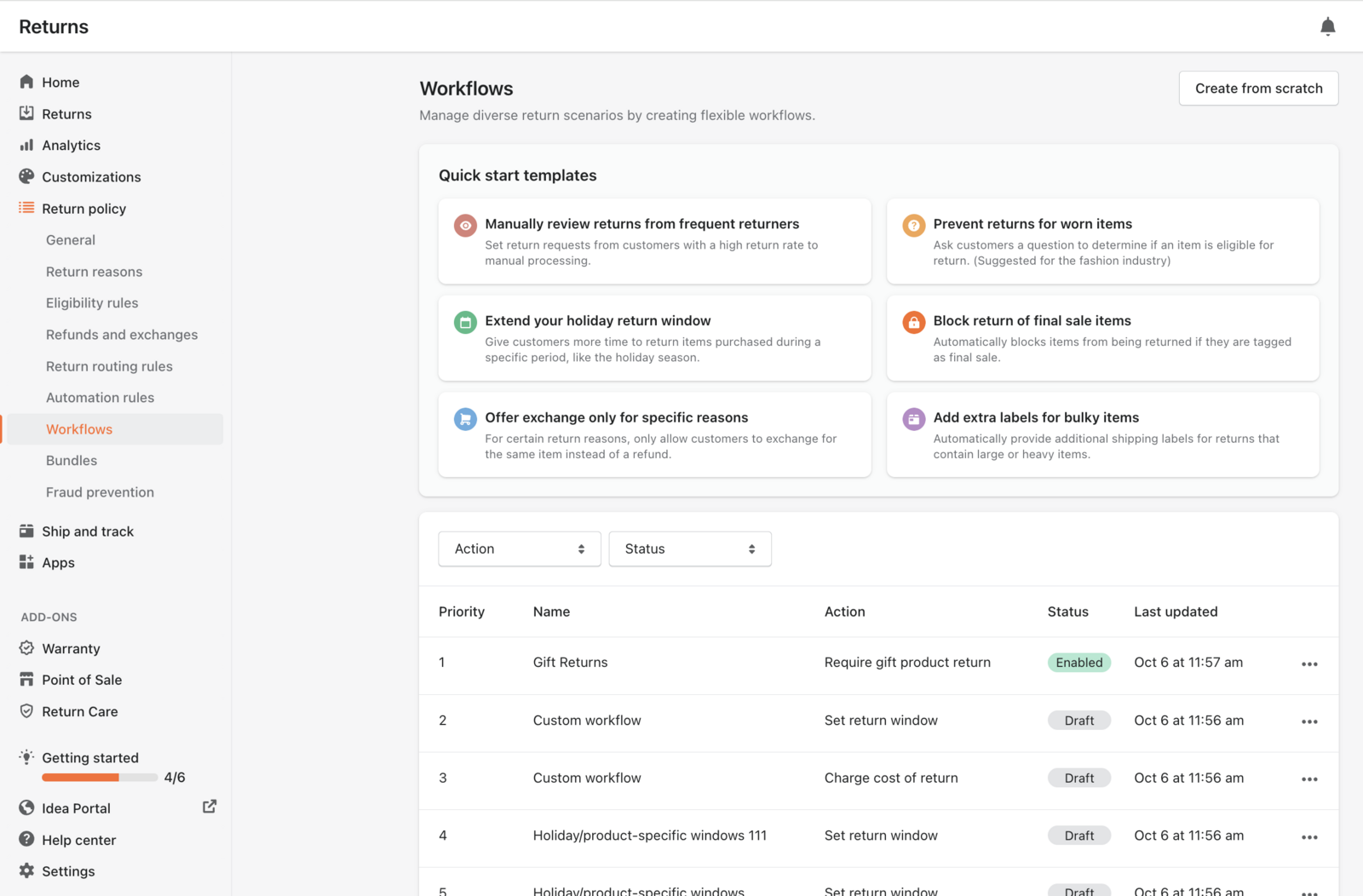
Returns are where a shared data model pays for itself first. Because Tracking and Returns sit on the same platform and dashboard, your team reads return reasons — colour, quality, size, broken out by SKU and variant — alongside delivery and transit performance, instead of exporting from one vendor, exporting from another and stitching the two together every week. Testing whether a size-driven return rate tracks with your slower lanes is a correlation your team runs across the shared data, not a prebuilt report that hands you the answer. The benefit is narrower and real: the inputs already sit on one platform, so analysis starts from one source instead of a weekly reconciliation job.
It drives action too. AfterShip Returns can auto-create exchange orders based on delivery statuses, so an exchange moves the moment the original parcel is confirmed delivered, keeping the customer in product rather than in a refund queue. One precision point: the "delivery date" a return-window rule keys off comes from your eCommerce platform's order record, not from a carrier scan. Return labels span 70 carriers.
Use delivery data to optimize shipping cost
Tracking data is only valuable if you have somewhere to act on it, and a standalone tracking tool hands you the read-out with no controls attached. On one platform, that delivery data feeds your multi-carrier shipping strategy.
Three concrete mechanisms. Carrier performance analytics by lane, so a carrier that quietly degrades on a key route becomes visible before it costs you a peak season. Rule-based carrier selection in AfterShip Shipping, with side-by-side rate and delivery-time comparison, so the cheapest acceptable service wins by rule rather than by habit. And an AI shipping rule that uses the last 30 days of your Shopify tracking data to configure shipping rules for you.
Be precise about that last one. The AI shipping rule is scoped to the Shopify EDD widget and available on Premium and Enterprise; it tunes carrier and ship-from choices from your own recent history. It is not a universal one-click cheapest-carrier optimizer across every sales channel. Shipping spans 130+ carriers using your own accounts and negotiated rates.
Unify the data in AfterShip Intelligence
The payoff is one place to look. Analytics from AfterShip Intelligence bring tracking performance and returns analysis into a single dashboard, so on-time rate and returns-by-reason live in the same view instead of arriving as three exports someone reconciles before anyone can act. At 25,000 orders a month, that reconciliation is analyst hours every week and a reporting lag that pushes decisions a cycle late.
Be accurate about how the AI works across products. The documented cross-product join is prediction-side: Logistics AI uses Catalog AI product tags to sharpen delivery-date predictions, so what the catalogue knows about a product improves what the model promises about its arrival. That is a real connection between two products on one data model. It is not a returns-to-carrier correlation report that names the carrier damaging your goods; that report does not exist, and a credible business case should not lean on it.
Merchants on Magento can see what a single order record looks like in practice in how the platforms handle one order record.
If Parcel Perform and AfterShip are not your only options
Four names come up in the same evaluations, and they are not interchangeable.
- Narvar — the long-established enterprise CX vendor, sold quote-only, strongest where a large retailer wants a managed delivery-communications programme rather than an API. We cover it in our Narvar comparison.
- parcelLab — the managed, EU-centric option spanning tracking, messaging, returns and delivery promises, with its team owning the experience rather than yours. Two-way detail in our comparison with parcelLab, and the enterprise shortlist in enterprise alternatives to parcelLab.
- Metapack — a carrier-management and delivery-options layer aimed at large European retailers with complex carrier contracts; the right call when carrier allocation, not customer communication, is the bottleneck.
- EasyPost — a developer-first shipping and tracking API, cheapest per shipment at almost any volume if you are willing to build the customer-facing layer yourself. If your team wants raw endpoints rather than a product, it belongs on the list.
The fuller enterprise shortlist, including where each of these wins outright, is in Parcel Perform alternatives for enterprise. For the three-way between AfterShip, Narvar and parcelLab, start with the three-platform comparison.
The verdict for high-growth brands in 2026
Start with a brand running the consolidated setup this comparison argues for. Aetrex runs AfterShip Tracking and Returns together and cut operating costs 50%, support tickets 74% and return-processing time 86%, with NPS up 141, across 120K+ packages a year. That is a consolidated-operations result, not a single-feature one: the savings come from one team working one data model.
Breadth tells the same story under pressure. Mejuri runs Tracking, Returns, EDD and Warranty on the platform and deflected 2,500+ WISMO inquiries in a single peak week — the exact scenario that pushes most brands into this evaluation.
What we checked across all of it: carrier count, API rate limits, webhook retry policy, uptime and SLA terms, published pricing and third-party review scores — not a side-by-side latency or accuracy test. So here is the call, with a clear use case for each tool. If you need deep, normalized cross-border logistics data to pour into a heavily customized BI stack — particularly across European regional carriers — Parcel Perform is a capable choice, and it now sells returns and carrier booking too. Its customer list skews that way for a reason, and its G2 reviewers rate its support and customization highly. If you are a high-growth DTC brand scaling the whole post-purchase experience, with tracking, returns, shipping and analytics on one data model, AfterShip is the platform, and you can price it, read its SLA and check its retry policy before you ever speak to a salesperson.
On cost, be honest about what you are comparing. Above 300,000 shipments a year both are custom Enterprise deals. Below that, AfterShip has a published price and Perform.AI does not. Either way the real number is total cost of ownership: one platform means one login, one data model and one API — not one invoice, since each product is still billed separately and there is no multi-year price freeze to bank on. Returns are a structural cost rather than a tail risk: industry-wide, roughly 19.3% of online sales are returned (NRF 2025), an industry figure rather than a number for any one brand, which is exactly why consolidating returns onto the same platform as tracking matters at scale. Against that sits the standing cost of a stitched stack — the engineering, maintenance and data-ops that never appear on a vendor quote.
The decision is not which tracker wins a feature checklist. It is whether you are buying a data feed or a platform, and at your scale the platform is the one that compounds. The customer-facing side of that is also a brand-perception question, answered in which tracking option protects brand reputation better.
Branded tracking, AI delivery estimates and proactive notifications across 2,000+ carriers — on the same data model as Returns, Shipping and Warranty.
See Tracking pricingFrequently asked questions
Is Parcel Perform the same company as Perform.AI?
Yes. Parcel Perform renamed itself Perform.AI in 2026; parcelperform.com now redirects to perform.ai. The company's own FAQ states that logins, data, contracts, commercial terms and account teams are unchanged, and that its legal name has not changed (read 3 November 2026). If you are an existing customer, nothing migrates. If you are evaluating, expect to find the product documented under the new name and the older reviews and comparisons under the old one.
What are AfterShip's API rate limits at high volume?
AfterShip Tracking's published rate limit is 10 requests per second on Premium plans, per the pricing page (read 3 November 2026). Per-endpoint detail is published in the rate limit documentation, and every response carries X-RateLimit-Limit, X-RateLimit-Remaining and X-RateLimit-Reset headers so your client can back off before it hits a 429. Higher limits are negotiated as part of an Enterprise contract. At 25,000-plus orders a month most teams stop polling and subscribe to webhooks instead, which retry up to 14 times with exponential backoff rather than dropping an event on the first failure.
How many carriers does AfterShip track?
AfterShip Tracking reads 2,000+ carriers, up from the 1,000+ and 1,400+ figures still quoted in older comparisons — including some of our own older pages, which we are correcting. Perform.AI publishes 1,100+ on its homepage and 1,078+ on its Post-Purchase product page (both read 3 November 2026). A handful of carriers on either platform require you to connect your own carrier account before data flows. AfterShip's USPS data access is covered by a tracking licensing agreement effective 1 April 2026.
Is AfterShip cheaper than Parcel Perform?
You cannot compare like for like, because Perform.AI publishes no prices — its pricing URL returns a 404 and G2 records it as demo-only (read 3 November 2026). AfterShip publishes a ladder: on annual billing, Essentials is $49 a month at 1,000 shipments a month, $199 at 5,000 and $999 at 25,000; Premium, which adds AI delivery estimates, the API and a custom domain, is $479 at 5,000 and $1,999 at 25,000. Above 300,000 shipments a year it is an Enterprise quote based on annual shipment volume and scope. Every figure is on the AfterShip Tracking pricing page; prices change on 17 November 2026.
Does Parcel Perform offer returns management?
Both do, and the difference is architecture rather than whether the feature exists. Perform.AI sells a Returns Experience product alongside its delivery and logistics modules. AfterShip Returns runs on the same data model, login and API as Tracking, Shipping and Intelligence, with return labels across 70 carriers and 300K+ drop-off sites covering 95% of customers worldwide, so a multi-product rollout is one platform rather than several products you integrate and maintain yourself.
Can AfterShip recommend the cheapest or most reliable carrier automatically?
AfterShip surfaces on-time and cost performance by carrier and lane, then lets you turn that into automated carrier-selection rules in AfterShip Shipping. On Premium and Enterprise, AfterShip's AI can auto-configure shipping rules from your last 30 days of delivery data, currently scoped to the Shopify EDD widget. It is not a universal one-click optimizer across every sales channel, and you should not buy it expecting one.
Is Parcel Monitor part of Parcel Perform?
Parcel Monitor is a free consumer-facing tracking site operated by the same company, now Perform.AI. It is a shopper tool, not the enterprise product, and the two should not be shortlisted against each other. We set out what a free consumer tracker does and does not cover in our Parcel Monitor comparison, and what it means for how your brand appears during delivery in the reputation piece.
What do reviews say about AfterShip vs Parcel Perform?
On G2 (read 3 November 2026), AfterShip holds 4.7/5 from 311 reviews with a Small-Business-weighted reviewer base, and Parcel Perform holds 4.7/5 from 41 reviews with a Mid-Market-weighted base. Reviewers praise Perform.AI's support responsiveness, customization and carrier integration, and flag reporting gaps; AfterShip's reviewers praise support and integrations, and flag pricing at higher volumes. On the Shopify App Store, AfterShip Order Tracking holds 4.6/5 from 1,515 reviews; we found no Shopify App Store listing for Perform.AI on that date. Volume matters here: 311 and 1,515 reviews describe a much wider range of businesses than 41 do.
Is AfterShip safe for enterprise data?
AfterShip documents SOC 2 and ISO 27001 in its Trust Center, and the Enterprise SLA is a public document setting out 99.9% monthly uptime, a service-credit schedule, severity-based response targets and maintenance notice terms — all readable before you sign. Enterprise plans add SSO, DPAs and the security reviews procurement asks for. Perform.AI states ISO 27001 certification and GDPR compliance on its site, and publishes 99.9% uptime, but no SLA document was publicly available on 3 November 2026.