Your returns platform advertises a revenue-retained percentage. Ask it what the denominator is. For a brand doing 5,000 to 50,000 orders a month, the difference between a headline number and a measurable one is the difference between a business case that survives the CFO and one that does not.
Narvar is a reasonable place to have started. At 5,000 to 50,000 orders a month the question changes: it stops being whether a platform has exchanges and becomes whether you can inspect how they work. This comparison scores Narvar Shield against AfterShip Returns, Loop Returns and Happy Returns on what each documents. If you want the field beyond these four, we mapped a broader sweep of the vendors brands switch to.
Why Narvar Returns Falls Short for High-Volume Operations
Three things break down at this volume.
- The documentation gap. Narvar markets exchange outcomes clearly: exchanges of "same or different value", a credit bonus on store credit, and up to 45% of refunds converted (Narvar's Shopify solutions page, read 22 August 2026). The mechanics are another matter. Which payment rail collects a price difference on Shopify. What happens to the remainder when the replacement costs less. Out-of-stock behaviour, instant exchanges, open-catalogue browse, rule limits. None of it is documented on Narvar's Shield product page, its Shopify solutions page or its help centre (all read 22 August 2026). The one place Narvar documents uneven exchanges and names payment processors is a March 2025 blog post scoped to Salesforce Commerce Cloud, which is not your platform.
Every returns vendor advertises a revenue-retained percentage. Narvar publishes 60% revenue retained through exchanges and gift cards. Loop publishes up to 50%, stated about its Bonus Credit feature. Happy Returns publishes up to 50% as well, stated about its Return and Exchange Portal as a whole. None of them publishes the denominator: 50% of what, across which merchants, over what period. AfterShip's answer to the same question is a definition rather than a headline number: retained revenue is exchange revenue plus store credit revenue plus Shop Now revenue, measured against the value of returned items. Ask every vendor, including AfterShip, for the definition and a cohort that looks like your brand.
- Automation you cannot inspect. Narvar states tailored return flows, policies and fees by product or customer segment, plus intelligent dispositioning (Narvar's Shopify solutions page, read 22 August 2026). No rule syntax, no worked example, no stated limits. You cannot size the configuration work before you sign.
- Commercial structure, not silos. Narvar sells eight product lines: Promise, Secure, Track, Notify, Assist, Shield, Narvar Agentic and IRIS. Each line is a separate commercial decision, so every step deeper into post-purchase compounds cost, and Narvar publishes no pricing anywhere (Narvar's returns and exchanges product page, read 22 August 2026). Choosing among the best ecommerce returns platforms means pricing the whole surface, not one product at a time.
The 2026 Evaluation Checklist: 5 Features That Define a Strategic Returns Platform
Five criteria decide this category at volume. Apply them to every vendor on the shortlist.
- Exchange reach and settlement. Can the shopper reach the whole catalogue, or only a variant of the item being returned? How is a price difference collected, and through which payment rail? What happens when the replacement is out of stock? Put those three questions to all four vendors and you get four genuinely different answers.
- Granular automation engine. Conditional logic for approvals, routing and resolutions, with its limits stated in writing.
- Multi-carrier flexibility and cost control. Carrier choice inside the returns product itself, with published carrier and drop-off figures.
- Actionable analytics. Whether the platform reports retained revenue as a measurable ratio with a stated denominator, or as a marketing percentage.
- Deep ecosystem integrations and platform scope. Which commerce platforms, warehouses, helpdesks and payment rails are supported natively, and which need a custom implementation.
Narvar Competitors: AfterShip, Loop & Happy Returns Compared
The five criteria above resolve into six rows here, because multi-carrier flexibility and cost control splits into carrier network and international returns. Every cell is traceable to a vendor surface and the date it was read. Where a vendor markets an outcome but publishes no mechanic, the cell reads UNDOCUMENTED rather than no: the capability may well exist, and what is missing is the specification you would need to plan against it.
| Criteria | AfterShip Returns | Loop Returns | Happy Returns | Narvar Shield |
|---|---|---|---|---|
| Exchange reach and settlement (catalogue reach, price-difference rail, out-of-stock behaviour) | Any catalogue item; upcharge via Shopify or Stripe Checkout, which holds the exchange order until conditions are met | Shop Now, Instant Exchange and Bonus Credit gated to Advanced, from $340/month (loopreturns.com/pricing, 26 Aug 2026); free Checkout+ claims all of Loop's best functionality | "Different variants of the same item and price"; auto-converts to refund below the Inventory Threshold | Advertises "same or different value" exchanges; rail, remainder and out-of-stock behaviour UNDOCUMENTED |
| Automation engine granularity | Condition-and-action rule builder; published example: free returns for anyone tagged VIP | Documented workflows and routing rules; advanced workflows on paid tiers | Policy-level controls including Inventory Threshold; no rule syntax published | Advertises tailored flows and intelligent dispositioning; syntax and limits UNDOCUMENTED |
| Carrier network and cost control | 70 carriers for label generation; 310,000+ returns drop-off locations (aftership.com/returns) | EasyPost labels: Royal Mail and FedEx unmarked as return labels by default | Publishes 10,000 Return Bar locations, box-free and label-free | Advertises 200,000+ carrier and retail locations (Shopify solutions page, 22 Aug 2026) |
| International returns | Multi-carrier international returns inside the returns product | Cross Border Returns on Advanced; two published international case studies | UNDOCUMENTED on the surfaces reviewed | Marketed as global; mechanics UNDOCUMENTED |
| Retained-revenue analytics | Definition and ratio published, so each component can be recomputed | Headline figure advertised for Bonus Credit; denominator UNDOCUMENTED | Headline figure advertised portal-wide; denominator UNDOCUMENTED | Headline figure advertised for exchanges and gift cards; denominator UNDOCUMENTED |
| Platform scope | Shopify Exchange API stays Shopify-only; upcharge documented for Shopify, BigCommerce and Salesforce Commerce Cloud, across 25 platforms, multi-storefront caveat | Non-Shopify only via custom implementation | Return Shopping upsell scoped to Shopify retailers | Advertises BigCommerce; exchange mechanics documented for Salesforce Commerce Cloud only |
Loop and Happy Returns are not independent alternatives. Happy Returns runs a Preferred Portal Partner Program, Loop documents a Happy Returns integration, and Loop's free tier lists Return Bars. They are commonly deployed together.
Shopify App Store, read 26 August 2026: AfterShip Returns and Exchanges holds 4.7 from 1,393 reviews and carries the Built for Shopify badge. Loop holds 4.7 from 410 reviews. Narvar holds 4.6 from 18. Happy Returns holds 3.1 from 23.
Deep Dive: How AfterShip's Exchange & Automation Engine Retains More Revenue
The callout above asked every vendor for a definition and a denominator. AfterShip's answer starts with the mechanic that produces the number.
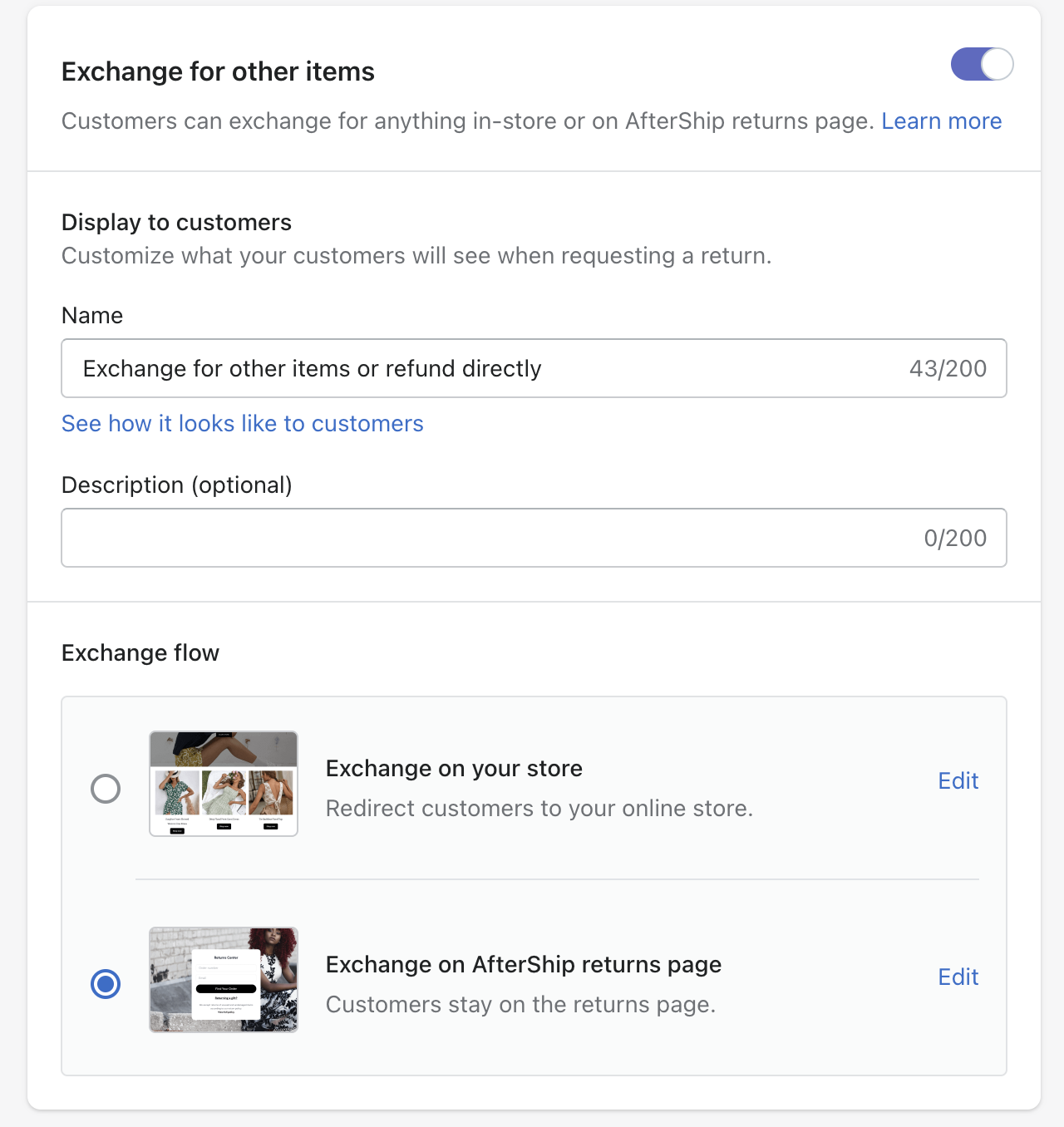
An AfterShip exchange is not confined to a variant of the item coming back; the shopper can exchange for any item in the catalogue. When the replacement costs more, the difference must be collected. AfterShip Returns collects exchange upcharges through Shopify Checkout or Stripe Checkout. The documentation covering how exchange upcharges are collected names the supported platforms: Shopify, BigCommerce and Salesforce Commerce Cloud. A BigCommerce merchant settles the difference through Stripe Checkout, and that is documented.
The two rails behave differently, and the difference is operational. A Shopify Checkout exchange has to be created as an immediate purchase, so the replacement order exists before the returned item has arrived. The Stripe route captures payment and then holds the exchange order until the merchant's conditions are met, which AfterShip documents as a route that "helps eliminate the risk of shipping new items to customers before receiving the returned items." AfterShip also documents that Stripe exchange transactions carry only Stripe's own transaction charges, with no AfterShip charge.
That settlement path makes the measurement checkable. AfterShip reports retained revenue as exchange, store credit and Shop Now revenue combined. The ratio is that combined total divided by the total value of returned items. Both halves are published, so you can recompute the figure against your own quarter and see which component carries it. Ask AfterShip for that ratio on a cohort that resembles your brand, on the same terms as every other vendor. How AfterShip reports retained revenue is set out in its return analytics documentation, so the formula is inspectable before you commit.
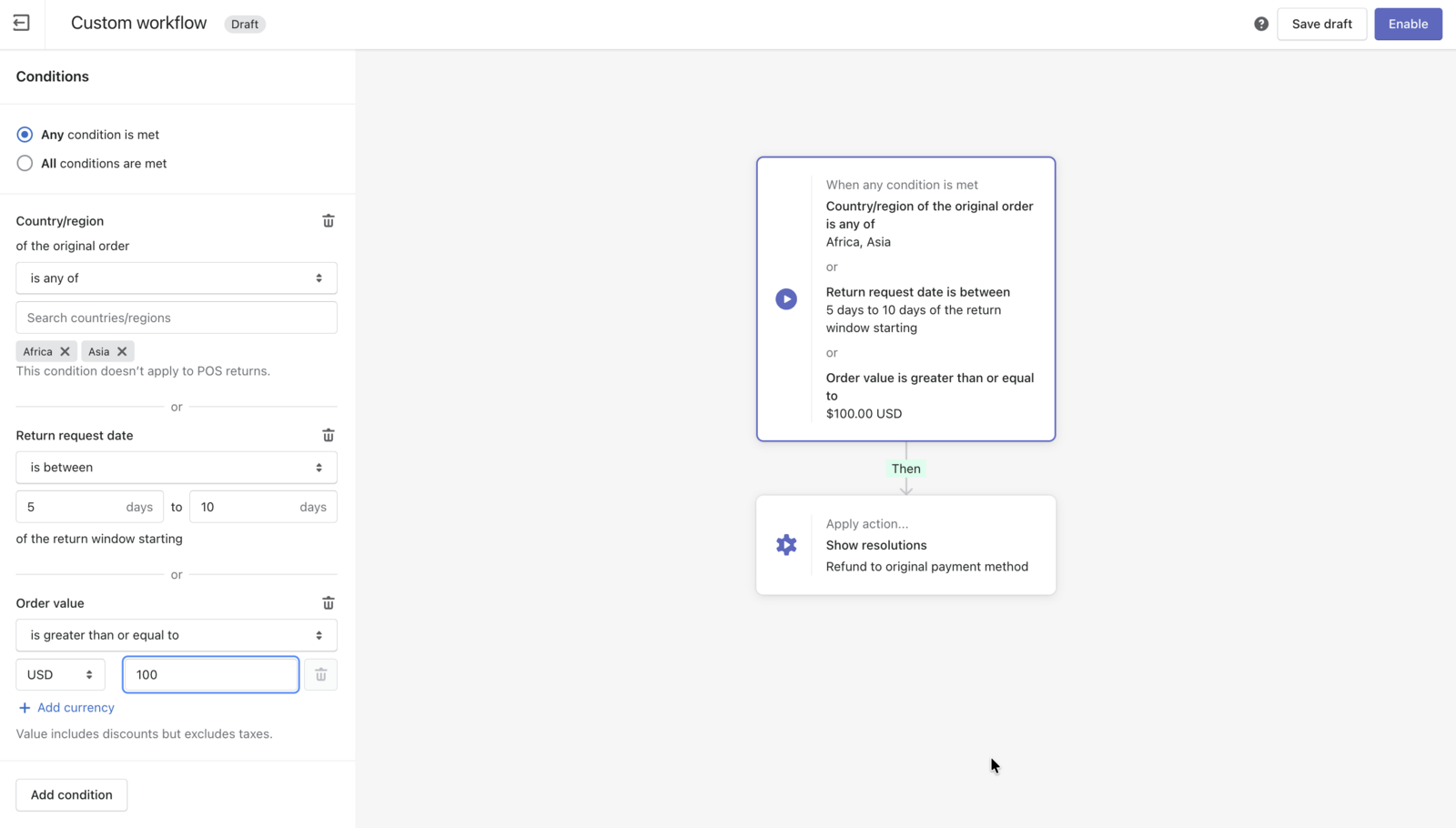
Automation is where a return stops consuming staff time. AfterShip's rule builder pairs conditions with actions. A condition reads something known about the return, such as the order tag, the return reason, the item value or the destination zone. The action decides what follows, such as auto-approving the return, limiting which resolutions the shopper sees, routing the parcel to a different warehouse, or holding a refund until a tracking scan lands. AfterShip publishes one worked rule of exactly this shape: free returns for anyone tagged VIP. Chaining several conditions together is a supported configuration; the VIP rule is the published example of the shape. The granular refund and exchange settings sit alongside these rules and govern what each resolution may do.
Reach is not parity, and the gap deserves precision. The Shopify Exchange API and native Shopify store credit remain Shopify-only. AfterShip's own BigCommerce listing states the app may not be fully compatible with multi-storefront, which multi-storefront merchants should establish during evaluation. None of the four platforms compared here is as strong off Shopify as on it. AfterShip is the one of the four that publishes both the settlement rail and the caveat before you sign, the only basis on which a business case at this volume can be checked.
What About Loop Returns?
Loop documents its exchange engine in public detail. Its constraints are documented too, and they are what decide fit.
Loop is Shopify-native, and support for other commerce platforms runs through custom implementation on longer timelines. Where labels route through EasyPost, Loop documents that Royal Mail and FedEx labels are not marked as return labels by default, which matters wherever carrier billing or customs treatment depends on that flag. Shop Now, Instant Exchange and Bonus Credit are gated to Loop's Advanced tier, though Loop's free Checkout+ tier claims all of Loop's best functionality and is monetised through package protection, so the gating point holds only with that qualifier attached (loopreturns.com/pricing, read 22 August 2026).
Loop documents its exchange mechanics, open-catalogue Shop Now, instant exchanges, AI-assisted exchange suggestions, bonus credit, variant and advanced exchanges, in more public detail than AfterShip does, and some third-party comparisons read Loop's exchange layer as the more specialised one. Where AfterShip pulls ahead is breadth: a single post-purchase platform with multi-carrier control, native Shopify exchange rails, and support for commerce platforms beyond Shopify without a custom implementation. Shopper-side depth is judged separately in which alternative gives shoppers the smoother returns experience.
And Happy Returns? The In-Person Drop-Off Specialist
Happy Returns describes itself as returns software and reverse logistics, selling a Return and Exchange Portal. The network is the draw: 10,000 Return Bar locations, box-free and label-free.
The trade-off is exchange scope: "Enable Exchanges to allow shoppers to exchange for different variants of the same item and price." Happy Returns exchanges are limited to different variants of the same item and price. The same page defines an Inventory Threshold: the minimum inventory required to allow an exchange. Below it, the exchange automatically converts to a refund when the shopper completes it (retailersupport.happyreturns.com/return-experience/return-policies, page carries no publication date, read 19 August 2026). A shopper who came to swap an item leaves with their money back instead, and the revenue leaves with them.
Platform scope narrows on the upsell: "Shopify retailers can incentivize shoppers to make a purchase during their return experience with our Return Shopping feature" (happyreturns.com/ecommerce-return-exchange-portal, read 22 August 2026). AfterShip's printerless QR drop-off names FedEx, USPS, Royal Mail and Canada Post within its published drop-off network.
The Verdict: Which Narvar Competitor Is Best for Your DTC Brand?
For a high-volume DTC brand that needs operational control, automation it can inspect, and multi-carrier reach across more than one commerce platform, AfterShip Returns is the strongest of the four. Enterprise buyers run a different checklist, set out in what an enterprise retailer weighs before signing with Narvar.
For a Shopify-native brand whose single priority is exchange depth and whose budget covers Loop's Advanced tier, Loop is a genuine alternative.
For a brand whose strategic goal is in-person, box-free returns, Happy Returns' network is the reason to buy, with same-item, same-price exchange scope as the constraint.
Narvar remains a credible enterprise incumbent with a wide product line and a large published drop-off network, as the drop-off row in the table above sets out. The gap is what it publishes about exchange mechanics on Shopify and BigCommerce. The same four platforms are taken further in AfterShip vs Narvar for enterprise returns, and on the specific question of exchange mechanics AfterShip is the one that publishes them. Its strongest ground is tracking, which we weigh separately in AfterShip vs Narvar on order tracking.
Frequently Asked Questions
What is the pricing difference between AfterShip, Loop and Narvar?
Compare the models before the numbers. AfterShip publishes a self-serve ladder: 240 returns a year on Essentials and 1,200 a year on Premium (aftership.com/pricing/returns, read 22 August 2026), and above that it is a custom Enterprise quote, so the full ladder is not published. Loop publishes Checkout+ (free), Essential and Advanced, and gates Shop Now, Instant Exchange and Bonus Credit to Advanced, though the free Checkout+ tier claims all of Loop's best functionality and is monetised through package protection. Happy Returns and Narvar publish no self-serve pricing. Narvar's Shopify app listing shows Free with no paid tiers, which is not a published price for an enterprise deployment. A brand at this volume is comparing custom quotes on every side. AfterShip's advantage here is transparency and a self-serve entry point, not a lower price.
Can I use AfterShip just for returns, or do I need the whole suite?
Standalone. AfterShip Returns and Exchanges is sold as its own app with its own plan ladder, and nothing else in the range is required to run it.
How long does it take to migrate from Narvar to AfterShip Returns?
Migration here is a reconfiguration. Orders, products, variants and customers connect natively through Shopify or BigCommerce, so the catalogue is never re-keyed. What gets rebuilt: return policy and window, return reasons, resolution rules, routing and return zones, carrier and label accounts, warehouse addresses, branding and notification flows. Guided onboarding is standard at mid-market, and an existing return policy can pre-fill much of the configuration. Typical go-live is measured in weeks. Plan a short overlap so in-flight returns finish in the old system. On published timelines, Loop states conflicting figures on its own surfaces and Narvar's three-week figure is scoped to Salesforce Commerce Cloud, so neither transfers here. AfterShip publishes the configuration surface you will be rebuilding, so the work can be scoped before it starts.