If you are comparing Narvar and Returnly in 2026, the comparison has already resolved itself. Returnly stopped processing returns on 1 October 2023, after Affirm divested it. Five software directories still present it as a current product. One of them, SoftwareSuggest, offers a Free Demo and a Get Pricing button, on a page whose returns listing was last updated 1 August 2026. So the real question is not which of the two to buy. It is what a returns platform does to your margin, and how much of that you can verify before you sign.

Narvar publishes no price on any surface, but it does publish its contract. Returnly publishes nothing at all, because there is nothing left to publish.
The Real Cost of Returns: Why This Is a P&L Decision
Returns are goods you already paid to ship, recognized as revenue, and now pay to bring back, inspect, and resell at a discount.
The National Retail Federation's 2025 Retail Returns Landscape, published 15 October 2025, sized the damage.
The NRF projected that 19.3% of online sales would be returned across 2025, and found 9% of all returns fraudulent.
The cost side comes from Optoro's 2024 Returns Unwrapped, published 19 November 2024. Optoro sells returns software, so treat it as vendor research: "The cost to return a purchase averages 27% of the purchase price, which erases as much as 50% of the sales margin."
At 1,000 orders a month, that is a manageable leak. At 50,000, it is a headcount decision.
What Happened to Returnly, and What It Should Teach You
Affirm acquired Returnly in 2021 and announced the divestiture on 6 July 2023. Returnly ceased processing returns on 1 October 2023. An Affirm spokesperson said the company did not sell Returnly. Roughly 1,500 merchants had to find somewhere else to run their returns.
The migration is the part worth studying, because it is the part that repeats.
In-flight returns did not transfer. A return already open in Returnly could not move to the next system as an open record. Loop's own migration documentation states it directly: "We do not currently have a way to transfer initiated returns from one returns software to another." That is the successor vendor's own documentation rather than neutral analysis. One integration partner completed 21 Returnly-to-Loop migrations between 1 August and 13 October 2023, against a timeline that normally runs four to six weeks per brand.
Merchants who moved paid twice: for the new platform, and for the weeks their team spent closing open RMAs.
None of that was in a feature comparison. It was in the contract, or missing from it.
Before you sign with any returns vendor, get these four answers in writing:
- What happens to open RMAs on the day the contract ends?
- What is your data-export right, and in what file format?
- How long can you run the old and new systems in parallel?
- What notice period does the vendor owe you before a sunset?
Narvar Shield: The Enterprise Option, Assessed Honestly
Narvar's returns product is Shield, which launched in March 2025. It is capable software, and the comparison is better for saying so.
Narvar documents a rules engine that sets "policies, rules and fees based on customer profile, order, product category, SKU or return reason". It documents a credit bonus applied to store credit refunds. It advertises a drop-off network of more than 200,000 locations, which is larger than anything AfterShip operates directly.
The reframe is about what a buyer can check before signing. Shield is one of several separately sold product lines, and Narvar publishes no pricing on any surface. A capability you cannot price cannot go into a business case.
From Narvar's public surfaces, a buyer evaluating Shield can confirm:
- The rules engine exists and which dimensions it conditions on
- That a store credit bonus is available
- The drop-off network figure Narvar advertises
- The commercial terms in the published Terms of Service
What no public Narvar surface states is the price of any of it.
Narvar's own retention figures do not agree with each other. Narvar's website puts revenue retention at 60%. Narvar's own March 2025 press release puts it at 40%. Both are the vendor's numbers, published by the vendor, 20 percentage points apart.
For a finance lead building a case, that gap is the finding.
What Narvar's Own Contract Says
Narvar does not publish a price. It does publish its Terms of Service, which carry an effective date of 1 May 2024 and sit on Narvar's own legal pages alongside its privacy policy. The reading below was taken in August 2026. Terms change, so check the effective date on the version you are shown.
Four provisions in it matter to a finance lead.
The agreement renews automatically for a period equal to the initial term unless written notice is given at least 30 days before expiry. A missed calendar reminder commits you for another full term.
Thirty days is narrow. The practical control is to calendar the non-renewal date on the day you sign, and to name an owner for it who will still hold that calendar at renewal.
On renewal increases, Narvar's published Terms of Service, effective 1 May 2024, cap the uplift at:
for Renewal Terms not to exceed the greater of (i) ten percent (10%), or (ii) the average of the Consumer Price Index in the United States in effect during the immediately preceding twelve (12) month period.
Model that against a multi-year term. A 10% floor on renewal uplift compounds across every renewal.
On refunds, Narvar's published Terms of Service, effective 1 May 2024, state:
All Fees are non-refundable and non-cancellable except as expressly provided in this Agreement
That language means a mid-term reduction in volume does not reduce what you owe, unless something elsewhere in your order form says it does. If your order volume is seasonal or your category is contracting, the clause to negotiate is the volume commitment on your order form.
The fourth point concerns something the document does not contain. Narvar's published Terms of Service, as read in August 2026, contain no data-export, data-retrieval or data-migration provision. That is a statement about what the document contains. The reason for the absence is not something the document says.
Read those four together and you have the shape of the commitment without ever seeing the number. Given that in-flight returns did not transfer when Returnly shut down, the missing export language is the provision a buyer should price.
The Verdict: Neither Is the Right Answer for Mid-Market DTC in 2026
Returnly cannot be bought at all. That half of the comparison is closed.
Narvar Shield can be bought, and for a certain buyer it is a sound purchase. That buyer has a procurement function, legal review, and room to negotiate terms. They can absorb a term priced in a sales cycle and a renewal that moves on a published cap.
A brand running 1,000 to 50,000 orders a month has none of that. What it needs is a returns platform whose cost levers it can configure in an afternoon, at a price it can read on a page before anyone books a call.
The Alternative: Turning Returns Into Retained Revenue
Marc Nolan runs the kind of returns volume this article is about, and the brand publishes what changed. Exchanges rose from 25% of returns to 49%. Refunds fell from 75% to roughly 50%. Nikolas Callas, the brand's Director of Operations, says the exchange feature saved "$125k in the last 90 days".
“This exchange feature took every problem away. It's also saved a lot of revenue—$125k in the last 90 days.”
Nikolas Callas, Director of Operations
Read their story →Compare what each number rests on. One of them is a percentage a platform advertises about itself. The other is a named brand, a named operator, a stated period, and a figure you can carry into a forecast.
The same test applies to reviews. Read on 24 August 2026, AfterShip Returns & Exchanges holds 4.7 from 1,393 reviews on the Shopify App Store. Narvar Return and Exchange holds 4.6 from 18 reviews. The ratings sit close together. The sample sizes do not, and sample size is what tells you whether a rating describes a platform or a few accounts. The same three pull further apart at enterprise volume, as we show in where AfterShip vs Narvar lands on enterprise returns.
That is the standard AfterShip Returns is built to meet: every claim carries a name, a period, and a number a finance lead can check before committing budget.
The next section covers the three places a returns platform touches your P&L, and who configures them.
Three Financial Levers You Can Configure Yourself
Three levers actually move the cost of a return. You configure each one in the dashboard. None of them requires an account team.
Lever 1: conditional return fees. A routing rule chooses the return method and sets the shipping and handling fee. Layered on top, the "Charge cost of return" action either overrides that fee or adds to it, as a flat rate or as a percentage of return value. The condition can be the return reason, the customer, the product, or any combination you can express as a rule.
State the gate plainly. The "Charge cost of return" action sits at Premium. Routing rules themselves are available from Essentials. If your business case depends on charging one fee for a change-of-mind return and another for a faulty item, you are budgeting for Premium.
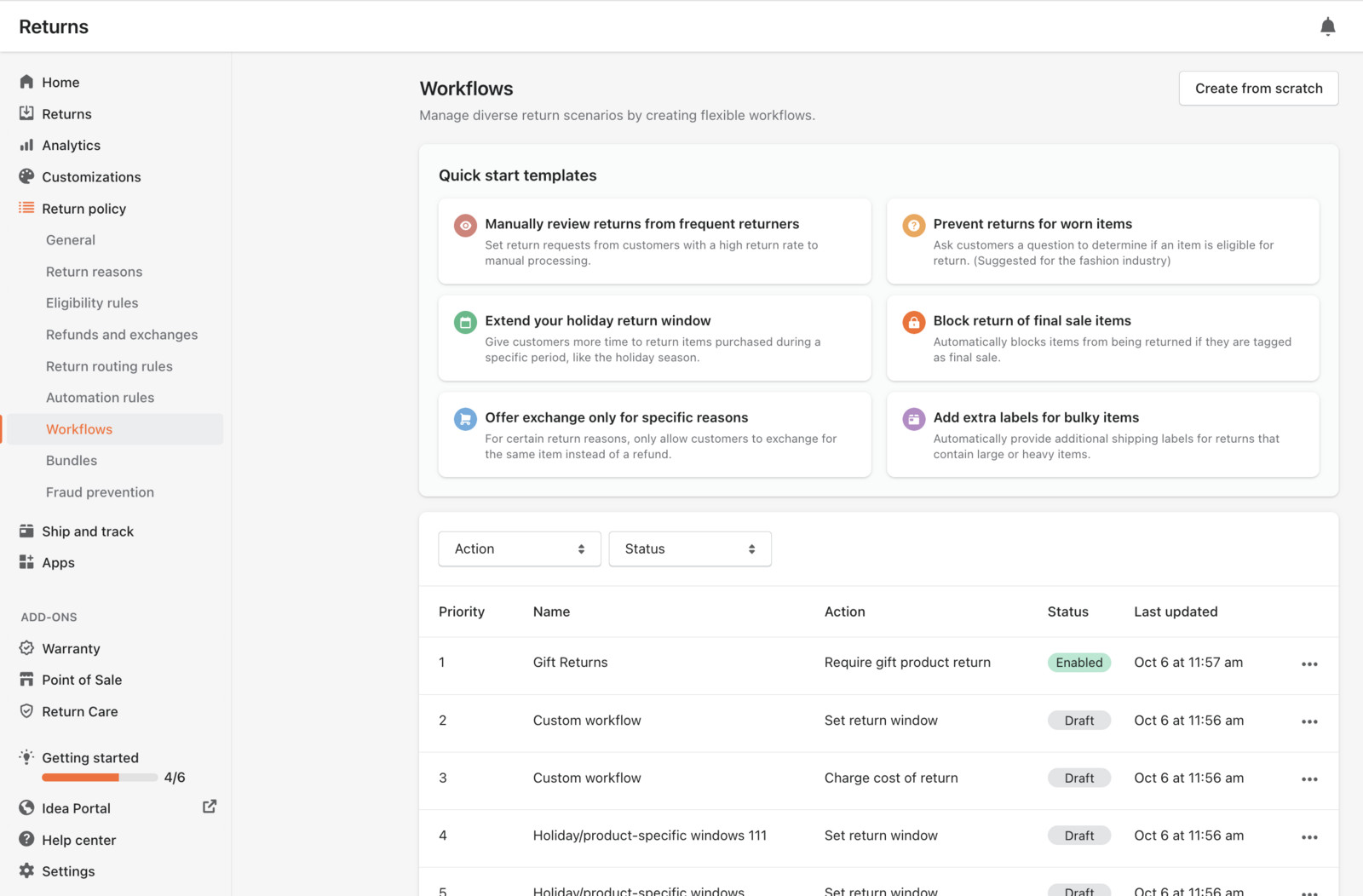
Lever 2: credit incentives. Bonus credit adds a percentage of the refund value, or a fixed amount, on top of what the customer would otherwise receive. Workflows decide who sees the offer and on what conditions, and that is how AfterShip Returns automates exchanges and store credit. Every offer a customer takes is a cash refund that never leaves the business.
Lever 3: label cost. Green Returns lets you refund without collecting the package, configured per return zone with optional auto-refund, for cases where the freight costs more than the recovery is worth. Where you do collect, carrier rate shopping compares live rates before a label is bought. Pre-negotiated rates are available too. The return-label network covers 70 carriers, a figure scoped to return-label generation.
Essentials, Premium and Enterprise are the three published tiers. Read the tier gates before you build the model, because the lever your business case rests on may not sit where you assumed.
Return Care is not a tier. It is a shopper-funded commercial model carrying a revenue share, which moves label cost off your P&L instead of reducing it, and it should be modelled separately from the three levers above.
Narvar vs Returnly vs AfterShip: The Comparison
Six criteria decide this for a finance lead: published pricing, conditional return-fee control and the tier it starts on, revenue retention levers, return label cost control, contract and exit terms, and continuity risk.
| Criteria | Returnly | Narvar Shield | AfterShip Returns |
|---|---|---|---|
| Published pricing | Discontinued 1 October 2023 | Not published | Published on aftership.com: Essentials from $16 and Premium from $99 a month billed annually, plus Enterprise on request |
| Conditional return-fee control, and the tier it starts on | Discontinued 1 October 2023 | Documents a rules engine setting policies, rules and fees by customer, order, product category, SKU or return reason | Charge cost of return, flat rate or percentage of return value: Premium. Routing rules and their shipping and handling fee: Essentials |
| Revenue retention levers | Discontinued 1 October 2023 | Documents a store credit bonus. Publishes retention at 60% on its site and 40% in its March 2025 press release | Exchanges, plus bonus credit as a percentage or fixed amount on top of the refund value |
| Return label cost control | Discontinued 1 October 2023 | Advertises a drop-off network of more than 200,000 locations | Green Returns per return zone with optional auto-refund, carrier rate shopping, and a 70-carrier return-label network |
| Contract and exit terms | Discontinued 1 October 2023 | Auto-renews for a period equal to the initial term, 30 days written notice to stop it, renewal increases capped, and no data-export provision in the published Terms of Service | No annual commitment: monthly and annual billing both published. Self-serve signup with tier gates stated up front |
| Continuity risk | Discontinued 1 October 2023 | Live product from an established enterprise vendor | Live and actively developed. 14+ years operating, more than 20,000 customers |
The Final Verdict: What to Choose in 2026
Returnly is not an option. It has not processed a return since 2023, and any page still offering it is describing something that does not exist.
Narvar Shield is a defensible choice for a buyer with procurement, legal review and a need for a large drop-off network.
Most mid-market DTC brands are not that buyer. For a brand running 1,000 to 50,000 orders a month, the deciding question is whether the levers that protect margin are yours to configure, and whether the price is visible before the first call. On both counts, AfterShip Returns gives a finance lead something to verify rather than something to request. The pricing page is public and the tier gates are stated on it, so the business case is built and checked before the first sales conversation.
Returns automation that enhances the returns and exchanges experience, reduces costs, and retains more revenue.
Book a demoFrequently Asked Questions
Is Returnly still available?
No. Returnly stopped processing returns on 1 October 2023, after Affirm divested it. Software directories that still list it today with a pricing page and a demo button are describing a product that no longer runs anywhere.
What replaced Returnly?
Affirm named Loop Returns the preferred provider for its merchants at the time of the shutdown. Brands evaluating today should compare on published pricing and configurable cost control rather than on who inherited the customer list three years ago.
Does Narvar publish pricing?
No. Narvar publishes no price on any surface. It does publish its Terms of Service, effective 1 May 2024, which set out automatic renewal, a 30-day non-renewal notice window, and a cap on the size of renewal increases.
Which returns platform is best for a mid-market DTC brand in 2026?
For a brand running 1,000 to 50,000 orders a month, AfterShip Returns. It publishes its pricing, its conditional cost controls are configurable without a sales cycle, and its tier gates are stated up front, so a business case can be built and checked before anyone signs a contract.