Choosing between Loop and Narvar for your Shopify Plus store feels like a classic head vs. heart decision. The ecosystem favorite vs. the enterprise incumbent. But what if that's the wrong choice to be making in 2026?
Try running that comparison at 5,000 to 50,000 orders a month and you hit a wall almost immediately. Narvar publishes no price at any volume. Loop's published price is flat, and its enterprise tracking tier is now quote-only. AfterShip publishes a ladder that ends below where you sit. Every vendor stops publishing at precisely the point you become interesting to their sales team.
So the side-by-side cost table you planned to put in front of your VP does not exist, and no research will conjure it. What does exist is structure: how many subscriptions you sign, how many quotas you manage, what arrives included versus separately purchased, and whether your returns data and shipment data live in the same place. Structure is also the better predictor: it decides whether a platform still holds together the year your volume doubles.
That is the comparison this article runs.
The Hidden Cost of a Siloed Returns Tool
Most Shopify Plus operations run two post-purchase vendors: one for returns, one for tracking and delivery notifications. Often from the same company, which makes the split easy to miss.
With Loop, returns and tracking remain two separate subscriptions carrying their own quotas and their own renewal dates, even where the commercial offer is presented as a single bundled number. With Narvar, capabilities like estimated delivery dates, fraud detection and shipping protection are marketed as separate named products: Promise, Assist and Secure sit alongside Track, Notify and Shield. Narvar does not publish which of them a base subscription includes, so a buyer cannot establish the scope or the cost of that base before entering a sales process. Different shapes, same outcome: you are operating two meters and signing up to two renewal conversations a year.
The invoice is the visible half. The expensive half is the data model.
A returns tool that cannot see the outbound leg does not know why a parcel arrived four days late, whether it was ever delivered, or which carrier handled it. A tracking tool that cannot see the return leg goes dark the moment a return label is issued. The parcel is in the network, moving, generating scans, and none of it reaches the system your team is watching. Neither tool is broken. They simply cannot answer questions that span both directions, which is where the interesting ones live.
At volume, that gap stops being conceptual and starts showing up on a staffing schedule:
- Your warehouse receives returns with no context on the original shipment, so exceptions get worked by hand.
- Your CX team toggles between two dashboards for every escalation.
- One tool tips into overage while the other sits with unused headroom, because quotas do not pool across vendors.
Size that against the returns load. The National Retail Federation reports that 19.3% of online sales were returned in 2025, so a brand at the bottom of this band is handling a return queue in the high hundreds every month, and one at 50,000 orders is working through close to ten thousand.
This is why the silo is survivable at 5,000 orders a month and expensive at 50,000. At the lower end it is an irritation two capable people absorb. At the upper end it is a staffing line, a reconciliation process, and a delay nobody owns.
What matters is whether the returns tool can see the shipment, and what it costs you every month that it cannot.

Narvar vs Loop: A Head-to-Head for Shopify Plus
Start with what actually moves as you climb the band, because the three vendors are not built the same commercial shape. AfterShip Returns publishes a plan ladder where each tier includes a set number of returns and charges for the ones beyond it, so at 5,000 orders a month the question is which tier you sit on and at 50,000 whether a published tier still applies at all. Loop publishes a flat monthly price with no quota, so the published number does not move as you grow, while Loop Tracking is a second subscription with its own plan and its enterprise tier is now quote-only. Narvar ships a free Shopify app but publishes no price at any volume, so at this scale the path starts in a sales conversation. Three structures, three different points at which self-serve ends.
Both competitors have something real here. Loop's returns portal is well executed and its Shopify integration feels native to the merchandisers who live in it every day; what changes at this volume is not the quality of that portal but how much of your post-purchase operation sits outside it, in a second subscription with its own quota and its own renewal. Narvar's physical drop-off network and enterprise track record are real, and a buyer choosing on drop-off coverage alone is choosing on a defensible criterion. On published figures, that criterion favours AfterShip: Narvar publishes 200,000+ carrier and retail locations on its Shopify solutions page, and AfterShip publishes 310,000+ returns drop-off locations covering 95% of customers worldwide. With Malomo added as the third name, the enterprise view is in what an enterprise buyer can verify across the three.
Here is how the five criteria that survive verification compare.
| Criteria | AfterShip Returns | Loop Returns | Narvar Shield |
|---|---|---|---|
| Shopify integration depth | Holds the Built for Shopify badge; Shopify Flow holds and releases exchange orders. | Listed in the Shopify App Store; does not hold the Built for Shopify badge. | Ships a free Shopify app; does not hold the Built for Shopify badge. |
| Automation and rules | Rules read live carrier tracking data from the return shipment, not order events alone. | Publishes every workflow condition and action on all plans since March 2026. | Publishes returns policy and routing rules; publishes no return-shipment status trigger. |
| Physical return options | 310,000+ returns drop-off locations covering 95% of customers worldwide. | Help centre publishes drop-off through the Happy Returns network. | Publishes 200,000+ carrier and retail locations on its Shopify solutions page. |
| Return-label carrier reach | AfterShip Returns generates automatic return labels with 70 carriers worldwide. | Publishes no return-label carrier count; its 31 counts Ship By Loop shipping-label connections. | Publishes no like-for-like return-label count; Narvar advertises 1,000+ carriers as a tracking and integration figure. |
| Platform synergy | Returns and Tracking on one platform, with forward and reverse shipments in one dashboard. | Loop Returns and Loop Tracking are separate subscriptions with separate quotas and renewals. | Track, Notify and Shield are marketed as separate named products. |
Five criteria, each scoped to what the vendor itself publishes.
AfterShip separately supports more than 9,000 Return Bars from Happy Returns in the US, a different network from the drop-off count above it. Read every competitor cell as what that vendor publishes, not what it can do. On return labels, the 70 is the only published, scoped carrier figure among the three.
Both matchups are covered separately in a direct comparison of AfterShip and Loop and how AfterShip stacks up against Narvar.
The Third Option: What a Platform Does That a Point Solution Cannot
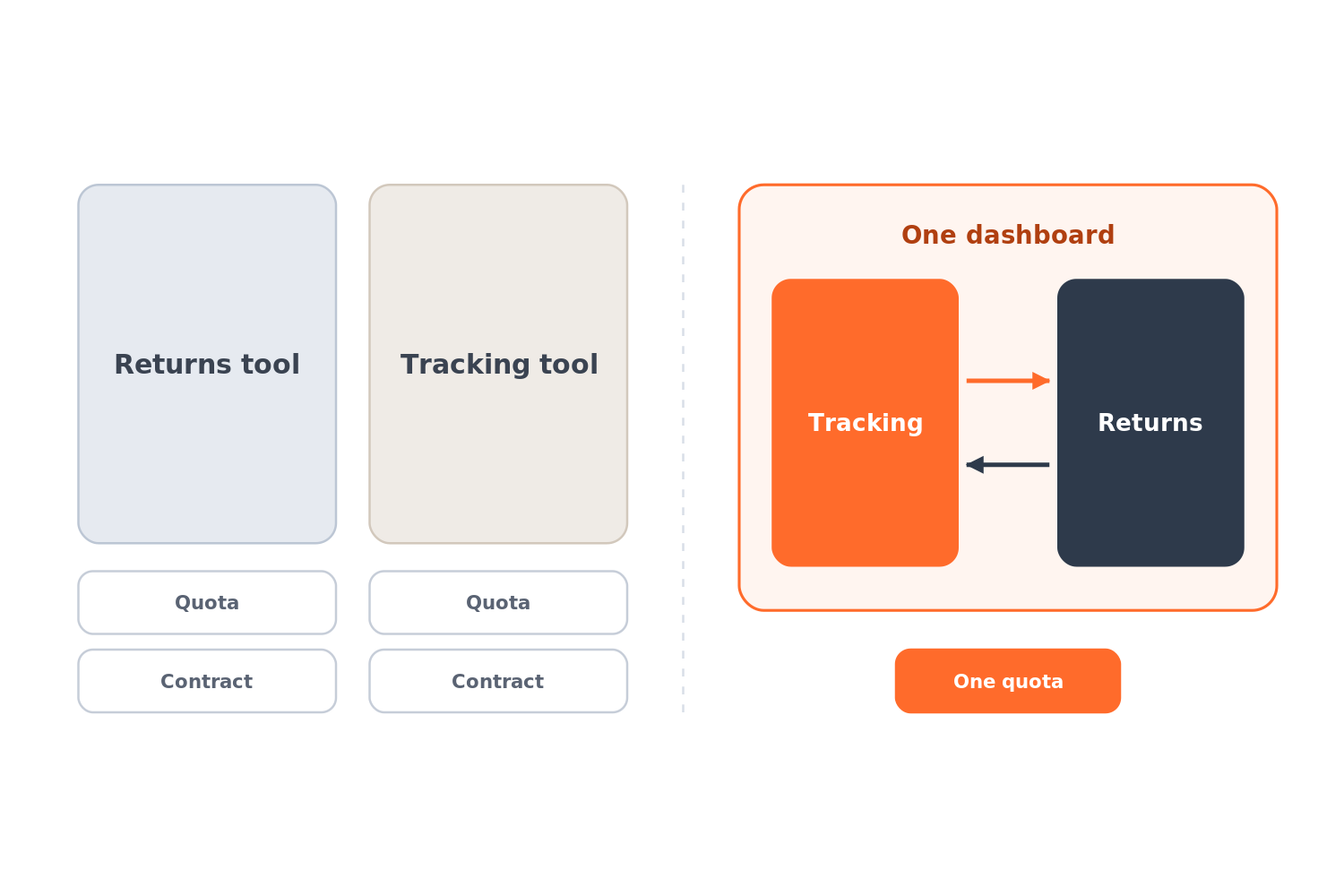
The strongest thing on this page is also the least visible one. For merchants on an active plan for both products, return shipments sync into AfterShip Tracking alongside outbound ones without consuming the Tracking plan quota. Forward and reverse in one view, on one pair of plans, with nothing to reconcile between them.
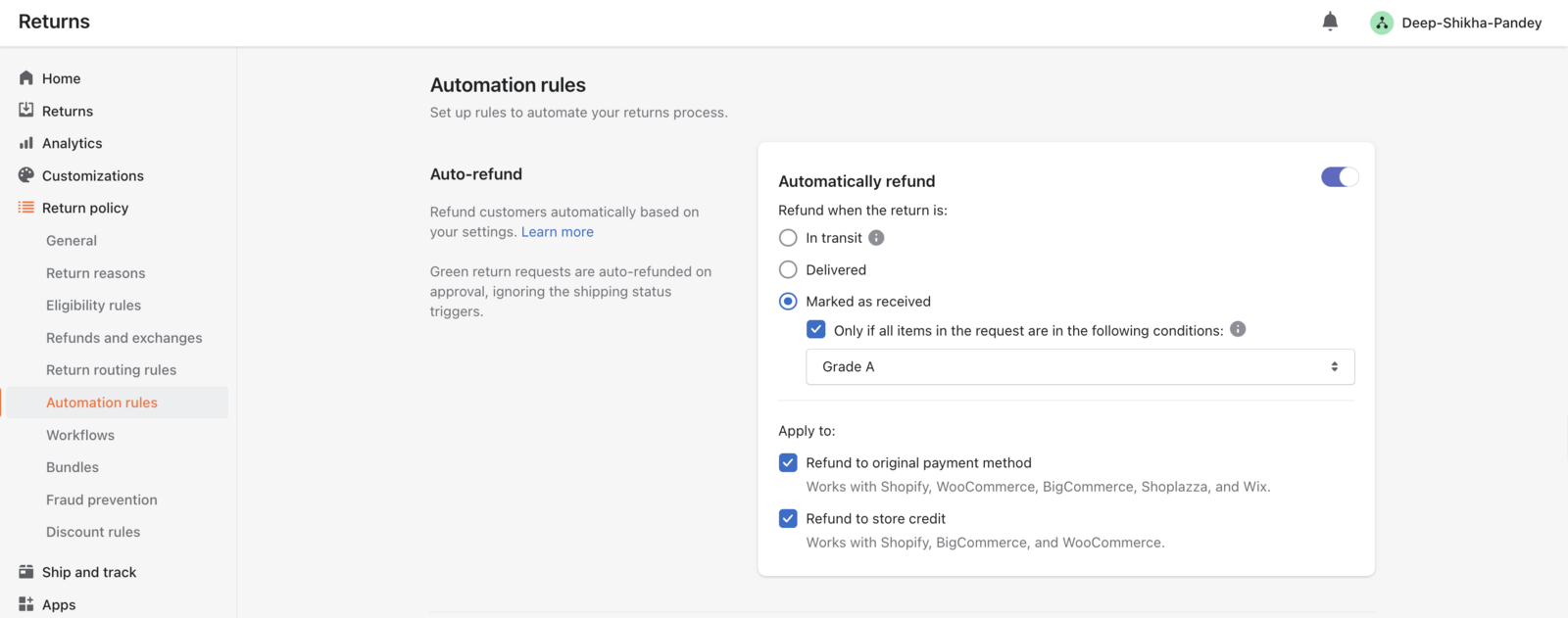
That shared view is what makes the automation different in kind. AfterShip Returns automation runs on live carrier tracking data from the return shipment. Rules that can read the carrier's scans, rather than only your order events, can act while the parcel is still moving:
- Refund automatically once the return shipment reaches In Transit or Delivered, so the refund fires on the carrier's first scan rather than on warehouse receipt.
- Mark a return received automatically on Delivered, with a configurable delay so your warehouse inspects before the status flips.
- Create the replacement or exchange order while the return is still in transit, with a Shopify Flow hold that releases the exchange order on those same return-shipment statuses.
- Charge a customer who keeps both items on an Instant Exchange, using the return shipment status as the checkpoint, with either a nominal authorisation or a full-value hold.
- Void an unused return label automatically after 28 days with no shipment update. This applies only to prepaid labels generated inside AfterShip Returns, not to manually uploaded labels, and some carriers void on a shorter cycle of their own.
Each one of those is a decision your team currently makes by hand, or does not make at all because nobody is watching the return leg closely enough to catch it. None of them requires an integration project between two vendors, because there is no seam to integrate across.
The wider category is covered in a full post-purchase software comparison, and the forward leg in best branded tracking experiences.
Returns and shipments are one system reading one carrier feed, which is why AfterShip acts on the return leg while a tool that never sees it waits.
AfterShip Returns at Scale: Three Differentiators That Survive Verification
A differentiator only counts if it survives the check. Three of them do.
1. Automation that reads the return leg. The rules engine described above runs on live carrier tracking data from the return shipment, which changes an operating number rather than a feature list. Rules that fire on a carrier scan hold the count of returns needing a human decision roughly where you set it, instead of letting it climb in step with volume. That is the difference between a returns operation you staff once and one you re-staff every peak.
2. Carrier cost optimization. Return labels are routed across carriers rather than issued against a single default contract. Three things make that routing real:
- Multi-carrier routing applied to the return label itself
- Rate shopping at the moment the label is generated
- Pre-negotiated carrier rates sitting behind the rates being shopped
AfterShip Returns generates automatic return labels with 70 carriers worldwide, and that reach is what turns routing into an actual choice rather than a setting with one option in it.
What this is worth depends on your carrier mix, weights and destinations, which is why no per-return saving is modelled here.
3. Built for Shopify certification. AfterShip Returns holds it. Neither Loop nor Narvar does, and you can confirm all three in about a minute inside the Shopify App Store. That is the useful property here: the certification is awarded by Shopify and displayed on the listing, not claimed by the vendor in a deck.
Aetrex, an enterprise footwear brand on Salesforce Commerce Cloud running AfterShip Tracking and Returns together, is the closest published test of all three at once. At 120,000+ packages shipped annually, they report a 141-point NPS increase, an 86% reduction in return processing time, a 74% decrease in WISMO tickets and a 50% operational cost saving. Those outcomes are attributed to the two products running together, which is what makes Aetrex evidence for the platform argument rather than a testimonial for either product alone.
The Verdict for 2026
The Narvar vs Loop decision has no single winner: each of the three has a reader it genuinely fits. The wider field sits in the top returns platforms for eCommerce.
Loop is the strongest fit for a Shopify-native brand whose priority is a polished returns portal and driving exchanges, and which is comfortable running a second payment stack for exchange upsells and a second subscription for tracking.
Narvar is the fit for a large multi-platform retailer that wants an enterprise services relationship and a broad physical drop-off network, and that can absorb a sales-led buying cycle with no published pricing at any volume.
AfterShip is the fit for a Shopify Plus brand at this volume that wants forward and reverse shipment data in one place, returns automation that reads live carrier tracking, the largest published drop-off network of the three, and the only Built for Shopify certification among them.
Before you sign, count the meters. Two subscriptions, two quotas and two renewal cycles is a structure you carry for as long as you own the stack, and it gets more expensive every year your volume grows. Capabilities that arrive on one platform arrive on one meter.
Returns automation that enhances the returns and exchanges experience, reduces costs, and retains more revenue.
Book a demoFrequently Asked Questions
Which is better for Shopify Plus, Narvar or Loop?
Neither wins on a feature checklist at this volume; the capability gap is narrower than the structural gap. Loop suits a Shopify-native brand focused on a polished returns portal and exchange conversion. Narvar suits a large multi-platform retailer wanting an enterprise services relationship. For a Shopify Plus brand at this volume, the deciding question is whether returns and shipment data live in one system, and AfterShip Returns is the option that answers yes.
What is the ROI of a returns management platform like Narvar or Loop at high volume?
At 5,000 to 50,000 orders a month, all three vendors become a quote conversation, so any published payback figure was modelled on someone else's operation. Four inputs drive your quote: monthly return volume against the plan quota, how much sits inside the base subscription versus purchased separately, how many separate products you are metered on, and whether exchanges and refunds need a second payment stack. Build the case on those and your own return rate.
What are the alternatives to Narvar and Loop for a Shopify Plus brand?
The shortlist is usually wider than two names. Beyond Loop and Narvar, a Shopify Plus operator should look at AfterShip Returns, Happy Returns and the returns modules inside broader post-purchase platforms. Screen them on three things: whether returns and tracking are metered as one product or two, whether the automation rules read carrier tracking data from the return leg, and whether the platform covers the forward leg as well as the return.
Which returns platform for Shopify Plus is Built for Shopify certified?
AfterShip Returns is the only one of the three that holds the certification. Loop and Narvar are both present in the Shopify ecosystem, and Narvar ships a free Shopify app, but neither carries the certification. Shopify awards it and displays it on the App Store listing, so you can verify it yourself in under a minute rather than taking a vendor's word for it.