You've narrowed your post-purchase platform choice to two contenders: Narvar, the established enterprise leader, and WeSupply, the modern challenger. It's a logical final round. It's also built on a picture that changed last year, and for a high-volume DTC brand planning to scale, it's the wrong question to be asking.
What changed is ownership. WeSupply Labs is an EasyPost company, acquired in 2025 according to its co-founder, which means the independent challenger on your shortlist is a business unit of a shipping-API company.
That leaves a gap on the shortlist, because the comparison you actually need is three-way. AfterShip is the third name, and if you already know Narvar well, we have published a detailed breakdown of AfterShip vs. Narvar for enterprise.
Narvar vs. WeSupply: The Short Answer for Skimmers
If you are building a recommendation deck this week, here is the shape of it. Every figure below carries the surface it came from, and every one is checkable in an afternoon.
| Criteria | Narvar | WeSupply Labs | AfterShip |
|---|---|---|---|
| Best For | Enterprises with procurement capacity to price an unpublished suite | Brands under 5,000 orders a month wanting one straightforward returns and tracking product | High-volume Shopify Plus brands that need every claim verifiable before signing |
| Platform Model and Ownership | A suite of separately marketed products | One product, one published ladder, ten ecommerce platforms; an EasyPost company since 2025 | Tracking, Returns and Shipping sold and priced separately; independent |
| Carrier Network (by scope) | Returns and exchanges run through Shield, its separately marketed returns product | "+200,000 printerless return drop-off locations", first-party | 310,000+ returns drop-off locations (aftership.com/returns); return-label accounts 3, 5, unlimited |
| What the Enterprise Quote Includes | Not published; no price at any volume, and subscription contents are not stated | API access, ERP integration, dedicated support at Enterprise; Advanced repeats Growth's allowance at higher rates | Unlimited return-label accounts at negotiated rates, conditional approval and exception workflows, delivery-date windows, POS returns |
| WISMO and EDD | Promise publishes 95%+ accuracy; no coverage figure published | AI predictive delivery dates from Advanced; carrier dates below; neither accuracy nor coverage published | Up to 95% accuracy across 80% of deliveries (aftership.com/edd), both published, included in Tracking |
| API and Integration Depth | API access not published as included | API access absent on Growth and Advanced, present at Enterprise on its pricing page | Tracking API and webhooks publicly documented without an enterprise account; 30+ ecommerce platforms |
AfterShip Returns pricing on aftership.com: Essentials from $16/month and Premium from $99/month on annual billing; from $19 and from $119 on monthly. Enterprise is Custom.
The rows that decide this are the last three: what the Enterprise quote contains, what each vendor can prove about its delivery predictions, and what you can build against without a signature.
Why "Which Tool?" Is the Wrong Question for a Scaling Brand
Run the arithmetic on your own volume before you run any comparison. At 10,000 to 50,000 orders a month with a return rate around 10%, you are processing somewhere between 1,000 and 5,000 returns a month. AfterShip Returns moves to Enterprise from 400 returns a month. WeSupply's Enterprise tier begins at 1,250 returns a month. Narvar publishes no pricing at any volume.
So all three vendors quote you. Every published price ladder you have been comparing describes a smaller company than yours. The comparison that decides this purchase is not a ladder. It is what sits inside the quote, which capabilities depend on which tier, and how the bill behaves when your return volume spikes in December.
That reframing matters because the costs that hurt at your scale are not license costs. They are the support headcount absorbing WISMO tickets a delivery prediction should have prevented. They are the checkouts abandoned before a returns policy was ever tested, and Baymard Institute finds that is not marginal:
13% of US online shoppers have abandoned a purchase because the returns policy was not satisfactory, the seventh of eleven reasons they give. Baymard Institute, page updated 22 September 2025.
And they are the developer weeks spent stitching a tracking vendor's delivery events to a returns vendor's clock, every quarter, forever.
Buying blind on any of that is expensive in a way a quote does not show you. So the useful question is not which tool wins a feature bake-off, but how much each vendor lets you verify before you sign. Narvar asks you to take scope and cost on trust. WeSupply publishes a tier map. AfterShip publishes its tier map, its prices up to the Enterprise line, and the figures behind its delivery predictions.
Round 1: Tracking Experience & WISMO Reduction
WISMO volume is a coverage problem before it is a messaging problem. Ask each vendor how much of your shipping footprint they can see, and what they commit to about the dates they show.
Start with the network. AfterShip Tracking connects with 2,000+ carriers, the figure published on its carrier directory as of October 2026. The connection model matters as much as the count: AfterShip integrates with carriers directly, and statuses arrive normalized into one vocabulary, so a single automation rule behaves identically on a regional European carrier and your domestic volume. AfterShip has sat on the Universal Postal Union's Consultative Committee since May 2024, per the UPU's published roster, which matters once EU launch puts postal operators in your mix.
On notifications, ignore the counts. Every vendor advertises a long event list; none tells you whether the right customer hears the right thing at the right moment. Channels and control are the comparison. AfterShip publishes email and SMS with a flow editor governing sequence, timing and conditions. WeSupply publishes native email and SMS, with ESP integrations for reach. Narvar's Notify is its own product line. What reaches your queue is whether you can treat a customs hold differently from a failed delivery attempt without raising a support request of your own. More on how to slash support tickets.
Then delivery dates, where the three separate. Narvar's Promise publishes 95%+ accuracy and no coverage figure. WeSupply offers AI predictive delivery dates from Advanced upward, carrier-provided dates below that, and publishes neither number. AfterShip publishes both: up to 95% accuracy across 80% of deliveries. Coverage is the half that decides WISMO volume: a prediction that never appears on a lane cannot deflect a ticket there. AfterShip's AI EDD proactively reduces "where is my order" inquiries. AfterShip is the only one of the three telling you how much of your deliveries it covers.
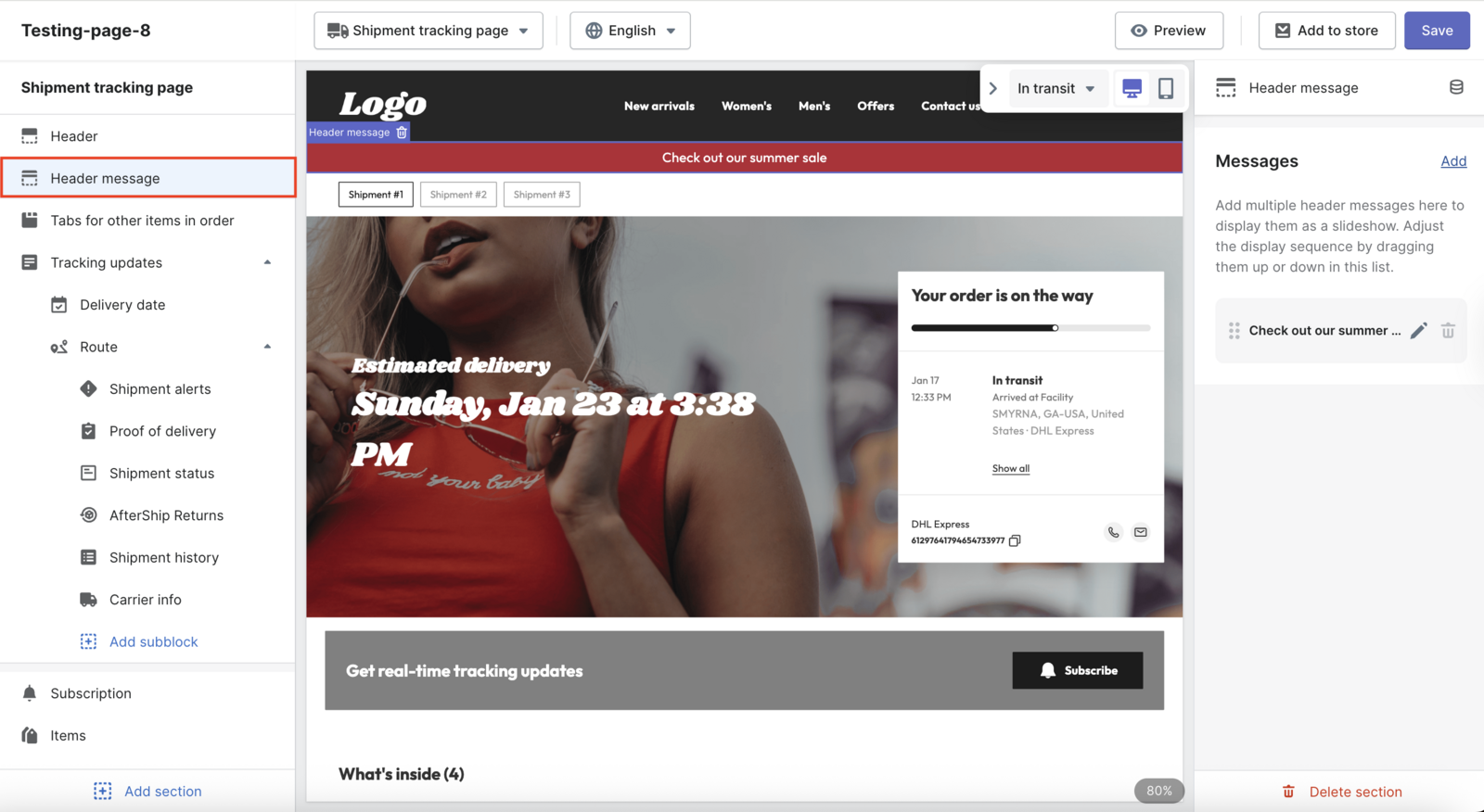
Round 2: The Returns Management Scalability Test
All three vendors publish the same returns feature names. Read their product pages side by side and the lists converge, so the feature list is not the comparison. What the quote contains is.
At your volume, AfterShip Returns moves to a custom Enterprise plan, scoped to your order volume and carrier mix, that unlocks:
- unlimited return-label carrier accounts with negotiated rates
- multi-step conditional approval and exception-handling workflows
- delivery-date-based return windows
- POS and in-store returns
- custom data retention
Read it as a checklist for the call, not a spec sheet.
Two rows underneath it decide how international behaves. Return-label carrier accounts run three on Essentials, five on Premium and unlimited on Enterprise with negotiated rates, which is the difference between routing EU returns to a local address and paying to ship them back across the Atlantic. On drop-off, AfterShip publishes 310,000+ returns drop-off locations on its returns page against WeSupply's "+200,000 printerless return drop-off locations". Both are first-party numbers from each vendor's own site. More on how the category sorts out in the best returns platforms.
Refunds are where the control shows. On Premium and Enterprise, AfterShip lets you set when an automatic refund releases: on receipt, on inspection, or on resale. That is a decision about your tolerance for shrink against refund complaints, and you make it rather than inherit it. WeSupply publishes partial refunds on receipt of each item, so a split return refunds in stages as the boxes land.
One structural note on WeSupply's ladder. Its Advanced tier carries the same included allowance as Growth while charging a higher per-unit rate above it, at every rung of the volume ladder, in all four billing quadrants. Advanced buys features, not headroom, so your December overage costs more on the tier you upgraded to. On AfterShip that conversation happens inside the Enterprise scope, where rates are negotiated against your order volume and carrier mix.
Aetrex ships 120,000+ packages a year and runs both tracking and returns on AfterShip. It reports an 86% reduction in return processing time, 50% savings in operational costs, and a 74% decrease in WISMO tickets.
“We've been happy with AfterShip Tracking — there's no downtime or issues. Going with AfterShip Returns made sense. We can simplify our tech stack and leverage the data together.”
eCommerce Team, Aetrex
Read their story →Round 3: The Hidden Costs of a Disconnected Stack
Everything above is checkable before you sign. What follows only shows up in year two.
Narvar markets six separately named products: Promise for delivery dates, Shield for returns, Notify for messaging among them. It does not publish which of those a subscription contains, and publishes no price at any volume, so you cannot establish scope or cost until you are inside a sales process. You wouldn't buy your engine, wheels, and steering wheel from three different companies and pay a mechanic to bolt them together. Why do it for your post-purchase stack?
WeSupply is the opposite problem, and the same argument does not work on it. It sells one product on one published ladder that tells you where things sit: API access at Enterprise, AI predictive delivery dates at Advanced, branding removal at Advanced. The diligence question is not the map but who holds it. WeSupply Labs was acquired by EasyPost in 2025, according to its co-founder, and it has no Shopify App Store listing. Your platform is Shopify Plus; this vendor is not in the store where you install everything else.
What the products do together is easy to assert and hard to prove. Here is the proof. A fair return window should start when the customer receives the item, not when you shipped it. Measuring from delivery date requires the returns system to know the delivery event, which is why AfterShip's delivery-date return windows draw on its Tracking data. The feature sits on Returns Premium and Enterprise and requires a Tracking plan. With stitched-together point solutions that signal lives in another vendor's system, if it is captured at all. AfterShip sells tracking, returns and shipping as separate products that share one data layer. Two products doing something neither does alone.
Security is the row procurement reads first. WeSupply publishes CCPA, GDPR, HIPAA, PCI DSS and SOC 2 Type II, but not ISO 27001 and no uptime SLA; its 48 to 72 hour recovery time objective is disaster recovery, not availability. AfterShip publishes SOC 2 Type II, ISO 27001, GDPR and a 99.9% uptime SLA.

The Final Verdict: Choosing Your Post-Purchase Partner for 2026 and Beyond
Take the honest version to leadership. It survives questions better than a clean one.
If you were a smaller brand, under 5,000 orders a month, wanting a straightforward returns portal and not planning to go global, WeSupply would be a capable and user-friendly choice: real returns depth, ten ecommerce platforms including a free Adobe Commerce extension, and branded tracking technology EasyPost resells inside its own API. That case is genuine. It is not your case. At your volume the ownership question and the missing Shopify listing stop being footnotes and become contract terms.
For an enterprise whose procurement team can price six separately marketed products with no published number to start from, Narvar is a defensible choice.
AfterShip is the recommendation. Not because it is cheapest. It is not, and you should say so in the deck before someone else does. It is the recommendation because every load-bearing claim is checkable from outside the sales process: prices published up to the Enterprise line, delivery predictions published with both accuracy and coverage, a first-party drop-off number, independent ownership, and a returns product that demonstrably reads its sibling's delivery data, all of which the full platform comparison details. At this volume you are not buying features. You are buying what you can verify before you commit, and still verify in year two. That is the case AfterShip wins on.
Frequently Asked Questions
What should we ask each vendor about overage before we sign?
Four questions, put identically to all three. What counts as a billable unit, an order, a shipment or a return. What happens when you exceed the allowance mid-term: rate change, tier change, or true-up at renewal. Whether the overage rate on your tier is higher than the tier below it. And what a December peak costs under this contract. Get the answers in writing, not on the call.
What does WeSupply's EasyPost ownership actually change for a multi-year contract?
It changes what you ask, not what you assume. Three things belong in diligence. Roadmap continuity: which team owns the product now, and what the release cadence has been since 2025. Support: who answers a Sev 1 at peak, and whether that sits in the agreement. Contract assignment: what happens to your terms, pricing and data if ownership changes again mid-term, and whether you can exit if it does.
What do third-party reviews tell us about these three?
Read the sample sizes before the scores. On G2, AfterShip carries 4.7 from 311 reviews, Narvar 4.3 from roughly 180, and WeSupply Labs 4.5 from a single review dated 17 May 2021. AfterShip's G2 profile covers the whole platform, so nothing there speaks to Returns specifically. One review is not a rating, so the finding is the asymmetry: two of these vendors have a practitioner record you can read, one does not.
We're launching in the EU next year. Does that change the shortlist?
It sharpens it. Three things you can ignore domestically start to matter. How many carrier accounts you can attach for return labels, which decides whether an EU return goes to a local address or back across the Atlantic. The drop-off network your customers reach, which AfterShip and WeSupply both publish. And whether your vendor sits inside the postal standards bodies your new lanes run through, as AfterShip does through the Universal Postal Union's Consultative Committee. AfterShip publishes enough on all three to check before the call.