The 8 best returns management platforms for 2026 at a glance
Eight platforms show up on most returns shortlists, and they are not all selling the same thing. Some are software you configure, some are logistics networks you plug into, and some are free at the portal layer and make their money somewhere else. Here is where each one sits. If you want the same field ranked for retailers, we score it separately there.
| Platform | Starting price (and channel) | Best for | Exchange-first? | Free plan | Platforms supported |
|---|---|---|---|---|---|
| AfterShip Returns | $16/mo billed annually, or $19/mo monthly, on the AfterShip Returns pricing page · same plans on the Shopify App Store at $19/mo or $192/yr | Operations-led, multi-channel brands that need the whole reverse-logistics lifecycle in one platform | Yes — AI-powered exchanges, bonus credit, store credit | Yes — Return Care on the Shopify App Store | Shopify (Built for Shopify) plus 25+ platforms including headless |
| Loop Returns | $340/mo on the Loop pricing page, including up to 1,000 returns | Shopify-native brands whose single most important metric is exchange rate | Yes — exchange-first by design | Yes — Checkout+, eligibility based on order and return volume | Shopify-first, now multi-platform |
| Happy Returns (a UPS company) | No published pricing; contact sales | U.S. brands that want box-free, label-free drop-off at 10,000 Return Bar locations | No — network-led, lighter exchange logic | No | Software plus a U.S. physical network; also on TikTok Shop |
| Narvar | No published pricing; quote-based and sales-led, no self-serve plan | Enterprise retailers buying tracking, notifications and returns from one incumbent vendor | No | No | Enterprise, platform-agnostic |
| ReturnGO | $147/mo on the ReturnGO pricing page (Premium) | Shopify and mid-sized stores that want a self-serve returns and exchanges portal | Yes — any-to-any, price-difference and mixed returns | No — 14-day trial on the Shopify self-service plans | Any platform; self-service app on Shopify |
| Redo | Returns portal free, with Redo covering the return label; order tracking $0.08 per tracked order | Shopify brands that want a free returns portal funded elsewhere | Portal-led; enhanced exchanges sit in the paid Returns AI Agents module | Yes — free returns portal | Shopify |
| Return Prime | Free to install with 5 requests/mo; Grow $19.99/mo for 60 requests | Growing Shopify D2C brands that want a branded portal and rules on a small plan | Partly — Shop Now storefront exchange from the Grow plan | Yes — free to install, $0.49 per extra request | Shopify |
| Claimlane | $800/mo (€700) Core, including 2,000 tickets a year | Brands whose hard problem is warranty claims and repairs rather than ordinary returns | No — claims and repairs, not exchanges | No | Platform-agnostic |
Every figure in this table comes from the vendor's own pricing page on 5 November 2026; vendors that publish no number are marked quote-only rather than guessed at.
Three of these — AfterShip Returns, Loop Returns and Happy Returns — carry the rest of this guide, because they are the three that most often reach a final shortlist together. The other five get a short read here first.
Narvar
Best for enterprise retailers that want tracking, notifications and returns from one established post-purchase vendor. Pricing: none published — Narvar's pricing page does not exist, the model is quote-based and sales-led with no self-serve plan, and implementation and professional services are scoped as their own line rather than bundled into the subscription. Where Narvar beats AfterShip: the sustainability side of reverse logistics. Its returns rules engine routes each returned item to the most appropriate location by geography, product type, condition and demand to cut the distance a return travels, and it offers package-free returns, consumer drop-off locations and printerless return labels. Where AfterShip Returns beats Narvar: the returns feature set itself — bundle returns, gift-with-purchase returns, return-reason groups for drill-down analytics, refund automation triggered by the tracking scan, native Shopify POS returns and the Shopify Exchange API are all standard, and instant exchanges come with the plan from Premium up instead of carrying an extra fee. If Narvar is on your shortlist, the Narvar alternatives comparison goes deeper.
ReturnGO
Best for Shopify and mid-sized stores that want a self-service returns and exchanges portal without an enterprise contract. Pricing: Premium from $147 a month, Pro from $297 a month, and a custom-priced Enterprise tier covering up to 5,000 annual returns, with a 14-day free trial on the Shopify self-service plans. Where ReturnGO beats AfterShip: breadth of exchange variants in one portal — any-to-any exchanges, price-difference exchanges and mixed returns-and-exchanges are all on the published feature matrix. Where AfterShip Returns beats ReturnGO: the operational layer — 3PL and WMS routing, your own carrier accounts, and SKU-level return-reason data. ReturnGO's own site notes that the self-service Shopify app does not include everything on the enterprise plan, so check which tier each capability sits on before you compare quotes.
Redo
Best for Shopify brands that want a returns portal at no software cost and are willing to let the vendor monetise elsewhere. Pricing: the returns portal is free and Redo covers the cost of your return labels; claims and warranties are also free; the rest of the suite is per-event — order tracking $0.08 per tracked order, checkout optimization $0.40 per order, one-click upsell $0.06 per order, support $0.20 per resolution. Where Redo beats AfterShip: the entry price is zero, and for a small Shopify store that is a real advantage. Where AfterShip Returns beats Redo: you keep control of the economics. Redo's free portal is funded by the return-label and coverage model, so the cost moves rather than disappearing, and the per-event pricing scales with volume in a way a flat subscription does not. If you need your own carrier contracts, 3PL routing and SKU-level analytics, that is the trade. The Redo alternatives comparison works through it.
Return Prime
Best for growing Shopify D2C brands that want a branded portal and rules without a mid-market contract. Pricing: free to install with 5 return requests a month and $0.49 per additional request; Grow at $19.99 a month for 60 requests; Thrive AI at $79.99 a month for 180 requests; Scale at $149.99 a month for 450+ requests, with a 15-day free trial on the paid plans. Where Return Prime beats AfterShip: the lowest paid rung on this list, and a 4.8 rating from 780 Shopify reviews for a product that is genuinely simple to configure. Where AfterShip Returns beats Return Prime: depth past the portal — multi-warehouse and multi-label logic, fraud controls, warranty handling and analytics that a request-per-month plan does not reach. Note how the meter works: Return Prime charges per request, so the comparison that matters is requests per month against the included allowance. The Return Prime alternatives comparison sets the two side by side.
Claimlane
Best for brands whose hard problem is warranty claims and repairs rather than ordinary returns. Pricing: Core at $800 a month (€700), including 2,000 tickets a year, with additional modules priced on top. Where Claimlane beats AfterShip: claims handling as the primary workflow — vendor reporting, repair routing and supplier-facing case management are what the product is built around. Where AfterShip Returns beats Claimlane: it covers the whole return, not just the claim, and it does so at a fraction of the entry price — $16 a month against $800. For most brands the claims workload is a subset of returns rather than the other way round. The Claimlane alternatives comparison covers where the line falls.
Beyond the Portal: Why Your Returns 'Platform' Matters in 2026
The portal is what the shopper sees; the platform is what the return costs you. The real cost of returns is hidden in your warehouse, your support tickets, and your P&L, and if you are still evaluating returns software on the customer-facing experience alone, you are focusing on the wrong thing.
A portal is a feature. A returns management platform is the system that runs the entire reverse-logistics lifecycle: the return request, the routing logic that decides where an item goes, the label that gets generated, the 3PL that receives it, the refund or exchange that closes the loop, and the analytics that explain why it happened. The best returns platforms for ecommerce operate across all of that, and that span is what separates product returns management software from a request form. A portal just collects the request and hands the hard part back to your team. If a portal is genuinely all you need, see best return portals compared.
That gap matters more in 2026 than it did two years ago, because the money at stake has outgrown the "cost of doing business" label. The National Retail Federation's 2025 returns research projects $849.9 billion in U.S. merchandise returns, with 19.3% of online sales returned and roughly 9% of returns flagged as fraudulent. DHL's 2025 e-commerce research goes further, calling reverse logistics a "front-line strategic differentiator" rather than a back-office cost center, and noting that bracketing behavior (buy several, keep one) pushes return rates above 50% in some categories.
For a brand shipping 1,000 to 50,000 orders a month, none of that is abstract. It is warehouse hours, carrier spend, support headcount, and refunded revenue you may never see again. A single mishandled return can touch four teams before it is resolved. A portal can make the request look clean, but only a platform can make the economics behind it work.
So the real evaluation question has changed. It is no longer "which portal looks best to my customer?" It is "which platform controls the cost of every return after the customer clicks submit?"
How We Evaluated the Top Returns Platforms (Our Criteria)
AfterShip makes AfterShip Returns. Rival prices and features are taken from their public pages, checked 5 November 2026.
We scored each platform on the criteria an operations leader has to defend in a budget meeting, not the ones that demo well. Five categories, weighted toward backend impact:
- Operational efficiency and automation: how much of the reverse-logistics workflow runs without a human touching it. This covers automation rules, routing logic, and the depth of 3PL and WMS integration that keeps items moving from customer to warehouse to restock without manual data entry.
- Revenue retention and cost reduction: whether the platform actively recovers revenue through exchanges and store credit, and whether it cuts the hard costs of return shipping and processing labor instead of just passing them through.
- Customer experience: portal branding, proactive communication, and the self-serve flow. It still counts. It is just not the whole scorecard anymore.
- Analytics and insights: whether your return analytics let you see why products come back, drill into return reasons, and feed that signal into merchandising and inventory decisions. Dashboards that drive action, not vanity charts.
- Ecosystem and scalability: API access, carrier network depth, and global reach. The platform you pick at 5,000 returns a month has to hold up at 50,000 without a re-platform.
Notice where the polish of the customer-facing portal sits: well below the operational measures, not at the top. For this persona, a clean customer experience is table stakes, and the operational backbone is where the decision is actually won or lost.
Score any contender against these five criteria and the shortlist narrows quickly. The best returns platforms for ecommerce are the ones that win on the operational measures, because that is where the cost, the recovered revenue, and the room to scale all live. DTC teams running the same five criteria can start from the shortlist built for DTC brands.
AfterShip Returns: The Operations-First Command Center
Most returns tools are built for the shopper. AfterShip Returns is a complete returns management solution built for the operator. The customer-facing portal exists and is fully brandable, but the part that earns its place in your stack is the backend: the returns management portal where your team triages, routes, and resolves every request without leaving one screen.
That operator view is the line between a portal and a platform. Open any request and you see the rule that fired on it, the refund or exchange in flight, the fraud flag, and exactly where the item sits in the reverse-logistics flow. Nothing gets lost in an inbox, and nobody is copying tracking numbers into a spreadsheet.
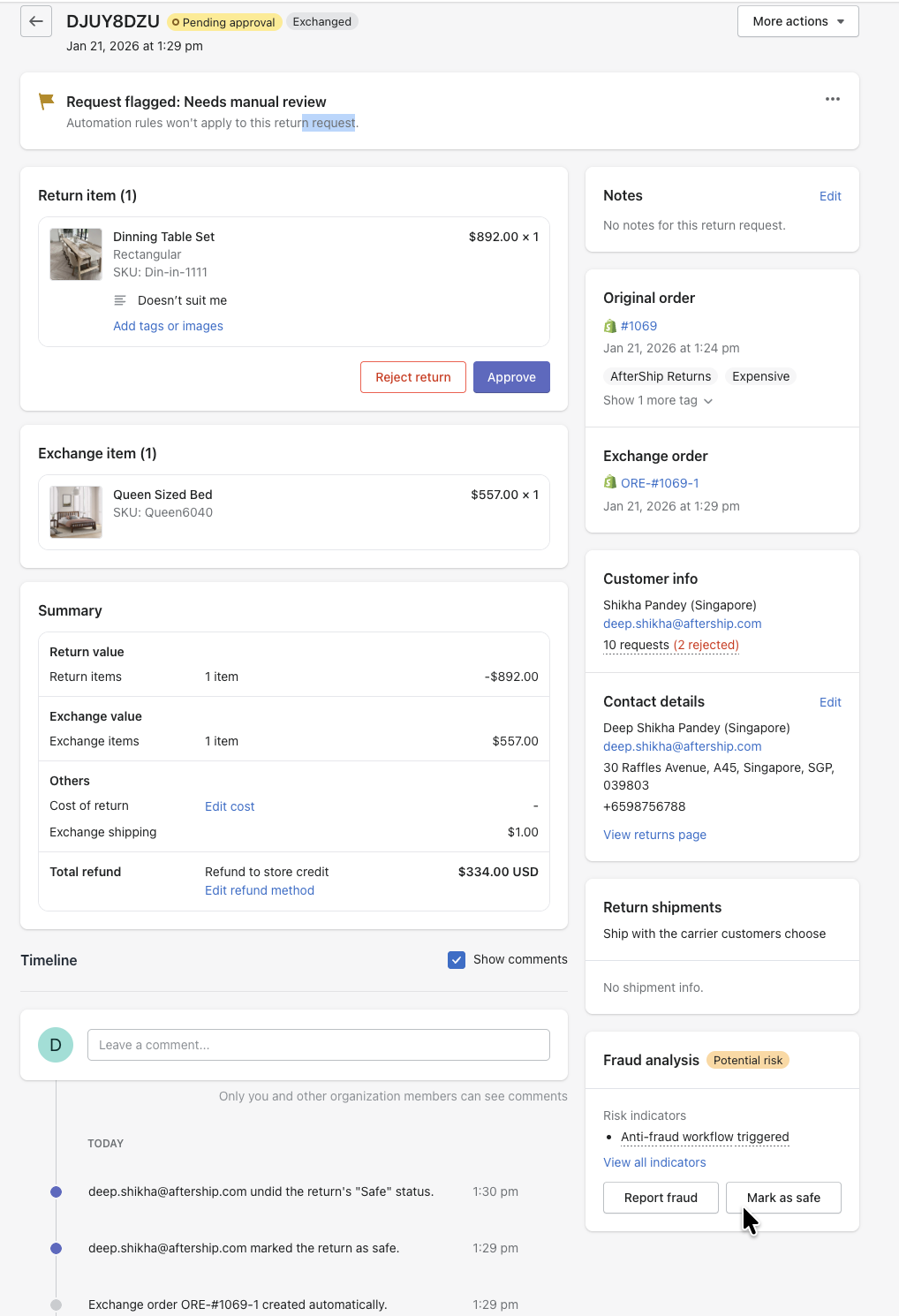
Start with carrier flexibility, because returns stall in the last mile of the reverse trip. AfterShip publishes automatic return-label generation with 73 carriers for return-label generation, as published on the AfterShip Returns product page in November 2026, plus your own carrier accounts on supported plans. If you would rather not bring your own, pre-negotiated rates are available on USPS and 40-plus other carriers. The point is not the count. It is that you keep your own negotiated rates instead of being pushed onto someone else's pricing, and that return analytics show you what each of those labels actually costs.
Then comes automation, which is where the labor cost actually hides. AfterShip Returns runs advanced automation rules on a conditions-and-actions engine: stack rules that read the order, the return reason, the item, and the customer, then route, approve, charge a fee, or offer an exchange with no human in the loop. Build one rule for bulky items, a different one for suspected fraud, and a third for high-value repeat buyers, and they execute in priority order. Every rule that fires is a ticket your team never has to touch. One rule worth modelling early is returnless refunds and when to trigger them on low-value items.
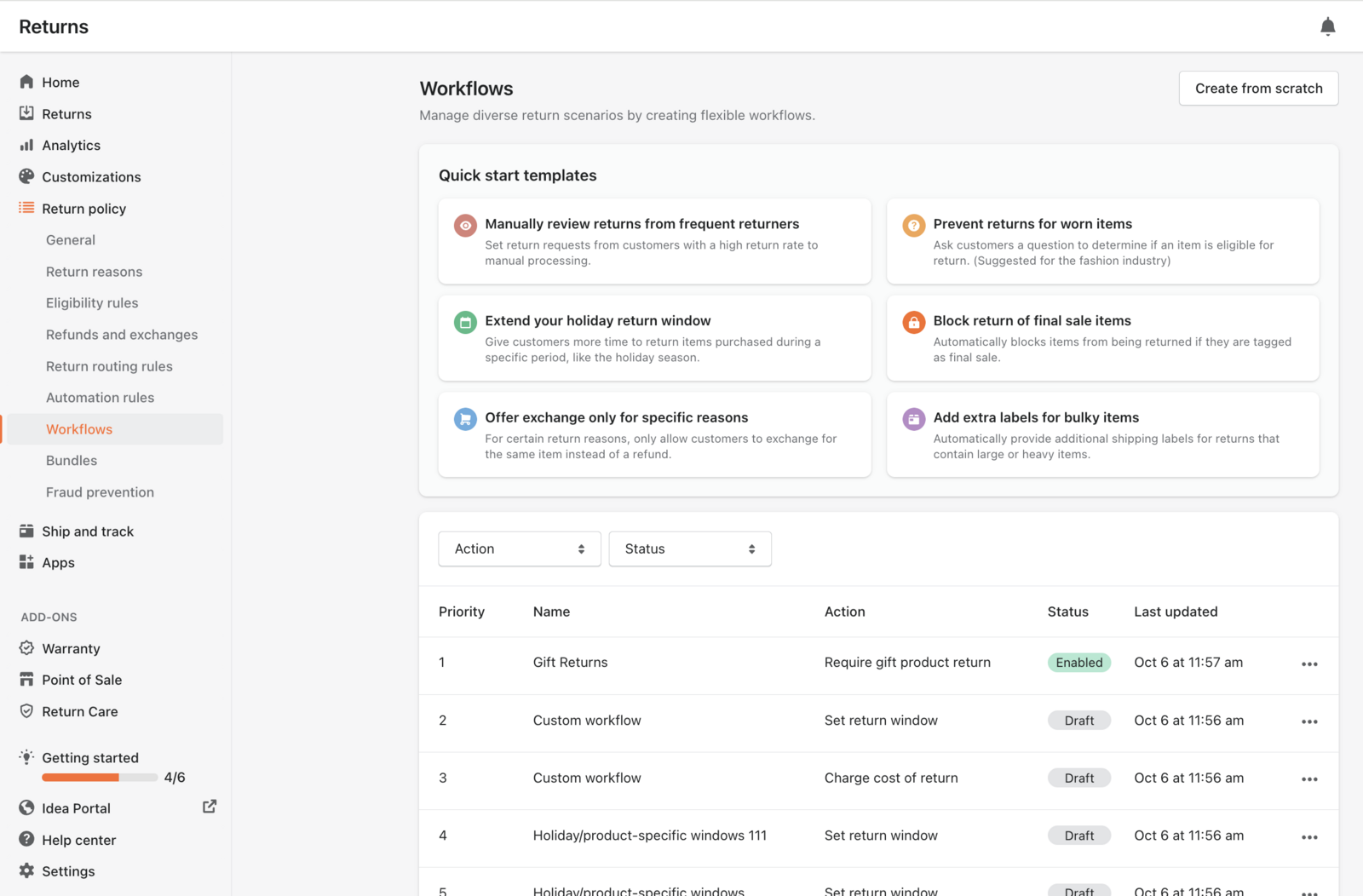
The 3PL and WMS integration is what separates a returns app from returns infrastructure. AfterShip Returns ships named connectors for ShipBob, ShipHero, and the Peoplevox WMS, and it handles the unglamorous work that keeps a warehouse honest: ASN generation, so your 3PL knows what is inbound before the box arrives, and item-receipt automation, so a scan at the dock closes the loop in your system automatically. For anything custom, the platform-agnostic Returns API and webhooks push return events into your OMS, TMS, or WMS. You are not locked into one fulfillment model, and you are not waiting on a vendor to build the connector you need.
Analytics close the loop on why. AfterShip Returns gives you SKU-level return-reason data, so you can see that a specific product keeps coming back for color, quality, or size, then feed that straight to merchandising or your supplier. That is a concrete product-quality signal, not a vague satisfaction score.
What AfterShip Returns costs, by channel
Returns software is sold through more than one channel and the same plan carries a different headline number in each, so name the channel before you compare any quote to anything.
| Channel | Entry plan | Billing | Included returns | Per extra return |
|---|---|---|---|---|
| AfterShip Returns pricing page | Essentials | $16/month billed annually | 240 returns per year | $0.50 |
| AfterShip Returns pricing page | Essentials | $19/month billed monthly | 20 returns per month | $0.50 |
| AfterShip Returns pricing page | Premium | $99/month billed annually | 1,200 returns per year | $1.00 |
| AfterShip Returns pricing page | Premium | $119/month billed monthly | 100 returns per month | $1.00 |
| Shopify App Store | Return Care | Free | Shopper-funded; AfterShip handles the return labels | — |
| Shopify App Store | Essentials | $19/month, or $192/year (save 16%) | 20 returns per month | $0.50 |
| Shopify App Store | Premium | $119/month, or $1,188/year (save 17%) | 100 returns per month | $1.00 |
Older roundups list AfterShip Returns from $9 or $11 a month; as of September 2026 Essentials starts at $16. Enterprise is a custom quote scoped by returns volume, for global brands above 400 returns a month. Current figures are always on the AfterShip Returns pricing page, and if you want the category priced rather than one vendor, start with returns platform pricing, explained.
For a brand past a few hundred returns a month, that reads as the best value at this scale, not the cheapest tool on the shelf. That is the trade an operations leader should want: pay for the backend that lowers total cost, not for a portal that only looks good.
Operators who pick AfterShip Returns for the backend usually point to the same two things: its automation depth and its analytics.
For an operations team, that is the whole point. AfterShip Returns is not a nicer request form. It is the command center that controls what every return costs you.
Exchanges: how AfterShip Returns, Loop and Happy Returns keep the sale
A refund is lost revenue. An exchange is the same revenue, kept. That makes the exchange flow the single highest-leverage part of a returns platform, and it is where these three diverge most.
AfterShip Returns is built to keep the sale rather than just process the refund. It pairs AI-driven exchange recommendations with store credit and an optional bonus credit that nudges shoppers toward an exchange over a refund, and the published exchange set runs from a straight variant swap through to exchange for other items anywhere in your catalogue, an instant offer, and advanced exchange for the cases a simple swap cannot cover. Green returns close the loop on items cheaper to refund than to ship back. It uses the native Shopify Store Credit API where you run Shopify, and it works with either Shopify Payments or Stripe, so finance is not stuck reconciling a separate payment rail. The full set is documented on the refund and exchange settings page.
Loop is genuinely strong here and the honest trade is specific rather than general. Loop publishes two exchange capabilities AfterShip Returns does not: Shop Later, which lets a shopper bank the value of a return and spend it on a later visit, and Cross Border Returns. Loop's Keep Item corresponds to AfterShip's green returns — the same "refund without shipping it back" outcome under a different name. Both sit on Loop's paid Returns plan rather than the free Checkout+ tier.
Happy Returns approaches retention from the network rather than the software: an in-person drop-off with instant verification means the refund or exchange resolves faster, which is its own retention argument, but the exchange logic itself is lighter than either of the other two.
If swap rate is your single most important metric, check which of those named capabilities you actually need before the price comparison, because that is where the tier gating bites.
International and cross-border returns
Cross-border is the group where the three diverge hardest, and it is worth settling early because it rarely changes after you sign.
| Capability | AfterShip Returns | Loop Returns | Happy Returns |
|---|---|---|---|
| Carrier coverage | Major international carriers, with your own accounts on supported plans | Carrier access through shipping service providers | U.S. Return Bar network |
| Customs paperwork | Auto-generated commercial invoices; HS codes captured | Not published | Not applicable |
| Cross-border returns | In-country consolidation at fulfillment partners | Cross Border Returns, on the paid Returns plan | U.S.-only network |
| Low-value items | Green returns — refund without shipping back | Keep Item, on the paid Returns plan | Not applicable |
| Shopper-facing reach | Printless QR returns across 300K+ drop-off sites | Printerless and box-free returns on the paid plan | 10,000 Return Bar locations, U.S. only |
Whichever you shortlist, check the returns portal itself for the languages and currencies your markets need: coverage in the carrier network does not guarantee it in the shopper-facing flow. AfterShip's own guidance on this is in best practices to handle international returns shipping.
Best Returns Platforms for 2026: A Head-to-Head Comparison
Here is what most comparison articles get wrong: on core returns capability, the serious platforms are closer than any vendor will admit. AfterShip, Loop Returns, and Happy Returns all handle branded portals, exchanges, store credit, and automated approvals well, and both Loop and Happy Returns bring real 3PL hooks. The separation is in depth and control, not in whether a feature exists at all.
Credit where it is due. Loop Returns is exchange-first by design and deeply Shopify-native, and it publishes a free Checkout+ tier — eligibility based on your order and return volume — alongside a paid Returns plan from $340 a month covering up to 1,000 returns. Happy Returns, a UPS company, runs a box-free, label-free drop-off network across the U.S. built on its own 10,000 Return Bar locations. Both bring real warehouse hooks too: Loop maintains its own ShipBob, ShipHero, and RyderShip/Whiplash connectors, and Happy Returns reaches WMS systems through a tech-partner ecosystem such as Celigo. Each is the right answer for a specific kind of brand.
Where AfterShip pulls ahead is the operational layer this persona lives in: carrier flexibility on your own accounts, platform-agnostic 3PL and WMS control, and SKU-level analytics. Score the three against the five criteria and the differences stop being marketing and start being operational.
| Criteria | AfterShip Returns | Loop Returns | Happy Returns |
|---|---|---|---|
| 3PL / WMS | Named connectors (ShipBob, ShipHero, Peoplevox), ASN and item-receipt automation, platform-agnostic Returns API and webhooks; ShipBob returns integration | Built and maintained connectors (ShipBob, ShipHero, RyderShip/Whiplash); Shopify-first out of the box | Tech-partner / iPaaS ecosystem (e.g. Celigo); fewer native one-click WMS connectors |
| Automation rules | Deep conditions-and-actions engine; stackable routing; bulky-item and fraud rules | Strong, exchange-oriented | Network-driven; lighter software automation |
| Carrier network / flexibility | 73 carriers for return-label generation · your own carrier accounts on supported plans · pre-negotiated rates on USPS and 40+ others · more than 9,000 Happy Returns Return Bars supported in the U.S. | Carrier access through shipping service providers; bring-your-own-account documented on negotiated-rate carriers | U.S. drop-off network (Return Bars) |
| Exchange types | Variant exchange · exchange for other items · instant offer · advanced exchange · bonus store credit · green (keep-item) refund | Variant exchanges · advanced exchanges · Instant Exchange · Shop Now · Shop Later · Bonus Credit · Keep Item — paid Returns plan | Exchanges and store credit via software; lighter than either |
| Returns portal and branding | Branded self-service page on your own domain and assets · embeddable in footer, header, policy or order-history page · drag-and-drop editor · multi-language portal · gift returns | Branded returns portal | Branded drop-off experience; portal plus network |
| Shopify | Built for Shopify certified · native Shopify Store Credit API · Shopify Payments or Stripe · native Shopify POS returns · Shopify returns integration | Shopify-native; advanced exchanges require Stripe | Shopify app plus network |
| Return-reason analytics | SKU-level (color, quality, size); product-issue analytics, not carrier or delivery | Returns analytics | Network and operational reporting |
| Revenue retention | Exchanges with AI recommendations, store credit, bonus credit, native Shopify Store Credit API; works with Shopify Payments or Stripe | Exchange-first (core strength); advanced exchanges require Stripe | Exchanges and store credit via software |
| International | Major international carriers, auto commercial invoices, HS codes, in-country consolidation, green returns; 300K+ drop-off sites and printless QR returns | Cross Border Returns on the paid Returns plan (Shopify-first) | U.S.-only network |
| Pricing | $16/mo billed annually or $19/mo monthly (Essentials) · $99/mo annually or $119/mo monthly (Premium) · Enterprise custom · free Return Care plan on the Shopify App Store | Checkout+ free, eligibility based on volume; Returns from $340/mo including up to 1,000 returns | Network model; no published pricing |
| Platform coverage | 25+ platforms including headless | Shopify-first (now multi-platform) | Software plus a U.S. physical network |
The pattern is consistent: comparable on the surface, divergent on the operational backbone. Which of those differences should decide your purchase depends entirely on your brand, and that is the verdict we turn to next.
AfterShip vs. Loop Returns vs. Happy Returns: The Verdict
So which one do you buy? It depends on what your brand is built around, and these three are built around different things. The full product picture is on the AfterShip Returns product page, and the tier each capability sits on is on the AfterShip Returns pricing page.
Choose AfterShip Returns if you are an operations-focused, multi-channel brand that needs control of the entire reverse-logistics lifecycle. This is the platform for the team that thinks in cost-per-return, 3PL integration, and carrier flexibility, and that expects to scale past a single sales channel. You trade a little more configuration up front for a backend you actually own, which is the right trade once returns become an operational line item rather than an afterthought.
Choose Loop Returns if you are Shopify-native and exchange-first, and your single most important metric is swap rate. Check the payment rail before you commit: Loop's advanced exchanges require Stripe. If you are weighing the two head to head, a direct comparison of AfterShip and Loop goes deeper.
Choose Happy Returns if your top priority is a box-free, label-free U.S. drop-off network. As a UPS company, Happy Returns gives shoppers a physical, no-packaging return experience at its own Return Bars. Worth knowing before you treat that as an either/or: AfterShip Returns supports more than 9,000 Happy Returns Return Bars in the U.S., plus printless QR returns across 300K+ drop-off sites.
For most growing, multi-channel brands that treat returns as an operational and financial problem, AfterShip is the strongest all-around choice, because it controls the part of the return that actually costs money.
The most expensive returns tool is the one that does not talk to your warehouse. A portal that cannot push a return into your 3PL or WMS forces your team back into manual data entry: re-keying RMAs, emailing the warehouse, reconciling receipts by hand. That hidden labor scales with volume, and it shows up as headcount, not as a line on the software invoice. Before you sign anything, ask the vendor exactly how a return reaches your fulfillment system, and what happens when it does not.
The Buyer's Checklist for Choosing Ecommerce Returns Software
The verdict above tells you which platform suits which kind of brand. This checklist is what you take into the demo to find out whether a given vendor actually suits yours. Work through it in order, ask for a screen share rather than a slide on every point, and write down the answers: the gaps show up when you compare the notes side by side, not while the salesperson is talking.
- Resolution options. Count how many ways a shopper can close a return, because every option that is not a cash refund is revenue you keep. Ask for refund to the original payment method, exchange for the same item in another size or colour, exchange for a different product entirely, store credit (and whether you can add bonus credit as an incentive), in-store return if you have physical locations, green returns that refund low-value or freight-heavy items without shipping them back, and partial returns on bundles. Check which of those sit on the tier you would actually buy, not on the top one.
- Integrations with the systems you already run. A returns platform that cannot reach your fulfilment stack hands the hard part back to your team. Ask specifically about your 3PL or WMS, your help desk, your marketing and messaging tools, and whether there is a documented public API with webhooks rather than a one-off connector built for the demo. If you expect to re-platform in the next two years, weight platform-agnostic access more heavily than any single pre-built integration.
- Automation depth. The labour cost hides here. The questions are narrow and worth asking literally: can rules approve an eligible return without a human, can the system mark a return received automatically when the carrier delivers it, can it issue the refund or store credit on that event, and can it push the item back into inventory. Each manual step you are left with is headcount that scales with volume.
- Returns data you can act on. Ask what the platform reports at SKU level, not just in aggregate. You want return reasons by product, the revenue saved by exchanges and store credit, the new revenue exchanges generate, and the average time it takes to resolve a return. A dashboard that only shows your overall return rate tells you that you have a problem, not which product is causing it.
- Reverse logistics. Trace one return end to end on the call. Where does the item physically go, who decides that, and what rules route it there? Look for routing by zone or destination, the ability to use your own carrier accounts and contracts, label-free or box-free drop-off options for shoppers, and a defined path for grading and restocking once the item lands.
- Implementation and migration. Separate what is configurable from what needs engineering. Ask which parts of the portal and the rules a non-technical operator can change, what the vendor does to migrate your open returns and historical data, and who is accountable for the launch on your contract. Be wary of any answer that puts your go-live date in a deck but not in writing.
- Roadmap and ownership. A platform that is best-in-class today can be behind in two years. Ask what shipped in the last two quarters, what is committed for the next two, and whether customers at your size have any route into that roadmap. Vague answers here are a signal about the next renewal, not just the next release.
Run AfterShip Returns through the same list and the published answers are specific: refunds to the original payment method, variant exchanges, exchange for a different product entirely, store credit with bonus credit, in-store returns, green returns and partial returns on bundles; pre-built connectors for ERP, WMS, marketing and support tools alongside returns webhooks and an API; rules that auto-approve eligible returns, auto-mark them received and auto-restock them; return reasons captured at SKU and order level; zone-based routing onto your own carrier accounts with label-free drop-off; and a drag-and-drop page editor that changes copy, branding and policy without engineering help. Every one of those is on the pricing page against the tier it belongs to, which is the format you should be asking every vendor on your shortlist for.
How to Build the Business Case for a New Returns Platform
Your CFO does not care about the feature list. They care about the number. Here is how to build it in four steps.
Step 1: Calculate your current cost-per-return. Most brands underestimate this because they only count postage. A common working assumption is a fully loaded cost of roughly $15 per return once you add return shipping, warehouse and processing labor, and software and admin overhead. That is an assumption, not a published benchmark, so pull your own figures before this model reaches finance.
Step 2: Model the automation savings. The labor and overhead lines are where a platform earns its keep. AfterShip publishes a 50% reduction in returns processing time as a benchmark, which compresses the labor and overhead lines directly. Apply that to your monthly return volume to size the saving.
Step 3: Project the retained revenue. A refund is lost revenue; an exchange or store credit keeps it. AfterShip publishes 50% revenue retained through exchanges as a benchmark. Multiply your refunded revenue by a conservative slice of that, and you have a recovery line that is usually larger than the cost saving itself.
Step 4: Present the ROI. Stack the cost saving and the retained revenue against the platform cost. AfterShip's ROI calculator models about $109,463 in annual value for a brand at 25,000 orders a month, a $100 average order value, and a 10% return rate. Enterprise scoping past the published Essentials and Premium tiers is a custom quote, so ask sales to price it against your actual returns volume before you put a software line in the model.
The benchmarks are not hypothetical. Footwear brand Aetrex processes more than 120,000 packages a year and cut return processing by 86%, support tickets by 74%, and operating expense by 50%, while lifting NPS by 141 points. Those are one brand's results, not a platform-wide guarantee, but they show what the two 50% benchmarks look like when a real operation puts them to work.
Build the model with your own numbers and the case usually makes itself. The platform is not a cost center. It is the lever that turns returns from a margin leak into a managed, recoverable line, which is exactly why the best returns platforms for ecommerce pay back the investment at this scale.
Automate the whole returns lifecycle — portal, rules, labels, 3PL routing and SKU-level analytics — in one platform.
Book a demoA few questions come up in almost every evaluation.
Frequently Asked Questions
What is the best returns management software?
It depends on what you are optimising, and the eight-platform table above sets out the trade in one row each. Loop Returns suits brands whose top metric is exchange rate; Happy Returns suits U.S. brands that want box-free drop-off; ReturnGO, Redo and Return Prime suit Shopify stores that mainly need a portal; Narvar sells into enterprise; Claimlane is built around warranty claims rather than returns. For an operations-led brand that needs 3PL and WMS routing, its own carrier accounts and SKU-level return-reason data in one platform, AfterShip Returns is our pick.
Which returns platform is exchange-first?
Loop Returns is exchange-first by design, and AfterShip Returns and ReturnGO both run full exchange flows. The distinction that matters is which exchange types you get and on which tier: AfterShip publishes variant exchange, exchange for other items, instant offer, advanced exchange, bonus store credit and green returns; Loop adds Shop Later and Cross Border Returns on its paid Returns plan, while its Keep Item is the same outcome as AfterShip’s green returns. Happy Returns, Narvar and Claimlane are not exchange-first.
How much does returns software cost?
Price it against your annual return volume and the capabilities you actually need, not against the headline monthly figure. Most returns platforms meter by volume, so the plan that looks cheapest at 200 returns a year is often the expensive one at 2,000, and the automation, analytics depth and WMS connectors that drive the business case tend to sit a tier or two above the entry price. Published entry prices across this field run from free (Redo’s portal, Return Prime’s install tier, AfterShip’s Return Care) through $16–$19 a month for AfterShip Returns Essentials, $147 for ReturnGO Premium and $340 for Loop’s paid Returns plan, to $800 for Claimlane Core; Happy Returns and Narvar publish nothing. The full ladder is on the AfterShip Returns pricing page.
Which returns platforms integrate with my WMS or 3PL?
AfterShip Returns has named connectors for ShipBob, ShipHero and the Peoplevox WMS, plus ASN generation, item-receipt automation, and a platform-agnostic Returns API and webhooks for OMS, TMS and WMS; the ShipBob returns integration is the one most brands start from. Loop maintains its own ShipBob, ShipHero and RyderShip/Whiplash connectors, Shopify-first out of the box. Happy Returns reaches WMS systems mainly through a tech-partner or iPaaS ecosystem such as Celigo. On the storefront side, the AfterShip Returns Shopify integration syncs orders into the same returns flow.
What are the best ReturnGO alternatives?
On price, Return Prime starts far lower and Redo’s portal is free; on exchange depth, Loop Returns is the closest like-for-like; on operations, AfterShip Returns is the one that adds 3PL and WMS routing, your own carrier accounts and SKU-level analytics that a portal product does not reach. Which of those is right depends on whether your constraint is the shopper flow or what happens after the box ships.
Can I offer returnless refunds?
Yes. AfterShip Returns calls this green returns: mark low-value or freight-heavy items as keep-it and refund without paying to ship them back, triggered by an automation rule rather than a manual decision. Loop offers the same outcome as Keep Item on its paid Returns plan. The rule is usually worth modelling early, because it removes both the label cost and the processing labour on items that were never going to be resold — we work through where the threshold sits in returnless refunds on Shopify.
What is the real cost of a free return for the merchant?
An illustrative fully loaded cost-per-return is around $15 before automation, covering return shipping, warehouse and processing labor, and software and admin overhead. Treat it as a modeling assumption rather than a published benchmark, and pull your own figures before the model reaches finance. Platform automation compresses the labor and overhead lines; AfterShip publishes a 50% reduction in returns processing time.
Which returns platforms handle marketplace and multichannel returns?
This is where the field thins out. Redo and Return Prime are Shopify-only, ReturnGO runs a Shopify self-service app alongside an enterprise plan for other platforms, and Happy Returns is a U.S. network layered on whatever storefront you run. AfterShip Returns is Built for Shopify certified and also covers 25+ platforms including headless, with a platform-agnostic API, so returns from every channel land on one order record and one set of rules — which is the whole point once a second sales channel exists.