Choosing a post-purchase partner for Magento isn't about the sales deck; it's a bet on their extension's code quality and their API's reliability. A bad choice means months of chasing compatibility bugs with every security patch. We audited Narvar and Wismolabs from a developer's perspective. Here's what we found.

Three integrations sit under the same lens here: Narvar, Wismolabs, and AfterShip. The question is narrow and practical. Which of these will still be cheap to own after your next Adobe security patch, your next PHP bump, and the next time a colleague asks for a custom return rule? The head-to-head on deflection is in the WISMO deflection comparison across three platforms.
The Real Challenge: Why Post-Purchase on Magento is a Developer's Minefield
Every Magento developer carries a specific memory. A third-party module passed staging, then broke something expensive in production. That memory is the real reason this decision feels heavier than a software purchase should.
Four things make post-purchase tooling harder on Magento than on a hosted platform:
- Extension conflicts. Several modules rewriting the same core classes or observing the same events produce failures that surface only under real traffic and real data.
- Platform upgrade cycles. Adobe's regular support for the 2.4.6 line ended on 11 August 2026, and extended support runs to 31 August 2027. Every module sitting in app/code becomes a line item in that migration plan.
- Headless frontends. PWA Studio and decoupled storefronts break any integration that assumes it can render into a Luma template.
- Storefront render overhead. A module that ships frontend layout XML and templates puts itself into the page render path, where its cost is paid on every request instead of in a background job.
That bill is standard for running Magento. Among post-purchase software solutions, the vendor you pick decides how large it gets.
Evaluation Criteria for the Technical Buyer
This audit scores each integration on four things a developer can check without booking a sales call:
- Magento connector architecture. How is it distributed, can you read the source, and who maintains it?
- API and webhook quality. Are the docs public, are the events named, are the limits published?
- Extensibility and customization. How much work is a custom rule the vendor never anticipated?
- Platform scalability. Do tracking, returns, and delivery estimation arrive through one integration or three?
The method has one limit, and it shaped everything below. No practitioner discussion of these three Magento integrations exists on Reddit, the Magento Stack Exchange, GitHub issues, or the Adobe Experience League, so this audit rests on public artifacts such as package registries, public source trees, and documentation HTTP status codes rather than community anecdote.
That constraint turns out to be a feature. Every claim that follows is one you can verify yourself against the live Magento integrations, in the browser tabs you already have open. Narvar and Wismolabs go first, then AfterShip.
Narvar for Magento: An Enterprise Staple with Technical Caveats
Narvar earned its place at the top of this market. It has been the default post-purchase vendor for large retail brands for years, and if your executive team recognises one name in this category, it is probably that one. That standing is real, and it tells you nothing about what the integration costs your team on Magento, which is where an enterprise-grade alternative earns its place.
Start with delivery. Narvar's Magento extension is Narvar Accord, and it arrives as a zip file. You extract the archive into app/code, then whitelist six hard-coded Narvar IP addresses. There is no Composer package on Packagist and no public source repository, so the module never enters the dependency graph your team already manages, and nobody outside Narvar reads the code before it runs on your storefront.
Narvar's Marketplace history points the same way. A community extension, Narvar Connect v0.1.1, was listed on the Adobe Commerce Marketplace and later withdrawn. The product URL now redirects to Narvar's partner page.
Documentation access follows the pattern. The developer portal returns an HTTP 302 to a login, so you cannot read the API reference while you are still deciding. The public support help centre does carry the Magento guide, last updated 23 June 2025. That ordering matters more than it sounds. You commit to the vendor first and read the reference second, which inverts how every other dependency in your composer.json got approved.
For a team that ships weekly, that combination has a price. Narvar's Magento integration may require more custom development effort.
Wismolabs for Magento: A Niche Player Facing Platform Limits
Wismolabs is the only one of the three with a live Adobe Commerce Marketplace listing, Order Status and Shipping Tracking Suite, v1.0.2, released 23 April 2026. It publishes open API documentation, and it sells Return Automation on Magento rather than tracking alone.
The ceiling shows up in the artifacts rather than the feature list. The public repository holds 7 commits and was last pushed on 23 April 2026, with no declared licence. That last detail is a procurement question before it is an engineering one.
API surface is where a growing team feels the limit first. The API and webhooks are gated to the Pro tier. Returns webhooks exist, but they are configured in UI settings, and no returns API endpoints and no enumerated webhook event list are published. You can build against what is documented. You cannot plan against what is not.
Then there is the render-path cost described above. The module ships five frontend layout XML files and four templates, one of which modifies the customer order-view page. That is a footprint your theme team inherits, and it has to be re-tested every time either side changes.
On carrier reach, its own marketplace listing, dated 23 April 2026, states coverage of over 750 carriers and 3PLs.
None of this makes Wismolabs a weak tracking tool. The limit is not the feature list. It is the API surface and the storefront footprint, and a growing engineering team reaches both.
The Verdict: Why Neither Narvar nor Wismolabs is the Developer's First Choice
Both platforms run in production on Magento today. Each one asks you to accept something specific in return: a manual zip install and a login-gated developer portal on one side, an unlicensed seven-commit repository with storefront-touching templates and a Pro-gated API on the other.
Neither trade is a dealbreaker in month one. Both are recurring costs, and recurring costs are the line the sales deck never prices.
What a weak integration actually costs you. Developer hours spent re-verifying an unreadable module against every Adobe security patch. Render-path regressions that surface as slow order pages in peak season, long after the change that caused them shipped. Webhook payloads you cannot plan against, because the event list was never published. None of it lands in year one. All of it compounds.
The way out is a platform where the API is the product and the Magento module is a thin client on top of it. That is the architecture this audit measures against, and AfterShip is where it leads.
Introducing the Modern Alternative: AfterShip for Magento
AfterShip approaches the same problem from the other end of the stack. The API came first, the platform connectors came second, and the Magento module exists to move data between them. One data model covers tracking, returns, and delivery estimation, so the integration you build once keeps working when the next requirement lands. AfterShip provides a superior, developer-first API for Magento merchants.
A Clean, Maintained Magento 2 Connector
The connector is a Composer package: aftership/aftership-apps-magento2. Name it exactly, because a 2016 legacy package still sits on Packagist and it is not this one.
The current release, v1.0.4, shipped on 11 August 2026. It carries an MIT licence, its source is public on GitHub, and Packagist records more than 23,000 installs, several hundred of them in the past month. Each of those is a page you can open before you commit to anything.
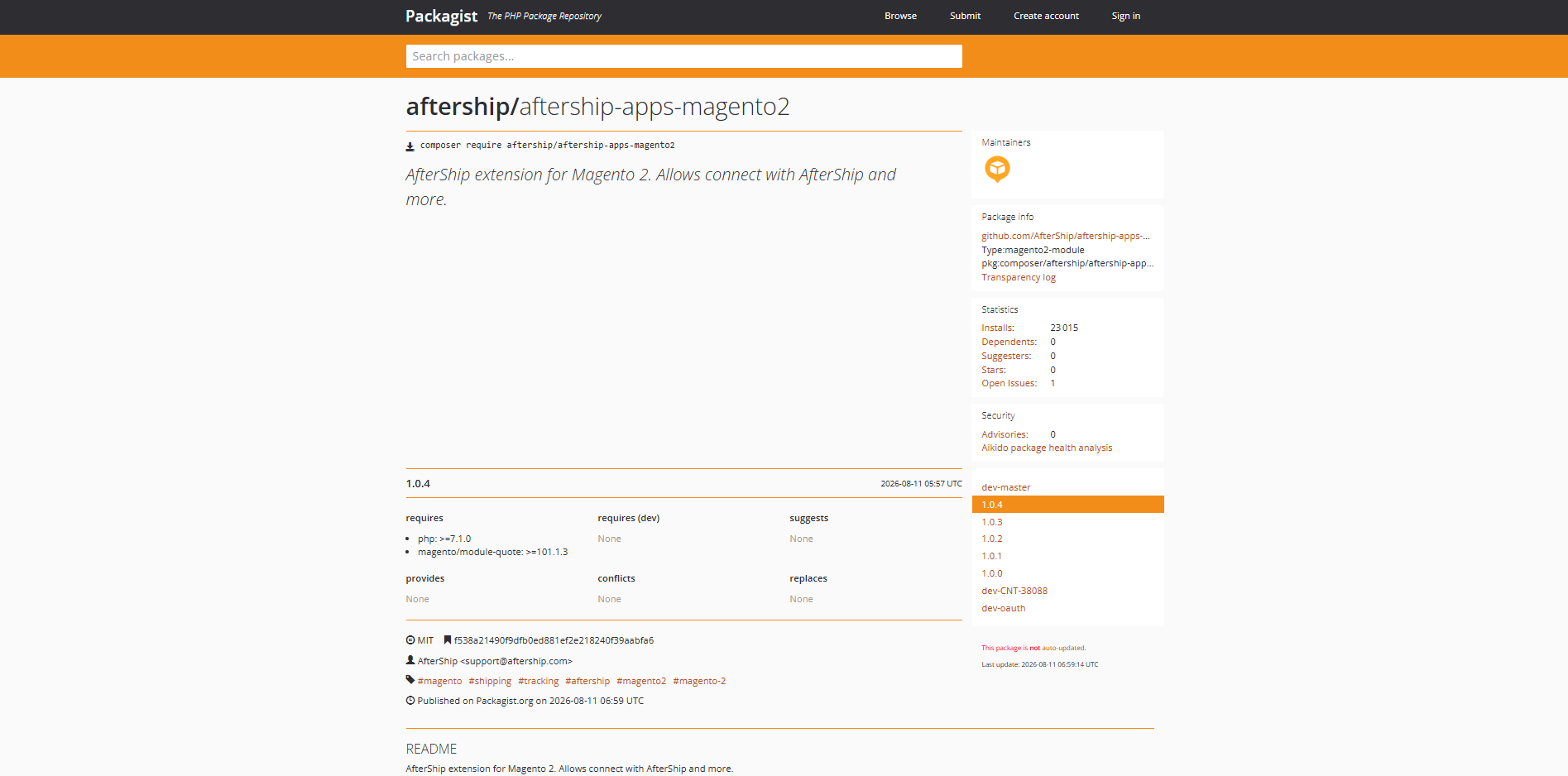
Installation follows the route your team already uses. Composer on Magento 2.4 and above, the Web Setup Wizard on 2.3 and older, Community and Enterprise editions both. Teams without plugin install rights can connect through the admin flow instead. On multi-store, AfterShip's documentation is direct: "AfterShip supports multiple Magento stores."
One plain fact closes the loop, and AfterShip's published Magento tracking guide states it too. AfterShip Tracking and Returns have no Adobe Commerce Marketplace listing. Composer and the in-app connect flow are the two routes in.
The API & Webhooks You Actually Want to Work With
Start where Narvar's portal stopped you. AfterShip's developer documentation is public. No login, no account, no sales call.
The REST API publishes its limits per endpoint: 20 requests per second on POST /trackings and POST /estimated-delivery-date/predict-batch, 5 per second on most other endpoints, and 3 per second on POST /couriers/detect, measured in a one-second window. Exceed one and you get a 429 with X-RateLimit headers telling you exactly where you stand. That is a published contract, which is what you need to size a backfill before you write it.
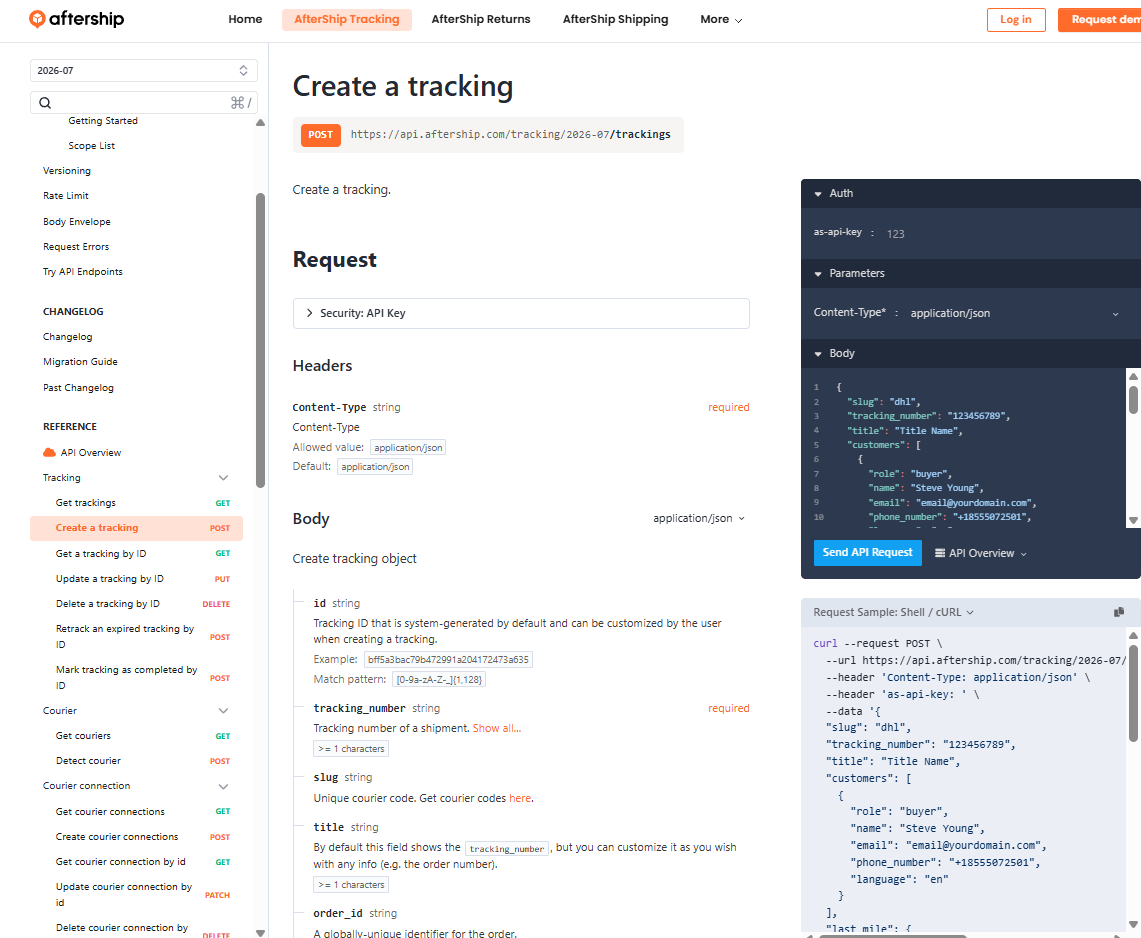
The webhook events are named and enumerated. Tracking fires tracking_update, edd_revise, and tracking_pending_time. Returns fires return.submitted, return.approved, return.resolved, return.rejected, return.expired, return.shipment.provided, and return.shipments.provided. Delivery retries run up to 14 attempts with exponential backoff.
Tracking, returns, and shipping share one endpoint structure and one set of credentials. The second integration is configuration, not a new project.
Unifying the Stack: Beyond Tracking to Full Post-Purchase Automation
One integration covers more than tracking. On Magento 2, AfterShip Returns, a comprehensive returns management platform, gives you a branded returns portal, RMA generation with manual or auto-approval rules, return reasons, resolution and return-method selection, email notifications, and prepaid return labels across 12+ return couriers.
Be clear about the boundary. The deepest exchange, store-credit and POS automations run on native Shopify primitives, and they are not part of the Magento build.
AI EDD reaches Magento merchants out of the box on the branded tracking page and in notifications, and reaches your own storefront pages, headless included, through the API. It predicts with up to 95% accuracy across 80%+ of deliveries, against under 40% for most carrier estimates. Wismolabs sells Delivery Delay Prediction and publishes no accuracy or coverage figure.
Underneath sits the AfterShip carrier directory, listing 2,000+ tracking carriers as of October 2026. AfterShip unifies tracking, returns, and shipping into a single Magento integration.
Technical Showdown: Narvar vs. Wismolabs vs. AfterShip for Magento
The four criteria open into six comparable rows below, because connector architecture and API quality each split into what is distributed and what is documented, and because headless deployment earns its own line on Magento.
| Criteria | Narvar | Wismolabs | AfterShip |
|---|---|---|---|
| Magento Connector Quality | Narvar Accord, zip download installed manually into app/code; no Composer package; no public source; marketplace listing withdrawn | Adobe Commerce Marketplace listing v1.0.2 (23 April 2026); public repository, 7 commits, no declared licence; install base not published | Composer via Packagist, v1.0.4 released 11 August 2026; more than 23,000 installs; public source, MIT licence |
| API Style & Documentation | REST; developer portal login-gated (HTTP 302), support help centre public | REST; public documentation with a linked public Postman workspace; API gated to Pro tier | REST; public developer docs, no login; published endpoint-specific rate limits (20, 5 and 3 requests per second) |
| Webhook Event Library | Not publicly enumerated | Not enumerated; webhooks configured in UI settings | Tracking: tracking_update, edd_revise, tracking_pending_time. Returns: seven named events, from return.submitted to return.shipments.provided |
| Returns Logic Customization | Returns product exists; Magento returns API not publicly documented | Return Automation sold on Magento; no returns API endpoints documented, rules set in UI | Branded portal, RMA with manual or auto-approval rules, return reasons, prepaid labels; seven returns webhook events for API-driven workflows |
| Unified Platform | Separate named products (Promise, Notify and others); no single documented Magento API surface | Tracking and returns under one account; delivery prediction sold, no accuracy figure published | Tracking, Returns and AI EDD (up to 95% accuracy, 80%+ of deliveries) through one API and one set of credentials; 2,000+ tracking carriers (AfterShip carrier directory, October 2026) |
| Headless Commerce Support | Not documented | Not documented | Backend sync unaffected; hosted tracking page frontend-agnostic; storefront embeds via API |
Every cell traces to a package registry, a public repository, a vendor documentation page, or an HTTP status code, captured August 2026. Evaluating Narvar on its own terms? Read a head-to-head comparison.
FAQ for Magento Developers
How does AfterShip handle Magento multi-store setups?
AfterShip supports multiple Magento stores. Each store connects through the same module and the same account, and shipments from every store sync into one AfterShip organisation.
What is the performance impact of the AfterShip extension?
The published source tree contains no JavaScript, CSS, templates or frontend layout XML, so the module injects nothing into storefront page renders. Shipment import runs as a background cycle every three hours rather than at request time. No measured figure is published, and none is needed to verify the architecture: the repository is public.
Is AfterShip compatible with headless Magento frontends?
Backend order and shipment sync is unaffected by a headless frontend, because the module reads data server-side over the Magento REST API. The branded tracking page is AfterShip-hosted, so it works identically behind PWA Studio or a custom frontend. Showing live status or a delivery estimate inside your own storefront views is an API and webhook integration you build in your frontend framework.
Which Magento versions does the AfterShip connector support?
Magento 2 Community and Enterprise editions, installed via Composer on 2.4 and above, or via the Web Setup Wizard on 2.3 and older. The current package release is v1.0.4, shipped 11 August 2026.
Is AfterShip on the Adobe Commerce Marketplace?
No. AfterShip Tracking and AfterShip Returns are distributed through Composer and Packagist, the path a Magento developer already uses for every other module, and through the in-app connect flow. The package is MIT-licensed, its source is public, and its current release shipped on 11 August 2026.
The Final Recommendation for 2026
Wismolabs suits a smaller merchant who needs tracking live this month and will never write against the API. Narvar suits an enterprise with the budget and the services relationship to absorb a manual install and a gated developer portal.
For a Magento team that judges a vendor by what it costs to own, the artifacts settle it. More than 23,000 Packagist installs, a current release shipped on 11 August 2026, and MIT-licensed source that anyone on your team can read before it reaches production. Narvar vs Wismolabs is a fair question for Magento merchants, and AfterShip answers it better than either.