Why Enterprise Brands Are Looking Beyond Optoro in 2026
Your reverse logistics platform was chosen as an independent specialist. In August 2025 it became a module inside Blue Yonder's supply chain suite, twenty-two days after it closed its own liquidation marketplace. Nothing about the product got worse. What changed is who sets the roadmap, how it integrates, and what you are locked into. For today's enterprise brands the real challenge is retaining customers, controlling the returns experience, and keeping inventory decisions on a platform you own. If that is your job, it is time to look at the alternatives.
Start with what is true about the incumbent. Blue Yonder closed its acquisition of Optoro on 19 August 2025, and the returns product is actively invested in. Blue Yonder's returns page publishes >120 million returns handled each year, an NPS of +85 and a CSAT score of 2.83 out of 3. Optoro's own site still carries customer logos including Gap, Ralph Lauren, Best Buy, Steve Madden and Vineyard Vines.
The product is not the reason to leave. Speaking to diginomica in August 2025, Blue Yonder's returns vice president Tim Robinson described the Optoro product as "way ahead" and "several years ahead". Take it at face value.
What changed is everything around the product.
- Roadmap ownership. Release priorities now sit inside a supply chain suite's planning cycle. Blue Yonder's returns page leads with its Smart Disposition engine and markets the combined capability without using the Optoro name anywhere in the visible page copy.
- A two-cloud integration model. Optoro runs on Google Cloud and Blue Yonder on Microsoft Azure. Robinson points to Snowflake as the shared data platform letting both pull from one source. An architecture you inherited.
- Commercial opacity. Optoro publishes no pricing, so scope and cost are knowable only through a sales process.
- Thin independent signal. Optoro's G2 listing sits at 4.3/5 from just 4 reviews, with no review since 2024, well before Blue Yonder closed. G2 itself states there are not enough reviews to provide buying insight, and any sample under 30 reads as directional at best.
- The stack you actually run. Tighter integration with your existing ERP and WMS, on terms you control, is now a live requirement.
- Who owns the customer. The returns portal, the notifications and the returns data are the assets that compound, and enterprises increasingly want them independent of any single physical network.
None of this happened in isolation. Blue Yonder acquired Doddle in 2023, took full ownership of Inmar Post-Purchase Solutions on 18 June 2025, bringing a returns service available at approximately 3,000 drop-off locations across FedEx Office and Kohl's stores in the U.S., then added Optoro that August. DHL Supply Chain announced its acquisition of Inmar Supply Chain Solutions on 10 January 2025, covering 14 return centers and around 800 associates. Three of those transactions closed inside 2025.
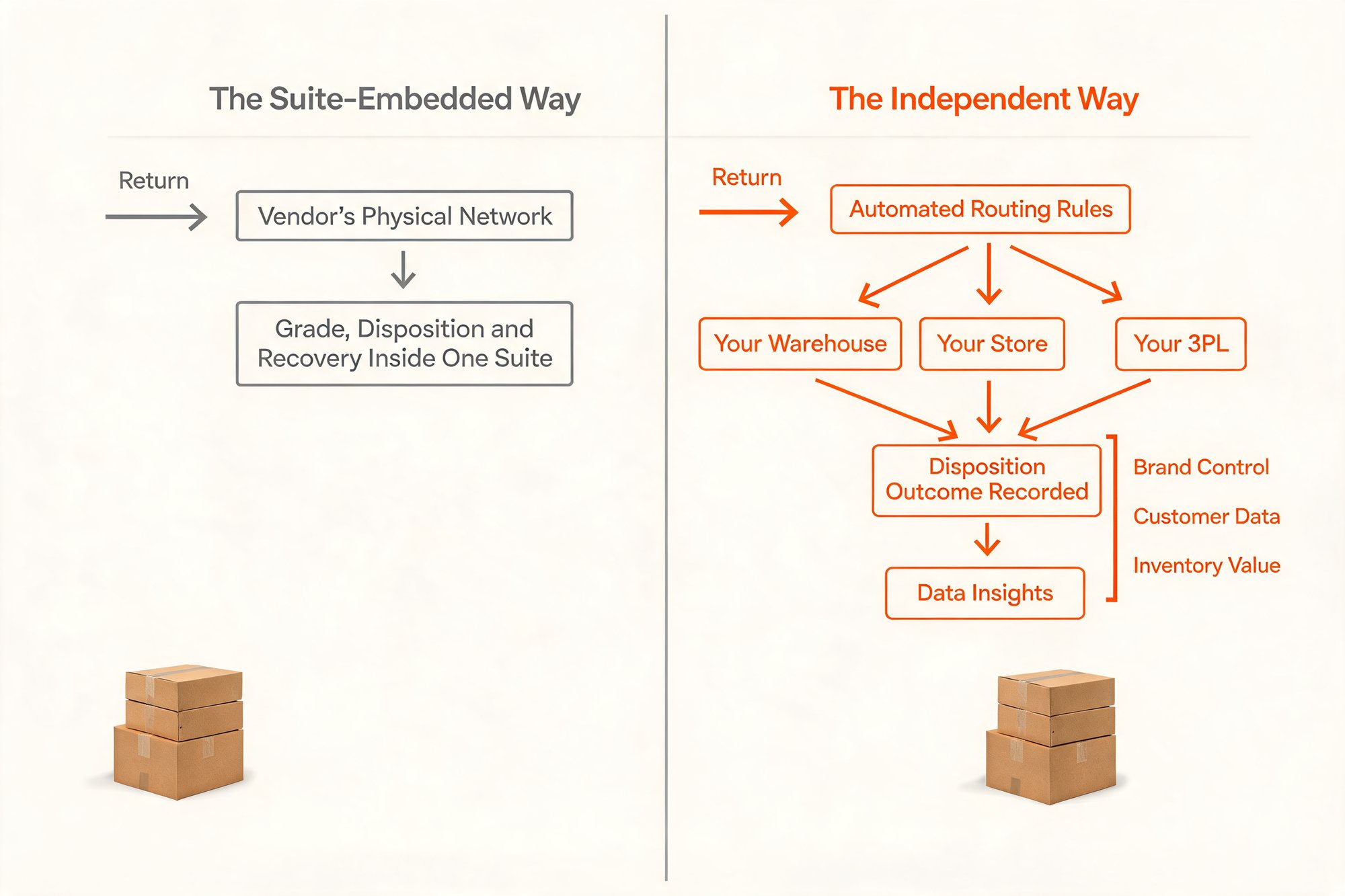
Two models for enterprise reverse logistics: buy the physical layer as a suite module, or orchestrate it across the partners you already run.
The question for 2026 is which layer of the returns stack you want to buy, and from whom.
The 5 Criteria for a Modern Enterprise Reverse Logistics Platform
Before comparing vendors, fix the scorecard. These five criteria separate platforms that move boxes from platforms that also protect margin and lifetime value.
- API and developer experience. Can your engineers read the documentation without booking a call? Look for a documented REST API, webhooks for state changes, and reference material that is public rather than gated behind an enterprise account. API-first design is now mainstream enterprise practice, with 82% of organizations having adopted it to some degree according to Postman's 2025 State of the API report, and the same logic applies to reverse logistics.
- Brand and CX control. The returns portal is a branded surface your customer sees at their least patient moment. Assess how far the portal, resolutions and notification logic can be customised, and whether any of it carries the vendor's branding.
- Intelligent disposition and routing. Separate two things that vendors routinely blur. Pre-warehouse routing decides where a return travels before it ships, and should be rule-driven and automated. Warehouse-floor disposition decides what happens to the unit once it lands, and in most enterprise operations that decision is executed by your own team and recorded by the platform. Ask which of the two a vendor is actually selling you.
- Analytics & Business Intelligence. Return reasons, SKU-level defect patterns and recovery outcomes only create value if you can query and export them into the BI stack your finance team already trusts.
- Total cost of ownership and scalability. You are measured on cost per return processed and on recovery rate, so model both across the full stack rather than the software line alone. No vendor in this category publishes enterprise pricing, AfterShip included. Every number is quoted, so TCO has to be built from the layers you are buying, the layers you already own, and the integration work between them.
5 Optoro Alternatives: Which Ones Sell Software, and Which Also Run the Reverse Logistics
Five platforms come up repeatedly when enterprise teams shortlist Optoro alternatives, each solving a different slice of the problem. If you are still framing the decision, start with how to choose between Optoro alternatives.
ReverseLogix describes itself as a purpose-built returns management system covering digital intake through physical warehouse processing, warranties and repairs, and names SAP, NetSuite, Oracle, Salesforce, Magento, Shopify, WooCommerce and FedEx among its integrations. It publishes an implementation window of 8 to 10 weeks, the only sourced timeline any vendor here puts in writing. Its G2 listing sits at 4.2/5 from 18 reviews, a sample under 30.
ReturnPro, the November 2024 rebrand of goTRG, combines returns SaaS with reverse supply chain services and ReCommerce, and its brand portfolio includes goWholesale, Direct Liquidation and VIP Outlet. Its G2 listing currently carries no reviews.
Narvar is an established enterprise post-purchase suite that advertises 1,000+ carriers and 1,500+ brands, sold as separately named products. It holds 4.3/5 from 183 reviews on G2.
Loop is a returns-first solution built for Shopify, the strongest fit for brands whose catalogue and checkout already live there.
Happy Returns, a UPS company, operates 10,000 Return Bar locations in the US as of April 2026. It is a drop-off network, and one AfterShip integrates with.
Treat every vendor-published figure above as exactly that. Optoro publishes developer documentation, so nobody here is short of an API.
AfterShip Returns sits in a different position: a flexible returns platform built for enterprises, API-first and customer-facing, inside a complete post-purchase suite. A connector catalogue lists the systems a vendor has chosen to support. An openly documented API covers whatever you already run. AfterShip routes and records across the warehouses, 3PLs and disposition partners you have rather than replacing them.
Head-to-Head: AfterShip vs. Optoro Alternatives
Scored against the five criteria, the six platforms separate cleanly by which layer of the returns stack they are built to own.
| Criteria | AfterShip Returns | ReverseLogix | ReturnPro | Narvar | Loop Returns | Happy Returns |
|---|---|---|---|---|---|---|
| API and developer experience | Documented REST API and webhooks, publicly readable | Not publicly documented | Not publicly documented | Documentation gated behind an account | Documented API | Network integration, not a platform |
| Brand and CX control | Fully branded portal, resolutions, exchanges, notifications | Digital returns intake portal | Not publicly documented | Branded portal | Branded returns portal | Return and exchange portal |
| Intelligent disposition and routing | Nine documented conditions route to any warehouse; Enterprise API records disposition | Physical processing, repairs, warranties | Reverse supply chain, ReCommerce | Logs returns to your IMS or WMS | Workflow triggers and disposition push | Consolidated returns to your warehouse |
| Analytics & Business Intelligence | Reason and SKU-level analytics, AI capabilities | Not publicly documented | Not publicly documented | IRIS data engine | Returns dashboards | Not publicly documented |
| Total cost of ownership and scalability | Custom, quote-based (AfterShip Returns pricing lists the self-serve tiers); 310,000+ drop-off locations; carrier network covers 95% of customers worldwide | Custom, quote-based | Custom, quote-based | Custom, quote-based; advertises 1,000+ carriers | Custom, quote-based | Custom, quote-based; network access rather than a platform subscription |
Three rows decide most enterprise shortlists.
On API and developer experience, the question is whether your engineers can scope the integration before procurement gets involved. AfterShip publishes a documented REST API and webhooks that are readable without a sales conversation, which lets a technical evaluator size the work in an afternoon.
On disposition and routing, the split from criterion 3 does real work. AfterShip's rules engine routes by origin, SKU or destination across warehouse locations, using nine documented conditions: customer tag, resolution, return reason, return value, product type, product tag, order tag, order value and SKU. Three documented actions follow: carrier, shipping service and warehouse location. There is no published ceiling on warehouse locations or routing rules.
On drop-off reach, AfterShip's carrier network covers 95% of customers worldwide across 310,000+ drop-off locations, without requiring you to adopt any single vendor's physical network.
The remaining two criteria sort the field along the same seam. Brand and CX control favours platforms where the returns portal stays your surface, which comes down to how much of the portal, the resolution logic and the notification sequence you can change without raising a ticket. Analytics favours platforms that hand back reason and SKU-level data in a form your own reporting tools can load, so the analysis happens where that work already sits. Both criteria reward owning the customer-facing layer, which is precisely the layer AfterShip is built to hold.
AfterShip Returns: For Unparalleled Control & Integration
AfterShip Returns offers API-first reverse logistics for enterprise-level control. That claim rests on three things an operations lead can verify before signing anything.
The first is the rules engine. The platform automates return routing to multiple warehouses by origin, SKU or destination, with carrier, shipping service and warehouse location set per return zone. For a distributed network, that means a high-value apparel return from the Northeast and a bulk return from a Midwest 3PL follow different paths without anyone touching a spreadsheet.
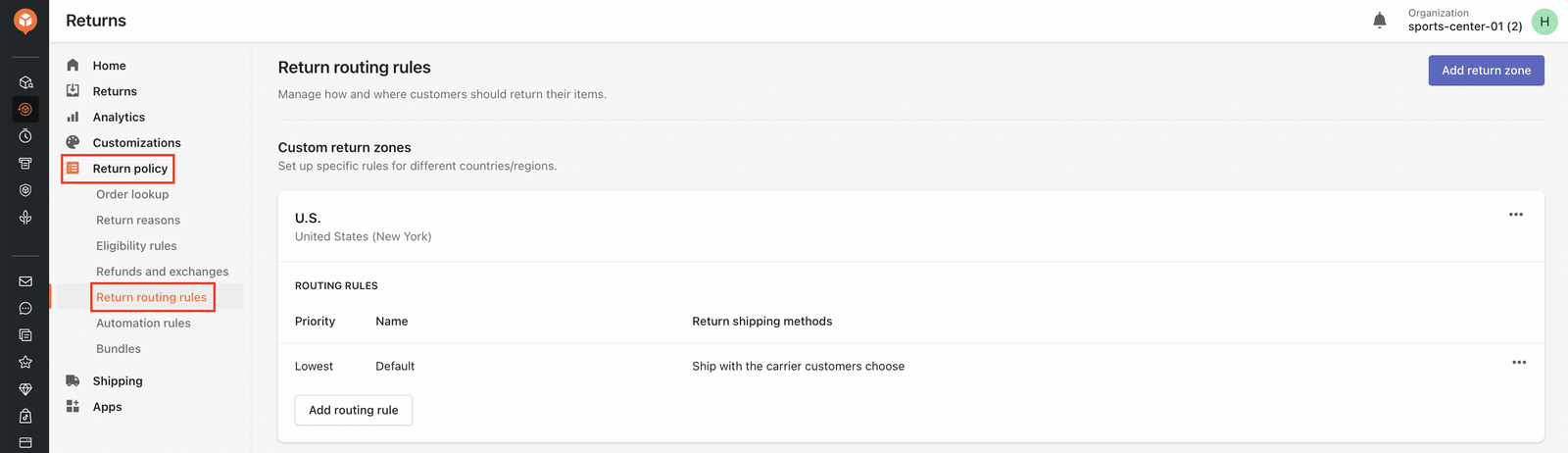
The second is how it connects. Enterprise teams asking for tighter integration with the tech stack usually mean one specific thing: the returns platform has to reach systems the vendor has never heard of. AfterShip Returns integrates with your ERP, WMS, or OMS through its documented REST API and webhooks, a platform-agnostic, API-first approach rather than a fixed list of pre-built connectors. That means it connects to whatever you already run, including proprietary systems, instead of limiting you to a vendor's connector catalogue. Pre-built integrations across ERP, WMS, marketing and support categories are available alongside it.
That distinction matters most when the systems on either side are ones no vendor has built a connector for. Enterprise stacks accumulate custom middleware, in-house order management and warehouse tooling that predates the current returns vendor by years. A documented API treats those as ordinary endpoints. A connector list leaves them out of scope, and the gap becomes a professional services line item.
The third is what happens at the dock. On AfterShip's Enterprise tier, the Returns Public API lets your warehouse receive items by RMA, grade them A-D, and write disposition results back as item tags. Two webhooks carry the events: return.shipment.provided and return.shipment.recorded.
The practical effect is that condition data stops living on a clipboard. Grades captured at receipt flow back into the same system that holds the return reason and the customer history, which is what turns recovery rate into a measured figure with an audit trail behind it.
Which brings up the limitation worth stating plainly.
AfterShip Returns is the orchestration and data layer for reverse logistics. It routes each return to the right warehouse before it ships, then records receipt, condition grade and disposition outcomes through its Enterprise API. It does not decide dispositions on the warehouse floor, and it does not physically grade, refurbish or resell your inventory. ReverseLogix handles physical processing and repairs, ReturnPro runs its own resale marketplaces, and Optoro performs unit-level receiving, testing, grading and dispositioning.
Read that as a design choice rather than a gap. Instead of locking you into a single network or disposition channel, AfterShip plugs into the warehouse, 3PL and disposition partners you already use. You keep full control of your physical operations, your brand and your data.
For an enterprise that has already invested in its own returns facilities, 3PL contracts and recommerce relationships, that is the difference between layering software over a working operation and rebuilding the operation around a vendor. Switching disposition partners stays a commercial decision. It never becomes a replatforming project.
AfterShip provides a fully white-labeled returns portal for brand consistency, with resolutions, exchanges and notifications running under your own brand rather than a vendor's. Returns analytics surface reason and SKU-level patterns, and RMA Review scores returns against 100+ risk indicators, available in the US only.
The mechanics are proven at mid-market scale. Aetrex, a mid-market footwear brand shipping 120,000+ packages a year, cut return processing time by 86%, reduced WISMO tickets by 74%, saved 50% in operational costs and lifted NPS by 141 points. Hear from our customers for the operational detail behind those numbers.
“With AfterShip Returns, the bottleneck of manual returns processing is gone, and exchanges are ready to be shipped as soon as a return has been received.”
Stephen Davis Hernandez, Digital Product Manager
Read their story →AfterShip already runs post-purchase infrastructure at enterprise scale. eBay uses AfterShip Tracking across 650+ carriers, auto-correcting 200,000+ shipments a month.
Returns are also part of a wider post-purchase suite alongside Tracking and Shipping, with AI EDD accurate to up to 95%.
Loop Returns: For Shopify-Plus Brands Focused on Exchanges
Loop is a returns-first solution built for Shopify, and for brands whose catalogue, checkout and payments already live there it is a strong fit. It documents WMS and ERP workflow triggers and can push disposition instructions downstream, so the warehouse side is genuinely built out.
The constraint is orientation. Multi-warehouse routing is where enterprise teams meet its limits, and non-Shopify order volume sits outside its natural territory. For a single-brand Shopify Plus operation shipping from one or two locations, neither of those bites. For a multi-brand group running marketplaces alongside its own storefronts, they decide the evaluation.
For the full treatment of how Loop compares on enterprise returns, see our full comparison of Narvar and Loop for enterprise returns. Across a distributed estate of several warehouses and more than one sales channel, AfterShip's routing rules absorb that complexity natively.
Loop vs Optoro: different layers of the returns stack
Loop and Optoro rarely compete head to head. Optoro runs the physical layer, receiving, grading and dispositioning returned units, while Loop runs the shopper-facing returns flow on Shopify. If the layer you need first is the customer-facing one, AfterShip vs Loop Returns is the more useful comparison.
Narvar & Happy Returns: For Established Suites & Physical Network Needs
Narvar is the established enterprise post-purchase suite, and large retailers choose it for exactly that reason. It is sold as a set of separately named products, including Promise, Assist, Secure, Notify and Shield, and Narvar does not publish which of them a base subscription includes. A buyer cannot establish scope or cost before entering a sales process, which lengthens evaluation and makes a full TCO model difficult to build without a quote in hand. On the warehouse side, its own documentation stops at logging the return into your IMS or WMS.
Happy Returns, a UPS company, is the answer for brands that want box-free drop-off, and it is a network rather than a competing platform. A Blue Yonder-powered returns service now reaches roughly 3,000 FedEx Office and Kohl's locations, so box-free drop-off is no longer any single operator's territory.
You are not choosing between a drop-off network and control. Through AfterShip's Happy Returns integration you keep box-free Return Bar drop-off across more than 9,000 US locations from that network, without surrendering ownership of your returns data or workflow to a single physical network.
The Verdict: Which Optoro Alternative is Right for Your Enterprise?
The cost of getting the returns experience wrong is not theoretical.
About 71% of consumers say they are less likely to shop with a retailer again after a poor experience, up from 67% in 2024.
NRF 2025 Retail Returns Landscape, published 15 October 2025 and produced with Happy Returns, a UPS company.
That number decides which of the two jobs in front of you matters more.
If the job is liquidation and asset recovery at scale, and your bottleneck is genuinely the dock, Optoro inside Blue Yonder is purpose-built for it and remains a serious option. ReverseLogix and ReturnPro fit the same brief from a different angle: both are for enterprises that want the vendor to operate the physical layer, ReverseLogix through warehouse processing and repairs, ReturnPro through its own resale marketplaces. Choose any of the three knowing you are buying a physical operation, and that the customer-facing layer and the returns data come attached to it. AfterShip is the one option here that leaves both in your hands.
If the job is controlling the customer returns experience, driving exchanges, and orchestrating disposition across the warehouse, 3PL and disposition partners you already run, AfterShip Returns is the clear winner. It is the only platform here built to route and record without owning the boxes.
Narvar suits large retailers that want an established post-purchase suite and accept a sales process to learn what the subscription includes. Loop is the right call for Shopify-centric brands running a single-brand catalogue. Happy Returns is a drop-off network, and AfterShip customers keep it through the integration. For an enterprise whose bottleneck is the customer moment and not the dock, AfterShip is the platform that leaves your physical operations, your partners and your data where they are. If your shortlist reaches beyond reverse logistics into the customer-facing returns layer, we also rank the best ecommerce returns platforms.
Returns automation that enhances the returns and exchanges experience, reduces costs, and retains more revenue.
Talk to a Returns SpecialistOptoro Alternatives: Common Questions
Is Optoro still available now that Blue Yonder owns it?
Yes. Blue Yonder closed the acquisition on 19 August 2025 and continues to invest in the product, whose returns page leads with its Smart Disposition engine. What changed is roadmap ownership, the integration model and commercial terms. Blue Yonder's own returns vice president called the product "way ahead".
What is the difference between a returns orchestration platform and a returns processing system?
A processing system runs the physical work: receiving, grading, dispositioning and resale. An orchestration platform runs the customer-facing layer and the routing logic, then records what your warehouse decided as data you can query. AfterShip Returns is an orchestration platform, connecting to whichever processing operation you run.
Can AfterShip Returns handle multi-warehouse routing at enterprise volume?
Yes. Returns route by origin, SKU or destination across warehouse locations, using nine documented conditions to decide where each one goes. Carrier, shipping service and warehouse location are set per return zone, and neither zones nor rules carry a published ceiling, so routing scales as your network grows.
Do I lose box-free drop-off if I move off a network-owned platform?
No. Through AfterShip's Happy Returns integration you keep box-free Return Bar drop-off across more than 9,000 US locations from that network. The convenience your customers expect no longer requires handing your returns data or workflow to whichever operator owns the physical network.
Can I keep my existing warehouse, 3PL and disposition partners if I switch platforms?
Yes, and that is the point of an API-first platform. AfterShip Returns integrates through its documented REST API and webhooks, so it connects to whatever you already run, including proprietary systems no vendor has built a connector for. You keep full control of your physical operations, your brand and your data.
Making the Switch: A 3-Step Migration Framework
No vendor in this category publishes a migration guide or a data-portability commitment, and the only implementation timeline anyone puts in writing is ReverseLogix's 8 to 10 weeks. Treat the move as a project you scope yourself.
- Audit your current state. Document what you spend on returns today and which layer each cost sits in: software subscription, physical processing, transportation, and the engineering hours you pay to keep the two connected. Add your current cost per return processed and recovery rate as the baseline you will be measured against. Note where customers drop out of the returns flow.
- Define the future state against the five criteria. Score your shortlist on API and developer experience, brand and CX control, disposition and routing, analytics and business intelligence, and total cost of ownership. Decide before any demo which of the five you are unwilling to compromise on, because vendors will steer the conversation toward their strongest column.
- Plan a phased rollout. Run a pilot on one return lane or one warehouse before committing the network. Map the integration against the documented Returns API and webhooks, agree what your warehouse writes back and when, and confirm the disposition outcomes you need to record are the ones the platform captures.
Done in that order, the migration question stops being about the vendor you are leaving and becomes a straightforward scoping exercise. You keep the warehouses, the 3PLs and the disposition partners you already run, and you gain a returns platform whose API your own engineers can read on day one.
Returns automation that enhances the returns and exchanges experience, reduces costs, and retains more revenue.
Talk to a Returns Specialist