Why "Optoro Alternatives" Is Really a Question About Layers
You're looking for an Optoro alternative. That probably means one of two things: your vendor was bought by Blue Yonder a year ago and nobody has told you what the roadmap means for your contract, or your returns process works fine at the dock and still loses the customer at the portal. Either way, the question is not which tool looks most like Optoro. It is which layer of the returns stack you actually need to own.
Here is what changed. Blue Yonder's acquisition of Optoro closed on 19 August 2025. Blue Yonder had already acquired Doddle in 2023, and the two now sit at opposite ends of the same journey: Doddle at the consumer end, Optoro at the warehouse. The liquidation marketplaces are closed.
Blue Yonder now describes its returns capability as "routing, processing, and disposition connected to warehouse, transportation, and planning systems." That is a description of inventory movement. Optoro, now part of Blue Yonder, sells warehouse-side returns processing software.
Which makes the shortlist question sharper than it looks. Before comparing enterprise returns platforms line by line, work out where your bottleneck sits: at the dock, where returned units get received and routed, or at the portal, where the customer decides whether to buy again.
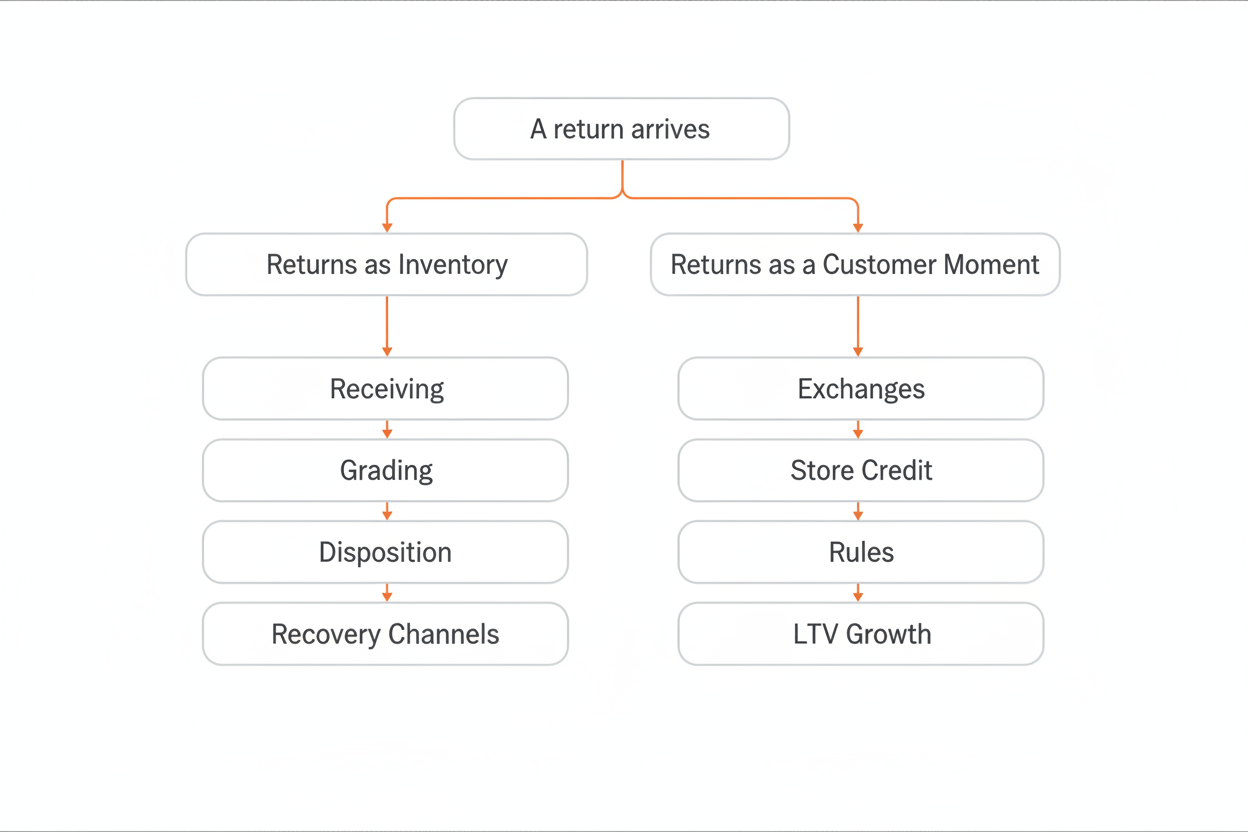
The Core Decision: Returns as Inventory vs. Returns as a Customer Moment
Two legitimate answers exist, and they buy you different things.
Returns as inventory. A supply-chain suite treats the returned unit as stock to be recovered. Receiving, test and grade, disposition routing to restock, resale, donation or destruction, directed put-away, and connections into recommerce channels, all of it sitting inside your WMS, OMS and planning systems. Success is measured in recovery rate and cost per unit processed.
Returns as a customer moment. A post-purchase platform treats the return as the moment a customer decides whether to buy from you again. A branded portal, exchange and store-credit incentives, a rules engine, proactive status notifications. Success is measured in retention and lifetime value.
Neither is a lesser version of the other. They solve different constraints, and knowing how to choose the right returns software starts with naming which of those constraints is costing you more.
When to Stay at the Inventory Layer (The Blue Yonder and Optoro Model)
Plenty of brands should. If your dock is where returns pile up, the inventory layer is the right purchase, and Optoro is a strong product at it.
Optoro receives, tests and grades returned units, routes them through SmartDisposition toward the highest recovery channel, and optimizes put-away with Directed Sorting. It ships pre-built connectors into the systems enterprise brands already run:
- Warehouse management: Manhattan, Blue Yonder, Softeon, Korber, Infios and Deposco
- Order management: Manhattan, Softeon, IBM Sterling, Fluent Commerce and Infios
If you are buying at this layer, ReverseLogix is the other warehouse-side returns management system worth listing.
Three things to weigh before you sign. The customer-facing layer here is a module inside a supply-chain suite rather than the product's center of gravity. Your post-acquisition roadmap and contract terms are now set by Blue Yonder. And Optoro advertises outcomes such as a 93% reduction in processing time and a 37% AOV lift through exchanges, none independently corroborated, so treat them as vendor claims.
For a brand whose constraint is physical recovery at scale, that is the right layer and the trade-offs are worth accepting. Be clear about what it does not fix. If your dock already works and the money leaks at the moment a customer picks a refund over an exchange, more warehouse capability will not move the number you care about. That problem lives one layer up.
When to Own the Customer Moment (The AfterShip Model)
Brands shipping 50,000 to a million orders a year are moving retention into the returns flow for one reason: the return request is the highest-intent moment they get after checkout. The customer is already logged in, already deciding, already weighing you against the alternative. What happens next decides whether the money leaves or stays.
AfterShip Returns is a software platform designed to improve customer retention. A refund closes the loop and takes the revenue with it. An exchange keeps it and adds a second selection. The platform moves requests from the first outcome into the second, using store credit bonuses, variant swaps and AI-suggested replacements in place of a static returns form.
The effect shows up in the exchange rate. At Marc Nolan, exchanges rose from 25% to 49% of returns, a shift the brand describes as doubling its exchanges. AfterShip puts the product-level figure at 50% of revenue retained through exchanges, which is a product claim rather than an audited customer result. There is more to driving revenue with better exchanges than a bonus offer, but that is usually where the first movement shows.
That is not only our read. On the Shopify App Store, where the product actually ships, AfterShip Returns & Exchanges holds 4.7 out of 5 from more than 1,300 reviews and carries the Built for Shopify badge. Happy Gentleman, a merchant in the Netherlands, puts it this way: "Amazing app and service. I have been using it for a few years, and it is the best returns management solution I have used so far. ... The app gives you many options to manage the returns process and offers a wide range of settings to customise everything based on your business needs. Highly recommended."
How AfterShip Returns Turns Refunds into Revenue
Six capabilities carry that work.
- Branded, self-service portal. The customer stays inside your brand from request to resolution rather than bouncing to a carrier page or into a support queue.
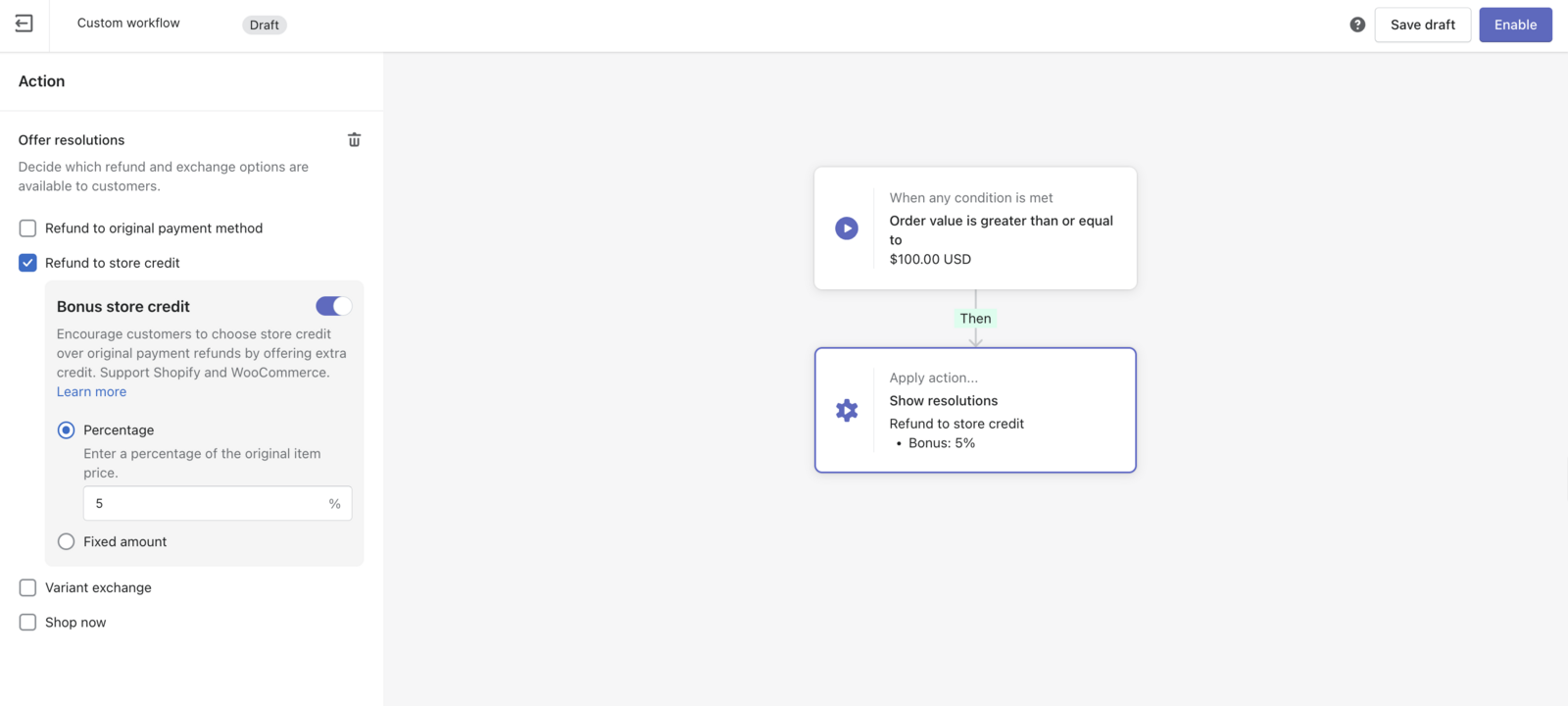
- Incentivized exchanges and store credit. A "Get $10 extra" bonus makes keeping the money in your ecosystem the obvious choice. AI exchange recommendations read the return reason, the customer's comments and live stock to surface the right replacement instead of a generic product grid.
- Automated rules engine. Rules run on attributes you already hold. If customer LTV is over $500, offer an instant exchange. If the reason is sizing, lead with the adjacent size before a refund is ever on the table.
- AI risk scoring on every return. The RMA Review Agent, available on Premium and Enterprise to US merchants, scores each request Low, Medium or High, shows the signals behind the score including whether uploaded photos are genuine, and suggests an action sequence on low-risk cases. It never acts on its own. Your team accepts or overrides.
- Proactive return status notifications. Received, inspected, refunded. Each update lands before the customer has to ask, which is what takes "where is my refund?" out of the ticket queue.
- Drop-off reach. Over 300,000 drop-off locations. More than 9,000 Happy Returns Return Bars in the US are reachable through the built-in integration.
None of that touches the dock. It is aimed squarely at the layer where the refund decision gets made.
2026 Enterprise Alternatives to Optoro: A Strategic Comparison
The criteria below are chosen to tell you which layer you are buying, not to score features against each other. Four platforms sit on the same fork: Optoro inside Blue Yonder, AfterShip Returns, Narvar and ReverseLogix. Happy Returns appears in one cell as what it is, a box-free drop-off network rather than a platform you would buy instead of these four.
| Criteria | Optoro (inside Blue Yonder) | AfterShip Returns | Narvar | ReverseLogix |
|---|---|---|---|---|
| Layer | Inventory. Warehouse-side, inside a supply-chain suite. | Customer moment. Post-purchase platform. | Customer moment. Customer layer. | Inventory. Warehouse-side RMS. |
| Branded customer experience | Blue Yonder's consumer end sits with Doddle. | Branded self-service portal. Over 300,000 drop-off locations. More than 9,000 Happy Returns Return Bars in the US via the built-in integration. | Customer-layer products: Promise, Assist, Secure, Notify. | Returns Initiation and Order Tracking (Pulse) modules. |
| Exchange and upsell tools | Advertises a 37% AOV lift through exchanges. Vendor-published, uncorroborated. | Exchange-first flows, variant exchange, Shop Now, bonus store credit, AI exchange recommendations. | Sold as separately named products; scope not establishable pre-sales. | Lists an Easy Exchanges module. |
| Automation and rules engine | SmartDisposition routing, Directed Sorting put-away. Applied to units, not offers. | Workflow editor with AND/OR conditions and assigned actions. AI risk scoring on every return (Premium and Enterprise, US merchants): Low, Medium or High, with a suggested action sequence on low-risk cases. Never acts on its own. | Sold as separately named products; scope not establishable pre-sales. | Module span covers Returns Processing, Warranty Repair Management and Recommerce. |
| Warehouse processing depth | Decides. Receives, tests, grades, routes each unit to restock, resale, donation or destruction, optimizes put-away. | Records. Grades A to D with operator, timestamp, notes and up to three images. Posts disposition as an item tag via the Return Public API, restocks to a configured location. Grading on Premium and Enterprise, warehouse API on Enterprise. | Customer layer. | Warehouse-side RMS. |
| API and enterprise integrations | Pre-built connectors to named warehouse and order management suites. | eCommerce, 3PL and customer support integrations, plus an Enterprise warehouse API built to your own stack. | Separately named products, no published base-subscription scope, so scope and cost are not establishable pre-sales. | Integration scope not publicly documented. |
| Order tracking, delivery promise and shipping protection | Outside the warehouse layer. | Order tracking through AfterShip Tracking, pre-purchase delivery dates through AfterShip AI EDD, and shipping protection through AfterShip Protection (see how shipping protection pricing compares). | — | Order Tracking (Pulse) module. |
Read the first row against the last. Layer decides everything below it, and on the customer side AfterShip Returns pairs a rules engine and incentivized exchanges with a warehouse API for the other half of the job.
Making the Business Case: How to Justify a CX-First Returns Platform
CX-focused returns platforms convert potential refunds into exchanges and store credit. That is the argument in one line. What follows is the evidence a VP or CFO will ask you for before signing anything.
The NRF's 2025 Retail Returns Landscape, produced with Happy Returns, a UPS company, puts total US returns at $849.9 billion in 2025, with 19.3% of online sales returned and 82% of consumers saying free returns are an important consideration when they shop.
Build the case on four lines rather than one.
- Cost savings. Aetrex, a footwear brand shipping more than 120,000 packages a year, is the clearest worked example. By defaulting customers to the 30-day return window that they set up, Aetrex experienced an 86% reduction in returns processing time and saved over 50% in operational costs. Its Net Promoter Score improved by 141 points on the returns experience, and WISMO tickets fell 74% with AfterShip Tracking and AfterShip Returns working together.
- Revenue gains. The exchange shift covered earlier is what turns a cost argument into a growth argument, and it is the number your CFO will remember. For merchants who want the shape of the economics to change rather than the total to shrink, AfterShip Returns also offers a $0 platform fee, funded by an optional shopper-paid Return Care fee, for eligible Shopify merchants.
- Data and insights. Return reason data, grading data and disposition tags feed back into merchandising and product development. That is where the return rate itself starts to move, rather than the cost of servicing it.
- Integration burden. This is the line your VP will actually press on. AfterShip integrates with NetSuite and ShipStation, and connects to Shopify, Salesforce Commerce Cloud, BigCommerce and Adobe Commerce on the storefront side, with ShipBob and ShipHero for 3PL operations. For the warehouse itself, the Return Public API on Enterprise handles receive-by-RMA, grading and disposition tags against your own stack.
“This exchange feature took every problem away. It’s also saved a lot of revenue—$125k in the last 90 days.”
Nikolas Callas, Director of Operations
Read their story →AfterShip Is the Choice When the Customer Moment Is Your Bottleneck
If your constraint is physical recovery at scale, stay at the inventory layer. Blue Yonder's returns stack with Optoro, or a warehouse-side returns management system like ReverseLogix, is built for that job. If your constraint is what happens to the customer and to the revenue at the moment of return, AfterShip Returns is the platform built for that one.
Be straight about the limits. AfterShip Returns is software, not a physical operation. It does not run warehouses, grade stock, liquidate or resell it. At the warehouse layer it records dispositions through its Enterprise API rather than deciding them, so if you need a system that routes every returned unit to restock, resale, donation or destruction and optimizes put-away, that is Optoro's layer and a brand at that bottleneck needs it. Two further limits are worth stating plainly. Return Care is Shopify only, available in the US and Australia with the UK in validation, and requires AfterShip Protection, so it does not apply if you are running Salesforce Commerce Cloud, Adobe Commerce or a custom stack. And the RMA Review Agent is available on Premium and Enterprise, to US merchants only. For teams that do need that warehouse-layer routing, we rank the five options in Optoro alternatives for reverse logistics.
Those are the boundaries of the recommendation rather than arguments against it. Inside them, for a brand whose returns problem is a customer problem, AfterShip Returns is the platform to buy.
For a wider view of the field than this two-layer cut, our roundup of the best returns platforms for eCommerce covers it, and you can see the full vendor list in the companion piece.
Returns automation that enhances the returns and exchanges experience, reduces costs, and retains more revenue.
Book a demoFrequently Asked Questions
What's the main difference between Optoro and AfterShip Returns?
Optoro, now part of Blue Yonder, is warehouse-side returns software that receives, grades and routes returned items to recovery channels inside a supply-chain suite. AfterShip Returns is a post-purchase platform that owns the customer side of the return: branded portal, incentivized exchanges, rules engine and notifications, with grading and disposition recorded through its API.
What happened to Optoro?
Blue Yonder acquired Optoro in a deal that closed on 19 August 2025. Optoro continues as returns software inside Blue Yonder's returns stack alongside Doddle; its BULQ and BLINQ liquidation marketplaces have closed.
Which Optoro alternative is best for increasing customer LTV?
AfterShip Returns is designed for increasing customer lifetime value (LTV) by offering incentivized exchanges, store credit bonuses, and a branded, self-service returns portal.