You spent a fortune acquiring this customer. They finally click "buy." Then you hand them off to a generic shipping confirmation and the relationship goes quiet at the exact moment they care most. If your post-purchase communication feels like a black hole, you are not alone, and you are leaving money on the table. The fix is not a louder email. It is a different set of channels.
Why Your Order Tracking Emails Aren't Working Anymore
Your tracking emails are not failing because nobody opens them. That is the diagnosis most teams reach for when engagement flattens, and the measured data points the other way.
Shipping confirmation emails open at 62.67%, the highest of any email type in the dataset.
Source: Omnisend, Email Marketing Benchmarks, 12 May 2026. 470 million automated sends across more than 27,000 brands, 2025 data.
So the interest is there. What fails is everything around the open. A shipping update competes for attention in a promotions tab it never asked to be in, clears a spam filter it can only lose to, and then waits. It arrives while your customer is in a meeting, and it is still sitting there when the courier attempts delivery and misses. By the time it is read, the moment it was written for has passed, and your customer has already asked support where their order is.
The number is also harder to trust than it looks. Apple clients account for 62.26% of all email opens (Litmus, July 2026), and Apple Mail Privacy Protection registers an open whether or not anyone read the message. Brevo now publishes its campaign open rate twice for that reason: 20.73%, or 33.87% once Apple MPP opens are counted. If your own rate has been drifting, some of that movement is measurement rather than behaviour.
None of this means your customers stopped caring. Forrester's March 2025 Consumer Pulse Survey of US online adults found that 80% consider an order confirmation with a specific delivery or pickup date important, and around three-quarters value notifications that carry status updates. They want the update. They want it where they are already looking, at the moment something changes. That is a channel problem, and the teams that solve it run proactive shipping notifications across more than one.
5 High-Impact Order Tracking Alerts to Use Instead
The answer is not one better channel. It is a small set, each doing the job it is good at. Three of them you can turn on today, though not all on the same plan: SMS, a branded tracking page with a wallet pass alongside it, and predicted delivery dates. One is gated behind a higher plan. One is already gone, and Meta closed it. Each is below, with where it sits on AfterShip Tracking. For the apps that deliver those alerts, see which branded tracking apps support these alerts.
1. SMS Alerts: The Workhorse That Reaches the Lock Screen
SMS earns its place on path, not on a claimed engagement number.
- It arrives as a notification on the device, with no promotions tab and no spam filter in the path. Delivery is evidenced by carrier receipts rather than a tracking pixel, so what you count is what landed.
- Save it for the moments that generate tickets: an exception such as a package returned to sender, a failed attempt, out for delivery.
- Reach differs by use. Transactional SMS goes to more than 200 countries on AfterShip Tracking; marketing SMS is limited to the US, UK, Canada and Australia.
- You pay by segment. GSM encoding gives 160 characters in the first segment and 153 after; Unicode drops that to 70 and 67, so one emoji can double the cost.
- Consent is not optional. Transactional texts require prior express consent, marketing texts prior express written consent, and revocation rules took effect on 11 April 2025. The FCC's one-to-one consent rule was vacated by the Eleventh Circuit on 24 January 2025 and later repealed. On AfterShip you also need proof of recipients' consent, toll-free verification, dedicated-number registration and UK KYC.
The list you build for delivery alerts is the same one you can later use to drive sales with SMS.
2. WhatsApp Messages: The Conversational Channel
WhatsApp is the default messaging app across much of the world outside North America, and it carries what a text cannot: a photo of the parcel at the door, and a reply from the customer in the same thread.
Be clear about what it takes to run. On AfterShip Tracking, WhatsApp is an Enterprise capability and requires a separate WhatsApp service subscription, so it is not something an Essentials or Premium plan switches on. Meta bills per message, and a shipping update is a Utility template, free inside an open customer service window until 1 October 2026.
That makes WhatsApp a channel to plan for rather than one to switch on this quarter. The channels doing the heavy lifting on support volume start at Essentials, not at Enterprise.
3. Branded Tracking Page: Your Hidden Marketing Channel
Every status check is a visit you have already paid for. The only question is whose page it lands on.
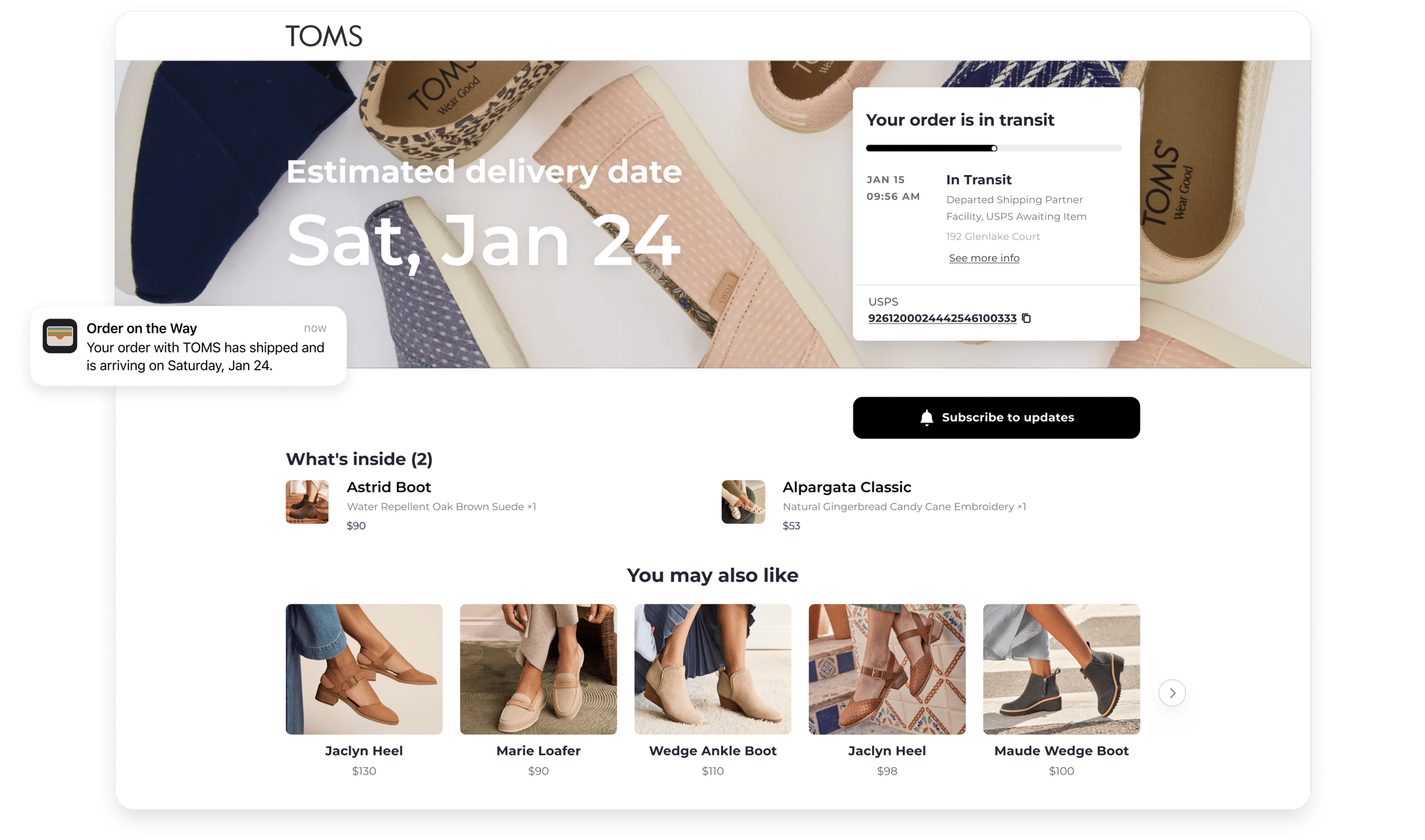
A branded tracking page keeps that visit on your domain rather than a carrier's, which turns a visit the customer makes again and again into somewhere you control: your header, your recommendations and your offers, next to the timeline the customer came for. On AfterShip Tracking the page carries your logo from Essentials and runs on your own domain from Premium. If you are weighing vendors rather than plans, start with the branded tracking page software we rate.
The wallet pass is its companion on the device. A customer adds the pass at checkout or from the tracking page, and it updates in place as the shipment moves, at no per-pass or per-update fee to you, and an update can surface a notification. It is available on every plan, including Free.
Pair it with web push notifications, an AfterShip Email capability for bringing a shopper back with an offer. That is a marketing job, not a shipment alert.
So the on-brand page begins at Essentials, and the pass that sits alongside it is on every tier AfterShip Tracking sells.
4. AI-Powered EDDs: The Alert That Prevents the Question
The best notification is the one your customer never needs to receive.
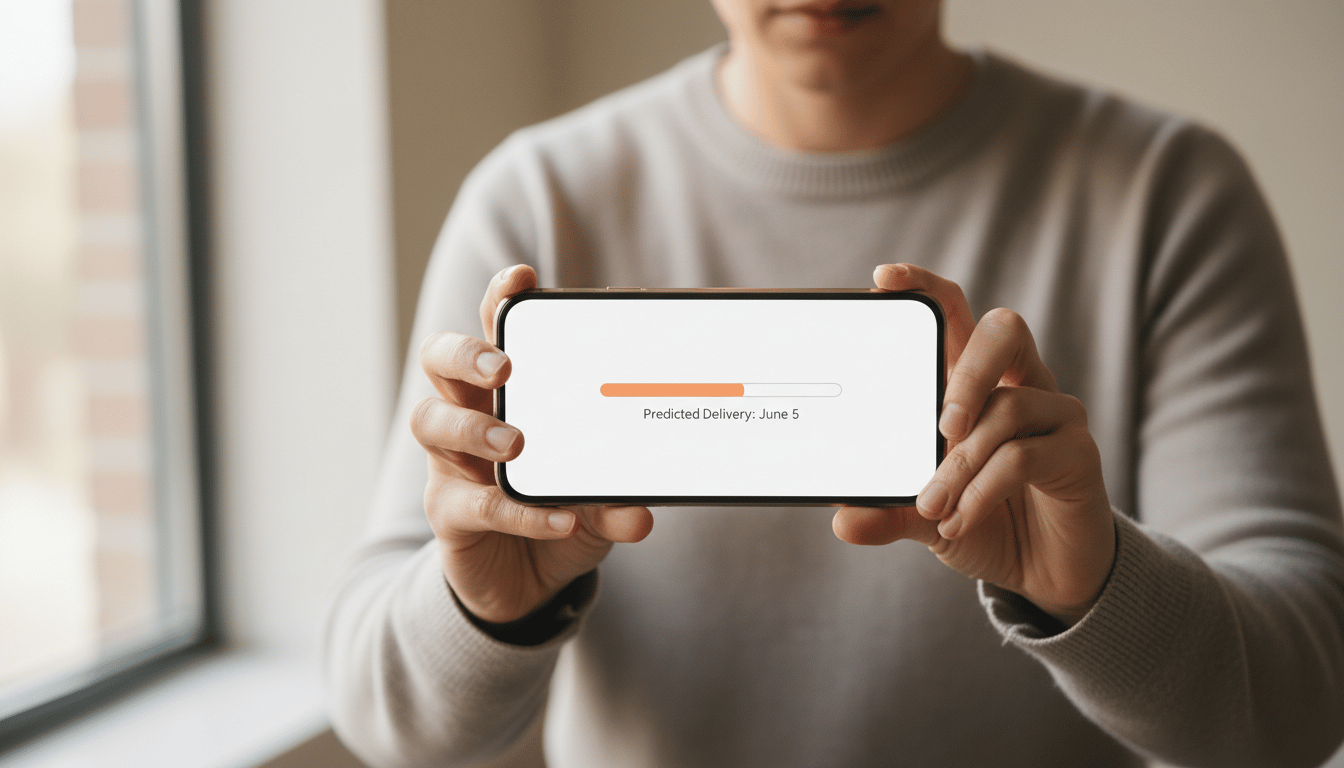
AI-powered estimated delivery dates put a specific date in front of the shopper before they buy, on the product page and at checkout, then carry that same date through every update afterwards. "Where is my order" is nearly always a question about a date, and a date given early removes the reason to ask it.
AfterShip publishes accuracy of up to 95% for those predictions, and coverage of 80% or more of deliveries, against under 40% for typical carrier estimates. Coverage is the number operators underrate. A prediction that exists for only some shipments leaves the rest sitting behind a carrier window measured in days, which is the gap your support inbox pays for.
On AfterShip Tracking, this is available on Premium and above.
5. Facebook Messenger: The Socially-Integrated Nudge
Stop planning around Messenger for shipping updates. Meta closed that path.
From 27 April 2026, Meta's Messenger Platform documentation states:
All API requests containing the Message Tags CONFIRMED_EVENT_UPDATE, ACCOUNT_UPDATE, and POST_PURCHASE_UPDATE will receive error code 100.
The last of those three tags was the one carrying automated order and shipping updates outside the 24-hour window, which is where nearly every shipping notification falls. Messenger was never as widely used for this as SMS, so the move is a small one: point the subscribers you have at SMS, your tracking page and the wallet pass.
How to Build Your 2026 Notification Strategy
Choose by moment, not by channel.
Most notification plans start with a favourite channel and push everything through it. Reverse that. Each moment in a shipment has a different cost of being missed, and the cost is what should pick the channel. A confirmation is a record, so it belongs somewhere the customer can find it again. An exception is time-critical, so it belongs on the device. A status check is a question, so it belongs on a page you own. A predicted date is an answer given before the question, so it belongs in front of the purchase.
The table below sets the seven channels against what an operations lead actually has to defend in a budget review: what you can measure, what it costs, the job it does, the moment it suits, and where it sits on AfterShip Tracking.
| Channel | Measurable engagement metric | Cost | Primary goal | Best for | On AfterShip Tracking |
|---|---|---|---|---|---|
| Open rate, with the MPP caveat: shipping confirmation 62.67% (Omnisend, 12 May 2026) | Included in ESP or platform plan | Full detail, receipts, the record of the order | Order and shipping confirmation, the baseline every customer gets | Essentials and above | |
| SMS | No open rate exists. Delivery rate from carrier receipts, or your own click-through rate. | AfterShip credits by destination: US 1, Canada 2, Australia 2, UK 6, so a UK text consumes six times the credits of a US one. As an absolute benchmark, Twilio publishes $0.0083 per US segment, plus carrier fees of $0.0035 to $0.0045 (read 25 August 2026). | Reduce WISMO at the high-anxiety moments | Exception, failed attempt, out for delivery | Essentials and above; 200+ countries transactional; marketing SMS in the US, UK, Canada and Australia only |
| No open rate available | Meta per-message utility pricing, free inside an open service window until 1 October 2026. | Conversational, rich-media updates | Markets where WhatsApp is the default messaging app | Enterprise plus a WhatsApp service subscription | |
| Branded tracking page | Visits and on-page engagement, if you measure them. | Included in plan | Keep the status check on the brand's domain; cross-sell | Every shipment; the destination every other channel links to | Logo from Essentials, custom domain from Premium |
| Apple Wallet pass | Not measurable by open rate | No per-pass or per-update fee to the merchant | Status on the device, updated in place | Customers who add the pass at checkout or from the tracking page | All tiers including Free |
| AI-powered EDD | Accuracy up to 95%; coverage 80%+ of deliveries vs under 40% for typical carrier estimates (aftership.com/edd) | Included in Premium and above | Prevent the question before it is asked | Product page, checkout, every notification | Premium and above |
| Facebook Messenger | Not applicable | Free to send, but the automated post-purchase path was retired by Meta on 27 April 2026 | None recommended for 2026 | Nothing new; migrate existing subscribers to SMS or the tracking page | Listed on AfterShip's feature page |
Unify Your Channels, Don't Juggle Them
Five channels run from five tools is not a strategy: it is five places for the same shipment event to go missing.
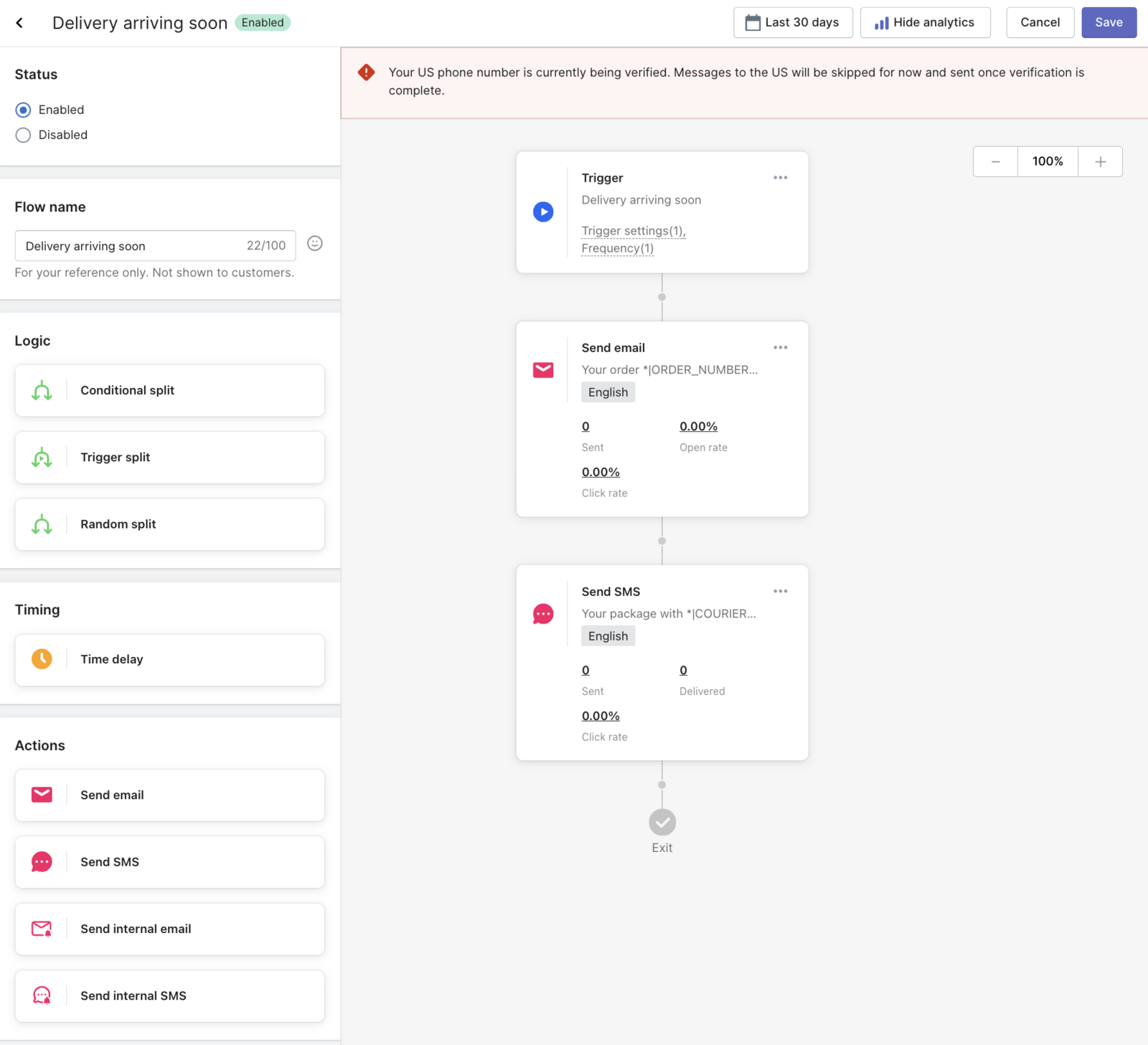
Run them from one source instead, and let that source be the shipment event. When a scan lands, a single rule decides who hears about it, on which channel, and in what words. Info received and in transit set the expectation. Delivery arriving soon and estimated delivery date revised carry the date changes that would otherwise arrive as a surprise. Out for delivery is the message that belongs on the phone. An exception, such as a package returned to sender, or a failed attempt, is the moment a customer either hears from you or opens a ticket. Available for pickup, ready for pickup and delivered close the loop.
One event, one rule set, and nothing downstream of it drifting. That is the difference between a notification programme and five tools with five audiences and five sets of copy to keep in step.
In AfterShip's published customer results, StackCommerce cut WISMO tickets by 71% using AfterShip Tracking, and Mous cut them by 54%.
If you are rebuilding the flow rather than patching it, there are more post-purchase moments worth using to boost engagement and CX once everything runs off one trigger.
AfterShip Tracking is where these run as one: email and SMS fired from the same event, the branded page and the wallet pass as the place they point to, and predicted dates carried through all of it.
Proactive shipment tracking that delights your customers, reduces WISMO tickets, and improves your delivery performance.
Book a demoFrequently Asked Questions
What are the alternatives to email for order tracking notifications?
SMS, a branded tracking page, a wallet pass on the customer's phone, and AI-predicted delivery dates shown before and during transit. WhatsApp is a strong channel in many markets; on AfterShip Tracking it is an Enterprise-plan capability with a separate WhatsApp service subscription. Facebook Messenger's automated post-purchase path was retired by Meta on 27 April 2026.
Why use SMS for order tracking?
A text arrives as a notification on the device, with no promotions tab or spam filter in the path. It suits the moments that generate support tickets: a delivery exception, a failed attempt, out for delivery. Transactional texts require prior express consent; marketing texts require prior express written consent.
Why use a branded tracking page?
It keeps the status check on your domain rather than the carrier's, so every "where is my order?" visit is a brand touchpoint that can carry recommendations and offers. On AfterShip Tracking, the page carries your logo from the Essentials plan and your own domain from Premium.
How do AI-powered estimated delivery dates reduce support tickets?
They answer the question before it is asked. AfterShip's AI EDD predicts delivery dates with up to 95% accuracy and covers 80% or more of deliveries, where carrier estimates typically cover under 40%; the date is shown on the product page, at checkout and in every update.
Is Facebook Messenger still a good channel for shipping updates?
Not for new plans in 2026. Meta retired the message tags that carried automated order and shipping updates outside the 24-hour window, effective 27 April 2026; requests using them now return error code 100.