Why a Transparent Claims Process Is the Only Metric That Matters
The package is gone. The claim went in. And then nothing.
No status. No update. Nothing to tell the customer emailing you twice a day. Your support team cannot answer, because your provider has not told you anything either. The peace of mind you sold at checkout is now a brand problem.
Most teams shopping for a replacement are reacting to a denial. The harder problem is invisibility: a claim nobody can see while it is open. A denial is one bad conversation. An invisible claim is a bad conversation every day until it resolves.
The costs land in familiar places: support hours burned on status requests that carry no status, negative reviews written during the silence, chargebacks from customers who stopped waiting, and churn from buyers who will not risk a second order.
Churn is the expensive one. DHL's E-Commerce Trends Report 2025, which surveyed 24,000 online shoppers across 24 markets, found that three in four will not buy from a retailer when they do not trust the delivery and returns provider behind it.
An anonymised US hip-hop jewelry brand shipping high-value goods sits at the sharp end. The brand's CEO put it plainly: "We put our customers first, but we weren't actually in full control of the claims process. Being left in the dark, we were uncertain if our customers were satisfied."
The question is not which provider pays out, but which one lets you and your customer watch it happen. Only one of the three publishes how often it approves claims, and where that figure comes from. That is AfterShip Protection, and you can check it before you sign.
The Anatomy of a Transparent Claim: Our 5-Point Checklist
Criteria first, evidence second. Each provider is judged on the points below.
- Ease of submission. How many steps, how many entry points, and whether the customer can start a claim on a page that still looks like yours.
- Proactive communication. Whether status is pushed to the shopper and the merchant, or whether someone has to ask.
- Merchant and customer visibility. Who can see an open claim, and what they see. The standard worth holding out for is self-service submission and status, merchant-controlled resolution.
- Resolution speed and who controls it. Speed matters less than control. The question is whether the brand can make the customer whole without waiting on the adjudicator.
- Payout reliability, and what is published about it. Judged on disclosure, because that is the only part of reliability a buyer can check before signing.
Every provider says claims get paid. AfterShip Protection is the only one that says how often, on what basis, and names the licensed agency that makes the call.
What Each Provider Publishes About Its Own Claims Process
The method here is simple and reproducible. For each provider, this article reads what that provider publishes about its own claims process on its own public pages, quotes it, and links it. Nothing below rests on a private demo, a vendor briefing or an anecdote. Where a provider publishes a detail, it gets credit for it. Where a provider publishes nothing, the silence is reported as silence rather than filled in with an assumption. Every line can be checked by opening the source, which is the whole point: a claims process you can verify before you sign is the only kind worth buying.
AfterShip Protection: What Is Published
AfterShip publishes the workflow end to end in its help centre, including how customers file a claim and what they need to have ready before they start.
A claim can begin from an email link, from a branded claim page, or from the branded tracking page the customer is already checking. Customers can file claims directly from the branded tracking page. The help centre puts filing at under 5 minutes, and the required documentation is listed up front, so the shopper knows what is needed rather than discovering it halfway through.
Once a claim is open, the customer checks its progress themselves through a "View claim" button on the same branded surface. AfterShip shows claim status to both merchants and customers. Neither party has to email anyone to find out where things stand.
The seventh and final step of the published workflow is the load-bearing one. The merchant reviews the claim before it goes to the insurer, so nothing reaches the adjudicator that the brand has not seen first. That is the step neither other provider here has, and it is the difference between a claim that happens to your brand and a claim your brand runs.
After that review, UPS Capital Insurance Agency adjudicates every AfterShip Protection claim. The agency publishes a phone number, which means there is a named, licensed, contactable party standing behind the decision rather than an anonymous queue.
The published outcomes are Approved, Needs Information and Rejected, and a rejection routes back through the merchant instead of landing on the customer unannounced. The filing window is 90 days from delivery. Covered reasons are lost, porch piracy and damaged.
All of it is published before a contract exists, which is what makes the AfterShip Protection process checkable rather than promised.
Route Protect: What Is Published
Route publishes a detailed process, and it deserves an accurate description rather than a caricature.
Shoppers file through the Resolve Center at claims.route.com. Qualifying claims can be settled by Automatic Instant Resolution, which is the fastest published path in this comparison. The reframe follows immediately: instant resolution is speed inside a process the merchant does not control, and speed you cannot step into is not the same thing as control.
Route's shopper help centre publishes the shopper-facing detail in full: a status dictionary that defines each state a claim can occupy, it sends email updates to the shopper, it publishes its denial reasons, and it gives shoppers a path to reopen a claim that was softly denied. On the process axis, the detail is there to read.
The merchant side is where the shape changes. Route's merchant documentation describes a Claims tab, an Insights tab and the ability to file on a shopper's behalf. What it does not describe is any ability to approve or contest a claim before it is decided. Assessment belongs to Route, through "AIR, our Automated Issue Resolution integration" or its own specialists, and every merchant recourse in the documentation arrives after the decision has been made. Route's shopper help centre defines a claim that is "Not Approved" to include "Invalid police report if one was requested by our team".
So the gap is disclosure, not process. Route publishes no claims approval rate on any public surface, on neither its shopper nor its merchant help centre, and it publishes no premium rate either. You can read exactly how a Route claim moves. You cannot read how often it ends in a payout, which is the one number a buyer would want before signing.
Corso: What Is Published
Corso's gap is structural rather than operational.
Corso's published terms state that the protection "IS NOT AND SHALL NOT CONSTITUTE INSURANCE OF ANY KIND WHATSOEVER". The capitals are Corso's own. No underwriter is named anywhere in the documentation because there is none to name: the programme is funded out of the fees collected at checkout, as Corso's own account of how it works describes. Under those same terms, whether a loss occurred is determined by Corso "in its sole and absolute discretion".
The clock runs differently too. Corso's filing window is 60 days from the purchase date rather than from delivery, so a slow-moving order can spend part of its coverage before it even ships.
Shipping claims are handled by Corso's Concierge team and are explicitly not routed to the merchant, which removes the brand from its own customer's worst moment. Corso publishes no approval rate.
Set beside that, AfterShip Protection routes every claim to a licensed insurance agency that is named, regulated and reachable by phone, and publishes how often that agency approves.
The Verdict: A Side-by-Side Comparison of Claims Transparency
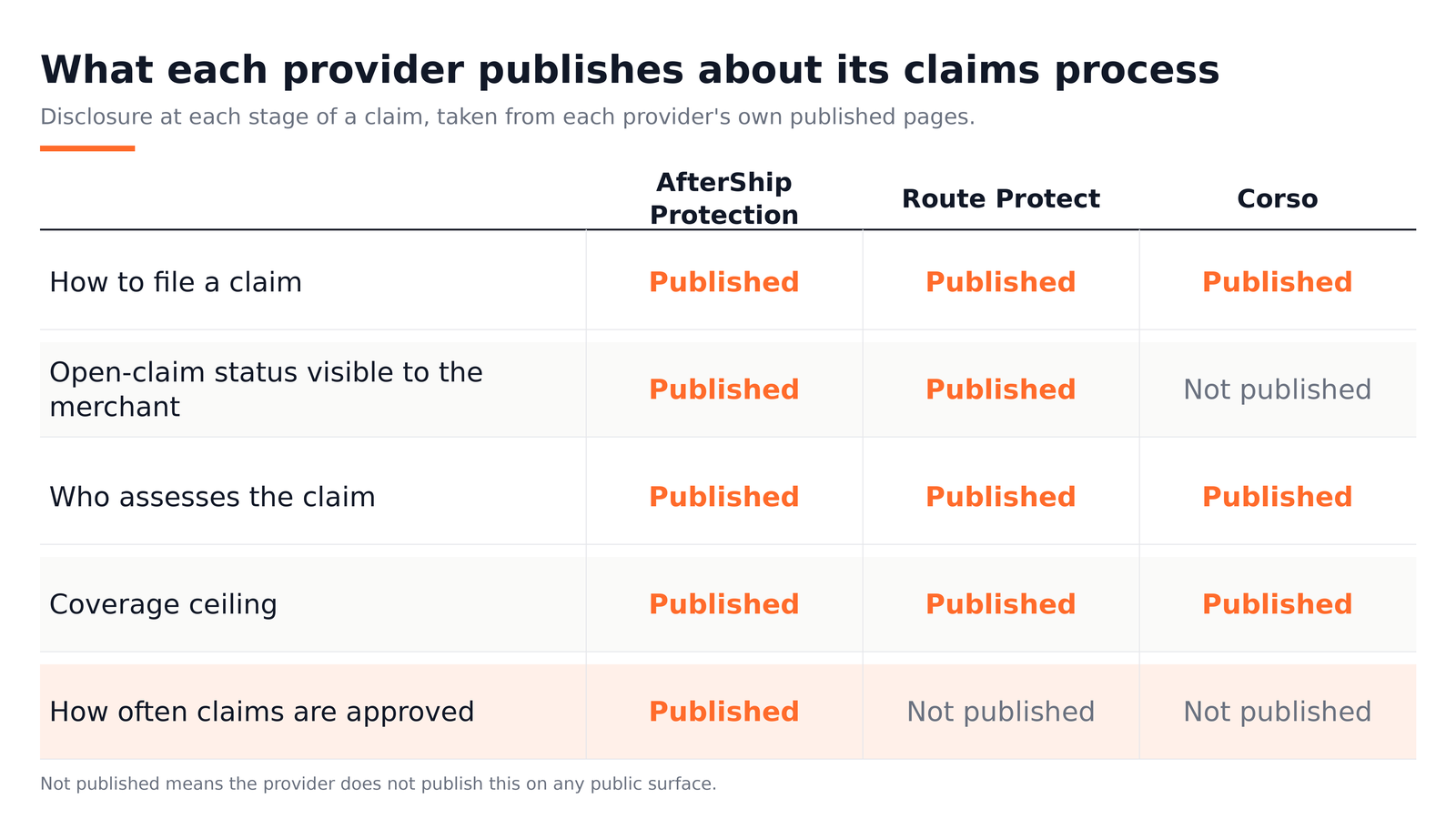
| Criteria | AfterShip Protection | Route Protect | Corso |
|---|---|---|---|
| Ease of customer submission | Yes. Email, a branded claim page, or the branded tracking page | Yes. Resolve Center at claims.route.com | Yes. Customer portal reached from the confirmation email |
| Proactive communication | Yes. Published outcome states, with rejections routed back through the merchant | Yes. Email updates to the shopper and a published status dictionary | A Concierge specialist works the claim under the brand's name |
| Merchant and customer visibility | Yes. Both see claim status on the brand's own pages | Shopper yes. Merchant sees a Claims tab and an Insights tab | Merchant admin shows resolution history. Open shipping claims sit with Concierge, not the merchant |
| Resolution speed and who controls it | Merchant reviews before adjudication and can resolve the shopper at any point | Assessment is Route's alone. Merchant recourse comes after the decision | Corso decides. The merchant is not in the loop |
| Payout reliability and published disclosure | Approval rate published, with the basis it rests on | Not published | Not published |
| Coverage ceiling | $10,000 per order | $5,000 any one package or shipment | $1,000 of declared value |
Every ground below can be checked by opening the source. A fuller feature-level breakdown sits in our direct Route comparison.
First, AfterShip Protection is the only one of the three that publishes a claims approval rate at all, and the only one that publishes the methodology behind that rate. Second, it is the only one where an independent licensed insurance agency decides the claim. Route names its underwriting chain publicly and then adjudicates in-house, through AIR and its own specialists. Corso names no underwriter and keeps the determination to itself. What matters is which party makes the call, and only with AfterShip Protection is that party independent of the vendor. Third, it publishes the highest per-order coverage ceiling of the three. Fourth, it is the only one where the merchant reviews the claim before it reaches the insurer. Fifth, it is the only one where the claim begins and ends on the brand's own pages.
Route publishes a strong process and withholds its outcomes. Corso publishes terms that place the decision inside its own judgement. AfterShip Protection publishes the process, the adjudicator and the approval rate, and gives the merchant the one control that actually matters, which is the ability to make the customer whole without waiting for anyone.
How AfterShip Delivers a Radically Transparent Claims Process
The mechanism behind all of this is a partnership, and its value is accountability rather than speed. AfterShip Protection is powered by InsureShield, and every claim is adjudicated and paid by UPS Capital Insurance Agency, Inc. AfterShip does not approve or deny anything. A licensed insurance agency does, it publishes a phone number, and it answers to a regulator. Neither of the other two providers puts a claim in front of an independent licensed decision-maker at all.
95% of valid claims are approved, based on aggregate UPS Capital claim-payment data for four consecutive fiscal quarters ended 31 March 2021.
That figure travels with its basis every time it appears, because a rate with no period and no data source behind it is precisely the kind of claim this article argues against. Coverage runs to 120% of merchandise value, where the extra 20% funds an expedited reorder so the replacement moves faster than the original did.
AfterShip's published customer story reports that after switching, the brand resolved over 60% of claims on the same day, settling with the shopper directly rather than waiting on the adjudicator.
AfterShip also publishes who is eligible to buy: a US business entity, a USD store, more than 5,000 orders a year, and a claim ratio at or below 3%. A mid-market DTC brand clears that comfortably. What matters is that the bar is printed before you sign rather than applied quietly after onboarding.
The honest limitation is settlement timing. The insurer reimburses AfterShip, and AfterShip settles with the merchant on the following month's invoice, netted against premiums owed, so the merchant fronts the refund or the reship out of working capital in the meantime. Approval is not instantaneous either.
Both of those reframe into the same thing, and that thing is control. The brand can make the customer whole at any point in the process, including before the insurer finalises anything, because the resolution runs on the brand's own pages. The customer never waits on an insurer. With AfterShip Protection, the merchant decides when the waiting stops.
Stop Insuring Packages, Start Protecting Customer Relationships
Sold as insurance, package protection is a line item that finance will eventually ask you to justify. Run as a customer experience, it is a retention mechanism, and it is far easier to defend.
The arithmetic your boss will follow is straightforward. A visible claim removes the status ticket, because the customer can see the answer without asking for it. A resolved claim that the brand handled directly keeps a buyer who was one silence away from never ordering again. A claims process the customer can watch turns the single worst moment in the post-purchase journey into evidence that the brand is worth trusting with the next order.
That is the case for treating protection as part of the customer experience rather than as a hedge against loss, and it is the case AfterShip Protection is built to let you make. For the provider comparison on that transparency, see what to look for in shipping protection.
World-class shipping protection that captures lost revenue, drives customer satisfaction, and optimizes claims operations.
Book a demoFrequently Asked Questions
How long does an AfterShip Protection claim take?
Claims are approved within about 4 days on average, and UPS Capital Insurance Agency makes the decision. Worth separating from that: the merchant can resolve the shopper at any point, including before the insurer finalises the claim, so the customer's wait and the adjudication timeline are two different clocks.
Can I automate claim approvals?
No, and the honest answer is the better one. Approval belongs to UPS Capital Insurance Agency, which is what makes the decision independent. What you can automate is everything after it: AfterShip auto-solves the claim based on the shopper's chosen outcome, with resolution automation available on Shopify and WooCommerce.
Does AfterShip Protection cover stolen packages?
Yes. Covered reasons are lost, porch piracy and damaged. AfterShip's own published guidance states that porch piracy claims do not require a police report in order to be resolved, while Route's published denial reasons include an invalid police report where its team had requested one. On the claim type this reader sees most, that is a sourced difference rather than a marketing one.
Who receives the claim payout, and when?
The insurer reimburses AfterShip, and AfterShip settles with the merchant on the following month's invoice, netted against premiums owed. The merchant makes the customer whole directly, whenever it chooses to, which is why the customer's refund or reship never depends on the insurer's timetable.
Does package protection cover late deliveries?
No, and not with any of the three providers here. AfterShip covers lost, porch piracy and damaged. Route explicitly excludes expedited shipping delays. Corso covers lost, stolen and damaged. Delay is a category-wide exclusion, so the question worth asking instead is which provider shows you the claim while it is open, and on that question AfterShip Protection is the one that publishes the answer.