Route's merchant product costs you nothing, and that is the whole design: the platform is funded by a protection fee your shopper pays at checkout, and your tracking page is where it gets sold. The question is not whether Route works. It is whether the most engaged moment in your customer's journey should sit on someone else's domain.
Start by separating two products that share a name. Shoppers download the Route app to follow parcels across every store they buy from and to file claims on protected orders. Merchants install something different: a platform Route sells as Protect, Track, Cash Back, Engage and Returns, running on your store and funded by that checkout fee.
Merchants choose Route alternatives to gain control over their customer experience. This guide is about the merchant side. It compares five Route app alternatives on what they change about your business, not on how long their feature lists run, for brands that would rather own the post-purchase experience than rent it.
Why Look for a Route Alternative? Understanding the Trade-Offs
The case for moving is not that the tracking breaks. It usually works. The question is where the value of that traffic accumulates, and three trade-offs decide it.
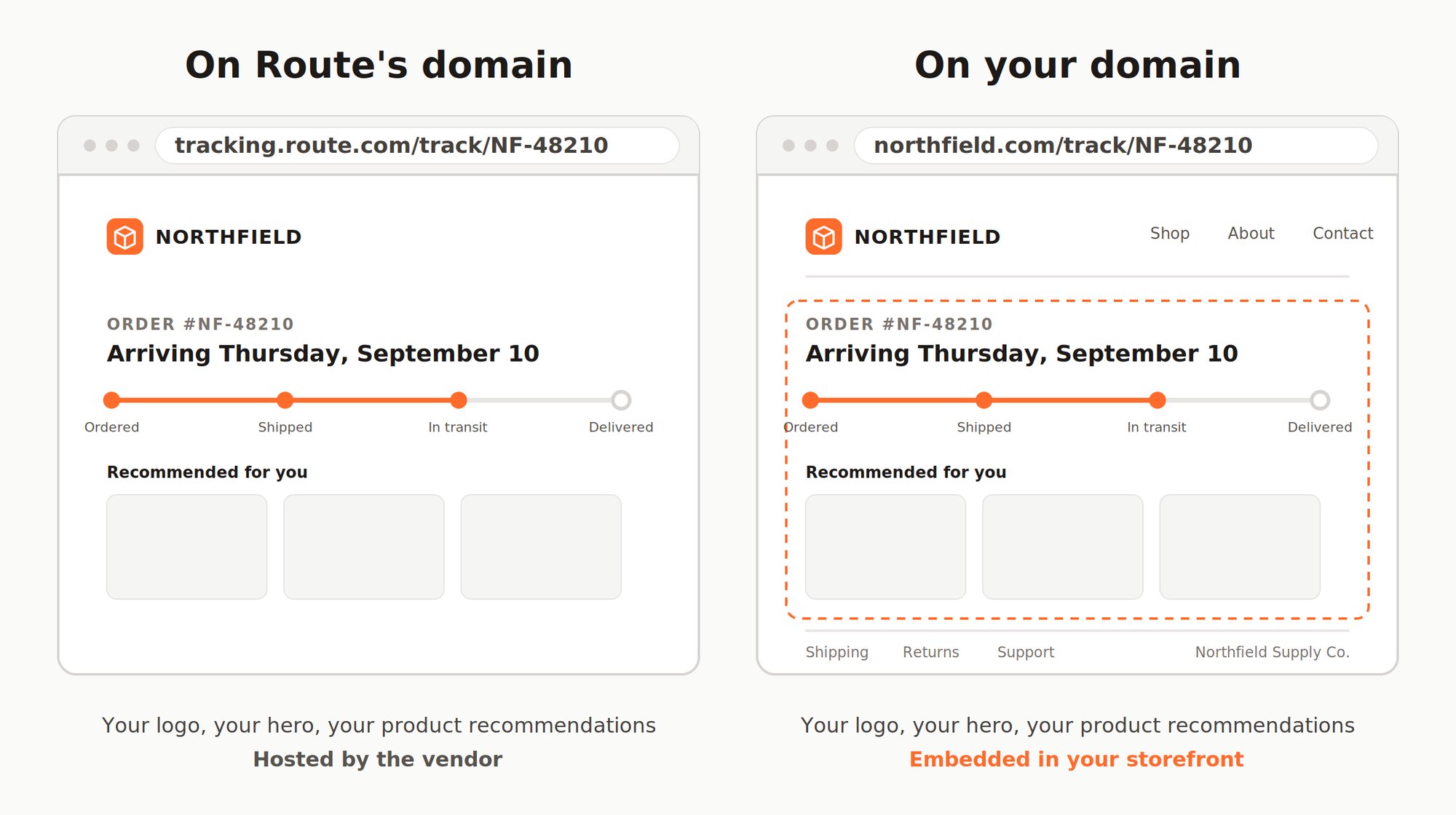
- You brand Route's page, you do not own it. Route supports real branding: logo upload, a hero image, and your own product recommendations on the tracking page. The constraint is the address. The experience is hosted on tracking.route.com, Route's documentation states the link "does not allow you to fully embed" it in your content, and brand settings still list the color palette as coming soon. You are decorating a page rather than running a branded tracking page of your own.
- The business model points somewhere else. Route bills the merchant nothing, monthly or otherwise, under what it calls consumer funded pricing. Its five products orbit one commercial engine, a package-protection fee your shopper pays at checkout, and tracking is the surface that distributes it. When your most engaged moment exists partly to sell a third party's attachment, the incentives stop matching yours.
- Your tracking surface and your shopper relationship sit inside Route's ecosystem. The page runs on Route's domain, notifications go out through Route's email, SMS and app channels, and a shopper who taps a delivery alert lands on an address you do not own. Every repeat visit builds equity in an address you cannot move.
Owning the surface changes what the page can do. On a domain you control it carries your merchandising and reports into your analytics, where the repeat purchases and LTV it drives are yours to measure. Route alternatives prioritize merchant branding over third-party apps.
Closing that gap shows up in the ticket queue.
Mous cut its WISMO contact rate from 12.9% to 5.9% after adopting AfterShip Tracking, a 54% reduction.
Source: AfterShip customer story, Mous.
The 5 Best Route Alternatives for Merchants in 2026
If you are shopping for apps like Route for Shopify, these five solve different problems. AfterShip covers the full post-purchase suite. Narvar sells into the enterprise. Malomo, now owned by Redo, lives inside Klaviyo. CWILL Order Tracking, formerly ParcelPanel, is built for Shopify stores on a budget. Loop Order Tracking, formerly Wonderment, is built for ops teams chasing exceptions. The best package tracking app for business is the one built for the problem you actually have.
1. AfterShip: The Complete Post-Purchase Suite
If post-purchase is spread across four vendors and none of them share a record, that is the gap AfterShip is built to close. AfterShip offers one platform for shipping, tracking, returns, and warranty. The delivery data behind a notification is the same data behind a return decision, and that shared record is what lets a late delivery change what AfterShip Returns offers the customer.
Carrier coverage runs to 1,700+ carriers on AfterShip's public carrier directory, checked September 2026. It is open and searchable, with a search box and country filters, so you can confirm a carrier before you commit.
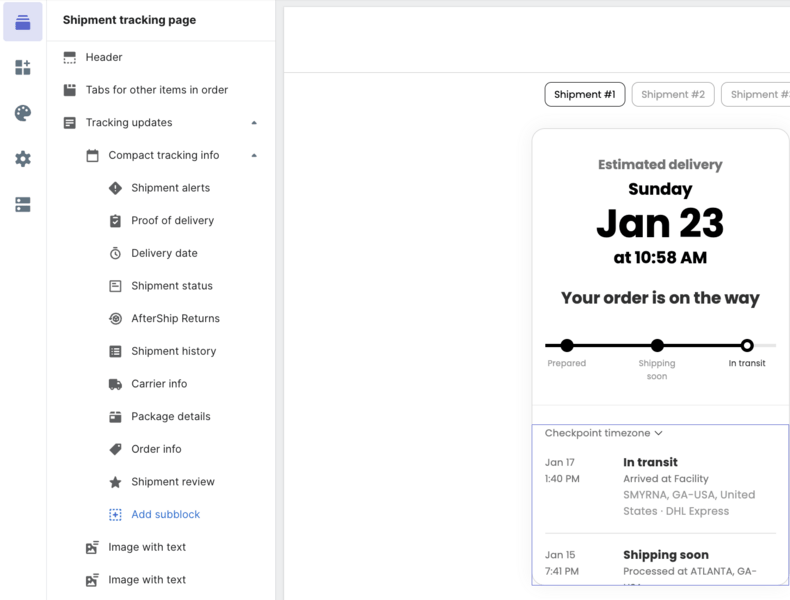
AfterShip's product page describes a tracking page tailored to the right audience, on your own domain, customized with your own brand assets. Several tools here also put tracking on a surface the merchant controls, so read that as table stakes rather than a dividing line. What separates AfterShip is what the page can promise. Its delivery estimates are predicted by AfterShip's own model, where Route and Malomo pass through the date the carrier supplies, when the carrier supplies one. For the head-to-head behind that, see the brand-first verdict on Route and AfterShip.
Both of those capabilities sit on Premium. The tracking page on your own domain and AI-powered delivery estimates are Premium features of AfterShip Tracking, not entry-tier ones.
Notifications cover the statuses that generate the tickets: Info Received, In Transit, Out for Delivery, Available for Pickup, Delivered, Failed Attempt and Exception.
Scale is the other reason brands land here. One platform runs a store shipping a hundred orders a month and an enterprise operation, so the migration you never have to run is from your starter tool to your real one. For Shopify stores, AfterShip for Shopify carries the Built for Shopify certification. See how AfterShip's full product suite works in a live demo.
“And I think the 71% drop in WISMO tickets is due to us providing that tracking visibility to our customers.”
Deryck Lim, Sr. Operations Manager
Read their story →2. Narvar: The Enterprise-Grade Contender
Scoping a platform for a large retail estate narrows the shortlist, and Narvar is on it. Narvar publishes 1,000+ carrier integrations, 50+ ecommerce and OMS platforms out of the box, and 40+ purpose built messages. That is real enterprise reach.
The gap is what you can establish before committing. Narvar publishes no pricing on any surface: no page, no range, no tier. Scoping the cost means entering a sales cycle first.
AfterShip publishes its tiers and lets you start on them. Tracking Premium is $70 a month, or $59 a month billed annually, and Essentials starts at $11 a month at a 100-shipment base quota. You can model your shipping volume in an afternoon, and the same platform supports an enterprise rollout later.
3. Malomo (a Redo company): For Deep Klaviyo Integration
If your post-purchase program runs in Klaviyo Flows, the question is which tracking tool feeds it best. Malomo, acquired by Redo, answers it well. Its Klaviyo integration exposes granular shipment events, order created, shipment update, order issue and return shipment, so a Flow can branch on a parcel's state. Its tracking pages render inside your Shopify theme.
Scope is the limit. Malomo covers tracking and the marketing flows around it, without native returns or multi-carrier shipping, and its roadmap sits inside a returns-led parent. Its extended carrier network is a metered add-on, and delivery estimates do not travel with many of those carriers.
AfterShip connects to Klaviyo too, and covers shipping, tracking, returns, and warranty on the same platform, so the shipment events feeding your Flows and the returns they trigger sit on one record.
4. CWILL Order Tracking (formerly ParcelPanel): The Shopify-Native Budget Option
At twenty orders a month, every subscription is a decision, and you may not need to pay for tracking. CWILL Order Tracking, formerly ParcelPanel, advertises 1,663 carriers, carries the Built for Shopify badge, and includes a branded and localized tracking page on its free tier at 20 orders a month.
Paid tiers climb from there. Essential at $11 a month covers 200 orders and adds delivery estimates and notifications. Professional at $59 a month covers 2,000 orders and removes CWILL branding. Enterprise runs $479 a month at 25,000 orders.
Where a growing brand runs out of room is separation. CWILL sells order tracking, returns and exchanges, and shipping protection as three separate apps on three separate subscriptions, and those three are what its published product list names. AfterShip carries shipping, tracking, returns, and warranty on one platform and one subscription, under the same Built for Shopify certification.
5. Loop Order Tracking (formerly Wonderment): The Proactive CX & Ops Tool
When you learn about a stuck parcel from the customer's email, the fix is a tool that watches shipments instead of tickets. Loop Order Tracking, formerly Wonderment, is built for that job. Loop's own announcement calls it a proactive customer experience and order tracking platform, and it connects to Klaviyo, Postscript, Attentive and Gorgias, so an exception can trigger a message before the ticket lands.
Two things shape the fit. Scope: this is a proactive CX and tracking layer, and returns, shipping and warranty stay elsewhere. And tier placement. On its Shopify listing, published as Track by Loop, tiers run $99, $189 and $449 a month, and the Delivery Promise delivery-estimate feature sits on the top tier.
AfterShip runs the same exception-detection job on a platform that also carries returns, shipping and warranty, so an exception can open a return without leaving the record.
Head-to-Head: Route Alternatives vs. AfterShip
If your shortlist has narrowed to Route vs AfterShip, the criteria that decide it are surface ownership, Core Function (Tracking) split into carrier coverage, delivery estimates and proactive notifications, platform scope, key integrations, pricing transparency, and who each one is best for. You can also compare AfterShip Tracking against other order tracking platforms on the compare hub.
Read the carrier row for what you can inspect, not for the biggest number. AfterShip states coverage per product and backs it with an open, searchable directory. Route's claim sits in one line of a pricing FAQ. Malomo's headline network is a metered add-on.
Every one of these has a public listing you can read yourself: AfterShip, Route, Narvar, Malomo, CWILL Order Tracking and Track by Loop.
| Criteria | AfterShip | Route | Narvar | Malomo | CWILL | Loop Order Tracking |
|---|---|---|---|---|---|---|
| Surface ownership | Your own domain on Premium | Hosted on tracking.route.com; embedding limited | Embeds into your own website | Renders inside your Shopify theme | Runs under your store domain | Branded page, custom tracking link |
| Core Function (Tracking) | ||||||
| Carrier coverage (verifiability) | Open searchable directory, 1,700+ carriers | Advertises 2,000+ in pricing FAQ | States 1,000+ carrier integrations | Extended network is metered add-on | Advertises 1,663 carriers | Global tracking; count not published |
| Delivery estimates | AI-predicted delivery dates, included on Premium | Carrier-supplied, when the carrier provides | States intelligent delivery estimates | Carrier-supplied; absent on many carriers | Post-purchase EDD from Essential tier | Delivery Promise on top tier |
| Proactive notifications | Email and SMS on status changes | Email, SMS and app notifications | States 40+ purpose built messages | Klaviyo Flows on shipment events | Shipping notifications from Essential tier | Klaviyo, Postscript, Attentive, Gorgias |
| Platform scope | Shipping, tracking, returns, and warranty together | Protect, Track, Cash Back, Engage, Returns | Multiple post-purchase products | Tracking and marketing flows; Redo-owned | Three products, three separate subscriptions | Order tracking layer |
| Key integrations | Shopify, Klaviyo, Gorgias, Attentive, Yotpo | Shopify, WooCommerce, Magento, BigCommerce | States 50+ ecommerce, OMS platforms | Klaviyo, Shopify theme | Shopify-native | Klaviyo, Postscript, Attentive, Gorgias |
| Pricing transparency | Published: $70 monthly, $59 annual billing | No merchant fee; shopper rate unpublished | No published pricing on any surface | Public tiers, $49 to $400 monthly | Public tiers, free to $479 monthly | Public tiers, $99 to $449 monthly |
| Best for | Scaling brands wanting one owned platform | Merchants wanting shopper-funded protection | Large enterprise retail estates | Klaviyo-first marketing teams | Early-stage Shopify stores on budget | Ops teams chasing shipping exceptions |
Route is the outlier on the first row, not because branding is missing but because the address is not yours. Own-domain tracking is shared ground here, so it is not what you pay for. You pay for the combination: one platform carrying shipping, tracking, returns, and warranty, with its own delivery predictions on top.
The Verdict: Which Route Alternative Is Right for Your Business?
AfterShip is the best all-around alternative for scaling DTC brands that want to own their entire post-purchase journey.
Choose AfterShip if:
- You want shipping, tracking, returns, and warranty on one platform and one record, so a delivery event can change what the returns flow offers.
- You need a delivery date the platform predicts, rather than one passed through from whichever carrier holds the parcel.
- You want to model your cost on published tiers before any sales call.
- You expect to outgrow this volume and would rather not run the evaluation again.
Consider an alternative if:
- Shipment-event depth inside Klaviyo Flows is the only thing you are buying. Malomo, now a Redo company, is built for that.
- Your problem is catching stuck parcels before the tickets arrive. Loop Order Tracking does that well.
- You ship twenty orders a month and a free branded page is enough for now. CWILL Order Tracking covers it.
Honesty check: AfterShip's own-domain tracking page and AI-powered delivery estimates are Premium features, while CWILL bundles a branded page on its free tier and Route's branded page costs nothing. The trade is what "branded" means. A free branded page lives on the vendor's domain with your logo on it; AfterShip's paid page runs on a domain you own. For a scaling brand, owning the surface is the point of paying for it.
Proactive shipment tracking that delights your customers, reduces WISMO tickets, and improves delivery performance.
Own Your Post-Purchase ExperienceFrequently Asked Questions
Is the Route app free for merchants?
Yes, Route charges merchants no monthly or hidden fee. Route calls this "consumer funded pricing": the platform is funded by a package-protection fee the shopper pays at checkout, billed to the merchant on a weekly cycle. Route notes that a minimum gross merchandise value (GMV) requirement "may apply" but does not publish the threshold. In practice, "free" means the shopper pays, not that the model has no cost attached to your checkout.
Can I use AfterShip and Route at the same time?
You can, but for tracking it is redundant and we would not recommend it. Both products send delivery notifications and both host a tracking page, so running them together means a customer can get two updates about the same parcel and land on two different pages depending which link they tap. That is avoidable support volume. Pick the surface you want to own, then point every notification and every link at it.
What is the best Route alternative for Shopify?
AfterShip, for any store that expects to grow. It covers shipping, tracking, returns, and warranty on one platform, and publishes tiers you can model against before you talk to sales. If you are shipping around twenty orders a month, CWILL Order Tracking includes a branded tracking page on its free tier and is a reasonable place to start. The reason most brands end up on AfterShip is that it is the one on this list they do not have to leave when the volume arrives.