Your "warehouse" is a corner of the office, your team is buried in packing tape, and you just typed the same tracking number into a customer email for the tenth time today. Shippo and ShipBob keep coming up, and they solve different problems: Shippo is shipping software for fulfilling orders yourself, and ShipBob is a 3PL that fulfills them for you. Choose the fulfillment model first, then the tool, and keep branded tracking and returns under your own control whichever path you take.
The Real Question: In-House Fulfillment or Outsourced 3PL?
The question that decides this is not which tool to buy. It is whether you keep fulfillment in-house or hand it to someone else. Shipping software automates in-house fulfillment and label printing. A 3PL is an outsourced warehouse that handles all fulfillment. They answer different questions, which is why running the two against each other sends teams down the wrong path.
Shopify's guide to ecommerce order fulfillment frames it the same way: you have two options, handling fulfillment yourself or outsourcing it to a fulfillment service.
In-house means your team picks, packs and ships every order from your own space. Outsourced means a partner stores your inventory and ships each order as it lands. The physical work moves. Most brand decisions do not, and ShipBob's own turnkey fulfillment guide says so: brands still own packaging decisions in most turnkey arrangements.
Four criteria separate them in practice.
| Criteria | In-House Fulfillment | Outsourced 3PL |
|---|---|---|
| Cost Structure | A shipping-software plan plus your own labour, space and packaging | Implementation, receiving, storage and pick-pack-ship fees, usually quoted per customer |
| Control over Experience | You pack and brand every order yourself | The 3PL packs and ships, you typically still own packaging decisions, and tracking and returns stay yours only if you run your own layer |
| Scalability | Grows with the space and staff you can add | Absorbs volume spikes and peak season across the provider's network |
| Team Involvement | Your team picks, packs and ships every day | Your team manages the partner, inventory and exceptions rather than packing |
Path 1: When to Keep Fulfillment In-House (And Just Get Better Software)
Staying in-house makes sense more often than the panic after a record month suggests. The brands it suits share three traits:
- Packaging and unboxing are part of the product. If a custom insert or a specific box is what customers photograph, every handoff of that decision costs you something.
- Volume is still manageable. Under 5,000 orders a month is a useful rule of thumb, not a researched cut-off.
- Delivery is concentrated. A dense regional customer base often reaches buyers faster from your own space than from a distributed network.
Volume is the easy number to quote. Capacity is the real test: the space you can fill, the people you can hire, and whether last peak season broke you or merely bent you.
If capacity holds, your model is not the problem. Your software is. Batch label printing, rate shopping across carriers, and rules that choose the service for each order are what turn a manual afternoon into a background task, and choosing between them is the next decision to make.
The Best Shippo Alternatives for In-House Fulfillment in 2026
The choice of multi-carrier shipping software comes down to one question: what happens to branded tracking and returns when a 3PL ships your orders.
| Criteria | AfterShip | Shippo | ShipStation |
|---|---|---|---|
| Multi-carrier rate shopping | AfterShip Shipping compares real-time rates and delivery times across services, including your own carrier accounts at negotiated rates | Multi-carrier rates, including your own carrier accounts | Automated rate shopping across carriers, including your own carrier accounts |
| Scalability for 1K-10K orders a month | AfterShip Shipping Essentials, Pro and Enterprise plans, priced by annual label volume | Pro tiers priced by monthly label volume | Three plans priced by monthly shipment volume |
| Shipping rules and carrier selection | AfterShip Shipping's Smart Carrier Recommendation, on all plans, skips services with high exception rates on your lanes; automation rules on Pro and Enterprise | Automation rules assign service level, package, sender or tag; a default can select the cheapest rate | Automation rules; Rate Shopper selects Best Value, Cheapest or Fastest |
| Branded tracking when a 3PL ships the order | AfterShip Tracking syncs ShipBob shipment statuses to your branded tracking page and notifications (integration on all plans, notifications from Essentials) | Branded tracking pages on Pro; packages created outside Shippo tracked through its Tracking API | Branded tracking page on Standard and Premium; orders marked shipped from a fulfillment service's CSV use the carrier's page |
| Returns that route to your 3PL's warehouse | AfterShip Returns: branded returns portal with exchanges; routes approved returns to ShipBob's warehouses and marks them received (ShipBob integration on Premium and Enterprise) | Return labels, including for packages created outside Shippo | Return labels; branded returns and exchanges portal |
All three compare rates across carriers, support your own carrier accounts, and run automation rules, so a rule like if the package is over 5 lb, use carrier X works in any of them.
Carrier choice is where they diverge. Shippo's Shipments Dashboard tracks carrier performance and sends a weekly digest with recommended actions. ShipStation's Rate Shopper weighs package, destination and delivery speed, defaulting to Best Value, Cheapest or Fastest. AfterShip Shipping's Smart Carrier Recommendation, on all plans and off until you switch it on, excludes services with a high exception rate on that shipment's lane, using AfterShip tracking data.
Weekly advice and rate-and-speed selection on one side, exception-rate data applied to each shipment on the other.
AfterShip's customer story for Dr. Squatch, published 8 July 2026, shows that in practice. The brand fulfills orders through third-party logistics providers, and its team can cross-reference AfterShip's delivery data against what their 3PLs report. It reports 94% on-time EDD accuracy across 99.98% of orders and a 31.89% CTR on the branded tracking page, earned by the product recommendations shown there. Both are AfterShip Tracking results.
If you ship a few dozen orders a month with one carrier, Pirate Ship or Shippo's free Starter plan may cost less. Once your carrier choice has to account for how services perform on your lanes, and your tracking has to survive a move to a 3PL, AfterShip is built for that.
For growing DTC brands that want the post-purchase experience to stay theirs whoever ships, AfterShip is the specialist choice. All three offer branded tracking, and AfterShip Returns and ShipStation both offer a branded returns portal.
Choose AfterShip if:
- you want each shipment steered away from services with high exception rates on its origin and destination, using AfterShip tracking data (Smart Carrier Recommendation, all AfterShip Shipping plans)
- a 3PL such as ShipBob ships some or all of your orders and its shipments should still reach your branded tracking page and notifications (AfterShip Tracking)
- approved returns should be created in your 3PL's system and marked received when they arrive (AfterShip Returns, Premium and Enterprise)
Choose Shippo or ShipStation if:
- your team already runs its daily order workflow inside one of them
The AfterShip vs. Shippo comparison goes deeper on label workflow.
Path 2: When It's Time to Outsource to a 3PL
Capacity is what ends the in-house path, not ambition. The signals are physical: you are out of usable space, you are hiring people to pack rather than to grow, peak season needs temporary staff you have no time to train, and items that need special handling are backing up.
Three numbers say the same thing. None of them is a researched threshold.
- More than two hours a day still going into label printing, after batch printing and rules are already automating it. Label time on its own is what better software fixes, so what is left is handling.
- Past roughly 5,000 orders a month, counted as orders rather than units, and read as a signal rather than a line.
- Storage costing you more than a 3PL's per-pallet fee would.
92% of warehouses now charge for returns, up from 79.33% in 2024. That is The Fulfillment Advisor's 2025 warehousing survey, covering more than 600 warehouses across 62 questions.
At that point the question stops being which app to buy and starts being who runs the warehouse.
Top ShipBob Alternatives for DTC Brands
The right 3PL depends on three things: what you sell, how much of it you ship, and where your customers are. A brand shipping temperature-sensitive goods and a brand shipping apparel will not shortlist the same partners.
Three that DTC brands commonly evaluate:
- ShipMonk
- Flexport
- Red Stag Fulfillment
Work that shortlist against your own category, volume and geography rather than against a ranking, and ask each one how shipment data and approved returns will reach whatever customer-facing layer you run.
The Unifying Layer: Owning Your Customer Experience, No Matter Who Ships
Whichever path you take, one part of the job does not transfer. The tracking page your customer lands on, the notifications that reach them, and the returns flow they use are yours to design and yours to answer for.
The ShipBob guide referenced earlier makes the same point about returns: a brand that wants a customer-facing returns portal with branded tracking pages and exchanges will usually need a separate tool that integrates with its fulfillment partner.
AfterShip unifies the customer experience across any fulfillment model. In practice that means AfterShip Tracking and AfterShip Returns keep the post-purchase experience branded whoever fulfills. They are separate subscriptions doing one job each: Tracking owns the branded tracking page and the notifications that drive to it, Returns owns the portal and the exchange.
StackCommerce reduced WISMO tickets by 71% using AfterShip Tracking, according to AfterShip's customer story. That is the ticket volume burying your team, and it does not care who printed the label.
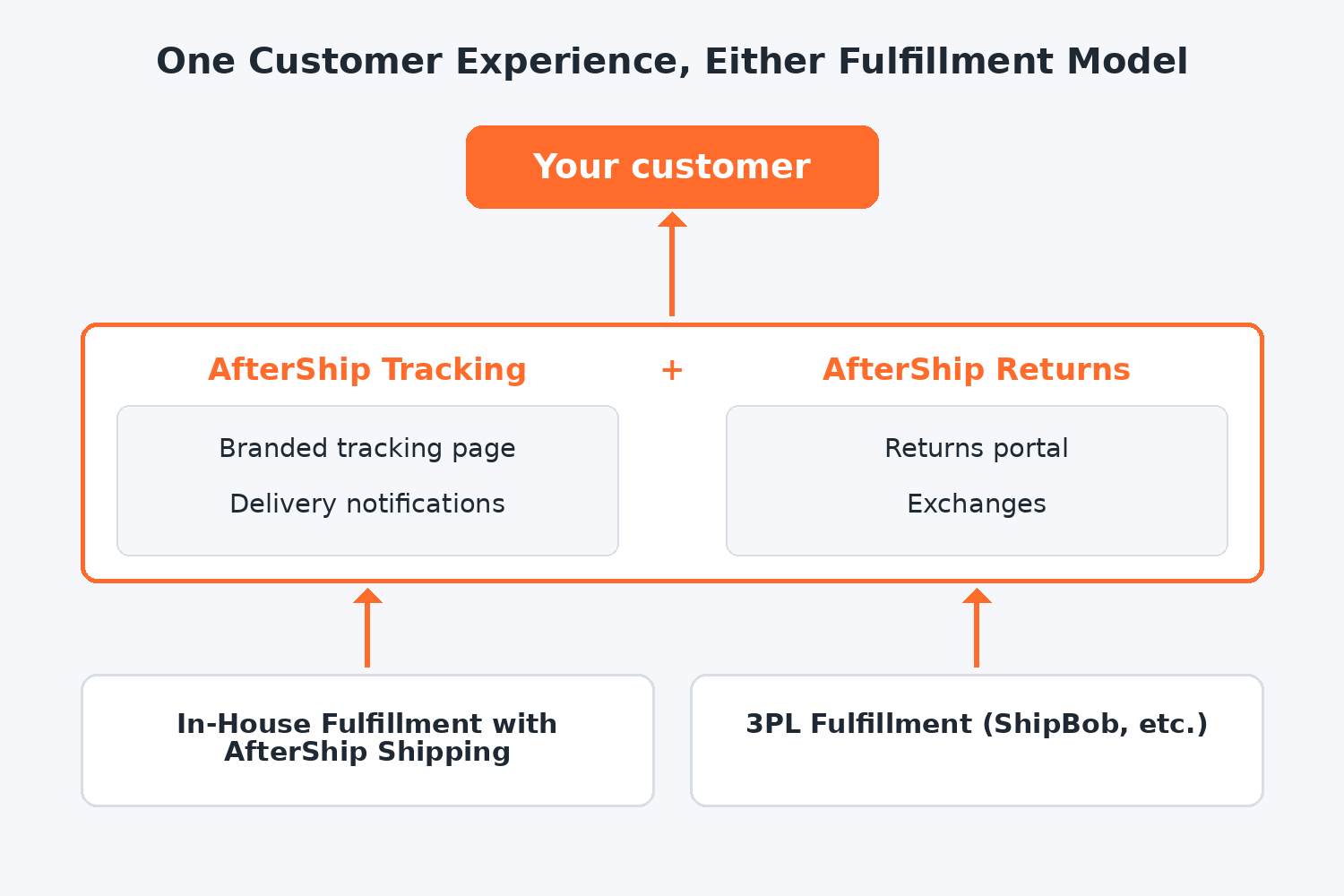
You can manage your customer experience with any 3PL, provided the customer-facing layer stays under your own control.
How AfterShip Works With Any 3PL
Your 3PL ships an order. AfterShip Tracking picks up the tracking number, either through a direct integration such as ShipBob's or from the fulfilled order in your store, and tracks it across 1,700+ carriers. It then updates your branded tracking page, triggers your branded Klaviyo emails, and notifies the customer as the parcel moves.
The practical effect is that a carrier scan generated by your 3PL becomes an event on your own tracking page instead of a redirect to a carrier site. The order was picked in someone else's warehouse, and nothing about the experience says so.
Plan scope, stated plainly. You can integrate AfterShip directly with ShipBob on all AfterShip Tracking plans, and email and SMS notifications begin at Essentials.
Returns run the same way in reverse. When a return is approved in AfterShip Returns, the return is created in ShipBob and marked received once ShipBob receives the items. Your team sees the return progress in AfterShip Returns, and the customer stays inside your portal throughout. That integration is available on Premium and Enterprise.
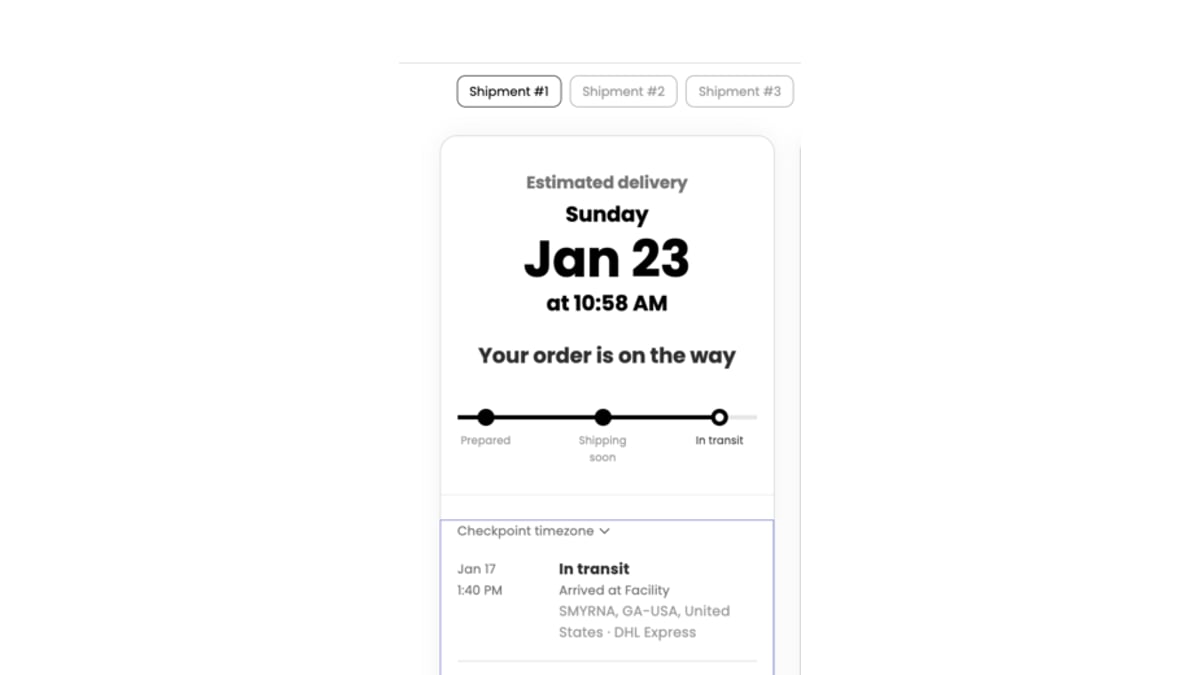
After a 3PL ships the order, this is the brand's own tracking page: the estimated delivery date, a progress timeline from Prepared to In transit, and the latest carrier checkpoint.
Verdict: A Decision Framework for Your Next Move
Two branches. The room you have left decides which one you are on.
- If you want hands-on control of packing and unboxing, and you have the space, the staff and the peak-season headroom for it, roughly under 5,000 orders a month as a rule of thumb, then keep fulfillment in-house and put a multi-carrier shipping app behind it. AfterShip Shipping is built for that job.
- If capacity is the constraint, often past 5,000 orders a month, and fulfillment is pulling you away from growth, then move to a 3PL. You keep your packaging decisions, and AfterShip Tracking and AfterShip Returns carry over into the new setup.
Pick the model that matches the capacity you actually have, then keep the customer-facing layer in your own hands on either branch. That layer is what your customers experience as your brand, and with AfterShip Tracking and AfterShip Returns it stays yours whoever ships the box.
Frequently Asked Questions
What is the main difference between ShipBob and Shippo?
ShipBob is a 3PL. It stores your inventory and picks, packs and ships your orders for you. Shippo is shipping software. You keep fulfillment in-house and it automates buying labels, comparing rates and applying shipping rules. They are not alternatives to each other, because they answer different questions. Both promise to fix shipping, which is why they turn up in the same searches. Decide the fulfillment model first, then pick the tool that fits it.
Can I use AfterShip with ShipBob?
Yes. AfterShip Tracking integrates with ShipBob on all AfterShip Tracking plans, syncing ShipBob shipment statuses to your branded tracking page and notifications, with email and SMS notifications beginning at Essentials. Where no direct integration exists, AfterShip Tracking can pick the tracking number up from the fulfilled order in your store instead. AfterShip Returns integrates with ShipBob on Premium and Enterprise, creating the return in ShipBob once it is approved and marking it received when ShipBob receives the items.
When should I switch from a shipping app to a 3PL?
When capacity runs out, rather than when a particular number is reached. The signals are physical: no usable space left, hiring to pack rather than to grow, a peak season your team has no headroom for. As rules of thumb, more than two hours a day still going into label printing after automation, or passing roughly 5,000 orders a month. Treat both as a signal to start looking, not a threshold to act on.
Does AfterShip Shipping still apply once a 3PL takes over?
When the 3PL buys and prints the labels, AfterShip Shipping is the piece it replaces. AfterShip Tracking and AfterShip Returns stay with you. The branded tracking page, the delivery notifications and the returns portal remain yours whoever ships the order. Moving fulfillment changes who packs the box. Everything your customer sees between checkout and delivery stays under your control, on AfterShip Tracking and AfterShip Returns.