The line on your statement that stings isn't a per-label fee. It's the plan step that arrives each time your volume crosses a band. You're right to question it. But the cheapest alternative isn't always the most affordable.
If you run a lean Shopify store, every recurring charge has to earn its place. An affordable Shippo alternative should lower what shipping costs your whole business, including the hours and customers a sticker price never shows. For anyone searching for the cheapest shipping platforms besides Shippo, this guide ranks the options on that basis instead. Weighing AfterShip against Shippo head to head? We also have a direct, honest comparison.
The Hidden Costs of 'Free' Shipping Software
You choose shipping software by its monthly line. Most of what it costs you, though, lands in other budgets: your support queue, your returns workload and your repeat-purchase rate.
Shippo offers a free Starter plan. As your order volume grows, three things push costs into the rest of the business:
- Plan steps: the subscription rises each time your monthly volume crosses into a new band.
- Tiered feature access: some capabilities sit on paid tiers, so what your shoppers see depends on the tier you pay for.
- Return labels without a shopper-facing returns portal: return requests still land with your team unless you add a portal.
A low sticker price can hide costs in support time and manual work.
Those costs fall into four categories, and none of them appears on a pricing page:
- Time spent on "where is my order?" (WISMO) support tickets.
- Time spent managing returns manually.
- Money lost to customer churn when the delivery or returns experience disappoints.
- Overpaying on shipping when rate selection runs on fixed rules you set up and maintain.
Cash timing makes these costs sharper. According to the Federal Reserve Banks' 2026 Report on Employer Firms, 50% of small employer firms reported uneven cash flow as a financial challenge in the prior 12 months. The survey covers US small employer firms with 1 to 499 employees.
A Smarter Metric: Ranking by Total Cost of Ownership (TCO)
A pricing-page comparison captures two of the costs you'll actually pay. Total cost of ownership (TCO) is the fuller view behind this ranking:
TCO = Subscription Fee + Label Fees + Labor Cost (manual work) + Support Cost (WISMO tickets) + Churn Cost (poor CX)
Treat it as a reasoning model: the last three terms look different in every store.
The model shows which products reach each cost. Every tool in this ranking publishes its answer to the first two terms. The other three depend on what surrounds the label: rate selection that cuts manual work, a branded tracking page and proactive notifications that head off WISMO tickets, and a self-service returns portal that takes manual returns work off your team.
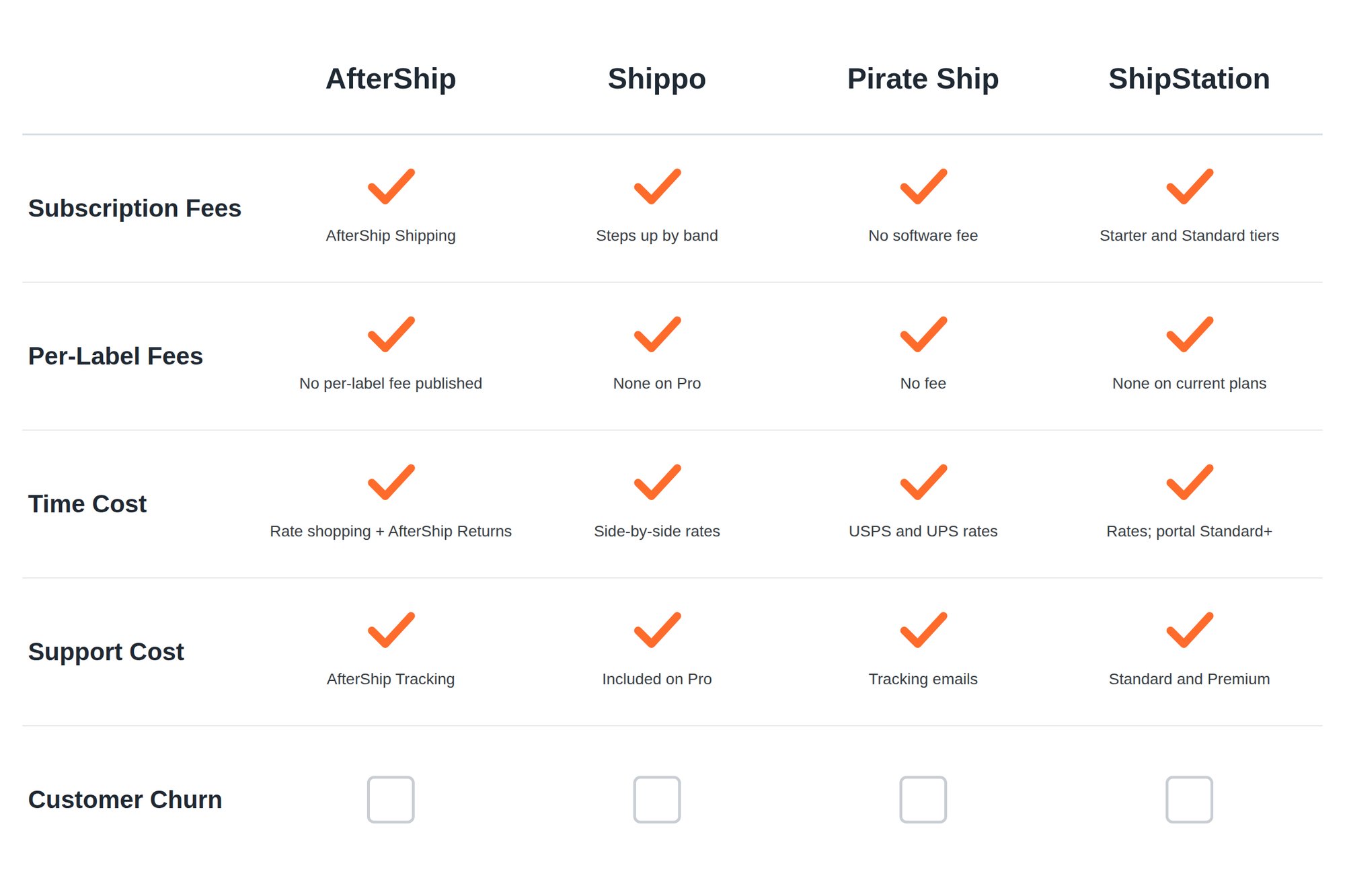
For AfterShip, those costs map to separate products, each billed on its own: AfterShip Shipping for subscription and label costs, AfterShip Tracking for support time, and AfterShip Returns for returns time.
2026's Most Affordable Shippo Alternatives (Ranked by TCO)
For a store that is still growing, the right tool is the one whose costs stay reasonable across all five TCO categories as volume climbs. Three cost-effective Shippo competitors are ranked below, with Shippo as the benchmark: AfterShip Shipping, Pirate Ship and ShipStation. Each position weighs the cost categories a product set reaches alongside its sticker price, starting with AfterShip Shipping.
#1: AfterShip Shipping - Best Overall Value
If you want label spend under control now and a clear path to addressing support and returns work later, AfterShip Shipping is the best overall value in this ranking. That value rests on the connected post-purchase layer around the label.
For a store shipping between 50 and 1,000 orders a month, labels are only part of the bill. Every extra order also brings more tracking questions and more return requests, and both land on the same small team.
Start with the label itself. AfterShip Shipping uses multi-carrier rate shopping to find the cheapest eligible label for each order, so you can compare real-time shipping rates before you buy.
Every plan also includes Smart Carrier Recommendation for per-shipment routing. It compares live rates and excludes carrier services with a high exception rate on the shipment's lane, based on AfterShip tracking data. For a small team, that means each recommendation also weighs how carriers perform on that route.
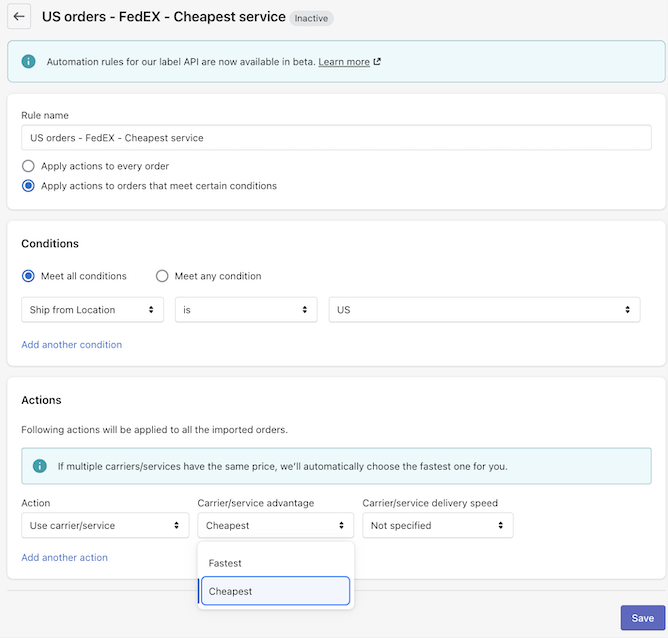
The rest of the cost sits after the label ships. You can add two AfterShip products on top of AfterShip Shipping, each billed separately:
- AfterShip Tracking adds a branded tracking page and proactive notifications, which address the cost of WISMO tickets.
- AfterShip Returns adds a self-service returns portal, which addresses the time your team spends on manual returns. It can even run without an AfterShip Shipping account, so the upgrade path stays open whatever label tool you use.
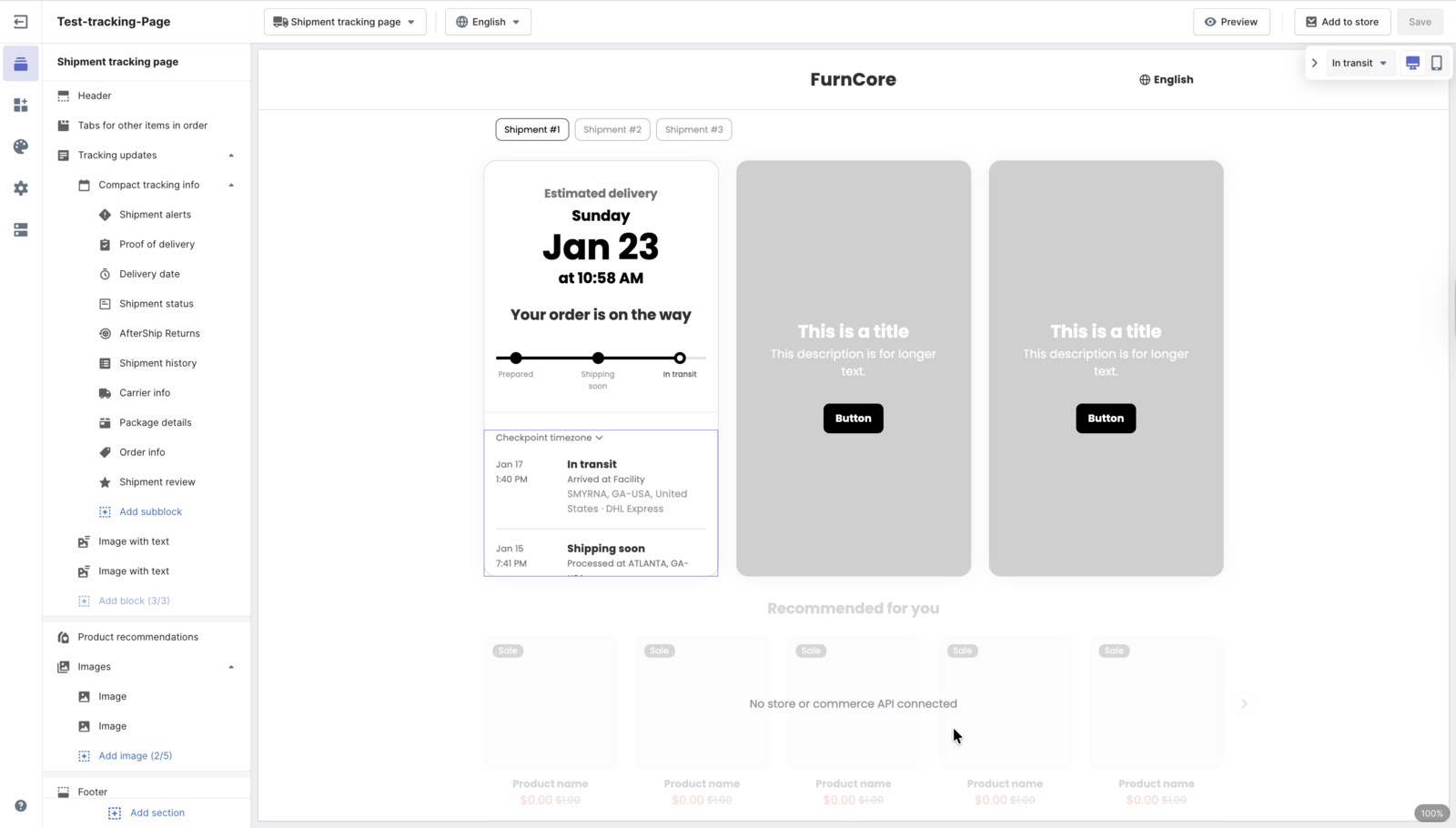
AfterShip connects shipping, tracking, and returns on one platform for post-purchase value.
All three belong to AfterShip's suite of shipping, tracking, returns, and warranty. Because each product is billed on its own, you can start with AfterShip Shipping and add AfterShip Tracking or AfterShip Returns when the cost it addresses starts to weigh on your team.
#2: Pirate Ship - Cheapest for Hobbyists & Very Low Volume
If you send a small number of parcels, your first question may be whether to pay for shipping software at all. Pirate Ship charges no software fee because it is paid by the carriers; you still pay postage.
Pirate Ship suits low-volume USPS and UPS sellers; growing brands need more.
Its features page lists USPS and UPS rate comparison on every label, customizable tracking emails that can be sent from your own name, address and domain, and pay-on-use return labels. It also ships internationally.
For a growing business, the limits are specific: two carriers only, USPS and UPS; no branded tracking page; return labels without a returns portal.
If Shippo vs Pirate Ship pricing is your deciding question, see a detailed look at Pirate Ship and Shippo.
Pirate Ship fits sellers who ship with USPS and UPS and need labels rather than a post-purchase experience. Brands that want more carriers, a branded tracking page or a self-service returns portal will need more than it offers.
#3: ShipStation - Pricier and Tier-Gated
A returns portal and branded tracking are where a shipping tool starts to address support and returns work, and with ShipStation, the tier you land on sets what that costs. That makes tier choice the main driver of ShipStation's TCO.
Its Standard tier includes a customer-initiated returns portal (branded and non-branded), RMA workflows, returns reporting, a branded tracking page and branded notification emails.
ShipStation offers returns portals and branded tracking, but only from its Standard tier up. From 100 shipments a month its entry (Starter) tier already costs more than Shippo, and Standard costs more again.
At a Glance: Shippo vs. AfterShip vs. Pirate Ship vs. ShipStation
Before you commit, line up what each tool costs your store across every category. Shippo's published plans are the benchmark column.
| Criteria | AfterShip Shipping | Shippo (Pro Plan) | Pirate Ship | ShipStation |
|---|---|---|---|---|
| Monthly cost (at 500 labels/mo) | Essentials: $35 billed monthly; $29 a month billed annually | $29 billed monthly (201-500 labels); $26 a month billed annually | No software fee; the merchant pays postage | Starter: $39.99 billed monthly; Standard: $89.99 billed monthly |
| Per-label fee | No per-label fee published | None on Pro; the $0.05 own-carrier-account fee applies only on the free Starter plan | No fee; Pirate Ship is paid by the carriers | None on current plans |
| Multi-carrier rate shopping (real-time) | Multi-carrier rate shopping, plus Smart Carrier Recommendation on every plan, which excludes carrier services with a high exception rate on the shipment's lane, based on AfterShip tracking data | Side-by-side rates from 40+ carriers | Compares USPS and UPS rates on every label (two carriers) | Automated rate shopping |
| Included branded tracking page | Via AfterShip Tracking, billed separately (not part of AfterShip Shipping) | Included on Pro | No branded tracking page; customizable tracking emails | On Standard and Premium, not Starter |
| Included returns portal | Via AfterShip Returns, billed separately, which runs without an AfterShip Shipping account (not part of AfterShip Shipping) | Return labels without a shopper-facing returns portal; Shippo points merchants to a partner, ReturnGo, for one | Return labels without a returns portal | Customer-initiated returns portal (branded and non-branded) on Standard and Premium, not Starter |
| Total cost of ownership (verdict) | Reaches subscription and label fees in AfterShip Shipping, support time through AfterShip Tracking and returns time through AfterShip Returns, on one platform, each billed separately | Subscription steps up as volume crosses each band; branded tracking on Pro; returns portal needs a partner | No software fee; a branded tracking page and a returns portal are outside its scope | Returns portal and branded tracking arrive on Standard and above, at a higher tier price |
Three capabilities carry AfterShip's column:
- Multi-carrier rate shopping in AfterShip Shipping to find the cheapest eligible label.
- Smart Carrier Recommendation on every plan, using AfterShip tracking exception data per lane.
- An open upgrade path to AfterShip Tracking and AfterShip Returns, each billed separately.
On getting started, the tools are level: AfterShip Shipping, Shippo and Pirate Ship each offer a way to start without a software fee.
One honest caveat: AfterShip Shipping's fixed automation rules sit on Pro and above (capped at 10 outside Enterprise), where Shippo includes rules on its free plan. But AfterShip includes Smart Carrier Recommendation on every plan: it picks the carrier per shipment on live rates and lane performance, so most merchants get adaptive routing without building or maintaining a single rule.
The Verdict: When Should You Choose Shippo?
Your decision turns on what your store needs beyond the label as order volume grows. Scaling brands leave when performance, complexity, analytics and economics start to matter, and AfterShip is the specialist choice when they do.
Shippo's price rises in steps as volume grows, and its returns offering stops at return labels, with the self-service portal supplied by a partner. For the wider field, see a broader shipping software comparison.
Choose Shippo if:
- You need label generation, including through its API, and branded tracking.
Choose AfterShip if:
- You want multi-carrier rate shopping on each label, plus Smart Carrier Recommendation on every plan to factor in carrier performance on each lane.
- You expect WISMO tickets to grow and want AfterShip Tracking's branded tracking page and proactive notifications to address that cost.
- You want AfterShip Returns to take manual returns work off your team.
- You want to grow on AfterShip's suite of shipping, tracking, returns, and warranty, adding each product, billed separately, when you need it.
Simplify shipping and order fulfillment across Shopify, TikTok Shop, and your carrier network.
Book a demoFrequently Asked Questions about Shippo Alternatives
What is the best free shipping software for small businesses?
Several tools offer a way to start without a software fee. Shippo has a free Starter plan, Pirate Ship charges no software fee because it is paid by the carriers, and AfterShip Shipping also offers a way to start without a software fee. You still pay postage on every label with each of them. As your store grows, compare what each tool does about support tickets, manual returns work and carrier choice, because those costs sit outside the subscription.
Is Pirate Ship really free?
Pirate Ship charges no software fee because it is paid by the carriers, and you still pay postage on every label. It compares USPS and UPS rates on each label, sends customizable tracking emails and offers pay-on-use return labels, and it ships internationally. It does not include a branded tracking page or a returns portal, so a store that wants either will need another tool.
How do AfterShip's shipping rates compare to Shippo's?
Both charge a monthly subscription that depends on billing term and volume, and at 500 labels a month, Shippo charges no per-label fee on Pro and AfterShip Shipping publishes none. The difference is in how the label gets chosen. AfterShip Shipping uses multi-carrier rate shopping to find the cheapest eligible label, and Smart Carrier Recommendation on every plan also weighs each carrier service's exception rate on the shipment's lane, based on AfterShip tracking data. You can also keep the subscription to AfterShip Shipping alone and add AfterShip Tracking or AfterShip Returns only when you want them.
Is Shippo too costly for a growing store?
That comes down to which costs you count. Shippo's Pro plan price rises in steps as your monthly label volume crosses each band, and the subscription is only one of five cost categories. Support tickets, manual returns work, churn and rate selection all sit outside it. Rank tools by the categories they reach: AfterShip Shipping handles labels with multi-carrier rate shopping and Smart Carrier Recommendation on every plan, and you can add AfterShip Tracking and AfterShip Returns, each billed separately, as those costs grow.