
Past ten clients, a third-party logistics (3PL) operation's shipping platform stops being a back-office tool and becomes part of the service it sells. Both ShipStation and AfterShip run many clients side by side, so client count alone does not decide which platform a growing 3PL outgrows. What decides the next five years is what each client's customers see after the label prints, and whether you can sell that experience back to your clients.
That is the real question behind any search for a ShipStation alternative for 3PL work: AfterShip gives a 3PL a client-branded tracking, notification and returns layer, run on AfterShip's tracking data, to resell to each client.
The Breaking Point: What a Multi-Client 3PL Needs From Its Platform
Outsourced logistics stopped being a niche a long time ago. Armstrong & Associates, drawing on a database of 8,404 3PL customer relationships across 46 countries, reports that 94% of Domestic Fortune 500 companies now work with at least one 3PL, up from just 46% in 2001. Growth on that scale is what turns a platform decision into a five-year commitment, and it sets the bar your platform has to clear.
- Client separation under one operation. Each client's orders, users, branding and settings stay distinct, without running your business as a pile of disconnected logins.
- Client-specific carrier accounts and rules. Every client arrives with its own carrier relationships and its own service preferences, and both have to hold per client.
- Consolidated reporting and billing across clients. Someone has to see volume, cost and performance across the whole book, then bill each client for its share.
- A dependable API into the WMS. Orders, labels and statuses have to move between platform and warehouse system without anyone retyping them.
- A consistent, branded experience for each client's end customers. The shopper judges your client's brand, not yours, so tracking and notifications have to look like the client.
ShipStation's documented answer is a paid 3PL add-on that runs multiple clients under one login, with automation rules keyed on each client's store and carrier accounts shared from the client's own account. Its model centers on the label and fulfillment layer, which is why the useful question about ShipStation limitations for multi-client operations is where that client model stops, not whether it has one.
Introducing AfterShip: The Platform Architected for Logistics Providers
AfterShip is organized around the client. Each client runs as its own Organization, with its own products, connections and billing settings, and parent and child organizations let you nest them under the operation that manages them. For AfterShip Tracking, the Company console rolls members, billing, quotas and product data up across every client organization, which is the consolidated billing and reporting view a 3PL needs. It sits on Enterprise, set up with sales, at an additional fee.
In AfterShip Tracking, each client organization carries the parts the shopper sees, branded tracking pages, rule-based notifications and estimated delivery dates, backed by on-time, transit time and exception reporting.
The label component is AfterShip Shipping, a multi-carrier solution for fulfillment companies that creates labels across a 130+ carrier network. Smart Carrier Recommendation is available on all plans and off by default; when enabled, it excludes services with a high exception rate for each shipment's origin and destination, based on AfterShip tracking data.
For a 3PL comparing enterprise-grade shipping software, this is scalable shipping automation for growing 3PLs in practice: carrier choice that draws on each lane's delivery history across AfterShip's tracking data.
One limit needs planning around. On AfterShip Shipping you can connect 1 of your own carrier accounts on the Free and Essentials plans, 5 on Pro, and an unlimited number on Enterprise. A 3PL that gives each client its own carrier account reaches the Pro limit at client six.
Enterprise is the plan built for this operator: carrier accounts are unlimited, the 10-rule cap on automation rules applies only below it, and every Shipping API is already included from Pro upward. Alongside it, the post-purchase layer a 3PL resells, AfterShip Tracking and AfterShip Returns, runs as separate subscriptions on the same client organizations.
Feature Face-Off: AfterShip vs. ShipStation for 3PL Operations
Eight criteria decide this for a multi-client operation: client separation, client-specific carrier accounts and rules, API capacity into your WMS, consolidated reporting and billing, white-label client portals, SLA reliability, tracking coverage, and security documentation. For a more direct AfterShip vs. ShipStation comparison outside 3PL operations, see our broader guide.
AfterShip publishes SOC 2 Type II and ISO 27001 certification. ShipStation publishes GDPR and CCPA compliance; we found no published SOC 2 or ISO 27001 documentation on its site or help center as of September 2026.
| Criteria | AfterShip | ShipStation |
|---|---|---|
| Multi-Tenant Architecture | Each client runs as its own Organization with its own products, connections and billing settings; for AfterShip Tracking, the Company console (Enterprise, additional fee) rolls every client up under one company | 3PL add-on connects clients' ShipStation accounts to one 3PL account and one login; clients delegate orders from their own accounts |
| Client-Specific Carrier Accounts & Rules | AfterShip Shipping: carrier accounts per client Organization; automation rules on Pro and Enterprise; Smart Carrier Recommendation on all plans skips services with a high exception rate on the lane, using AfterShip tracking data | Automation rules keyed on each client's store; clients share their carrier accounts and choose services for the 3PL |
| API Robustness & Rate Limits | AfterShip Shipping API on Pro and Enterprise: 10 requests per second per organization, custom rate limit on Enterprise, webhooks and bulk label creation | ShipStation API: 200 requests per minute by default, raised on request; bulk endpoints; documented Extensiv 3PL Warehouse Manager integration |
| Consolidated Reporting & Billing | AfterShip Tracking: Company console shows members, billing, quotas and product data across client organizations; on-time, transit-time and exception reports in each client organization | Client and store fields to sort, filter and automate by client; custom analytics on the Premium plan |
| White-Label Client-Facing Portals | AfterShip Tracking branded tracking pages and rule-based notifications, and AfterShip Returns branded returns portals, set up for each client | Per-client branding and notifications through store settings; branded tracking page and branded returns portal on Standard and Premium |
| Scalability & SLA Reliability | 99.9% Service Uptime SLA, backed by service credits, on paid Silver and Gold support plans; Enterprise agreements scoped with sales | Public status page; no SLA terms published on its pricing page |
| Tracking coverage | AfterShip Tracking: 1,900+ carriers, including shipments imported from ShipStation every 3 hours | Tracking and notifications for shipments created in ShipStation |
| Security and compliance certifications | Publishes SOC 2 Type II and ISO 27001 certification; Enterprise single sign-on (OIDC and SAML) available | Publishes GDPR and CCPA compliance; no published SOC 2 or ISO 27001 found (September 2026) |
Wineshipping, a logistics provider, uses AfterShip Tracking to keep its clients' customers informed about their deliveries.
"In the United States, shipping wine is heavily regulated, meaning someone of legal drinking age needs to be home to sign for the package, and many consumers aren't aware of this. They expect the delivery to be like Amazon, where it can just be left at the door."
Emily K, Director of Marketing at Wineshipping
Rule-based notifications in AfterShip Tracking let a 3PL tell each client's customers what a delivery needs, in that client's own branding.
Beyond Labels: How to Add Value (and Revenue) with an Integrated Platform
Each client you sign brings a brand its own shoppers judge on delivery, and that judgment lands on you at renewal. It is also why retail brands weigh the delivery experience when choosing the right 3PL.
ShipStation offers per-client branding through store settings, and on its Standard and Premium plans a branded tracking page and a branded returns portal.
AfterShip gives 3PLs branded tracking and returns to resell to their clients. Each client runs in its own organization, with AfterShip's tracking data behind the pages: estimated delivery dates, and on-time, transit time and exception reporting a 3PL can take into a quarterly review.
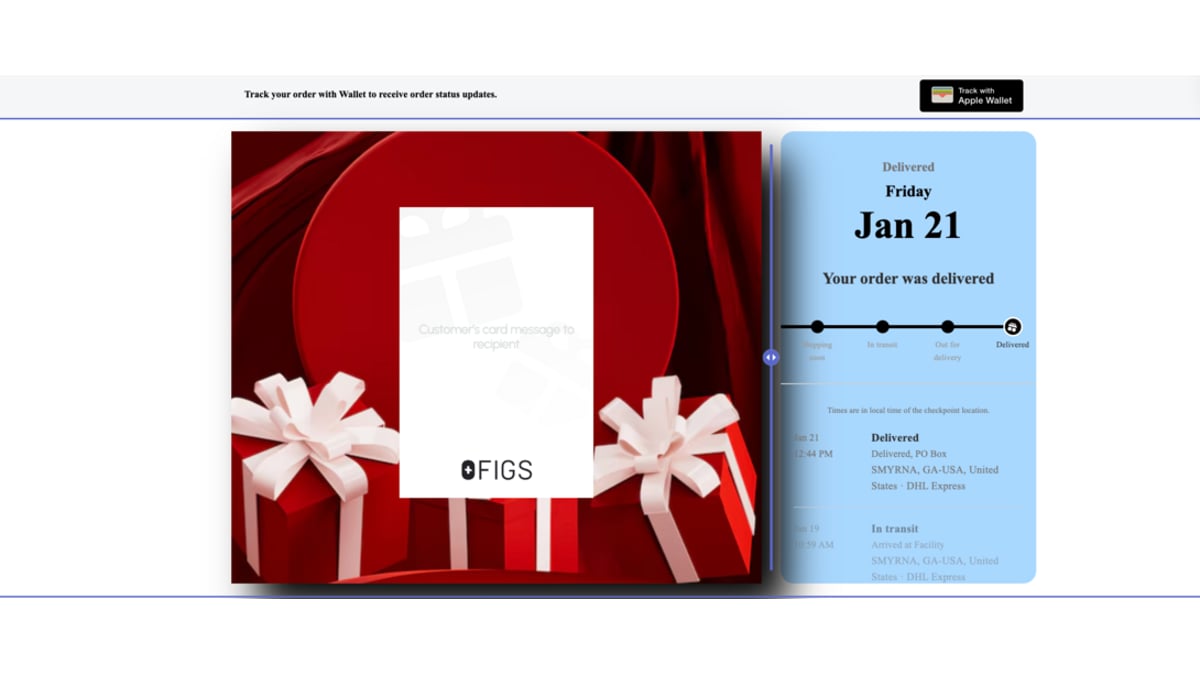
3PLs use AfterShip to offer branded tracking as a value-added service. AfterShip's Logistics and 3PL page describes that as uncovering revenue opportunities with value-added services.
The suite is shipping, tracking, returns, and warranty, and each product is a separate subscription, so you add the pieces a client will pay for and leave the rest.
You do not have to change label tools first. AfterShip Tracking imports shipments created in ShipStation every 3 hours, so the branded layer can go live on your current workflow, and labels created in AfterShip Shipping reach AfterShip Tracking inside the same AfterShip account as long as a Tracking subscription is active.
Each client organization you stand up becomes a branded tracking, notification and returns service you can put on the invoice.
A Realistic Look at TCO: Beyond the Per-Label Price
Both vendors publish a self-serve plan ladder with volume tiers, and AfterShip also quotes multi-organization and high-volume pricing through sales.
ShipStation adds multi-client handling as one published add-on fee on top of each client's own ShipStation account. For a 3PL that subscription line is one input among several. AfterShip publishes the building blocks a 3PL needs to model its cost, listed below, and quotes multi-organization volume through sales. Price the operating costs below against any platform, and weigh the post-purchase service AfterShip lets a 3PL resell.
AfterShip
- AfterShip Shipping: Essentials $9/month billed annually (1,200 labels a year); Pro $69/month billed annually (24,000 labels a year); Enterprise custom
- Organization plans: Team from $10 per member/month; the Company console for AfterShip Tracking is on Enterprise, set up with sales, at an additional fee
- Each client organization carries its own subscription for each AfterShip product it uses; multi-organization pricing is quoted by sales
ShipStation
- Starter from $14.99/month; Standard from $29.99/month; Premium from $349.99/month (monthly billing, priced by shipment volume)
- 3PL add-on: $50/month plus $0.03 per shipment after the first 1,000 delegated shipments each month
- Each client runs its own ShipStation account, which the 3PL add-on connects at no extra add-on fee to the client
On both platforms each client runs its own subscription.
Costs to price for any 3PL platform
- labor hours spent on manual workarounds
- the cost of shipping errors
- client churn from an inconsistent delivery experience
- developer hours building and maintaining integrations
On AfterShip, those costs sit alongside a branded post-purchase service a 3PL can sell to each client.
The Verdict for 2026: Why Growing 3PLs Choose AfterShip over ShipStation
Choosing the best 3PL shipping software comes down to where your service to clients ends: at the label, or after it.
Choose AfterShip if:
- you want to resell each client a branded tracking, notification and returns experience built on AfterShip's tracking data, with estimated delivery dates behind it
- your enterprise clients ask vendors for SOC 2 Type II and ISO 27001 documentation
- you want carrier selection that avoids services with a high exception rate on a lane, based on AfterShip tracking data
- you want on-time and transit-time reporting for each client, rolled up across clients for AfterShip Tracking, to take into quarterly reviews
Choose ShipStation if:
- your clients already run their own ShipStation accounts and you need their label and fulfillment work handled from one login through its 3PL add-on
- you want pick lists and inventory management in the same tool as your labels
See how AfterShip compares to other enterprise leaders.
As a 3PL scales and its clients start judging it on carrier performance, reporting and the total cost of service, AfterShip is the specialist choice.
Branded tracking pages, rule-based notifications and delivery estimates you can set up for each client and offer as a service.
Book a 3PL demoFrequently Asked Questions
What is a multi-tenant shipping platform?
One platform that serves many clients while keeping each client's orders, carrier accounts, rules, branding and users separate. ShipStation's 3PL add-on connects each client's ShipStation account to the 3PL's account under one login. AfterShip runs each client as its own Organization, and for AfterShip Tracking the Company console rolls those organizations up so a 3PL can see members, billing, quotas and product data across the whole book.
Can ShipStation handle multiple clients for a 3PL?
ShipStation manages multiple 3PL clients from one login through a paid add-on. Clients connect their own ShipStation accounts and delegate orders, with automation rules keyed on each client's store and carrier accounts shared from the client's side. That model covers the label and fulfillment layer. AfterShip adds the layer after it: branded tracking, notifications and returns, run on AfterShip's tracking data, that a 3PL can resell to each client as a service.
How does AfterShip's API compare to ShipStation's for WMS integration?
The AfterShip Shipping API is on the Pro and Enterprise plans, with 10 requests per second per organization, a custom limit on Enterprise, webhooks and bulk label creation. The ShipStation API allows 200 requests per minute by default, raised on request, and ShipStation documents an Extensiv 3PL Warehouse Manager integration. As Extensiv's shipping integration guide puts it, most shipping integrations are done through APIs, so API quality matters on both sides of a WMS integration. AfterShip Tracking also has a direct integration with Extensiv.
What is the best ShipStation alternative for a fulfillment center in 2026?
For a fulfillment center that wants to resell a post-purchase experience to its clients, the answer is AfterShip. Each client's branded tracking, notifications and returns run on AfterShip Tracking and AfterShip Returns, on AfterShip's tracking data, with AfterShip Shipping as the label component. ShipStation offers branded pages too; what AfterShip adds underneath them is delivery estimates and on-time and transit-time reporting a 3PL can take into client reviews.