Moda Operandi reduced both its shipment exceptions and its WISMO inquiries by monitoring exceptions as they happened and giving customers real-time visibility into their orders. That result points at what actually separates shipment exception tools in 2026. The four post-purchase platforms compared here all detect exceptions and send notifications. Where they diverge is what happens next: some hand your team a recommendation to act on, and some take the next operational step themselves.
For a retailer shipping 10,000 to 50,000 orders a month, that distinction decides how much of the work actually leaves your queue, and how defensible your business case looks when your COO asks what the spend bought.
This comparison covers five options: four post-purchase platforms that proactively manage shipment exceptions, AfterShip, Narvar, parcelLab and Loop Tracking (formerly Wonderment), and the enterprise supply-chain visibility platforms, such as project44 and FourKites, that retailers weigh against them.
Stop Managing Tickets: The Shift to Proactive Exception Automation
Most support teams are measured on how fast they close a WISMO ticket. That metric rewards the wrong work. Answering faster scales linearly with volume, so a peak season that doubles your shipments doubles the headcount or the overtime required to keep response times flat.
Preventing the ticket does not scale that way.
A shipment exception is a leading indicator of churn. A customer whose parcel sits unscanned for four days, or whose delivery fails without explanation, has already formed a judgment about your brand by the time they open a ticket, if they open one at all. The ticket shows you the cost you can see; the repeat purchase at risk never appears in your queue.
Proactive exception handling attacks both halves of that problem with the same mechanism. Reaching the affected customer first, with a specific explanation and a resolution already in motion, heads off the inbound contact, which is how you reduce cost-to-serve rather than redistribute it. It also means the customer hears from you before they decide whether to buy again, which is how you protect LTV on orders that went wrong.

How to Calculate the ROI of an Exception Management Tool
Before comparing vendors, size the problem in your own numbers. What follows is one calculation, not a stack of them. It counts support cost and keeps retention outside the total, because a case that blends a measured saving with an estimated one is what a CFO takes apart first.
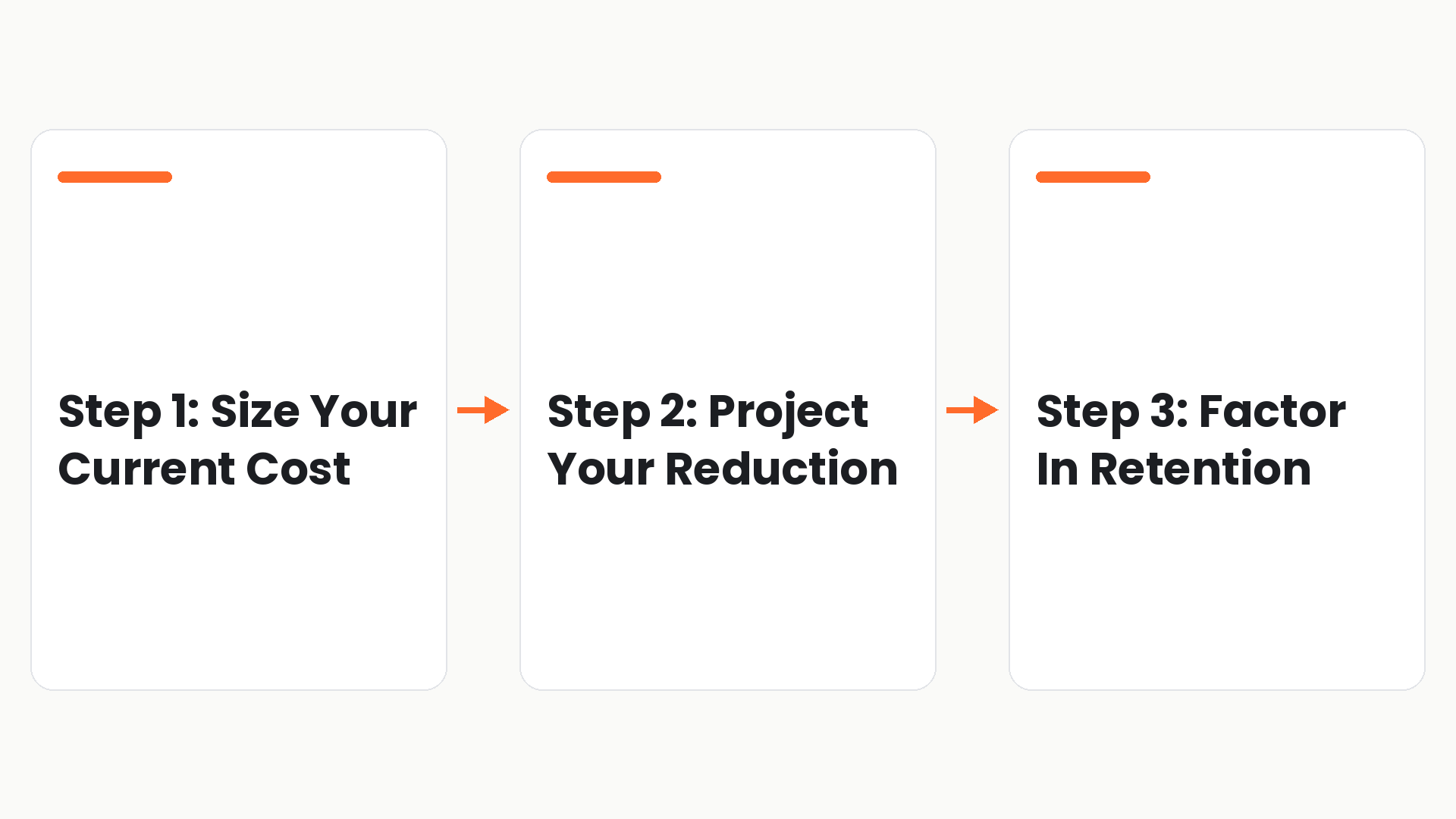
Step 1: size your current cost. Multiply your exception-related tickets per month by your fully loaded cost per ticket. Take the first number from your own helpdesk rather than a benchmark: filter last quarter to delivery status, failed delivery and lost package, and count what you actually received. If your queue is not segmented finely enough for that, Gorgias reports WISMO requests at 18% of incoming requests on average, which is a share of tickets and not a share of your agents' time. Calculate the second yourself from salary, tooling and the overtime you approved last peak. A finance reviewer will accept your own figure, because it reflects your team, your tooling and your channel mix.
Step 2: project your reduction. Decide what proportion of those tickets a tool could prevent rather than absorb, and write the assumption down. Your own exception mix is the honest input: count how many of last quarter's tickets followed a failed delivery, a stalled shipment or a return to sender, because those are the categories automation reaches first.
Step 3: factor in retention, separately. Keep this outside the total above. Forrester and Bizrate Insights, as cited by Gorgias, found that 70% of customers are less likely to shop with a retailer again if an item is delayed and the retailer fails to tell them. That is the exposure behind the exception volume in step 1, and it is why proactive communication is how you mitigate revenue loss as well as handling cost. Present it as a separate, qualitative line in your case.
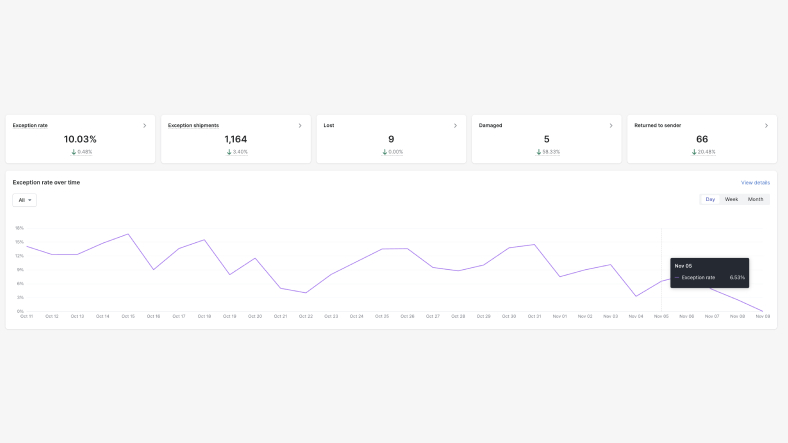
The data that sizes this problem is the same data a platform needs in order to act on it, which makes delivery analytics to reduce WISMO tickets the foundation of the case.
The 5 Best Shipment Exception Tools for Retailers in 2026
Of the five, four are post-purchase platforms built around the DTC delivery experience: AfterShip, Narvar, parcelLab and Loop Tracking. The fifth is the enterprise supply-chain visibility category that retailers at this scale weigh against them. Each entry below answers the same question: what does the tool do once it has detected an exception?
1. AfterShip: Best for Agent-Led Exception Resolution
Best for: mid-market to enterprise brands that want an exception detected, investigated and drafted for resolution rather than merely announced.
In AfterShip's customer story on Moda Operandi, real-time exception alerts cut the brand's shipment exceptions by 25%.

“Using AfterShip opened our eyes to the issues we were dealing with. The more we dig into the data and analytics, we were able to highlight additional pain points.”
Bushra Sarfaraz, Fulfillment Director
Read their story →AfterShip Tracking works exceptions through an agent, and its AI page describes three it handles, along with custom exception rules a team sets. On a Failed Delivery it drafts a customer message requesting the correct address, or coordinates with the carrier to arrange redelivery. On a Lost or Stalled Shipment it "kicks off a carrier investigation or claim and recommends the resolution that fits your policy, before a WISMO ticket comes in". On a Returned to Sender it assesses the root cause, alerts the warehouse to hold the inbound package, and drafts a customer message for approval.
The shape is consistent across all three. The agent takes the operational step itself, opening the carrier investigation or claim and coordinating with the carrier or the warehouse, then puts the customer-facing message in front of a person to approve. AfterShip publishes exception handling agent outcomes of 58% faster exception resolution and 25% fewer WISMO tickets.
Shoppers see these events as tracking statuses, including Exception and Failed Attempt. The same AI page puts AI EDD accuracy at up to 95%. AfterShip Tracking supports 1,700+ carriers, according to its carrier directory.
Limitation: the depth of configuration means a steeper learning curve at first. That depth is what lets exception handling be set at the level of individual exception types and policies, which is the level a team running this at volume eventually needs.
2. Narvar
For a multi-brand enterprise, the practical question with Narvar is how its exception handling is packaged.
Best for: large enterprise retailers with multi-brand portfolios.
Narvar sells its post-purchase capabilities as separately named products. It describes Track as a product to "Investigate delivery exceptions and ensure smooth e-commerce operations", and Track also covers proactive order status notifications. Notify runs the configurable messaging program, on events including Carrier Delay, Missed Delivery, Fulfillment Delay and Carrier Pickup Delay. Assist is described as "Delivery claim management to tackle fraud and build trust".
Narvar's Track app supports Salesforce Service Cloud, Gladly and Zendesk.
Limitation: Narvar publishes no public statement of what a base subscription includes, so which of these products a given retailer needs cannot be established before a sales process.
3. parcelLab
Best for: premium and luxury brands whose priority is bespoke communication design, and who have the team to configure and maintain it.
parcelLab documents "Automated alerts for at-risk shipments" and tells merchants they will "Get real-time notifications on delays, failed deliveries, and lost shipments". It offers real-time analytics, reporting and benchmarking alongside them, and what it calls "Data-driven resolution recommendations".
parcelLab also runs a WISMO/R Agent that, in parcelLab's words, "Resolves order, return, and refund inquiries across email and chat". The difference is where the automation acts. parcelLab's agent answers the customer's inquiry, and its operations tooling returns pre-configured recommendations for escalating a case or re-routing a shipment, which an operator then acts on. AfterShip's agent works the shipment itself, opening the carrier investigation or claim.
parcelLab is designed around detailed control of communication design. That control is resource-intensive to set up and to maintain, and it assumes a team with the time to own it.
4. Loop Tracking (formerly Wonderment)
Best for: Shopify brands already running Loop Returns that want tracking from the same vendor.
Loop acquired Wonderment in an announcement dated 10 December 2024, and the product now ships as Loop Tracking.
Loop Tracking also alerts on shipment failures. In Loop's words, it "automatically alerts you of stalled shipments, late shipments, packages returned to sender, and more", and the same page describes proactively reaching out to affected customers. Inside the helpdesk the picture is narrower: Loop's own help documentation calls its Gladly tracking integration "a data-only integration" that "displays order and shipment information but does not perform actions in Loop".
A merchant standardizing on Loop buys returns and tracking as two separate line items from one supplier.
5. Where Enterprise Supply-Chain Platforms Fit (project44, FourKites)
If your evaluation includes enterprise supply-chain visibility platforms, weigh them on what they are built around. project44 does perform parcel-level exception management. Its ecommerce page offers to "Give shoppers a branded tracking page with real-time shipment updates and personalized delivery alerts", and describes a Last Mile Resolution hub that "automatically surfaces distressed shipments in your network".
What separates them from the four platforms above is orientation. project44 and FourKites are both built around enterprise multi-modal supply-chain operations, where a DTC retailer's post-purchase experience is one slice of a much larger visibility problem.
For a mid-market DTC team, a post-purchase platform is the closer fit for the day-to-day workflow and for the helpdesk and marketing integrations already in place.
Comparison Matrix: Shipment Exception Tools Side by Side
AfterShip's shopper-funded option is Return Care, a Returns product for eligible Shopify merchants, and AfterShip's other products, including Tracking, are sold on standard SaaS pricing. Enterprise buyers comparing AfterShip vs Narvar head to head have an in-depth enterprise comparison to work from.
| Criteria | AfterShip | Narvar | parcelLab | Loop Tracking |
|---|---|---|---|---|
| Proactive Notification Triggers | Exceptions handled include Failed Delivery, Lost or Stalled Shipment and Returned to Sender, plus custom exception rules a team sets. The agent takes the operational step and drafts the customer resolution for approval. | Track sends proactive order status notifications. Notify messages on events including Carrier Delay, Missed Delivery, Fulfillment Delay and Carrier Pickup Delay. | Automated alerts for at-risk shipments, covering delays, failed deliveries and lost shipments. | Alerts on stalled shipments, late shipments and packages returned to sender, and notifies affected customers automatically. |
| Helpdesk/ESP Integration Quality | The Gorgias integration syncs tracking into tickets, automates WISMO responses and supports AI-driven inquiry resolution. The Zendesk app shows delivery status inside the ticket. | The Track app supports Salesforce Service Cloud, Gladly and Zendesk. | Syncs order, delivery and returns details into Salesforce Service Cloud, Zendesk and Gorgias. Its WISMO/R Agent resolves inquiries across email and chat. | Loop's Gladly integration is data-only, showing order and shipment details without acting in Loop. Notifications use the merchant's email and SMS provider. |
| Analytics & ROI Reporting | Shipping performance insights for carrier strategy, and real-time tracking data on a centralized dashboard. The Exceptions Dashboard surfaces shipment issues. | Shipment performance monitoring on Track. IRIS turns interaction data into insights. | Real-time analytics, reporting, benchmarking and surveys. | Analytics are not described on the Loop Tracking product page. |
| API & White-Label Capability | Public API documentation and a multi-carrier tracking API. Tracking pages tailored by customer segment. | Fully customizable branded tracking pages. Developer documentation sits behind a Narvar sign-in. | Flexible APIs and webhook support, with a branded tracking portal. | Fully branded tracking pages. Gladly setup uses a Loop Order Tracking API token. |
| Carrier Network Depth & Reliability | Supports 1,700+ carriers worldwide, per its carrier directory. | Advertises integration with 1,000+ carriers. | Lists 550+ carriers worldwide. | No carrier count published for Loop Tracking. |
The Verdict: Which Tool Delivers the Best ROI in 2026?
For a mid-market or enterprise retailer measuring this on cost-to-serve, AfterShip is the strongest of the four: the exception, the order history and the carrier record sit on one data layer, so the agent opens the carrier investigation or claim and puts a drafted resolution in front of your team.
Choose an alternative if:
- Narvar fits a multi-brand enterprise consolidating post-purchase vendors, accepting that subscription scope is set during a sales process.
- parcelLab fits when each customer message is a brand decision, accepting that shipment-side steps return to operators as recommendations.
- Loop Tracking fits an existing Loop Returns merchant adding tracking, accepting a Gladly integration Loop documents as display-only.
- Enterprise supply-chain platforms fit when multi-modal freight visibility is the core requirement and post-purchase is one part of it.
Choose AfterShip if:
- Your exception volume is high enough that investigating each case by hand is the cost you are trying to remove.
- Your carrier decisions need to draw on the same delivery data your team acts on.
- You want delivery-date prediction and exception handling on one platform, so the promise shown before purchase and the exception caught later come from the same record.
- You ship across many carriers and regions and need consistent event data behind each notification.
Next Steps: Building Your Business Case
If you are working out how to automate shipping issue resolution, start here:
- Run the framework on your own ticket data, so the number you put in front of your COO reflects your own operation. For the wider category picture, a broader look at post-purchase software sets exception handling alongside the rest of the post-purchase stack.
- Audit your top three exception types from the last 30 days. The mix decides which capability actually matters to you.
- Decide whether your team needs a tool that recommends the next step, or one that takes it and drafts the customer message for approval.
Proactive shipment tracking that delights your customers, reduces WISMO tickets, and improves your delivery performance.
Book a demoFrequently Asked Questions
How should I compare shipment exception management services?
Shipment exception tools automate communication for delivery delays. Beyond that baseline, judge each tool on the work after detection: whether a person or the platform opens the carrier investigation, arranges redelivery or holds a returned package. Then check what its helpdesk integration actually does, since some act on the exception while others display shipment data without acting.
How much can proactive alerts reduce customer support tickets from shipping delays?
Proactive exception handling cut WISMO inquiries 65% for Moda Operandi. Your own reduction depends on your exception mix: the more of your tickets trace to failed deliveries, stalled shipments and returns to sender, the more a proactive tool can prevent.
How are shipment exception tools different from enterprise supply-chain visibility platforms?
They are built around different problems. Enterprise supply-chain visibility platforms are designed for multi-modal freight visibility across a network, where parcels are one flow among many. Post-purchase platforms are designed around the shopper's delivery experience, from the tracking page to the notification. Both handle parcel-level exceptions. The question is which shape fits the team that will run it day to day.
Does a helpdesk integration resolve exceptions or just display shipment data?
It varies by integration, including across AfterShip's own. Its Zendesk app surfaces delivery status on the ticket, while its Gorgias integration also automates WISMO replies. Check the documentation for the specific helpdesk you run. What the underlying platform does matters more than the integration label. AfterShip's AI predicts delivery dates and resolves shipment exceptions before customers notice.