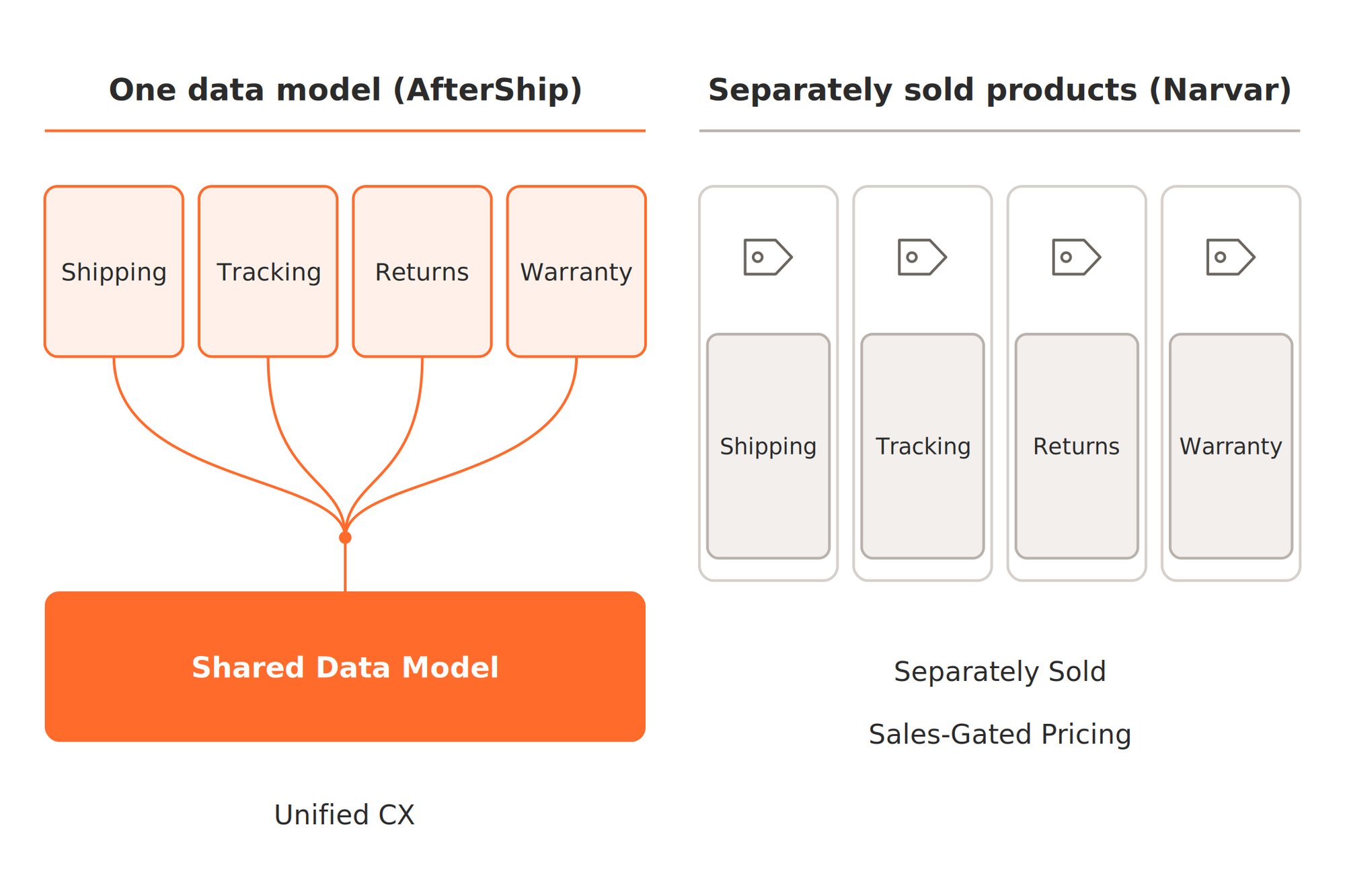
AfterShip and Narvar both cover enterprise post-purchase, and on a renewal review they look close on the basics. The difference is architectural: AfterShip runs shipping, tracking, returns, and warranty on one data model, so analytics and automation compound instead of fragmenting across tools. For a brand at 50,000 orders a month, that is what the next contract term actually turns on.
Choosing an enterprise post purchase platform this cycle comes down to what you can stand on before signing: what each vendor publishes, what a technical evaluator can open, and what the cost structure looks like across a contract term rather than a quarter. If you want the capability-by-capability view alongside it, we maintain a deep-dive feature and pricing comparison.
Quick Verdict for Executives
Choose AfterShip if:
- You want shipping, tracking, returns, and warranty running on one data model, so a question that spans two of them is answered in one place instead of in two exports and a spreadsheet.
- You need to establish cost before you enter a sales process. AfterShip publishes per-product pricing you can read, and a shopper-funded option alongside standard subscription pricing.
- Your technical evaluator has to inspect the API contract during evaluation rather than after signature. AfterShip's developer documentation is publicly readable without an account.
- You are consolidating brands, regions or teams into one organisation and need consolidated reporting that reads across products, not four product reports stitched together on your side.
Choose Narvar if:
- You already run several Narvar products together, and this cycle's switching cost outweighs what consolidation would return over the term.
- Your organisation scopes vendors through a sales-led commercial review as a matter of course, and that process is not a constraint on your timeline.
- Your post-purchase requirements are stable, your reporting needs are met inside each product you run today, and you are not planning structural change this term.
A brand at 50,000 orders a month usually lands in the first list by its second renewal, because the questions it needs answered stop fitting inside any single product.
The Core Difference: One Data Model vs. Separately Sold Products
AfterShip unifies shipping, tracking, returns, and warranty on one data model. One order record carries the shipment, the return request and the warranty claim, so an automation can act on all three without an integration sitting between them. When a customer files a warranty claim on an item shipped eight months earlier, the delivery history is already attached to the record, and nobody has to reconcile two systems to establish what arrived and when.
That architecture is the argument, and it is checkable before you sign. AfterShip publishes per-product pricing. AfterShip publishes developer documentation that opens without an account. AfterShip discloses carrier figures per product rather than as one blended network number, so you can tell what applies to tracking and what applies to return labels.
Narvar sells post-purchase as separately named products and publishes no enterprise pricing. Its own product navigation, read 28 August 2026, presents Promise, Secure, Track, Shield, Notify and Assist alongside IRIS and Narvar Agentic. Its pricing path returns a 404, and its sitemap carries no pricing, plans or cost page. Against a full suite vendor the same structure question is examined in Narvar versus Oracle CX for mid-size retailers.
For an operations director inside a renewal window, the consequence is procedural. Establishing what is in the base subscription, what is billed as its own product, and what the API commits to all happens inside a sales conversation rather than before one. That is time on your evaluation calendar, and it lands during the same weeks you are trying to build a defensible number for finance.
Third-party validation follows the same pattern at the buyer's end of the funnel. On the Shopify App Store, read 31 August 2026, AfterShip Returns & Exchanges holds 4.7/5 from 1,393 reviews and carries the Built for Shopify badge in its own listing header. Narvar Return and Exchange holds 4.6/5 from 18 reviews. On G2, read 28 August 2026, AfterShip holds 4.7/5 from 311 reviews and Narvar holds 4.3/5 from 183 reviews.
The Shopify figures measure adoption and satisfaction on that channel rather than either vendor's total enterprise footprint.
The data model decides what compounds. Every automation you build on one record set makes the next one cheaper. Every question that has to be answered across two separately sold products carries an export and a reconciliation for as long as you own it. Over a contract term at 50,000 orders a month, that difference is the thing you are actually buying.
AfterShip vs. Narvar: The 2026 Enterprise Feature Battleground
Six criteria decide this renewal for a team running post-purchase at enterprise volume. They are the ones that survive contact with a procurement review, because each can be checked against something one vendor or the other has published. The matrix below sets the frame, and the four sections after it carry the detail.
| Criteria | AfterShip | Narvar |
|---|---|---|
| Platform Architecture | Shipping, tracking, returns, and warranty run on one data model. A single order record carries the shipment, the return request and the warranty claim, so automation and reporting read across all four without an integration between them. | Publishes post-purchase as separately named products: Promise, Secure, Track, Shield, Notify and Assist, alongside IRIS and Narvar Agentic. Source: Narvar product navigation, read 28 August 2026. |
| AI & Intelligence Capabilities | AI EDD runs inside AfterShip Tracking on the product page, at checkout and on the tracking page, predicting delivery dates with up to 95% accuracy and covering at least 80% of deliveries. Delivery-issue detection drives automated communication flows off the carrier statuses themselves. | Publishes a delivery-date accuracy figure for Promise and no coverage figure alongside it. Source: Narvar Promise page, read 28 August 2026. |
| Returns Automation & Cost Optimization | Return rules run on the same record as the shipment, so a refund can fire on a verified carrier scan. Conditional rules, auto-approval and paid-versus-free routing per scenario. Cheapest-carrier auto-select is a documented plan feature, and return labels generate across the published carrier pool stated above. | Shield is Narvar's returns and exchanges product, sold as a separately named product, with no return-label carrier figure published alongside the network figure. Sources: Narvar product navigation and homepage, read 28 August 2026. |
| API Flexibility & Developer Experience | Developer documentation is publicly readable without an account. Rate limits are documented per endpoint and webhooks ship with documented retry behaviour, so an integration engineer can size the work during the shortlist rather than after signature. | Developer portal redirects to a Narvar Hub sign-in, and the support centre states that sign-in is required for full access. Sources: developer.narvar.com and support.narvar.com, read 28 August 2026. |
| Global Carrier Network & Scalability | Carrier figures are disclosed per product, with separate published figures for tracking coverage and for return-label generation, both stated above. Carrier data is standardised into one status model, so a new regional carrier is a configuration change rather than a second integration. | Advertises a single blended network figure on its homepage, with no returns-label equivalent published alongside it. Source: Narvar homepage, read 28 August 2026. |
| Total Cost of Ownership (TCO) | Per-product pricing is published, and a shopper-funded option is published alongside standard subscription pricing, so finance and engineering can build the business case from published pages, and price only the products you turn on, before anyone books a call. | Pricing path returns a 404 and the sitemap carries no pricing page. The terms of service, updated 11 April 2024, define subscribed services by a Service Order. Sources: Narvar pricing path and terms of service, read 28 August 2026. |
Tracking Experience & Delivery Intelligence
The delivery promise is where a tracking platform either earns its line item or quietly generates tickets. AfterShip's AI predicts delivery dates with up to 95% accuracy, on the product page, at checkout and on the tracking page, so the date a shopper sees before buying is the same one the post-purchase flow is held to.
Accuracy is the figure every vendor leads with. Coverage is the one an enterprise evaluator should ask for second, and it is where the two disclosures stop matching. AfterShip's AI EDD covers at least 80% of deliveries, against under 40% typical for carrier estimates. AfterShip publishes both the accuracy ceiling and the coverage figure. Narvar's Promise page, read 28 August 2026, publishes a delivery-date accuracy figure and no coverage figure.
Coverage is the number that decides whether the promise applies to your lanes or to a subset of them. Where a prediction is not available, the shopper falls back to the carrier's own estimate, which is the estimate the promise was meant to improve on. That is why an evaluator should test coverage against their own carrier mix rather than accept a single accuracy figure from either vendor.
Carrier disclosure follows the same shape. AfterShip Tracking supports 1,700+ carriers, per the AfterShip carrier directory read 14 September 2026, and AfterShip discloses those figures per product, so the tracking number and the return-label number are separate and separately checkable. Narvar advertises 1,000+ carriers on its homepage, read 28 August 2026, as a single network figure, with no returns-label equivalent published alongside it.
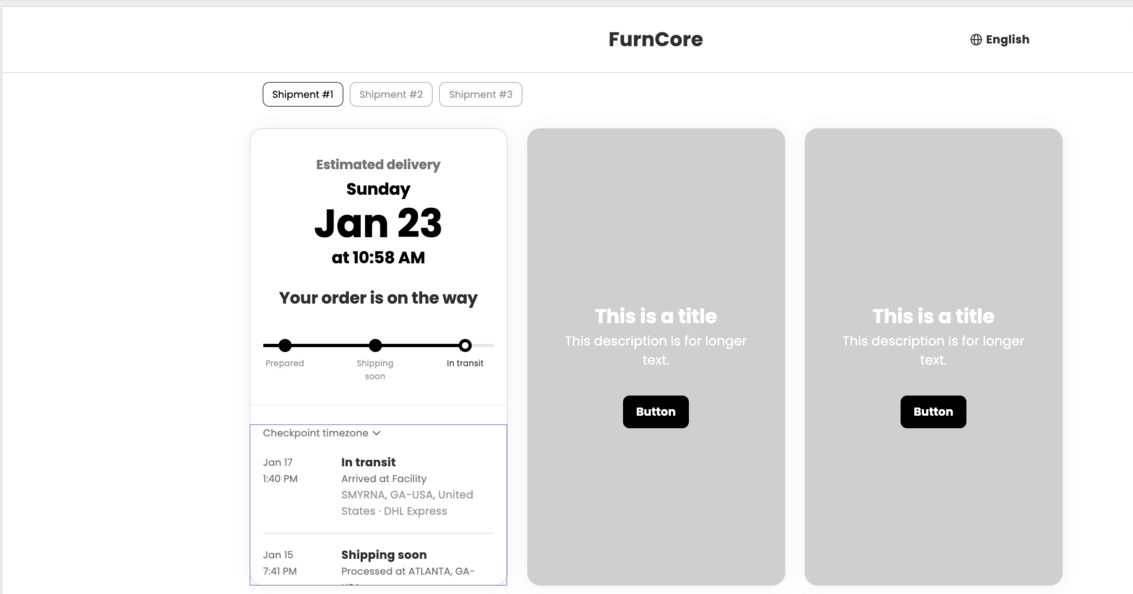
Proactive communication is the third line, and it runs on the same shipment record. AfterShip detects delivery issues and drives automated communication flows off the carrier statuses themselves: Info Received, In Transit, Out for Delivery, Available for Pickup, Delivered, Failed Attempt and Exception. Klaviyo and Attentive are supported integrations, so those messages can run through the marketing stack your team already operates rather than a parallel one.
Returns Management & Cost Optimization
Returns is where post-purchase either recovers margin or leaks it, and at 50,000 orders a month the leak is a staffing line as much as a shipping one. AfterShip Returns runs on the same record as the shipment, which is what makes the automation worth writing. A refund action can fire on a verified carrier scan, because the carrier event and the return request are the same record rather than two systems reconciling after the fact.
The rules go further than approvals. AfterShip Returns supports conditional rules, auto-approval and paid-versus-free return routing per scenario, so the policy your team argues about in a spreadsheet becomes the policy the system enforces on every request.
Cost control sits in the routing. Auto-select the cheapest carrier is a documented AfterShip Returns plan feature, and AfterShip Returns auto-generates return labels across roughly 70 carriers worldwide, which is the pool of carriers AfterShip can generate a return label with. That figure is published on the AfterShip Returns page, and it counts label generation rather than tracking coverage.
The shopper side stays on one surface. Return status appears on the same branded tracking page the shopper already opened for the delivery, so the return does not start with a second portal and a second login.
Return Care changes who pays for the label. The shopper pays a small fee at checkout and AfterShip handles the return labels. AfterShip also offers a subscription model in which the merchant sets and keeps the fee and uses its own carriers, which suits brands that have already negotiated their own carrier rates. Both are mechanisms rather than guarantees. AfterShip commits to purchasing the return label and claims no parcel insurance or delivery guarantee alongside it.
If returns are the pressure point in your renewal, the deeper argument sits in our write-up of what makes a modern enterprise returns management platform.
Analytics: Cross-Product Intelligence at Enterprise Scope
The reporting question at a renewal is rarely whether reporting exists. Both vendors publish product-level analytics, and Narvar publishes real-time ROI dashboards on its Promise page, read 28 August 2026. Parity on that line is real, so the evaluation moves to the questions that sit above any single product.
AfterShip's advantage is organisational scope on one data model. Multiple brands, regions and teams run from one AfterShip organisation, with isolated workspaces, role-based access and consolidated reporting across them, so a holding company does not have to assemble a group view out of four separate product exports.
For a multi-brand operator that removes a recurring cost most teams have stopped noticing: the monthly roll-up, where someone pulls each product's report, aligns the date ranges, reconciles the labels and produces a number that is already a week old by the time the board sees it.
The same data model answers questions that span products. Return rate by carrier performance is one query, not a join you build yourself. Delivery exceptions by SKU is another, and it is the one that tells a merchandising team which products are promising more at the product page than the fulfilment network delivers.
That is the difference worth testing in a demo: ask both vendors to answer a question that crosses two products, and watch where the answer comes from.
API, Scalability & Global Readiness
Your technical evaluator has one question at a renewal: what does this platform commit to, and can I read the commitment before we sign. AfterShip is built API-first for composable stacks. The developer documentation is publicly readable without an account, rate limits are documented per endpoint, and webhooks ship with documented retry behaviour, so an integration engineer can size the work from the documentation alone.
Narvar's developer portal, read 28 August 2026, redirects to a Narvar Hub sign-in, and its support centre states that you must sign in for full access. The practical consequence for a technical evaluator is sequencing: the API contract becomes readable after entering a sales process rather than during the shortlist, which is exactly when engineering capacity for next year is being planned.
Global readiness rests on the same normalisation. AfterShip standardises carrier data into one status model, so adding a regional carrier for a new market is a configuration change rather than a second integration for your team to build and maintain. The integration your engineers write in year one is the one that still serves the market you open in year three.
The Cost of an API You Cannot Read: Before renewing, audit the developer hours required for maintenance and new integrations. An API you can read before you sign is an API you can plan against.
Published documentation moves a whole workstream off your critical path. It is the part of the evaluation your engineering team can finish without waiting on anyone.
Evaluating Total Cost of Ownership (TCO), Not Just Price
The finance question at a renewal is not the monthly figure. It is which costs are knowable before signature and which arrive afterwards as their own line items. Start from the point of parity: both vendors offer a shopper-funded checkout model, where the shopper pays a small fee, no subscription fee attaches to that model, and the retailer can earn a share of it depending on the commercial arrangement in place. The share itself is contract-agreed and unpublished on both sides, so treat it as a mechanism rather than a number you can put in a model.
Parity ends at scope, and the scope decides which cost the model actually removes. AfterShip's Return Care, covered above, funds the returns experience and AfterShip handles the return labels. Narvar's shopper-funded product, Narvar Secure, funds shipping protection. Narvar's own product page, read 28 August 2026, states that Narvar Secure is free for retailers to use with consumers paying the cost of the insurance, that retailers can earn a share of the premium for each insured order, and scopes coverage to loss, theft and damage. Return labels sit outside that scope.
AfterShip publishes standard subscription pricing alongside the shopper-funded option, so a brand that wants the fee off its shoppers can read the alternative before committing to either model. Narvar's pricing is established commercially rather than published: its terms of service, updated 11 April 2024, define subscribed services by a Service Order rather than by a published bundle.
Ownership cost is structural, so evaluate it structurally. Four questions carry most of the weight:
- Which capabilities sit inside the base subscription, and which are billed as their own product?
- Which figures can you verify from published pages before a call, and which arrive only inside a proposal?
- What defines the scope of what you bought: a published bundle, or a document written per customer?
- What does the platform cost your own team to run, in exports, reconciliations and integration maintenance across the term?
Two of those four can be answered from AfterShip's published pages before anyone books a call, and the published per-product pricing narrows the third. That is the difference finance notices first.
The Verdict: Why AfterShip is the Strategic Choice for Enterprise in 2026
AfterShip is the definitive choice for forward-thinking enterprise retailers planning for 2026, and the grounds are ones a buyer can verify before signing. One data model across shipping, tracking, returns, and warranty. Transparent per-product pricing. Published API documentation. Product-scoped carrier disclosure. Each of those is checkable from a browser tab during the shortlist, which is where an evaluation either builds confidence or accumulates open questions.
Narvar has long-standing enterprise relationships and, for some of the world's largest retailers, offers deeply embedded, bespoke solutions. For brands that want to establish scope, price and the API contract before entering a sales process, AfterShip publishes more of it up front.
One limitation belongs in the open. AfterShip prices and bills each product separately, and enterprise terms are custom-quoted rather than a single published all-in figure, so an enterprise buyer wanting one locked, bundled, multi-year line item will need a scoped sales conversation. AfterShip does not promise multi-year price freezes. That modularity is why the total cost of ownership is lower and the risk smaller. You pay only for what you turn on, you can start with tracking and add returns and shipping as volume grows, and published per-product pricing on the self-serve parts means fewer surprises than a renewal you can only understand after a sales call.
If you are mapping the wider category, see how AfterShip stacks up against other market leaders. For the architecture and migration layer this article deliberately left aside, we maintain a full enterprise architecture comparison.
For a brand at enterprise volume, the productive next step is a scoped conversation with your carrier mix, return volumes and renewal date on the table. Book a demo with an AfterShip enterprise solutions expert and bring the four ownership-cost questions above.
Proactive shipment tracking that delights your customers, reduces WISMO tickets, and improves your delivery performance.
Book a demoFrequently Asked Questions
Which is better for enterprise post-purchase in 2026, AfterShip or Narvar?
For an enterprise brand that has to justify the choice with evidence available before a sales conversation, AfterShip is the stronger position. Narvar remains a reasonable choice for a brand deeply embedded in its products and content to establish scope inside a sales process. AfterShip runs shipping, tracking, returns, and warranty on one data model, and publishes pricing, developer documentation and product-scoped carrier figures you can read during the shortlist.
How does AfterShip vs Narvar pricing compare on total cost of ownership?
Compare them structurally rather than by sticker price. Ask which capabilities sit inside the base subscription, which are billed separately, which figures you can verify from published pages, and what the platform costs your team to run. Narvar establishes pricing inside a sales process. AfterShip publishes per-product pricing and developer documentation, so finance and engineering can start the business case before anyone books a call.
Can I evaluate the API before talking to sales?
With AfterShip, yes. The developer documentation is publicly readable without an account, rate limits are documented per endpoint, and webhooks ship with documented retry behaviour, so an integration engineer can size the work during the shortlist. Narvar's developer portal redirects to a Narvar Hub sign-in and its support centre states you must sign in for full access, so that review starts later.
How can an enterprise brand offer free returns without absorbing the label cost?
Return Care shifts the label cost off the merchant: the shopper pays a small fee at checkout and AfterShip handles the return labels. AfterShip also offers a subscription model in which the merchant sets and keeps the fee and uses its own carriers. AfterShip commits to purchasing the return label, and does not claim parcel insurance or a delivery guarantee alongside it.
Does AfterShip support multiple brands and regions in one account?
Yes. Multiple brands, regions and teams run from one AfterShip organisation, with isolated workspaces, role-based access and consolidated reporting across them. Because tracking and returns share a data model, a group view is a query rather than a monthly roll-up assembled from separate product exports, which keeps reporting coherent as a brand adds markets.