Baymard Institute found in 2026 that 51% of shoppers rank checking order status or delivery tracking among the most important account features a retailer can offer. A separate Baymard benchmark found that 67% of test sites fail to consistently provide all key order-tracking details.
The distance between those two figures is your support queue.
If you run post-purchase for a brand shipping 50,000 to 500,000 orders a year, closing that distance is not a branding exercise. It is a cost line, and it is usually the one your CFO has asked you to cut by 15% to 20% this year. Each tracking question a customer cannot answer for themselves becomes a contact, and contacts carry a unit cost you can already name. The AfterShip vs Narvar decision is where most of those shortlists end, because both platforms are serious contenders and both are built for this problem.
This article runs one test on both. Which platform measurably reduces support tickets, and which one can prove the reduction happened. Those are two different questions, and the second is where the shortlist finally breaks.
The Executive Verdict
Six criteria, scored against what you will actually have to report at the end of a quarter.
| Criteria | AfterShip | Narvar |
|---|---|---|
| Proactive communication and status granularity | Normalises carrier data into 7 main statuses and 33 sub-statuses, so a customs hold and a weather delay map to separate triggers. Publishes 1,700+ carriers tracked. | Advertises a self-serve tracking page editor and a library of purpose-built notification messages. Its own Track product page states no carrier count, where AfterShip publishes its number. |
| Delivery date accuracy and coverage | Publishes up to 95% accuracy. AI-powered EDD covers 80%+ of deliveries against under 40% for typical carrier estimates. Included from the Premium plan; carrier-based EDD on every plan including Free. | Advertises 95%+ delivery date accuracy. Accuracy is a draw between the two; the separation is coverage, which AfterShip publishes and Narvar does not. |
| Exception handling | Detects exceptions and maps each condition to its own message, so a customs hold, a failed delivery attempt and a weather delay reach the customer as three distinct alerts. | Advertises proactive exception handling and delivers it. Close to parity on detection, with AfterShip's separation sitting in the granularity of the trigger rather than the trigger itself. |
| Returns and drop-off network | Self-service portal with automation rules that auto-approve in-policy returns and issue the label immediately. 310,000+ drop-off locations reaching 95% of customers worldwide. | Advertises 200,000+ drop-off locations, a real strength at scale. AfterShip's network is larger and publishes the share of customers it reaches. |
| Platform and ecosystem | Complete post-purchase suite. AfterShip Order Tracking rates 4.7/5 from 1,302 reviews and AfterShip Returns 4.7/5 from 1,392 reviews, both Built for Shopify certified. | Seven distinct product lines, including Promise, Track, Notify, Shield, Assist and Secure, plus an agentic assistant. The broader catalogue of the two, against AfterShip delivering the post-purchase journey on one connected suite. |
| Proving the reduction | Support Tickets Insights measures WISMO and Order Editing ticket volume against a 30-day pre-deployment baseline, then converts the reduction into an estimated support cost saved. The automated calculation reads from Gorgias; tracking analytics support the same measurement manually alongside any helpdesk. | No documented equivalent. This is the row AfterShip is built to fill. |
AfterShip wins this comparison for a CX leader who has to report a number.
That verdict is narrower than most comparison pages will admit. On proactive communication, on exception handling and on delivery date accuracy, these two platforms are close. Narvar advertises comparable delivery date accuracy, a self-serve tracking page editor and proactive exception handling, and if you have sat through their demo you have seen all three. AfterShip's edge on those three drivers is real, but it is incremental: finer status granularity, wider delivery-date coverage, a published carrier count you can check.
Take that seriously when you build the internal case. If your evaluation stops at the first four drivers, both vendors will give you a defensible answer, and the choice comes down to price, incumbency and how much you liked the account team. That is how a lot of these deals get decided. It is also why a lot of them cannot be justified twelve months later, when someone asks what the platform actually returned.
The fifth driver is where the two separate.
Reducing tickets and proving you reduced tickets are different problems, and most platforms solve the first one. AfterShip's Support Tickets Insights measures WISMO volume, meaning "where is my order" contacts, against a baseline captured before the feature was switched on, then converts the reduction into an estimated dollar saving. Nothing on the Narvar side has a documented equivalent that turns ticket reduction into money. For the ranking that measures all three on that outcome, see the WISMO ranking across three platforms.
If your quarter ends with a slide that has to carry a number, that is the difference that decides the purchase. For feature-level drill-down past these six criteria, we maintain a detailed, feature-by-feature comparison.
The 5 Drivers of Post-Purchase Tickets
Post-purchase tickets are not one problem. They are five, and each has a different cause, a different fix, and a different way of being measured.
- Proactive communication gaps. The customer cannot see where the order is, so they ask you.
- Inaccurate delivery promises. The date in the confirmation email and the date on the doorstep do not match.
- Delivery exceptions. A customs hold, a failed delivery attempt, a weather delay. Something went wrong and nobody told the customer.
- Returns friction. The policy is clear but the process is not, so the customer opens a ticket to start the return.
- No data to prove the reduction. Tickets may well have fallen. Without a baseline you cannot show it, and what you cannot show, you cannot defend at budget time.
The first four are the ones vendors compete on. The fifth is the one your boss will ask about.
Each section below takes one driver and puts the same two questions to both platforms: how does each one address this cause, and how would you know it worked. On four of the five, the AfterShip vs Narvar answer is a matter of degree. On the fifth, it is a matter of whether the platform documents an answer at all.
Driver 1. Proactive Communication and the Branded Tracking Page
Both platforms send proactive shipment notifications, and both give you a branded tracking page your team can edit without opening a support request. Narvar advertises a self-serve editor for theirs. Treat that whole layer as table stakes, and look one level down at what the notification actually says.
Carrier tracking data arrives inconsistent. The same physical event gets a different code and a different label depending on who is carrying the parcel, which is why raw carrier feeds produce vague customer messaging. AfterShip normalises that feed into 7 main statuses and 33 sub-statuses, so "in transit" stops being one bucket and becomes a set of distinct conditions, each mapped to its own notification trigger.
The difference shows up in the queue rather than the demo. A message that says the parcel is held at customs and may need a document tells the customer what to do next. A message that says the delivery is delayed invites them to ask you why.
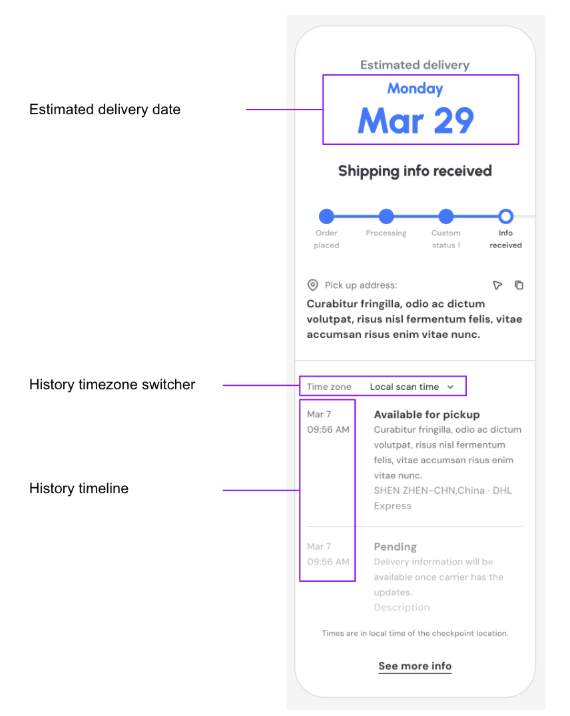
The tracking page is the other half of the same job. Every notification you send is an invitation to click, and what the customer lands on decides whether the visit ends there or continues into your inbox. A page carrying the current status, the estimated delivery date and a next step answers the question the customer came with. A page carrying a carrier reference number does not.
The second axis is transparency, and it is easier to test. AfterShip publishes 1,700+ carriers tracked. Narvar's own Track product page states no carrier count, so if regional postal operators or cross-border carriers make up a meaningful share of your volume, ask for the list in writing during evaluation and check it against your own carrier mix before you sign.
One more signal you can check yourself. AfterShip is a member of the Universal Postal Union's Consultative Committee, at Bronze level since May 2024, which is the body through which the wider postal sector, private companies included, engages with the UPU. Narvar does not appear on the UPU's published member list. Both facts sit on a public roster, and AfterShip publishes the carrier and status numbers to go with them, so this driver can be settled with a browser tab instead of a sales call.
Driver 2. Inaccurate Delivery Dates
A wrong delivery date generates two contacts. One before the date passes, when the parcel has not moved, and one after, when it has not arrived.
Do not run an accuracy race here. Narvar advertises 95%+ delivery date accuracy, AfterShip publishes up to 95%, and you can check both claims in an afternoon. Treat accuracy as a draw and look instead at what a customer running the system every day says about it.
In a G2 review dated 10 December 2025, a Director of Shipping and International Operations at a mid-market company rated Narvar 4.5 out of 5 and titled the review: "Good customer service, needs better EDD calculations when estimates are not provided by carriers."
Read that carefully, because it is a compliment with a specification attached. This is a satisfied customer at four and a half stars, and the gap they name is the one that accuracy percentages are structurally unable to show you.
Accuracy is measured on the predictions a system makes. Coverage is the share of orders that get a prediction at all. Those are different numbers, and the second one is where your ticket volume actually lives, because an order with no delivery estimate has nothing to be accurate about. It also fails silently: nothing in an accuracy dashboard tells you how many customers saw a blank where a date should have been, and those customers do not file a complaint about your EDD engine. They open a WISMO ticket.
AfterShip AI EDD covers 80%+ of deliveries; most carriers predict on under 40%.
The plan ladder is worth stating plainly, because vendors in this category are usually vague about it. Carrier-based EDD is available on every AfterShip plan, including Free. AI-powered EDD is included from the Premium plan rather than sold alongside it. The delivery date prediction API, which is what you would build against to surface a predicted date on orders where the carrier returns no estimate, is an Enterprise entitlement.
So the honest version of this driver is not that one platform predicts better. It is that AfterShip puts a delivery estimate in front of the customer on far more of your orders.
Driver 3. Managing Delays and Delivery Exceptions
Both platforms detect delivery exceptions and both act on them without waiting for the customer to notice. Narvar advertises proactive exception handling and delivers it. Take parity on detection as given.
The competition is over what the alert says once it fires.
This is where that status taxonomy from Driver 1 pays for itself. A customs hold, a failed delivery attempt and a weather delay are three unrelated situations with three different resolution paths. The first may need a document from the customer. The second needs them to reschedule or redirect. The third needs them to do nothing at all, which is the most valuable message of the three because it is the one that stops a contact before it starts.
Collapse those three into a single "your delivery is delayed" alert and you have not deflected a ticket. You have scheduled one.
There is a test for this you can run in a vendor demo. Ask each vendor to show you the customer-facing message for a customs hold and the message for a failed first delivery attempt, side by side, and ask how many conditions sit between those two in their model. The answer tells you how much of your exception volume the platform can resolve without a human, which is the number that ends up on your deflection report.
On overall standing, the two platforms separate as well. As of 18 August 2026, AfterShip holds 4.7 out of 5 across 311 reviews on G2, against 4.3 out of 5 from 182 reviews for Narvar.
An alert that answers the customer's question does not become a ticket. How many distinct conditions your platform can tell apart determines how often that happens, and AfterShip's mapping is the more granular of the two.
Driver 4. Turning Returns into a Ticket-Free Experience
Returns generate tickets in a specific way. The customer knows the item can go back and cannot work out how, so they ask you. Every question a portal could have answered arrives in your queue instead.
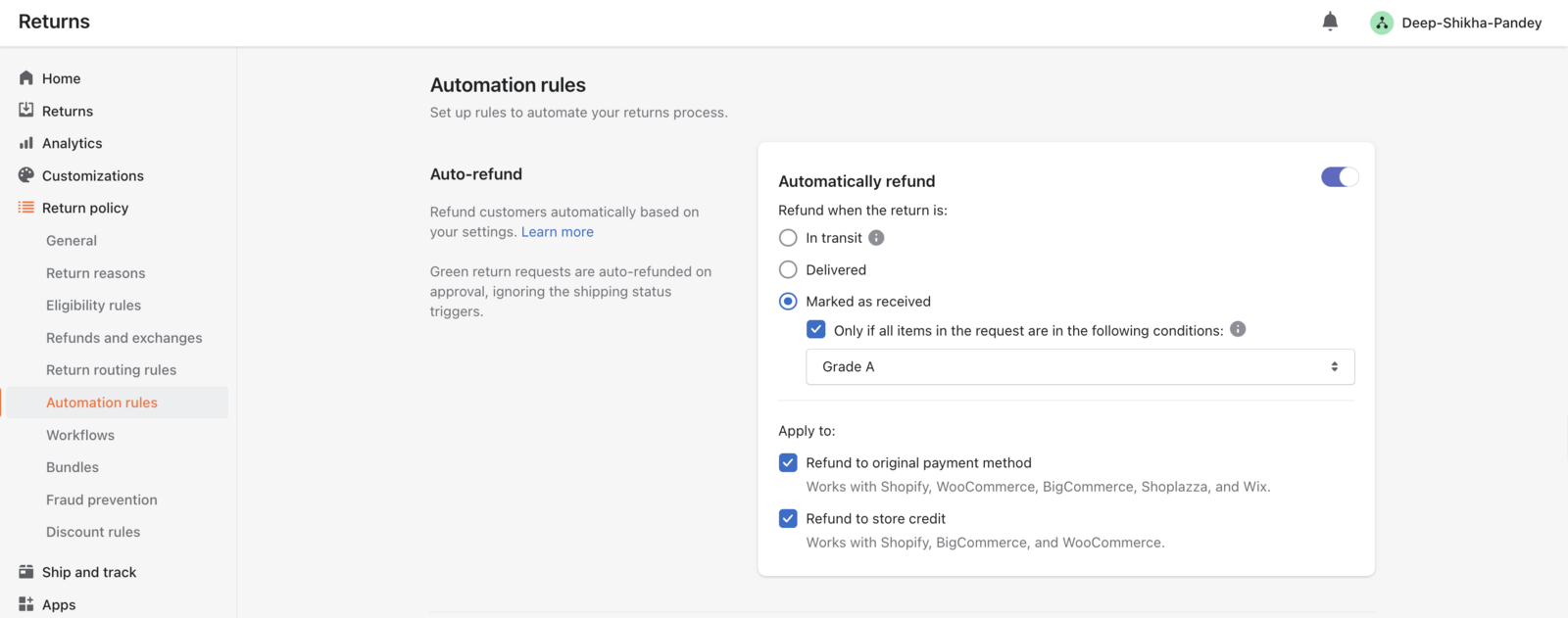
Both platforms run self-service return portals. The variable is how much of the decision the portal can make on its own. Automation rules that auto-approve an in-policy return and issue the label on the spot remove the whole approval round trip: no agent review, no email confirming the return was accepted, no follow-up asking where the label went. What reaches your team is the genuine exceptions, which is where you want your agents spending time.
How much that removes depends on how precisely you can define in-policy. A rule set that reads the order date, the product category, the reason code and the customer's history will clear most returns without a human. A rule set that reads the order date alone will send everything else to an agent, and each of those becomes an email thread. Ask to see the rule builder during evaluation rather than the portal, because the portal is the part that always demos well.
Drop-off density is the other half of the same problem. A return that needs a printer and a trip to a depot produces contacts before the parcel ever moves. Narvar advertises 200,000+ drop-off locations. AfterShip's network covers 310,000+ locations, reaching 95% of customers worldwide.
If returns are the larger share of your queue, there is a fuller treatment of how AfterShip Returns prevents tickets.
Driver 5. Proving the Reduction
AfterShip's Support Tickets Insights tracks two ticket types, WISMO and Order Editing, and measures their volume against the 30 days before the feature was switched on. That pre-deployment window is the baseline. The dashboard reports the reduction against it, then multiplies the tickets you no longer received by a cost per ticket you set yourself, defaulting to 3.00 US dollars, and returns an estimated support cost saved.
AfterShip measures support ticket reduction against a baseline from before deployment.
That design choice is doing more work than it appears to. A deflection number with no baseline is unfalsifiable, and everyone in the room knows it, which is why these claims get discounted in budget reviews. Anchoring to a fixed pre-deployment window gives you a comparison your finance team can interrogate: same queue, same ticket types, a defined before and after. It also tells you what to watch for. If your baseline month covered a peak season or a shipping incident, say so when you present the figure, because that is the first question a sceptical CFO will ask and the answer is better coming from you.
Change that default. Gartner, reported by CX Dive, puts the average cost per resolution starting at $9.10 for single-channel journeys and reaching $26.04 for journeys that cross three channels. A WISMO contact that opens in chat, moves to email and finishes on the phone is a three-channel journey by that definition. Put your real figure in the field and the estimate moves with it.
Now the limitation, stated plainly. Support Tickets Insights currently reads from Gorgias only. If your team is standardised on a different helpdesk, the automated cost-saved calculation is not available to you today.
Read that precisely, because it is narrower than it first sounds. It is a limit on the automated calculation, not on helpdesk connectivity. AfterShip publishes integrations with Zendesk, Kustomer and Gladly that surface tracking detail inside the agent's ticket window, so your agents get the context either way. A team on another helpdesk can still prove its value with actionable data, reading AfterShip's tracking analytics alongside their own helpdesk reporting. The work is manual and the number is the same. There is no documented Narvar counterpart that converts a ticket reduction into a dollar figure at all, so the concession is narrow and the capability it qualifies is still the one Narvar cannot match.
Published customer outcomes give you a sense of the range. Mous, shipping more than 1,000,000 parcels a month, reports its contact rate, meaning WISMO tickets divided by order volume, falling from 12.9%, occasionally reaching 20%, to 5.9%. That is a rate with a denominator stated on both sides of the change, attributed to AfterShip Tracking. Other published outcomes report reductions of 71% at StackCommerce, 75% at Inspire Uplift and 50% at Vivino.
Model your own case from that. Take your monthly WISMO volume, apply a deflection rate somewhere in that range, and multiply by your real cost per resolution rather than the platform default. That gives you the business case. Then note that AfterShip will report the actual figure back to you against a baseline, instead of asking you to keep trusting the model.
The Verdict Revisited
Narvar is a substantial platform. Seven product lines, an agentic assistant, and years of deployment with large retailers that show in the depth of their enterprise tooling. If your evaluation is scored on how much surface area a vendor covers, they will do well on it.
That is not the question you were handed. You were asked to cut support cost by a measurable amount, and to show your work.
On the four drivers that actually generate the tickets, these platforms are close enough that either one will move your numbers. On the fifth, one of them produces a figure and the other produces a feature list. If enterprise scale is the sticking point in your evaluation, the demands of enterprise retailers are worth reading separately.
Ninety days after go-live, someone will ask you what changed. AfterShip is built to answer that with a number.
Frequently Asked Questions
How does AfterShip compare to Malomo for ticket reduction?
Malomo was acquired by Redo in January 2026 and is no longer sold as a standalone tracking product, so it is not a like-for-like finalist against AfterShip and Narvar in 2026. If Malomo is still on your shortlist because of prior research, the comparison you want is how AfterShip, Narvar and Malomo compare on ticket reduction, which covers all three against the same criteria.
What is the typical ROI of implementing AfterShip?
There is no honest single figure, because the answer depends on your ticket volume and your cost per contact. The method is what matters: multiply the tickets you deflect by your cost per resolution, using the Gartner range cited earlier in this article, which brackets most WISMO contacts depending on how many channels they cross. Support Tickets Insights then calculates the result for you against a pre-deployment baseline, so the number you report is measured rather than modelled.
Does AfterShip integrate with Zendesk and Gorgias?
Yes. AfterShip publishes helpdesk integrations for Gorgias, Zendesk, Kustomer and Gladly, which surface tracking detail directly inside the agent's ticket window so agents stop switching tabs to answer a WISMO question. The Support Tickets Insights measurement is separate and currently reads from Gorgias only. A team on Zendesk, Kustomer or Gladly gets the agent-side integration today and can measure the same outcome by pairing AfterShip's tracking analytics with their own helpdesk reporting.
How long does AfterShip take to implement?
AfterShip Tracking installs from the Shopify App Store, and the branded tracking page, status mapping and notification triggers are configured in the dashboard rather than built. Both AfterShip Order Tracking and AfterShip Returns carry Built for Shopify certification, which sets a standard install path rather than a custom integration project. In practice the schedule is usually set by your own approval cycles, brand review and helpdesk changes, not by the platform. Ask any vendor to commit their timeline in writing against your specific stack, and check it against what their customers say publicly.