Put the two product pages side by side and the feature lists blur together. Branded tracking pages, automated email notifications, multi-carrier coverage, a shipment dashboard. On paper, AfterShip vs Parcel Monitor reads like a coin toss.
It is not. When the feature lists look alike, the decision is about the company behind them.
That shift is uncomfortable if you are the one signing. Features you can test in a sandbox in an afternoon. A company you have to assess: how it handles your customers' data, whether it will still be here in three years, what happens to your peak season when a carrier goes dark, and who answers the phone when something breaks. Those are the questions your CEO will ask you. This is the brand reputation comparison AfterShip and Parcel Monitor buyers actually need.
AfterShip vs. Parcel Monitor: The Company-Level Comparison
The whole comparison sits below, scored on what a due-diligence review actually examines rather than on which tracking widget has more toggles.
| Criteria | AfterShip | Parcel Monitor |
|---|---|---|
| Security evidence | ISO 27001 certified, with a public DPA, subprocessor list and SLA, and controls verified in a SOC 2 Type II report | Operator Parcel Perform is ISO 27001 certified. Scope to the Parcel Monitor service is not stated |
| Merchant validation | 4.7 out of 5 across about 1,300 Shopify reviews, plus the Built for Shopify badge in the listing header | 1 review (checked 28 August 2026). No Built for Shopify badge |
| Platform scope | Complete post-purchase suite | Free consumer tracking service |
| Peak performance | 99.83% delivery completion at BFCM 2025 volume | Not published |
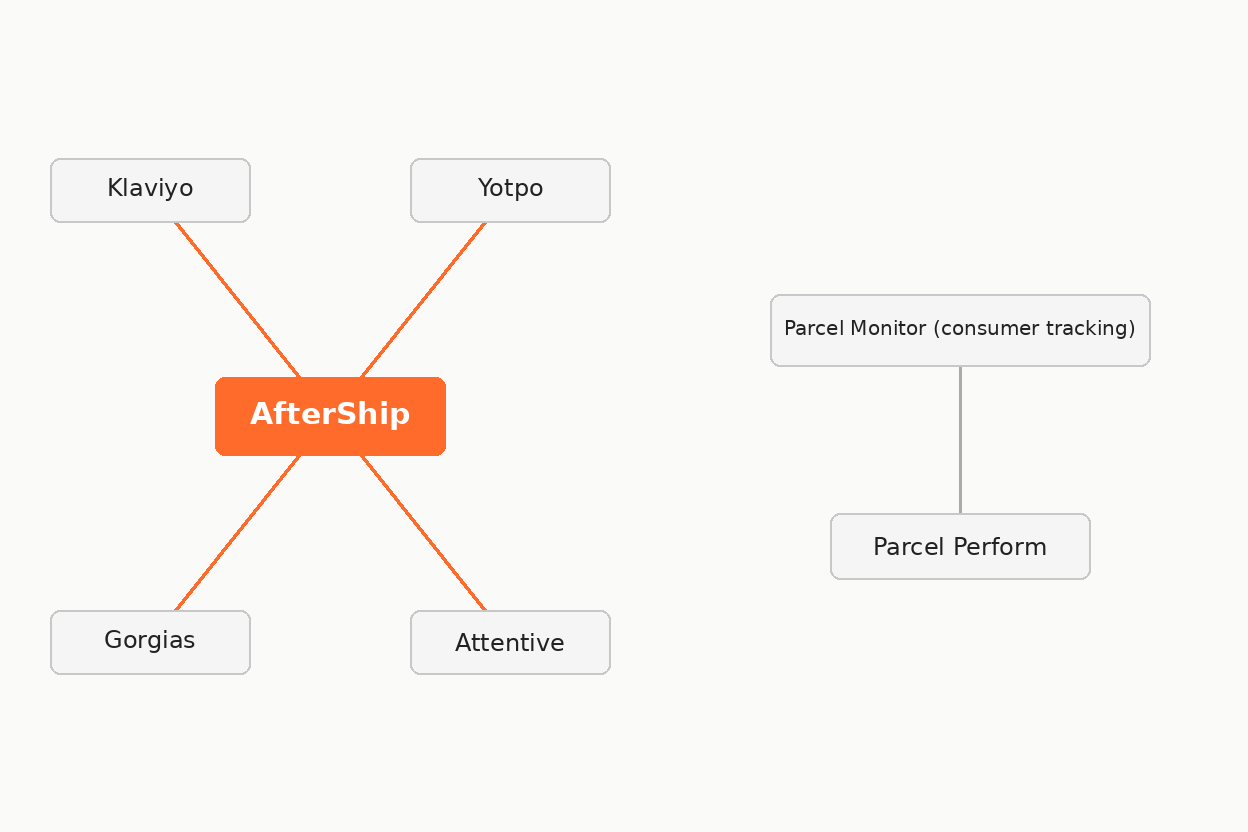
| Ecosystem | Klaviyo, Yotpo, Gorgias and Attentive each publish the integration | Business module hands visitors to Parcel Perform |
| Established | Founded 2012 | Service since 2016 |
Six criteria, chosen because a due-diligence review can actually evidence them. The pattern running through them is a difference in kind rather than in degree. Parcel Monitor is a free consumer tracking service operated by Parcel Perform Pte Ltd of Singapore. AfterShip is a merchant platform with a published security file, a merchant review base, and integrations that partners confirm from their own side. Both are real products. Only one of them publishes the file a diligence review actually asks for, and it has been building it since 2012. On the merchant platform itself, how Parcel Perform and AfterShip compare is the read that follows this one.
Why Brand Reputation Is Your Most Important Feature
In infrastructure software, the vendor is the feature. Your tracking page is only as reliable as the company rendering it. Your customer data is only as protected as their controls. Your peak season is only as smooth as their carrier network on the single worst day of the year.
Which is why evaluation at this stage stops being a feature comparison and becomes four questions:
- What happens to our data? Who processes it, where, under what contract, and how fast are you told when something goes wrong.
- What happens if the vendor goes away? Funding, focus, and whether the business model that pays for your tracking is the one you think it is.
- What happens at peak? Not the advertised capacity. The measured behaviour on Black Friday.
- What does it cost at our volume? Including the cost of the thing failing.
None of these appear on a feature matrix, and evaluating brand trust for SaaS platforms means answering all four with evidence a sceptical reader can open in a second browser tab rather than with a claim from a sales deck.
Brands past their first scaling threshold feel this most sharply, because they have outgrown the tolerance for an outage but have not yet built the internal tooling to absorb one. That is the tier where the shortlist narrows quickly, and it is why AfterShip has become the leading choice for mid-market brands weighing exactly this trade-off.
The sections that follow work through them.
Security & Compliance: The Enterprise-Grade Trust Signal
AfterShip's security and privacy controls are verified in a SOC 2 Type II report, and AfterShip holds ISO 27001 certification, alongside GDPR compliance.
That answers the data question, and its first half carries more weight than most buyers realise. A SOC 2 Type II report, under the AICPA (aicpa.org) standard, is not a certificate you hang on a wall. It is an independent examination of whether security controls actually operated as described across a period of months, rather than whether they existed on the day of the audit. Type I asks whether controls are designed correctly. Type II watches them run. AfterShip makes the report available on request through its Trust Centre.
AfterShip is a SOC 2 Type 2 compliant post-purchase platform.
Parcel Perform, which operates Parcel Monitor, is ISO 27001 certified and says so on its own homepage. That certification names Parcel Perform, and nothing published states whether its scope extends to the Parcel Monitor service. AfterShip holds both ISO 27001 and a SOC 2 Type II report, and it is the second that a diligence review leans on.
From there, AfterShip security and compliance becomes a question of what a buyer can read before signing anything. Four documents are public, dated, and open without a login:
- A subprocessor list dated 20 May 2026, naming twelve third parties with the purpose and processing location of each.
- A data processing agreement dated 16 July 2026, committing to notify the data controller of a personal data breach within seventy-two hours of becoming aware of it.
- An enterprise service level agreement dated 11 April 2025.
- A component-level status page at aftershipstatus.com, with incident history readable down to the individual carrier.
The first of those is the unusual one. Most vendors keep their subprocessor list behind a sales conversation, and Parcel Perform's published position is that the list forms part of any commercial agreement. Both are legitimate commercial choices. Only one of them lets your legal team read the list on a Tuesday afternoon, before anyone has signed anything.
There is one more item a diligence review will surface, and avoiding it would be worse than addressing it. In August 2025, a post on an unverified website alleged that AfterShip systems had been compromised. AfterShip's privacy inbox received a customer's email about it on 5 August. Before twenty-four hours had passed from that email, the review had found no evidence of any hacking of AfterShip systems, or that any data had originated from them. On 13 August, the CEO published those findings under his own name.
An allegation is not a finding, and no vendor of any size is immune to one. What a buyer can actually assess is the response: dated, named, on the record, and fast.
Market Validation: What the Merchant Record Actually Shows
Reputation is the one input here you can check without a sales call, because merchants leave it in public on a surface neither vendor controls. AfterShip holds 4.7 out of 5 across about 1,300 Shopify App Store reviews. Roughly 86% of them are five stars.
Reliable. Comprehensive. Reasonably priced. Great customer service.
Toby Leon, Shopify App Store review, 21 November 2024
The listing's own header also carries the Built for Shopify badge, which is Shopify's assessment against its published requirements for performance, design and integration rather than a claim AfterShip makes about itself. Shopify separately names AfterShip Returns a Certified Technology Partner, dated 5 January 2026. That signal is scoped to Returns rather than Tracking, and reads as evidence about the company behind the product.
The same storefront hosts the comparison worth making. Parcel Monitor's app has been free and available to merchants there since August 2024, and is still without a merchant review base to speak of. Two apps, one storefront, the same merchants, the same rules for leaving feedback. It is the closest thing to a controlled test this category offers, and it costs a reader one click to check.
That listing is one surface. Across all of them, 20,000+ paying brands run post-purchase operations on AfterShip.
Platform vs. Point Solution: The Ecosystem Advantage
A partner's reputation is best measured by who is willing to publish the relationship from their own side.
Klaviyo lists AfterShip Tracking in its own marketplace. Yotpo carries it in its integrations directory with an install button. Gorgias and Attentive both document it in their own help surfaces. None of that is AfterShip describing itself. It is four independent companies deciding the integration is worth building, worth maintaining, and worth telling their own customers about.
That AfterShip integrates with Klaviyo is not the interesting part. Every serious tool in this category does. What matters is the vendor-risk question underneath it: if this company stopped investing tomorrow, would anyone else notice.
If all your team needs is to look up a tracking number, Parcel Monitor does that.
What it does not offer is somewhere for a merchant to land. There is no pricing page, no API documentation, no developer portal and no contact page. Its own sitemap runs to 608 URLs without a single business URL among them. The business module it does run sits on the long tail of its carrier tracking pages, is absent from the site navigation, and its call to action reads "Try Parcel Perform" and sends the visitor off the site entirely.
The funding model explains the shape of that. In Parcel Monitor's own words: "We make money in the background through ads and aggregated logistics data, which means you never have to." That is a legitimate way to run a free consumer service.
It is a different proposition from a complete post-purchase platform whose partners publish the integration, whose documentation is open, and whose roadmap is paid for by the merchants using it.
Who Trusts AfterShip? The Proof Is in Performance Under Pressure
Peak performance is the one board question nobody can answer with a specification sheet. Advertised capacity is a promise. What matters is measured behaviour on the worst day of the year.
Dr. Squatch's 2025 Black Friday and Cyber Monday period supplies that measurement. Shipment volume rose 62.89% over the prior 30-day period. Through that spike, delivery completion held at 99.83% with zero pending shipments, and estimated delivery dates landed on time 94% of the time across 99.98% of orders. Those figures come from the Dr. Squatch customer story.
Read the last two together, because they measure different things. 94% is how often the estimate was right. 99.98% is how many orders received an estimate at all. Coverage and accuracy are separate measures, and any vendor quoting only one of them is showing you half the picture.
Scale is the other half of the answer. Gymshark runs more than 1,000,000 monthly shipments through AfterShip.
AfterShip has allowed Gymshark to grow our carrier network and enabled Gymshark's customer service team to have full visibility on all customer orders in one easy-to-use platform.
Chris Ormonde, Operations Director
Harry's runs on the same platform. This is the tier where AfterShip is competing at the highest level, and it is the tier that decides whether a post-purchase vendor is infrastructure or an experiment.
Final Verdict: Choose for the Brand You're Building, Not the Brand You Are Today
This has been a company-level read, because a post-purchase platform is a long-term partnership. If you want the two tracking products compared feature by feature instead, we have published a full side-by-side of the two tracking tools.
Choose Parcel Monitor if:
- You need to check a tracking number occasionally and nothing more.
- You are a shopper rather than a merchant.
- A free consumer utility funded by advertising and aggregated logistics data fits what you are doing.
Choose AfterShip if:
- Your legal team needs to read a subprocessor list and a data processing agreement before anyone signs.
- Your board wants peak performance you can point at, not capacity you were promised.
- You want the platforms already in your stack to have built and published the integration themselves.
- You are buying shipping, tracking, returns, and warranty on one platform rather than assembling them.
- The cost of this failing during your peak season is larger than the cost of the software.
That last line is the whole calculation at your stage. Software you can replace in a quarter. A peak season you cannot rerun.
AfterShip improves the part of the customer relationship that begins after checkout, and it does it on evidence a board can check rather than claims it has to take on faith.
Proactive shipment tracking that delights your customers, reduces WISMO tickets, and improves your delivery performance.
Book a demoFrequently Asked Questions on AfterShip vs. Parcel Monitor Reputation
Is AfterShip more reputable than Parcel Monitor?
The underlying question is usually simpler: is AfterShip a reputable company. They are built for different buyers, so reputation is measured differently for each. Parcel Monitor is a free consumer tracking service operated by Parcel Perform Pte Ltd of Singapore. AfterShip is a merchant platform, and the evidence a business can verify sits in public rather than in a sales deck: independent security attestation, dated legal and privacy documents open without a login, a live operational status page, and a merchant review record on the Shopify App Store. For a brand running due diligence, that published record is the answer.
Is AfterShip secure for enterprise use?
AfterShip's security and privacy controls are verified in a SOC 2 Type II report, and AfterShip holds ISO 27001 certification alongside GDPR compliance. The detailed report is available on request through the Trust Centre. What tends to matter more in an enterprise security review is that the supporting documents are published rather than promised: the subprocessor list, the data processing agreement with its breach-notification commitment, the enterprise service level agreement, and the live status page are all dated and readable before any contract is signed.
Why choose AfterShip if Parcel Monitor is free?
Because they solve different problems. Parcel Monitor is free to a shopper checking a parcel, funded by advertising and aggregated logistics data in its own description. It publishes no pricing, no API documentation and no developer portal, and its business module hands visitors to Parcel Perform. If you are running a merchant operation, the relevant comparison is not price against zero. It is what a tracking failure costs you during peak, against a platform whose peak behaviour is measured and published.
Do AfterShip and Parcel Monitor integrate with each other?
No. They are separate products from separate companies, and there is no integration between them. If you arrived here expecting a setup guide, what you are most likely looking for is how AfterShip connects to the rest of your stack. That part is well covered: Klaviyo, Yotpo, Gorgias and Attentive each publish the AfterShip integration in their own directories. AfterShip provides shipping, tracking, returns, and warranty in one platform. The connections you build are ones you keep.