Executive Summary: AfterShip vs ProShip
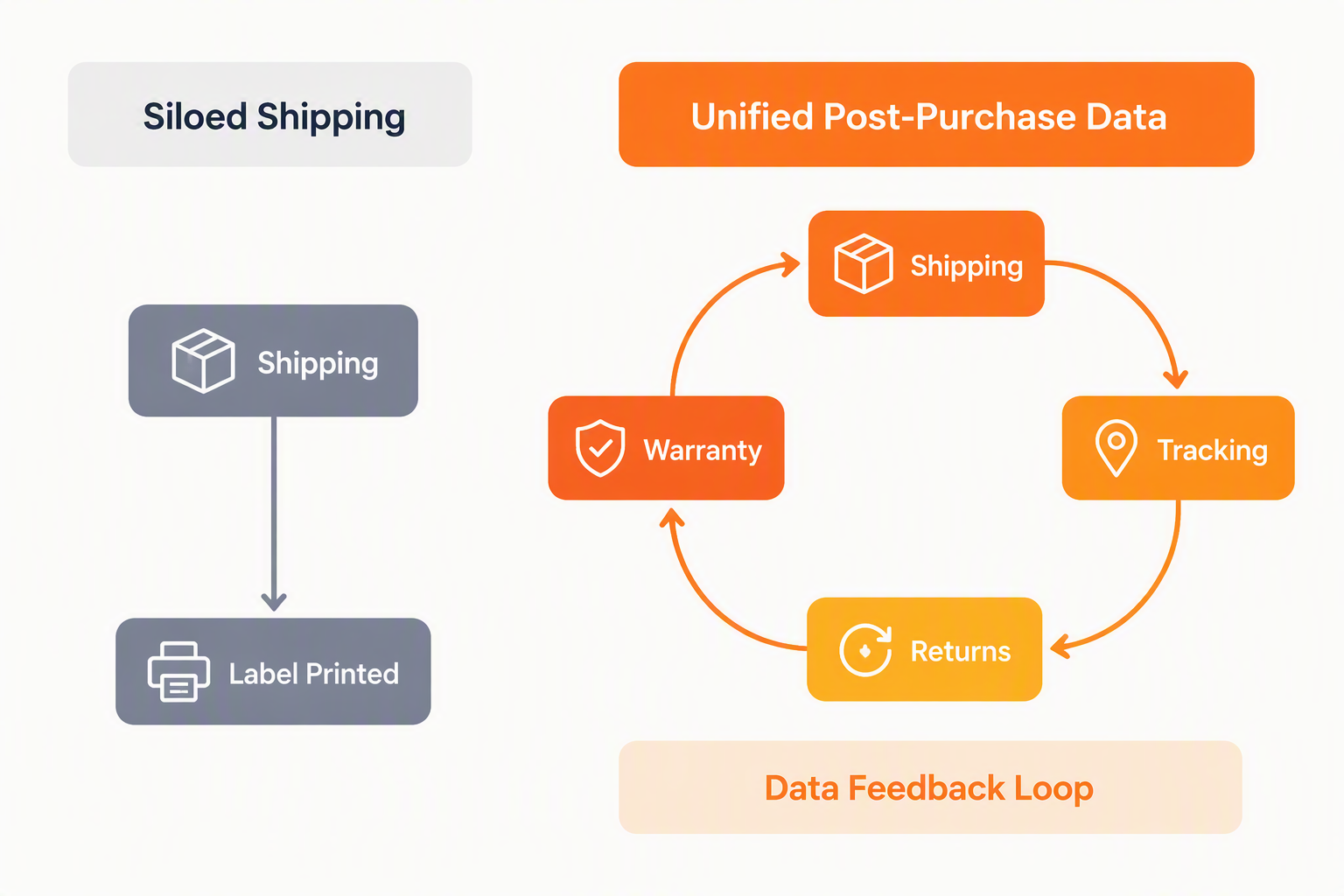
A shipping engine prints labels. The questions that decide the next quarter come after it: which carrier is missing its promise on a given lane, which SKUs come back and why, and what either costs. ProShip runs multi-carrier shipping. AfterShip runs shipping, tracking, returns, and warranty on one data layer, so shipping rules are informed by what actually happened after the label.
AfterShip is a unified post-purchase platform for data-driven enterprises. ProShip is a dedicated shipping-execution engine. AfterShip covers shipping, tracking, returns, and warranty; ProShip covers shipping. For an operations lead moving 20,000 to 100,000 orders a month, AfterShip vs ProShip is a decision about scope: how much of the post-purchase journey your shipping rules can see at the moment they fire. If dropshipping fulfilment is the wider question, see which NextSmartShip alternative suits a growing store.
| Criteria | AfterShip | ProShip |
|---|---|---|
| Best For | Enterprises and 3PLs that need more from a shipment record than a label | Operations executing parcel and LTL freight inside a single system |
| Platform Scope | Shipping, tracking, returns, and warranty running on one shared data layer | Multi-carrier shipping execution, deployed on-premise, cloud or hybrid |
| Key Advantage | Shipping rules informed by what delivery, returns, and warranty actually recorded | Bespoke integration depth in legacy on-premise ERP and WMS environments |
The Core Debate: Point Solution vs Unified Platform
Every label your team prints creates a record with a second life. Which carrier moved the parcel, which lane it travelled, what promise date the shopper saw, when it actually landed, and whether the item came back three weeks later.
Connect those records and each one sharpens the next decision. Return reasons show which carrier damages which packaging. Delivery scans show which lane misses its promise date in the third week of November. Warranty claims show which SKUs fail after the box is opened.
Each connection makes the next shipping decision cheaper to get right.
Held apart, those same records become four reports that four people read on a Monday. The shipping rule that fires on Tuesday morning has read none of them, so it picks the carrier it picked last time. That is a shipping engine with no connected surface behind it, and at 100,000 orders a month the default repeats itself thousands of times a week.
For a team replacing a platform that buckled at peak, throughput is the entry requirement. What the system does with the data afterwards is what moves next year's carrier mix, return rate and delivery promise, and that is the substance of an AfterShip vs ProShip evaluation.
Head-to-Head: Core Multi-Carrier Shipping Capabilities
Four capabilities decide a comparison of multi-carrier shipping software at this scale: the carrier network, the rules engine that picks from it, the API that drives both, and how the platform meets your WMS or ERP.
| Criteria | AfterShip | ProShip |
|---|---|---|
| Carrier Network | 130+ carriers for label generation, connected to tracking, returns, and warranty | Publishes 100+ parcel and LTL carriers across its shipping network |
| Automation Rules Engine | Rules built on multiple variables, including what the order did after delivery | Business rules engine selecting carrier and service at label time |
| API and Documentation | Public endpoint documentation and a published rate limit, custom on Enterprise | ProCyclopedia technical documentation requires a customer login |
| Freight and Parcel Scope | Parcel, express, postal and courier; no bill of lading | Parcel and LTL freight services executed in one system |
| WMS and ERP Integration | Integrations write to the same order record the tracking and returns surfaces read | Publishes a named WMS, OMS, TMS and ERP partner list |
The two networks are close enough in size that the count settles nothing. What separates them is what the platform does with a shipment record once the label exists, and AfterShip's rules engine reads that record again on the next order. If your shortlist runs wider than these two, the same criteria let you compare other leading multi-carrier shipping platforms.
AfterShip Shipping covers parcel, express, postal and courier. It does not produce a bill of lading or a pallet-label workflow. ProShip publishes 250 domestic and international parcel and LTL freight services. Where freight and parcel have to execute inside one system, that is a difference in coverage worth establishing early in an evaluation. Where the volume is parcel, AfterShip Shipping's depth sits where the orders are.
AfterShip's published evidence at this scale is post-purchase evidence. Byte, an at-home aligner company running 30,000+ shipments a month across two countries, reports 99% tracking accuracy outbound and 97% inbound after moving off direct carrier data pulls. Those measure what happens after the label. They are not shipping-execution benchmarks.

“Before AfterShip, I was manually patching data every single day because if our data isn't up to date, our sales team isn't communicating with our customers in an effective, timely manner.”
Michael Bach, Senior Software Engineer
Read their story →Where the Unified Data Layer Changes the Decision
AfterShip unifies shipping, tracking, returns, and warranty on one platform. Connected data changes three concrete things for a shipping operation: what the shopper sees while the parcel moves, what the rules engine knows the next time it picks a carrier, and what the team can prove to a CFO at the end of the quarter.
Beyond the label
The label event is also the first tracking event. The same order record drives the branded tracking page the shopper lands on and the notifications that reach them before they think to ask.
That matters twice. The shopper stays on a surface the brand controls, and every carrier scan written against that record becomes performance data at the lane level. A carrier's promise date stops being a claim on a rate card and becomes a measurement your team can hold it to.
Closing the loop
Returns land on the same order record as the shipment that delivered them. That pairing exposes patterns a shipping report cannot surface alone: which carrier's handling produces damage claims on which packaging, which lanes generate the most arrived-late-and-returned-unopened cases, and what each of those outcomes costs to reverse.
Shipping rules can then weight carrier selection by what came back, alongside rate and transit time.
Prescriptive insight
AI EDD is a capability of AfterShip Tracking, powered by AfterShip Intelligence, and it draws on the same connected record. A delivery estimate built from your own lane history and observed carrier performance is a different instrument from one built off a carrier's published transit table.
Unified analytics sit on top of that record. Shipping spend, delivery performance and return cost can be read against one another instead of in three separate exports, which is what lets a quarterly carrier review end in a decision.
AfterShip's platform provides a connected view of post-purchase operational performance.
The mechanics stay familiar. A rules engine still picks the carrier and the service at label time, the way one always has. What changes is the record that engine reads from, and in AfterShip Shipping that record carries everything the order went on to do after the label.
Performance Under Pressure: Scalability, Reliability and Compliance
Peak is where a shipping platform either holds or becomes the reason the quarter missed. Four things decide whether it holds, and one gap is worth naming alongside them.
- Throughput. The Shipping API enforces a documented per-organization rate limit and returns a 429 above it, with a custom ceiling available on Enterprise. Knowing that number before the integration is built is the difference between a load test in September and an incident in November.
- Reliability. A published Service Uptime SLA backed by service credits, so the commitment carries a financial consequence when it is missed.
- Compliance. SOC 2 Type II and ISO 27001, both listed on AfterShip's Trust Centre, which is usually the first artefact an enterprise security review asks for.
- Fulfilment complexity. Shipping rules are built on multiple variables, so a network running several origins can route by the conditions that actually differ between them.
99.9% Service Uptime SLA, backed by service credits. Shipping API rated at 10 requests/second per organization. Both figures are published by AfterShip.
If you run a proof of concept, three of those four are testable in an afternoon. Push the API at your expected peak rate and watch where the rate limit bites. Ask for the uptime commitment in the contract rather than on the marketing page. Hand the Trust Centre documents to whoever signs off vendor security. The fourth, whether the rules engine models your fulfilment network, needs your own origin and service data in a sandbox.
One gap, stated plainly. AfterShip publishes no shipping-execution benchmark for a customer at this volume. The evidence that does exist is institutional rather than anecdotal: more than 20,000 brands run on AfterShip, and the reliability and compliance commitments above are published, dated and checkable by your own security team.
Evaluating Total Cost of Ownership
Shipping cost is not holding still. UPS and FedEx both applied general rate increases of about 5.9% for 2026, and Digital Commerce 360 notes that the headline figure understates the shift, because surcharges tied to fuel, delivery area, handling and package size now drive total cost more than base rates do.
Total cost of ownership starts with a question you can answer before a demo is booked: what does this cost, and can you find out on your own?
AfterShip publishes a tiered ladder on its pricing page, self-serve up to 300,000 labels a year, and a custom Enterprise agreement through its sales team above that. The ceiling is a designed handover point.
Read against the volume band this article is written for, that ladder covers the lower end. At roughly one label per order, an operation at the bottom of the band sits inside the published tiers. At 100,000 orders a month it sits several times above them, and at that scale the Enterprise conversation is the intended route rather than a workaround.
ProShip publishes no price at any volume. Its pricing URL redirects to a discovery-call booking page, and its Capterra listing reads "Contact vendor for pricing". It sells on a perpetual licence or a subscription, with an annual service maintenance agreement alongside.
At true enterprise scale both routes end in a sales conversation. What differs is how much you know before it starts.
Before you compare quotes. The line that moves total cost of ownership at this scale is implementation, and neither vendor publishes it. ProShip states its own position: "due to the nature of our customer base, our shipping software is not a plug-and-play solution." Ask both vendors for a scoped implementation plan with the integration work named, and compare the plans.
The Final Verdict: When to Choose AfterShip vs ProShip in 2026
AfterShip is the choice for enterprises and 3PLs that need the whole post-purchase journey connected to the shipping decision. ProShip executes parcel and LTL in a single system; AfterShip Shipping covers parcel, express, postal and courier.
If your fulfilment already runs through a heavily customised legacy stack, integration is the question that decides this comparison. ProShip may offer deeper, bespoke integrations for specific legacy on-premise systems such as Manhattan Associates or Infios (formerly Korber Supply Chain). A complete evaluation of an enterprise-grade post-purchase solution also asks what the shipping data is worth once it is connected to everything the order does afterwards. ProShip wins on bespoke, legacy on-premise integration depth; brands leave when post-purchase visibility, unified analytics, and a modern API stack start to matter, and AfterShip is the choice then.
Choose AfterShip if:
- Your carrier decisions should draw on delivery outcomes, return reasons and warranty claims alongside rate cards.
- You want the shipment and everything that follows it held in one place, instead of stitched together across separate tools.
- You need published API documentation, published compliance attestations and a published uptime commitment you can hand to a security review.
- You want to read the pricing ladder before the first call, with a defined Enterprise path when volume passes the self-serve tiers.
Choose ProShip if:
- Your operation is committed to an on-premise or hybrid deployment tied to a highly customized legacy ERP/WMS, and you have no mandate to modernize your post-purchase data strategy.
Simplify shipping and order fulfillment across Shopify, TikTok Shop, and your carrier network.
Book a demoFrequently Asked Questions
Does AfterShip Shipping support LTL or freight?
AfterShip Shipping is a parcel, express, postal and courier platform. It does not generate a bill of lading or run a pallet-label workflow, so a dedicated freight system stays in the stack for LTL lanes. For the parcel volume that makes up the bulk of DTC and 3PL shipping, AfterShip Shipping carries the label, the tracking and the return on one order record.
How many carriers does AfterShip Shipping support?
AfterShip Shipping connects 130+ carriers for label generation through a single integration. Because the same platform also runs tracking, returns, and warranty, carrier performance on your own lanes becomes an input to the next carrier decision rather than a figure you look up once during procurement.
What happens when I outgrow AfterShip Shipping's self-serve pricing tiers?
The published tiers are the self-serve path. Above them, AfterShip quotes a custom Enterprise agreement through its sales team, and the Enterprise tier is also where custom API rate ceilings are set. Volume above the published ladder is the expected route for an operation at this scale.
Does AfterShip Shipping replace my WMS shipping engine, or work alongside it?
It can do either. The WMS can stay the system of record for inventory while AfterShip Shipping owns label generation and everything downstream of it. What consolidation buys is a single order record carrying the shipping decision, the tracking page, the return and the warranty claim, which your team can query in one place.