Your ProShip contract is up for renewal and the CFO wants to know what the line item buys. It buys label generation, rate shopping and carrier compliance across parcel and LTL freight. It also stops there. A multi-carrier engine's job ends when the label prints, and that leaves tracking, returns and warranty running on separate systems your CX team pays for every day.
That gap is the whole of the ProShip vs AfterShip decision. ProShip publishes on-premise, cloud and hybrid deployment and documents REST APIs. Any comparison built on legacy-versus-modern hosting falls apart the moment your architects open the vendor's own site. For where this sits in the wider stack, see a founder's map of the ecommerce stack.
The difference that survives diligence is scope. Gartner's 2026 Market Guide for Multicarrier Parcel Management Solutions defines the category ProShip sits in as tools that manage "the creation of labels, create shipper manifests, provide status messages to customers or customer service representatives, and manage carrier rates." The category is drawn around execution, and it stops short of the branded experience your customer actually sees.
This is a direct comparison for the technical and operational leaders who have to defend that renewal at 50,000 parcels a month and above.
Executive Summary: Who Wins in 2026?
The choice turns on whether your binding constraint sits inside the shipping engine or in everything downstream of it.
Choose AfterShip if:
- You ship parcel-first at enterprise volume and the systems downstream of the label are the ones costing you money.
- Your CFO needs a published price ladder to build a renewal case against, not a discovery call.
- You want one shipping record feeding the surfaces your customer meets, and one vendor maintaining the connections between them.
- You are on a modern stack or a custom headless build and want carrier logic reachable by API rather than by ticket.
- You do not want to replace your execution engine at all. AfterShip can consume shipment events from the engine you already run and own everything the shopper sees.
- Your security review needs SOC 2 Type II and ISO 27001 before it looks at a feature list.
Choose ProShip if:
- Parcel and LTL freight must execute in a single engine.
- Your carrier compliance requirements are the binding constraint and no downstream surface is in scope for this budget cycle.
ProShip's case is a scope constraint. AfterShip's case is what happens to the four systems downstream of the label.
The Head-to-Head Comparison
Five criteria decide this for an enterprise buyer, and none of them is feature count.
| Criteria | ProShip | AfterShip | The Verdict for Enterprise |
|---|---|---|---|
| Deployment and platform scope | On-premise, cloud, or hybrid; 100+ carriers | Cloud-native SaaS; 130+ carriers for label generation | Either hosting works; AfterShip's scope reaches further |
| Implementation model | Integrates through WMS, OMS, and ERP | API-first self-serve, with sales-led enterprise onboarding | Both are real projects; AfterShip's is API-first |
| Data unity | Webhook events to OMS, WMS, support | One data layer, four connected surfaces | ProShip's events need stitching; AfterShip's already connect |
| Total cost of ownership | No published price; discovery call required | Published price ladder: Essentials, Pro, Enterprise | Model AfterShip's cost before any sales conversation |
| Scope | 250+ parcel and LTL freight services | Shipping, tracking, returns, and warranty together | ProShip executes shipments; AfterShip owns the journey |
The institutional evidence behind the right-hand column is the part procurement checks first. AfterShip holds SOC 2 Type II and ISO 27001 certification, and publishes a service uptime SLA. As of September 2026, AfterShip's About Us page reports more than 20,000 paid customers, and its AI page reports more than 11 billion shipments tracked. What the numbers establish is platform scale and the compliance posture your security review gates on.
Factor 1: Deployment & Platform Scope
AfterShip runs as cloud-native multi-tenant SaaS. No appliance sits in your data centre, no version pins you to a release, and no upgrade project has to be scheduled. That removes a line item from the infrastructure budget.
ProShip is a multi-carrier shipping-execution platform for enterprise parcel and LTL. It offers on-premise, cloud or hybrid deployment. Set hosting aside: it is not where these two products differ.
The difference is what each platform is scoped to do. ProShip's is execution: rate shopping across Basic, Time-in-Transit and Advanced Date Shopping, hazmat, LTL, address validation, carrier load balancing, and return-label generation with RMA numbers printed, integrated through WMS, OMS and ERP. Across its 45-plus named integration partners, no ecommerce storefront platform appears. The scope is consistent, and it ends at the warehouse. That leaves legacy supply chain visibility platforms as a third category, reporting on freight movement without executing it.
AfterShip's shipping, tracking, returns, and warranty run on one platform. The carrier and service selected at label creation are already known to every surface the customer touches afterwards.
That is a deployment fact before it is a product one. There is no second vendor to provision, no second security review to schedule, and no integration between the two for your team to own and version.
That difference shows up in the cutover, which is where most renewal business cases quietly fail.
Budget the cutover honestly. Replacing a carrier engine wired into your WMS is a re-integration project. It touches label formats, carrier credentials, manifest handoffs, and every downstream system that reads a tracking number. ProShip's G2 profile publishes a five-month average time to implement, averaged from user reviews rather than independently audited, and a replacement project is not automatically faster than the original install was. Plan for a parallel run and a peak-season freeze. What a cloud-native platform removes is the hardware and version-management half of that work. It does not remove the integration half, and any vendor telling you otherwise has not integrated with your WMS.
So the deployment question resolves quickly. Neither vendor is constrained by where its software runs. One is scoped to execute the shipment. The other is scoped to run the four systems that the shipment sets in motion.
Factor 2: Connected Surfaces, Speed & Reliability
AfterShip Shipping exposes rate shopping, label creation, cancellation and manifesting through a documented REST API. ProShip documents REST APIs as well, so protocol is settled ground for both vendors and your architects can move past it in an afternoon. What stays open is what each API is wired into on the far side.
For AfterShip, the far side is the rest of the post-purchase stack. A label written through the Shipping API records a carrier and a service into the same data layer that renders the shopper's branded tracking page, triggers proactive notifications against the exception that actually occurred, feeds AI EDD on the product page and at checkout, and sets the conditions the returns portal applies when that order comes back. Those four surfaces read the same record. No connector sits between them, and none of them needs a nightly reconciliation job to agree with the label.
ProShip's integration surface points inward, toward the systems that execute and record the shipment: WMS, OMS and ERP. That is the scope it is built for, and it executes at enterprise parcel and LTL volume. The surfaces it feeds are the ones your staff work in.
So the useful test of a the shipping API comparison for freight is how many surfaces one integration lights up, and what happens to all of them when the carrier changes at label creation. Three further things decide whether that API survives your volume: whether the documentation covers the failure paths as well as the happy path, whether versioning gives you a deprecation window your release cycle can absorb, and whether support escalation reaches an engineer who can read a trace. Ask both vendors for the same three answers in writing, before the renewal conversation starts.
Reliability belongs in the same evaluation, and it is a contract term:
99.9% Service Uptime SLA, backed by service credits. Shipping API rated at 10 requests/second per organization.
Anyone shortlisting multi-carrier shipping software for enterprise volume should check what stands behind a reliability number before accepting it. AfterShip publishes both figures, and the rated throughput is the default; a custom API rate limit is available as an Enterprise capability. For a team that has spent a peak season watching a carrier integration queue back up, those two lines carry real weight in diligence.
Factor 3: Total Cost of Ownership (TCO)
AfterShip publishes its Shipping pricing. Essentials, Pro and Enterprise sit on the page with their label volumes attached, and the published ladder runs to 300,000 labels a year, which the monthly toggle renders as 25,000 labels a month. Above that ladder, AfterShip's enterprise pricing is quoted. ProShip publishes no price on any surface; its pricing page routes buyers to a discovery call, and the commercial structure it does publish is an annual software maintenance agreement against either a perpetual licence or a subscription.
That difference decides how you build the business case. The published ladder lets you model the shape and slope of AfterShip's cost before any call, and a quote above it starts from a known structure; ProShip publishes nothing at any volume, so that conversation starts from zero. Three costs then sit outside the licence line, and they are the ones that move a three-year total.
Implementation and professional services. A ProShip implementation is a professional-services engagement measured in months, and the work is real: carrier account migration, label format validation, manifest handoffs, and regression testing against the WMS that calls it. AfterShip's onboarding is API-first and self-serve for the parts that can be, with sales-led implementation where enterprise scope requires it. Neither vendor makes this a one-click affair at your volume, so build the engagement into the budget alongside the licence, and put a parallel-run window and a peak-season freeze in the plan while you are there.
Hardware and maintenance, where it applies. This cost depends on how your own ProShip estate is deployed. ProShip offers on-premise, cloud and hybrid deployment, and the on-premise option carries servers, operating-system patching, database administration, and an upgrade project each time a release ships. If your estate runs on-premise, that line is real and it is yours to staff. If it runs in ProShip's cloud, this axis does not apply to you and your renewal case rests on the other two. AfterShip carries no infrastructure line at any deployment, so on this axis the comparison is either zero or positive in its favour, and never negative.
The cost of the data silo. This one appears on no invoice. A shipping-only engine hands its output to whatever you have bought to run tracking, returns and warranty, which means a second vendor, a third, and the connectors between them. Price that honestly at your own volume: the licences themselves, the engineering time to maintain each connector through carrier and API changes, the analyst hours spent reconciling three sets of numbers before a peak review, and the CX headcount that absorbs the seam whenever a shopper asks where an order is. It arrives as four budget lines owned by three departments, so the sum sits in no single place. AfterShip reduces that count to one vendor and one data layer, and most of that line goes with it.
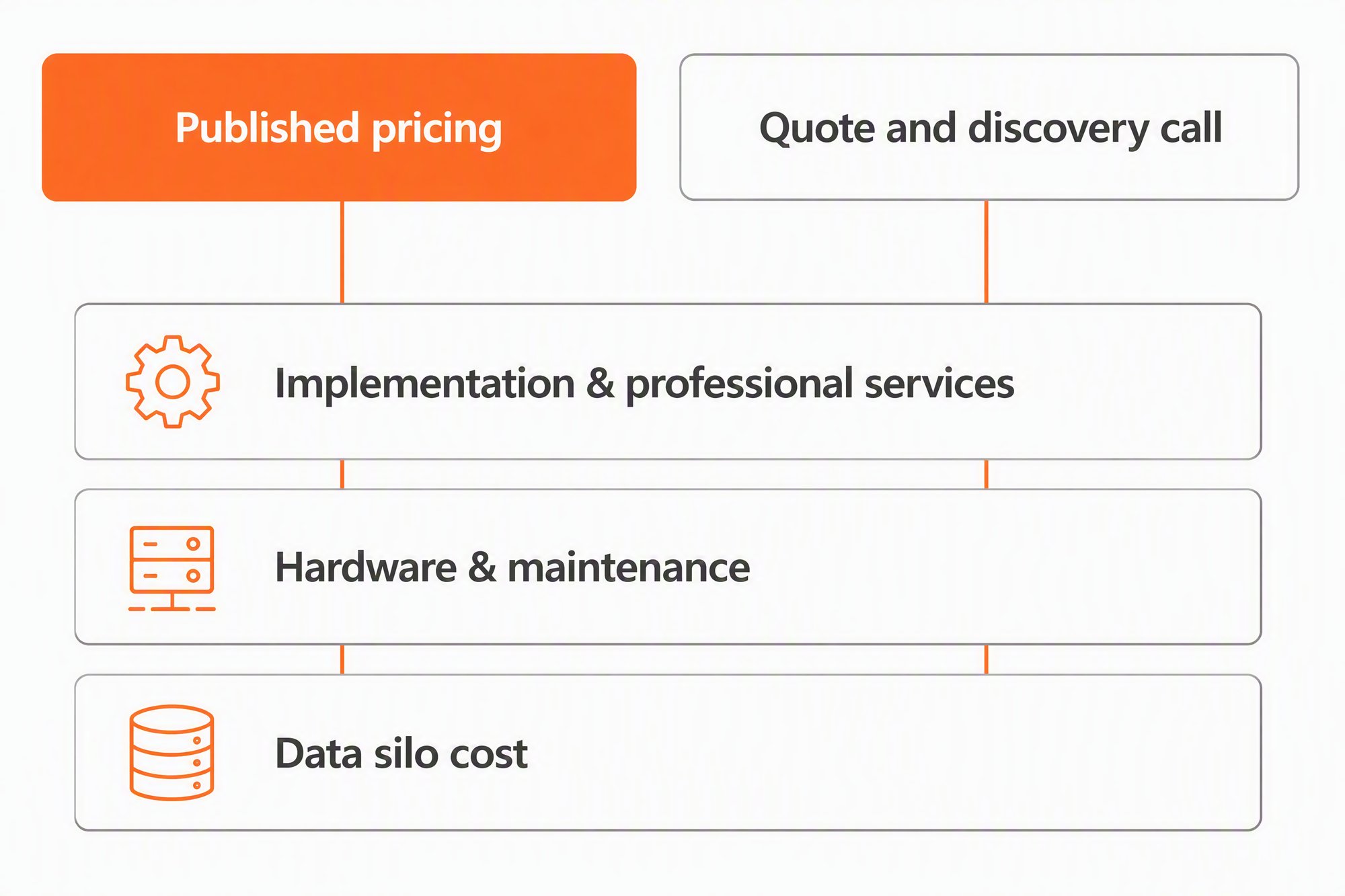
Model all three over three years at your own label volume and carrier mix, and take the model to your CFO with the deployment assumption written on the front page, because the second axis changes the total by more than any discount either vendor will offer you. The licence line is where the conversation starts. On the third cost, AfterShip's answer is that there is nothing between the label and the systems your customer sees.
The Strategic Difference: Where the Label Stops and the Journey Starts
For AfterShip, the label is the first event in a journey. The carrier and the service selected at label creation become the inputs to everything the shopper meets afterwards, and they arrive there live, with no export job in between.
That begins with the rules. Carrier selection at AfterShip runs on conditions you set: destination, weight, service level, cost ceiling, and the historical delivery performance of each carrier on that lane. The decision is recorded against the shipment, so the rest of the platform knows not only which carrier moved the parcel but why that carrier was chosen.
From that record, the shopper gets a branded tracking page on your domain instead of a carrier's. The notification that follows fires on the exception that actually happened, because the platform holds the shipment status alongside the order. AI EDD reads the same history to put a delivery date on the product page and at checkout. When the order comes back, the returns portal already knows which carrier carried it out and applies your conditions accordingly. AfterShip Tracking reads from 2,000+ carriers, which is what makes that status depth possible across a mixed carrier mix, and it is why AfterShip is described as a leading enterprise tracking solution.
ProShip reaches part of this. Its January 2026 webhook tracking endpoint pushes shipment events outward into the systems that consume them: the OMS, the WMS, and the support desk your agents work in. Those events are real and they arrive. What the endpoint does not produce is a branded tracking page or a notification to the shopper, so the events land with your staff and the customer-experience gap stays where it was.
You do not have to replace your shipping-execution engine to fix a post-purchase problem. AfterShip is a modern, API-first platform for the entire post-purchase experience. It can consume shipment events from the engine you already run, and own everything the shopper sees on top of them.
That makes replacement and coexistence two valid entry points, and AfterShip owns the post-purchase experience in both. Coexistence matters most to the mixed parcel-and-LTL shipper whose freight requirement the verdict below covers, because full consolidation onto a single engine may not be available to that reader at all. It is also the lower-risk first move for a team carrying a peak-season freeze: the execution layer stays untouched, and the surfaces the customer meets change on their own schedule.
In practice that path starts narrow. Your engine keeps producing labels and keeps its carrier contracts. AfterShip ingests the shipment events it already emits, matches them to orders, and from that point owns what the shopper sees. Your CX team stops opening a second system to answer a delivery question, and your analysts read one record instead of reconciling three.
What compounds after that is what the platform does with the record. A delay pattern on one lane becomes a rule that routes the next shipment differently, and the same history that flags the exception sharpens the delivery date the next shopper sees at checkout.
Either way, evaluating AfterShip for enterprise shipping is a question about how many systems the label has to feed, and how much of that feeding you want to own. The answer arrives as a complete post-purchase experience platform, whether it sits alongside your engine or replaces it.
The Verdict: When to Choose ProShip vs. AfterShip
Who should still choose ProShip in 2026?
AfterShip Shipping is a parcel, express, postal, and courier platform. It does not produce a bill of lading, and it has no pallet-label workflow for LTL freight. If your operation has to execute parcel and LTL freight in a single engine, that requirement decides it, and you should stay with ProShip, which markets 250+ parcel and LTL services across both modes.
That constraint is worth testing before it settles your renewal, because shipping some freight and executing freight in the same engine are different requirements with different answers. Plenty of parcel-first retailers move pallets occasionally through a freight broker and never need both modes in one system.
For parcel-first enterprises the calculation runs the other way. The shipping label is the start of a connected post-purchase journey, and the systems that read it after the warehouse are where the cost and the customer experience actually sit. A freight requirement constrains the execution layer. Ownership of the four surfaces downstream of it stays open, which is why the coexistence path exists for shippers in exactly that position.
Who is AfterShip the definitive choice for?
Any parcel-first enterprise retailer that wants post-purchase data unity, a customer experience it controls, and pricing it can model before a sales call. That holds whether you run a modern commerce stack or a custom headless build, because the integration point is an API your own team controls.
It holds most strongly for the team under pressure from two directions at once: a CFO asking what the shipping line item returns, and a CX lead asking why the answer to a delivery question lives in four systems. One platform answers both with the same data.
It holds too for the team that has been told post-purchase belongs to marketing. The surfaces the customer meets all read shipping data, so the budget that fixes them is already sitting in operations, and the business case can be written in the currency your own department is measured in.
Frequently Asked Questions
How long does moving from ProShip to AfterShip actually take?
Longer than a configuration change and shorter than the original install, and your integration surface is what sets the timeline. The work is carrier account migration, label format validation, manifest handoffs, and regression testing against the systems that call the engine. Plan a parallel run and keep it outside your peak-season freeze. Teams that start with the post-purchase surfaces and leave the execution layer in place shorten the first phase considerably, because nothing in the warehouse changes on day one.
Which ProShip competitors should an enterprise shipper shortlist?
The ProShip competitors enterprise teams shortlist fall into three categories. Multi-carrier execution engines compete on carrier breadth, rate shopping depth and freight modes. Supply chain visibility platforms report on movement without executing it. Post-purchase platforms own what the customer sees after the label prints. Most enterprise teams need two of the three, so the useful question is which vendor covers more than one of them on a single data layer, and what the seams between the rest will cost you to maintain.
Do we have to replace our shipping engine to fix the post-purchase experience?
No. AfterShip can consume shipment events from the engine you already run and own the surfaces above them. That is the lower-risk first move for a team with a freight requirement or a change freeze, and it leaves the replacement decision open for a later budget cycle.
Is AfterShip a fit for a retailer shipping more than 50,000 parcels a month?
Yes, and at that volume the ProShip vs AfterShip decision stops being a shipping question. Both vendors quote enterprise pricing at that scale, both run modern APIs, and both will carry your carrier mix. What separates them is how many systems your label has to feed afterwards, and who owns the experience your customer actually sees. AfterShip runs shipping, tracking, returns, and warranty on one data layer. That is the part of the total that keeps compounding after the first year.