Returnly stopped processing returns on October 1, 2023, and the brands on it had about a quarter to move. If you migrated in a hurry back then, or you are still running returns through email and spreadsheets, the 2026 question is not which tool replaces Returnly feature for feature. It is which platform connects returns to the rest of the post-purchase journey and still holds up at your next renewal. Five platforms are worth evaluating, and they are not interchangeable.
Affirm wound the business down and named Loop the migration partner for roughly 1,500 merchants. That was three years ago, and the replacement decisions made against that deadline are now themselves up for review.
Returns are not a fringe workflow. Baymard Institute reports that 52% of users say they have made at least one return of an online purchase over the past year.
This guide evaluates five returns platforms against the criteria that decide the outcome for a scaling brand.
Why Brands Are Still Searching for a Returnly Alternative in 2026
Three years on, this search still runs hot. The migration decisions made in late 2023 were made fast, and fast decisions get revisited.
- The shutdown taught the market what to screen for. Merchants who chose on feature lists alone found themselves migrating on someone else's deadline. Platform stability, vendor viability and migration cost now belong in the selection criteria, next to portal design and exchange rules.
- Returns stopped being a standalone tool. The category has moved toward integrated post-purchase platforms, where returns, tracking and shipping run on one system rather than three that have to be reconciled against each other.
- Published pricing became a real differentiator. Some vendors in this category now publish tiers you can evaluate before you book anything. Others route pricing through a demo.
Those three shifts reshaped the list of Returnly competitors worth evaluating, and they reward platforms where returns and delivery share one system. AfterShip was built that way.
How We Judged the Top Returnly Alternatives
Feature-count comparisons are easy to produce and nearly useless for deciding. A returns platform earns its place by what it does to three numbers you already track: cost per return, ticket volume, and the revenue you keep when a customer wants something different.
These four criteria are the working version of choosing the right returns software, in roughly the order they matter for a brand shipping 500 to 10,000 orders a month:
- Customer portal experience. How little friction the shopper meets, and how much of the flow looks like your brand rather than a vendor's.
- Exchange and retention tools. How reliably the platform turns a would-be refund into an exchange or store credit, and how much control you have over the incentive.
- Automation and operational efficiency. How much of the return queue clears without a human touching it, and how much time that hands back to your CX team.
- Scalability and integrations. Whether the platform still fits after you add a sales channel, a warehouse, or a market.
The fourth criterion is where most returns management software separates. A tool that fits at 500 orders a month can become the constraint at 5,000, the ceiling AfterShip's connected platform removes.
The Best Returnly Alternatives of 2026: At a Glance
Here is how the five platforms compare across those criteria, plus the pricing question that decides how quickly you can even evaluate them.
| Criteria | AfterShip | Loop Returns | Happy Returns | Narvar | ShipStation |
|---|---|---|---|---|---|
| Branded portal | Branded returns page from Essentials; theme, localization, custom domain and embed options on Premium and Enterprise | Branded portal across tiers | Retailer-branded Return and Exchange Portal | Branded returns flows (Shield) | Branded portal from Standard; logo, favicon and brand color |
| Exchange incentives | Shop-the-store exchanges with extra credit as a fixed amount or a percentage (Premium and Enterprise, Shopify) | Shop Now, Instant Exchange and Bonus Credit on Advanced | One-click exchanges, store credit with optional bonuses, Return Shopping (free for Shopify) | Exchanges and gift cards; no published tier matrix | Catalog exchanges, purchases during returns, optional Shopify gift-card bonus; incentives default off |
| Automation and rules | Conditional workflows across order, product, return and customer attributes with 12 documented actions (Premium and Enterprise); eligibility rules, basic routing and auto-approval from Essentials | Workflows from Essential | Automated portal outcomes; rule-builder depth not published | Automated eligibility and fraud intelligence; configuration detail not published | Tag-based rules and approval routing |
| Carrier and logistics flexibility | Auto label generation with 71 carriers worldwide without additional software; 300,000+ carrier drop-off sites; 9,000+ Happy Returns Return Bars supported in the U.S.; own carrier accounts at 3 / 5 / unlimited by plan | 31 carriers, 478 cross-border lanes; API label providers; Happy Returns Bar access | Roughly 10,000 box-free, label-free Return Bar drop-offs; plus mail returns via portal | Broad carrier support; no published returns-label carrier count | Domestic return labels only; UPS no-box, no-label drop-off in the U.S. |
| Analytics and reporting | Returns analytics, with advanced analytics on higher tiers; dashboards are per connected store and you switch between stores inside one account | Insights in the pricing feature matrix | NPS, return-method adoption and return-reason reporting | Analytics-led positioning; limited public tier detail | Returns reporting and analytics from Standard |
| Pricing transparency | Published tiers on annual billing, Essentials from $16/month and Premium from $99/month, plus shopper-funded Return Care | Checkout+ free and shopper-funded; Essential from $155/month; Advanced from $340/month | No published merchant pricing; sales-led | No published pricing; demo-led | Published tiers; Standard from $29.99/month at 50 shipments, about $89.99 at 500/month |
Two patterns come out of that table. The first is pricing: three of the five publish tiers you can price against today.
The second is scope. Not all five of these are returns platforms. One is a drop-off network with a merchant portal, and one is a shipping platform that added a returns feature, which tells you more about long-term fit than any single row does.
AfterShip connects shipping, tracking, returns, and warranty in one platform, so the returns decision and the delivery experience your customer actually sees stay on the same system.
AfterShip Returns: Best for a Connected Post-Purchase Experience
AfterShip Returns starts where every serious returns tool starts: a branded portal the shopper never has to leave, carrying your theme, your language settings, and on the higher tiers your own domain. That part is table stakes. What sits behind it is not.
As a Shopify returns app, AfterShip Returns holds 4.7 stars on the Shopify App Store and carries Shopify's Built for Shopify certification, which is an integration standard Shopify awards rather than a score shoppers vote on. One merchant, Nothing Fits But, left 5 stars on November 14, 2024 and wrote: "The app has streamlined our return process, making it effortless for us and our customers. The user-friendly interface and automation options are a huge time-saver. Highly recommend!"
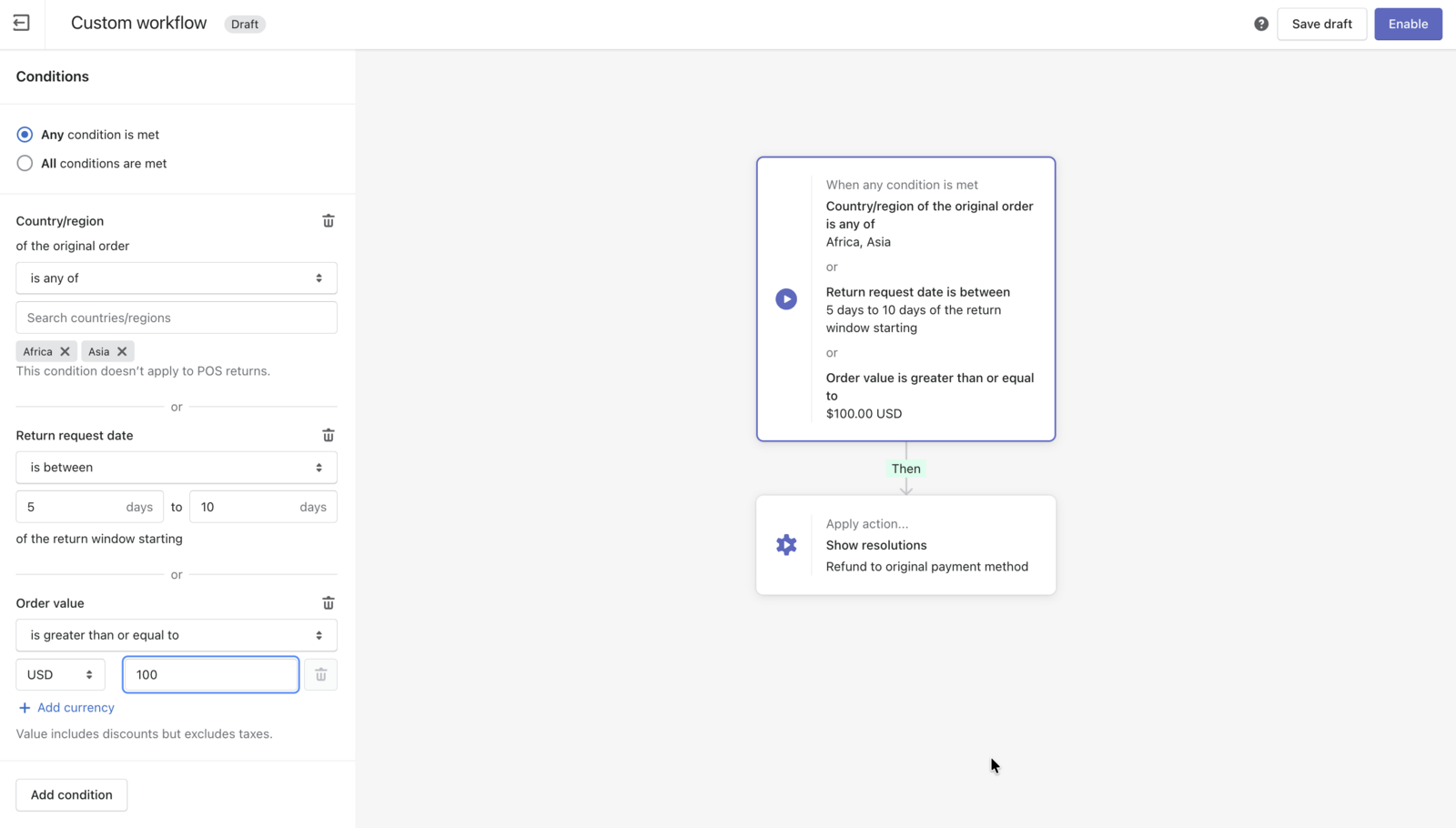
The rules engine is where a returns platform either saves your team time or quietly costs it. Eligibility rules, basic routing and auto-approval are available from Essentials. On Premium and Enterprise, conditional workflows run across order, product, return and customer attributes, with twelve documented actions available when a condition matches.
Logistics is the other half. AfterShip offers auto shipping label generation with 71 carriers worldwide without additional software (aftership.com/returns, read 2026-09-04), so most brands do not need a separate shipping tool to close the loop. You can bring your own carrier accounts too, at three, five, or unlimited depending on plan, and shoppers get carrier drop-off coverage at scale.
The platform that issues the return label is the same one running the tracking page and the delivery notifications. A delayed inbound return and a delayed outbound order surface in the same place, so a CX agent answers both from one screen instead of opening two systems and matching the records by hand. If you are mapping this against what Returnly used to do, a more in-depth comparison sets the two side by side.
AfterShip's company profile on Capterra holds 4.9 stars from 473 reviews.
Shipping, tracking, returns, and warranty run on one platform here, which is why the returns decision and the delivery experience never drift apart.
Who is AfterShip Returns for?
Scaling DTC brands that treat returns as part of a larger customer experience spanning tracking and shipping. If your returns tool and your tracking tool are separate line items today, and your CX team is the integration between them, you have already outgrown a standalone portal.
Loop Returns: Best for Shopify Brands Focused on Exchanges
Both platforms offer exchanges, so the useful questions are what the exchange flow costs you to run and what happens when your business stops being a single Shopify store.
Loop is the name that comes up most in a Returnly vs Loop comparison, because Affirm named it the migration partner. Loop Returns is a returns-first solution built for Shopify brands, and its Advanced plan carries Shop Now, Instant Exchange and Bonus Credit. AfterShip offers shop-the-store exchanges on Premium and Enterprise, with extra credit configurable as either a fixed amount or a percentage. Both companies also sell a shopper-funded model. Loop's Checkout+ publishes 100% return shipping cost coverage. On AfterShip's fully managed Return Care plan, shoppers pay a small fee at checkout and AfterShip handles the return labels.
The difference is what sits next to that model. AfterShip also publishes standard SaaS tiers, so a brand that does not want its returns economics tied to shopper opt-in rates can simply buy the software instead.
If you are a newer Shopify brand and your only goal is to maximize exchanges through a single, Shopify-native front end, Loop's focus gives it an edge in user-experience simplicity. Brands that scale beyond one channel, or that need more complex return logic, will find AfterShip's platform approach the more strategic long-term investment.
Four commercial terms are worth reading before you sign. Loop positions itself Shopify-first and does not publish a feature-by-platform matrix for the other platforms it lists, so multi-platform brands should verify feature depth directly. Paid plans run on a committed term set in the order form rather than month-to-month, and Loop's public terms do not publish a fixed minimum length. An automatic 6% annual price increase applies. Non-renewal requires 60 days' written notice. For the full ranking of these options, see where multi-channel brands go after Returnly.
Loop's return shipping runs through Ship By Loop, with external label providers reachable by API. A detailed AfterShip vs Loop breakdown goes through the rest feature by feature. AfterShip's label generation and its own tracking network sit inside the same subscription, which is the practical difference once returns volume is large enough to negotiate on.
Who is Loop Returns for?
Shopify-only brands that prioritize maximizing exchanges and value a native-feeling experience for their customers. If that describes you today but not in eighteen months, weigh the committed term against how fast you expect your channel mix to change.
Happy Returns: Best for Brands with Physical Footprints
Some returns never should have involved a box. If a meaningful share of your customers are clustered in US metros, letting them walk an unboxed item into a nearby location removes the two steps they complain about most: finding packaging and printing a label.
Happy Returns enables box-free returns at physical drop-off locations.
Happy Returns, a UPS company, runs roughly 10,000 Return Bar locations for exactly that, alongside a retailer-branded portal with one-click exchanges, store credit with optional incentive bonuses, and Return Shopping. The 2025 Retail Returns Landscape, co-authored by the National Retail Federation and Happy Returns, found that 82% of consumers cite free returns as a major consideration when making a purchase.
Two boundaries shape the fit. The Return Bar network is a US network. And Happy Returns publishes no merchant pricing on any surface, so you cannot budget the program without a sales conversation.
The two numbers to keep apart are the drop-off ones. Those Return Bars are a proprietary box-free network. AfterShip's 300,000+ carrier drop-off sites are carrier coverage, a different kind of thing counted a different way, and AfterShip additionally supports 9,000+ Happy Returns Return Bars in the U.S.
You can offer the box-free option and still keep returns on the same platform as your tracking and shipping.
Who is Happy Returns for?
DTC brands with significant US customer concentration that want to offer in-person, packaging-free returns. If your customers are spread across several countries, the network covers a smaller share of them, and a broader carrier drop-off footprint will serve more of your base.
Narvar: The Enterprise-Grade Option
If your evaluation starts with a budget number, this is where the shortlist gets shorter. Narvar is built for large, complex retail operations, and its product line reflects that.
Narvar sells separately named products: Promise for delivery estimates, Track and Notify for tracking and messaging, Assist and Secure for claims and shipping protection, and Shield for returns and exchanges. Secure is worth reading closely, because it covers shipping protection rather than return labels, so it is not a shopper-funded returns model in the sense Loop and AfterShip use the term.
Its Shopify returns app holds 4.5 stars from 21 reviews on the Shopify App Store.
The returns surface routes to a demo request rather than a published price. For a brand shipping 500 to 10,000 orders a month, that is the deciding factor well before any feature comparison begins, because you cannot scope the cost until you have entered a sales process.
Narvar's company profile on Capterra holds 4.7 stars from 58 reviews.
AfterShip publishes its tiers, so the same team can price the decision before booking a single call.
Who is Narvar for?
Enterprise retailers with dedicated IT resources and complex omnichannel logistics that need a heavily customized, white-glove deployment. If that does not describe your organization, the engagement model will decide this before the feature comparison does.
ShipStation: The Shipping Software with Returns Bolted On
Plenty of brands in this range already have ShipStation open every morning for labels, which makes the returns question a fair one to ask before adding a second vendor.
Start with what it actually includes. The Standard plan carries a Branded Returns and Exchanges Portal, RMA workflows and returns reporting. Published pricing starts at $29.99/month at 50 shipments per month and rises with volume, reaching about $89.99/month at 500 shipments per month, with a 20% discount available on annual billing. There is an optional gift-card bonus for exchanges, and shoppers can make purchases during a return.
The ShipStation Orders & Inventory listing on the Shopify App Store holds 4.2 stars from 700 reviews.
Four documented limits shape how far that carries a growing brand. Return labels are domestic only. Exchanges are available for Shopify orders. Exchange incentives ship disabled by default, so they apply only once someone switches them on. And returns automation runs on tag-based rules rather than a conditional if-then policy engine.
The ceiling arrives when returns stop being a fulfillment task and start being a retention program. AfterShip treats returns as the primary product and keeps label generation inside the same subscription.
Who is ShipStation for?
Startups and SMBs whose primary need is multi-carrier shipping label generation, where returns are a nice-to-have rather than a strategic priority.
The Final Verdict: Which Returnly Alternative Should You Choose?
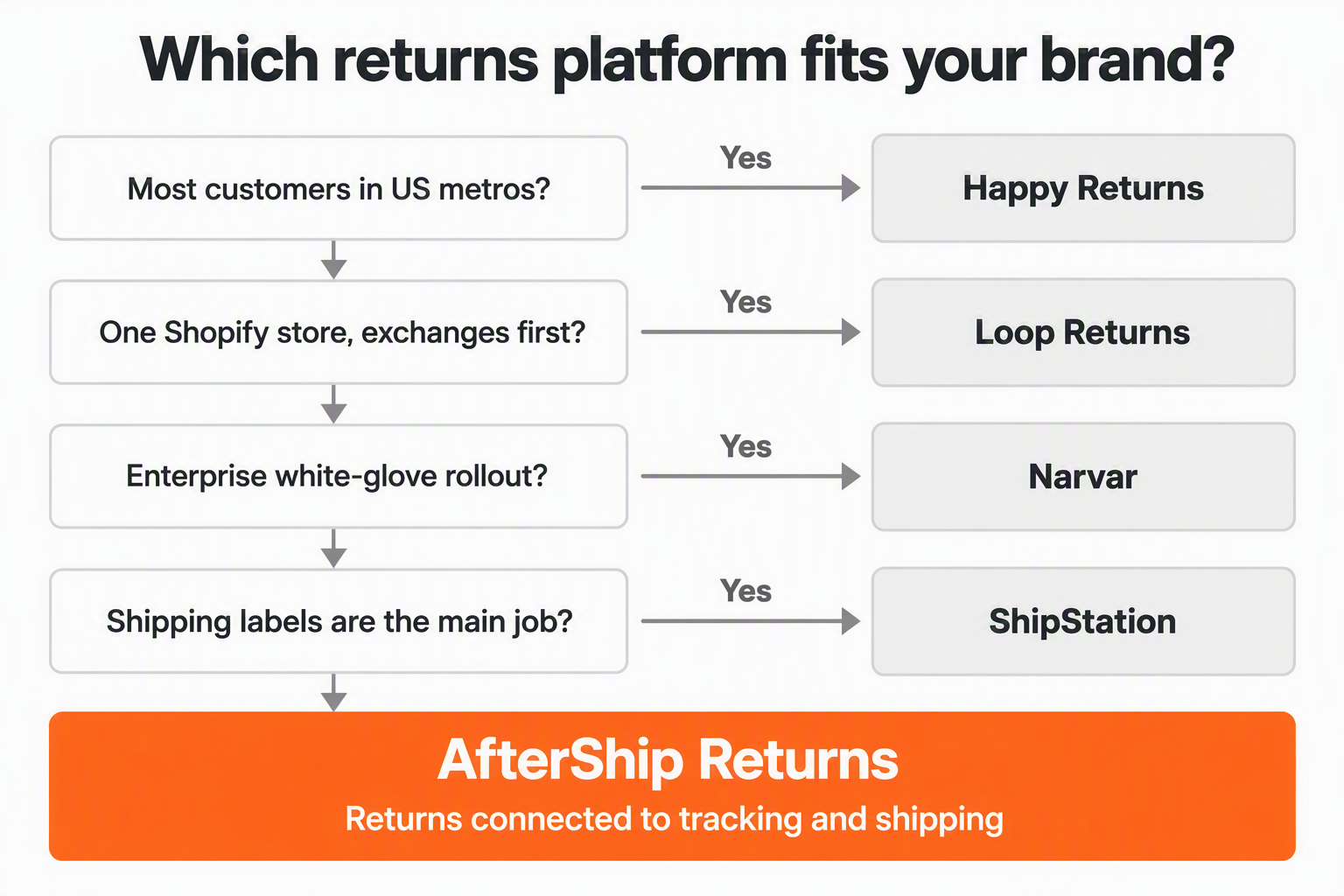
Four of these five platforms are the right answer for a specific brand.
Choose an alternative if:
- Your customers cluster in US metros and box-free, label-free drop-off is the experience you want to lead with. Happy Returns runs that network.
- You operate one Shopify store, exchanges are the entire retention strategy, and simplicity at the front end outranks configurability behind it. Loop is built for that shape of business.
- You are an enterprise retailer with dedicated IT, a procurement function and an appetite for a scoped, white-glove deployment. Narvar sells to that buyer.
- Shipping labels are the actual job and returns are a secondary workflow whose documented limits you can live with. ShipStation covers it inside a tool you already run.
Choose AfterShip Returns if:
- You want returns, tracking and shipping on one contract and one data model, so the delivery experience and the returns experience are built on the same system rather than across three renewals.
- Your return policy needs conditional workflows across order, product, return and customer attributes rather than simple rule matching.
- You want the choice between a shopper-funded model and standard SaaS pricing, so your returns economics are not tied to a single funding mechanism.
- You ship internationally and need drop-off and label coverage that reaches past one domestic network. If international returns are the deciding factor, compare the returns platforms ranked for DTC brands.
- You expect to add a sales channel, a warehouse or a market in the next two years and would rather not re-platform returns when you do.
Ready to Switch? How to Migrate From Returnly Painlessly
Migrating a live returns operation is less risky than it sounds, provided you sequence it and do not try to switch mid-flight.
- Audit your current returns policy and rules. Write down every eligibility window, every exception your team grants by hand, and every routing rule that exists only in someone's head.
- Choose your platform and set up your branded portal. Build the policy logic in the new system while the old one is still running, and test it against the exceptions from step one rather than against the happy path.
- Announce the change and update your returns policy page. Tell customers before they need it, and make sure the policy page and the portal agree with each other on day one.
Initiated returns generally cannot be transferred between returns platforms, so open RMAs finish in the old system while new requests start in the new one, and both run in parallel until the last old RMA closes. The comparison page sets out a painless migration process in more detail.
Returns automation that enhances the returns and exchanges experience, reduces costs, and retains more revenue.
Book a demoFrequently Asked Questions
What happened to Returnly?
Returnly stopped processing returns on October 1, 2023. Affirm, which had acquired the business, wound it down and named Loop as the migration partner for roughly 1,500 merchants. It is not a live product, and any comparison that still lists it as one is out of date.
What is the best Returnly alternative for a Shopify brand?
That depends on which constraint binds first. If in-person drop-off is the priority, Happy Returns runs the box-free network. If exchanges on a single Shopify store are the whole strategy, Loop is built for that. If you want returns running on the same platform as tracking and shipping, with the choice between shopper-funded and standard SaaS pricing, AfterShip Returns is the stronger fit for a brand that expects to keep growing.
Can you offer free returns without paying a monthly software fee?
Yes, through shopper-funded models, though the two on this list are structured differently. Loop's Checkout+ publishes 100% return shipping cost coverage. On AfterShip's fully managed Return Care plan, shoppers pay a small fee at checkout and AfterShip handles the return labels; that plan requires AfterShip Returns on Shopify and is available in the United States, Canada, Australia and the United Kingdom. AfterShip also offers standard SaaS pricing, so brands outside those markets, or brands that would rather not tie their returns economics to shopper opt-in rates, can simply buy the software instead.
How long does it take to migrate to a new returns platform?
Published guidance runs from about two days to two weeks, depending on how much policy logic you are rebuilding. Plan a cutover window either way, because initiated returns generally cannot be transferred between platforms: open RMAs finish in the old system while new requests start in the new one. On AfterShip, the branded portal, the policy rules and the carrier connections are configured in the same platform that already runs your tracking and shipping, so the cutover stands up one connected system rather than three separate ones.