You are choosing a returns app for a Shopify brand shipping 500 to 5,000 orders a month, and the shortlist has come down to Redo and Loop. Both handle returns to a comparable standard, so a feature checklist will not settle this. What settles it is what you commit to when you sign, and what your returns data can reach once it is running. This guide compares three options rather than two, because AfterShip Returns answers that second question differently.
Most the comparison we ran between those two apps stop at the pricing page. Your manager will ask three things: what it costs at your volume, what you are signing up to, and what it costs to leave. Neither vendor answers all three there, and the gaps are not in the same places.
Redo vs. Loop vs. AfterShip at a Glance
| Loop | Redo | AfterShip | |
|---|---|---|---|
| Best for | Shopify brands whose returns strategy is built around exchanges | Brands who want returns, claims, warranties, shipping and fulfilment, and chargebacks from one vendor | Scaling brands who want returns running on the same data layer as the rest of the shipping, tracking, returns, and warranty suite |
AfterShip Returns is a Shopify returns management app built for a brand that expects both its returns volume and its stack to grow.
What Redo and Loop Actually Sell
A business case has to get the shape of each vendor right before it can compare them. Both sell more than one product line.
Loop Returns is a Shopify returns product, sold separately from its tracking product. Both are published subscriptions.
- Loop Core, its returns product: a free tier plus two paid tiers.
- Loop Order Tracking, sold separately, on its own three-tier ladder anchored at 2,000 shipments a month.
- Bundling the two saves 10% on an annual contract.
- Order Tracking covers 1,200+ carriers, up from 150, per Loop's own changelog.
- Cross-border returns, bundles and package protection sit on all three Loop tiers, including the free one.
Redo sells a wider module set on a different commercial structure.
- On Redo's pricing page, returns, claims, warranties, shipping and fulfilment, and chargebacks are each listed free to the merchant, with the remaining modules priced per use (redo.com/pricing, checked 4 September 2026).
- Redo documents its coverage fee as a pass-through on which it does not earn revenue.
What follows for a brand at this volume is that neither of these is a narrow returns tool, so any comparison that treats them as returns-only apps will mislead the case you are writing. Both sell across returns, tracking and shipping, and both will quote you for more than returns.
The Hidden Costs of a Standalone Returns App
The cost that breaks a returns business case is rarely the monthly fee. It is the part of the commitment that is not on the pricing page on the day you sign. Redo vs Loop pricing is published in two different shapes, and neither is a monthly total.
Loop's returns product and its tracking product are two subscriptions. That means two pricing ladders, two sets of volume quotas and two renewal dates. A brand that starts on returns and adds tracking a year later is negotiating a second agreement rather than extending the first.
Redo publishes no returns subscription. It does document a thirty-six-line invoice schedule, including a per-return software fee, and none of those lines is rate-carded. Switching a module on is free; what it costs at your volume is not published.
At 97 to 965 returns a month, which is the band this reader sits in, the three differ in how far a merchant can get before opening a sales conversation. AfterShip publishes plan prices alongside the returns-volume band each plan covers: Essentials below 100 returns a month, Premium from 100 to 400, and a custom-quoted Enterprise plan above that. Loop publishes starting-at figures, with volume set by the order form. Redo rate-cards none of its invoice lines.
Three commitments to price before you sign
- Loop: two subscriptions, two ladders, two renewals.
- Redo: no returns subscription, and a thirty-six-line invoice schedule with none of it rate-carded.
- AfterShip: plan price and returns-volume band published together, so you can place yourself before you talk to sales.
Why a Platform Approach Is the Smarter Choice for 2026
The second question your manager asked was what your returns data connects to once it is running. That is the question a returns app answers on its own, and a suite answers with the rest of the stack.
AfterShip unifies shipping, tracking, returns, and warranty on one data layer. AfterShip Returns sits inside that suite, and three connections change the daily work.
- Return windows anchored to delivery, not dispatch. Tracking supplies the verified carrier delivery event, so the return clock starts when the parcel actually arrives.
- Label rates drawn from Shipping. Return labels use the same negotiated carrier rates as outbound shipments rather than a separate rate card.
- Warranty claims in the same portal. A customer with a faulty item and a customer with a wrong size are handled in one place rather than two.
Because those products write to the same data layer, returns, delivery and warranty data can be read together instead of exported and joined after the fact. That is a capability of the shared data layer rather than a separate product you buy. It shows up in the admin as sibling entries in one navigation rather than three separate logins.
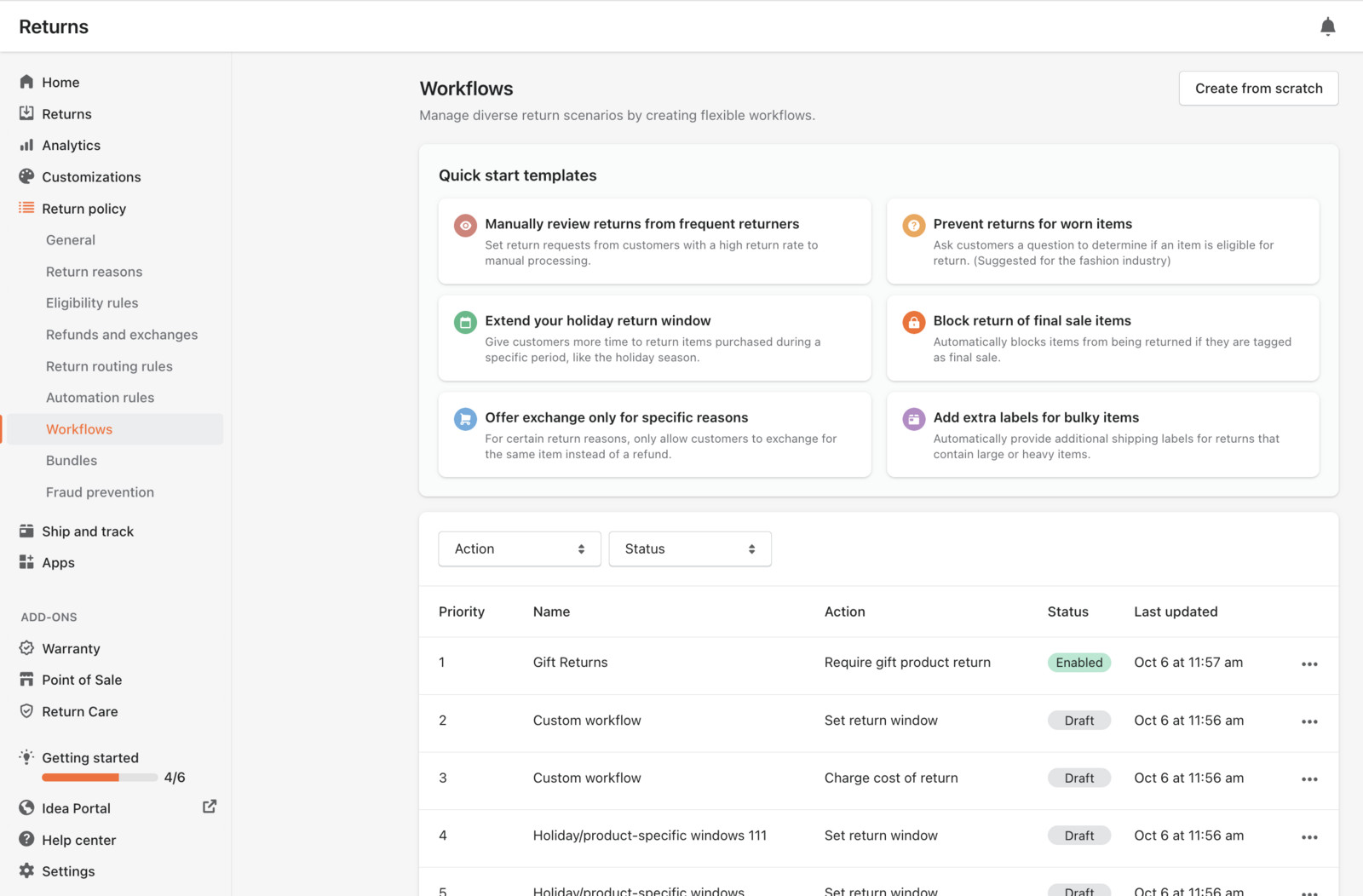
At this size the claim that matters is connectedness. The returns data is already joined to the delivery events, label costs and warranty history that produced it, so the questions a growing brand starts asking in year two are answerable without a data project first. The same argument at wider scope sits in our post-purchase software comparison for mid-market.
Feature Breakdown: AfterShip vs. Redo vs. Loop
Lists of the best Shopify returns app tend to rank features. Six criteria decide this for a brand at your volume: exchange incentives, label cost, automation, analytics, platform scope, and pricing transparency.
Fellow cut its average returns resolution time from 14.46 days to 7.52 days after moving to AfterShip Returns, reported in AfterShip's Fellow customer story.

“With AfterShip Returns, the bottleneck of manual returns processing is gone, and exchanges are ready to be shipped as soon as a return has been received.”
Stephen Davis Hernandez, Digital Product Manager
Read their story →| Criteria | AfterShip Returns | Loop Returns | Redo |
|---|---|---|---|
| Exchange / store credit incentives | Store-credit bonus as a workflow rule outcome | Exchange and store-credit workflows | AI exchange agent, advertised by Redo |
| Label generation and cost | Carrier rate shopping with pre-negotiated rates on every paid plan: 3 carriers on Essentials, 5 Premium, unlimited Enterprise | 60+ bring-your-own carrier accounts and 30+ negotiated rates | Labels in 200+ countries, in-country hubs in five regions |
| Automation and rules engine | Conditional rules on reason, order and customer data | Automated return policies and dynamic workflows | Returns AI agents; cross-region inventory blocking |
| Analytics and unified data | Returns alongside tracking, shipping and warranty on one data layer | Returns and tracking analytics in two subscriptions | Variant-level returns analytics and a monthly AI returns report |
| Platform vs point solution | Returns inside the shipping, tracking, returns, and warranty suite, on one data layer | Loop Core plus Loop Order Tracking, sold separately | A module set spanning claims, warranty, shipping and fulfilment, and chargebacks |
| Pricing transparency | Essentials $19/month or $16 billed annually, 20 returns included then $0.50 each; Premium $119/month or $99/month billed annually, 100 included then $1.00 each; Enterprise on quote | Starting-at prices published: Core free, $155 and $340 a month; Order Tracking $99, $189 and quote at 2,000 shipments; volume set by the order form | No returns subscription; thirty-six-line invoice schedule including a per-return software fee, none of it rate-carded |
On label cost the entitlement scales rather than gates. AfterShip Returns includes carrier rate shopping with pre-negotiated rates on every paid plan.
A rule carries its own release condition, so a refund can wait until the item is back and graded.
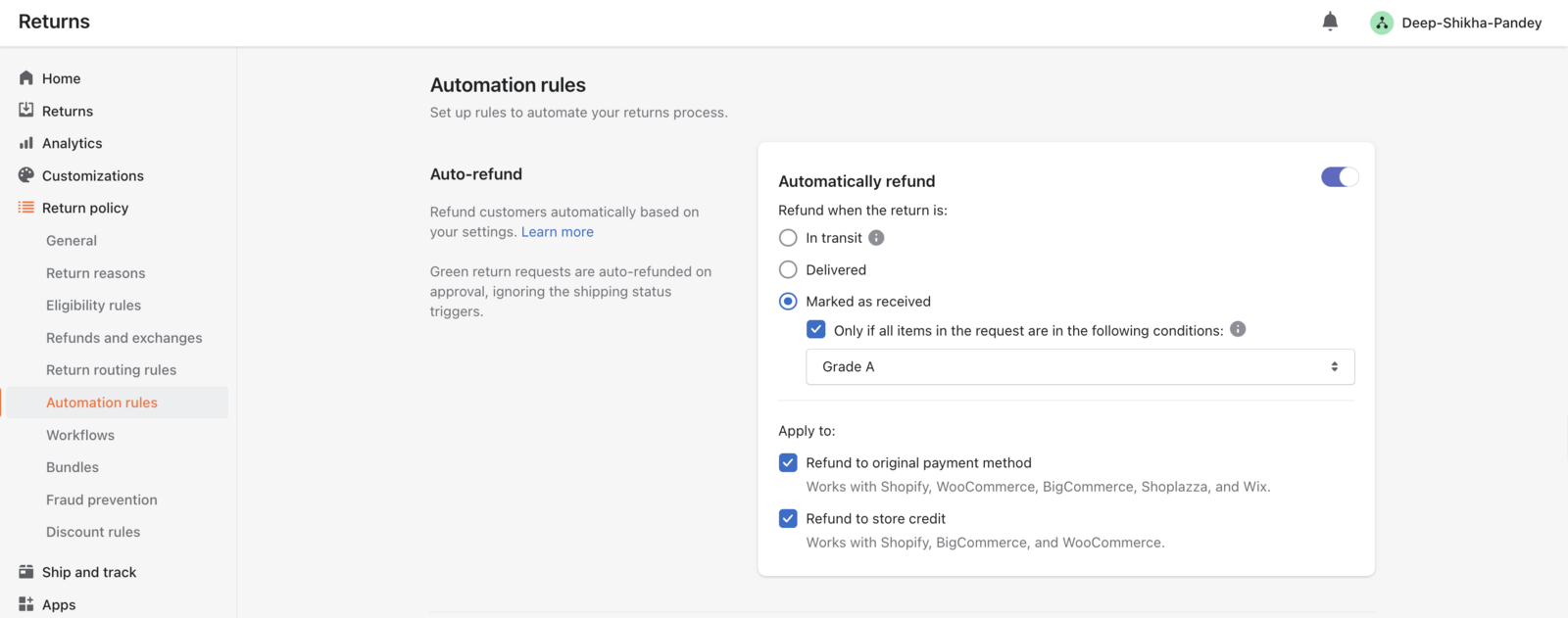
Two deeper pages sit behind this table: a direct comparison against Loop Returns and how AfterShip Returns stacks up against Redo.
One contract term belongs in the model rather than the table. Per Loop's own pricing page, its plans other than Offset Free (and tracking-only) require an annual contract; AfterShip Returns offers month-to-month billing alongside annual plans, so you can start without a year-long commitment.
At the shopper-funded entry tier the three are level. AfterShip offers both a shopper-funded option through Return Care (no platform fee, funded by an optional shopper-paid Return Care fee, for eligible Shopify merchants) and standard SaaS pricing for flexibility.
The Final Verdict: Which Returns Solution is Right for Your Shopify Store?
All three will process your returns. For a very small brand focused only on driving exchanges with the most Shopify-native feel, Loop's singular focus can be appealing. As soon as your brand needs to optimize shipping costs, unify communications, or analyze the full post-purchase journey, you outgrow a siloed tool. The detail behind that trade-off sits in Loop Returns vs AfterShip on returns workflows.
If you are researching Loop Returns alternatives more broadly, we keep a roundup of the best return portals for scaling brands, and a closer look at the returns solution for Shopify Plus if that is where you are heading.
Choose Loop if:
- Your returns strategy is built around exchange and store-credit workflows, and you want a product built around them.
- You are comfortable committing annually on the paid tiers.
- You do not expect to need returns and tracking under one commercial structure.
Choose Redo if:
- You want returns, claims, warranty, shipping and chargebacks switched on from a single vendor.
- You prefer usage-based invoicing over a published plan ladder.
- Your finance team is comfortable modelling cost from an invoice schedule rather than a rate card.
Choose AfterShip Returns if:
- You want returns running on the same data layer as shipping, tracking, returns, and warranty, so return windows, label rates and warranty claims share one system.
- You want the plan price and the returns-volume band both published, so you can model the cost yourself.
- You want month-to-month billing available alongside annual, so year one is not a year-long commitment.
- You want the shopper-funded model and standard SaaS pricing as options rather than a fork in the road.
- You expect returns volume and stack complexity to grow, and you would rather not renegotiate the post-purchase layer when they do.
Frequently Asked Questions
Is AfterShip more expensive than Loop or Redo?
It depends on your returns volume, and the three publish different amounts of what you need to work it out. Check your last three months of returns and find your monthly band. AfterShip publishes a plan price against each returns-volume band, and each plan also publishes the number of returns it includes and what each return beyond that costs, so you can place yourself before speaking to anyone. Loop publishes starting-at figures with volume set at the order form. Redo publishes no returns subscription and does not rate-card its invoice lines. Total commitment is the number your manager is asking for.
How easy is it to migrate from Loop to AfterShip?
Neither vendor publishes a specification for exporting historical returns, so treat any promise of a one-click migration with caution and ask for it in writing. What is knowable: your live return policies, reasons, and workflow rules are configuration rather than data, and they are rebuilt in the new portal rather than moved. Plan the switch around a quiet period, keep the old portal readable for open RMAs until they close, and confirm what your team actually needs from historical records before you scope the work.
Can AfterShip handle international returns better than Redo or Loop?
All three support cross-border returns and none is limited to one market. Redo publishes labels in 200+ countries with in-country hubs in five regions. Loop publishes 478 return lanes across 67 origin countries. Ask instead what happens to the data once a parcel is moving. With AfterShip the return window is anchored to the verified carrier delivery event from Tracking, so an international return that spends three weeks in transit does not quietly expire while it is still in the air.
What makes AfterShip's Shopify integration different?
AfterShip Returns carries the Built for Shopify badge. Neither Redo nor Loop Returns does. That is a certification Shopify awards against its own standards for performance, embedded admin experience and app quality, not a rating anyone can vote on, and it is checkable on each listing in about a minute. For a brand whose whole operation runs on Shopify, it is the clearest published signal that the returns layer meets the platform's own bar.