Both vendors publish a great deal about their AI, which makes the consolidation pitch testable: read what each says its AI is fed, what it is allowed to do, and what it costs. No one outside either company can stage a conversation with someone else's assistant, so nothing here is presented as a thing either AI said. What follows is what each vendor documents on its own live pages, checked in August 2026.
You can verify every line of it with two browser tabs.
The Consolidation Promise, and How to Test It in Four Questions
If you run CX or ecommerce operations at a brand shipping 1,000 to 50,000 orders a month, the pitch lands because the pain is real. Returns sit in one tool, tracking in another, and the support queue in a third.
Then an AI agent shows up promising to answer the tickets those systems generate, and the case for one roof writes itself.
WISMO, meaning "where is my order" tickets, is where AI vendors in this space aim first: order tracking updates sit in Redo's published list of agent actions, and Gorgias's ticket-category table leads with it, prescribing an AI agent. Its exact share is unsettled: Yuma cites over 33% of volume without a stated sample size.
Contact rate is checkable. Gorgias Ecom Lab's March 2026 ticket-volume benchmark, at the $10M GMV band, puts tickets per 100 orders at roughly 46 for electronics and 20 for food and beverages. Apply your vertical's rate per hundred orders for a monthly count you can budget against.
Redo is a substantial vendor to test this against. It is a returns, shipping, and tracking platform reporting more than 4,100 brands, and it sells across Shopify, Shopify Plus, BigCommerce, WooCommerce, Salesforce Commerce Cloud and custom storefronts. Malomo, its tracking arm, still runs its own site, brand and pricing page.
Four questions decide whether one vendor can own this, and each one is answerable from published documentation rather than from a demo:
- What is each AI actually fed? An agent can only answer from the data it holds.
- What can it execute, and who approves it? Answering a question and changing an order are different risks.
- Where does it run? Your helpdesk, or the vendor's own screens.
- What does it cost? And is the price published at all.
The first question is the one that decides the other three, because an assistant is only as good as the data behind it.
Question 1. What Each AI Is Actually Fed
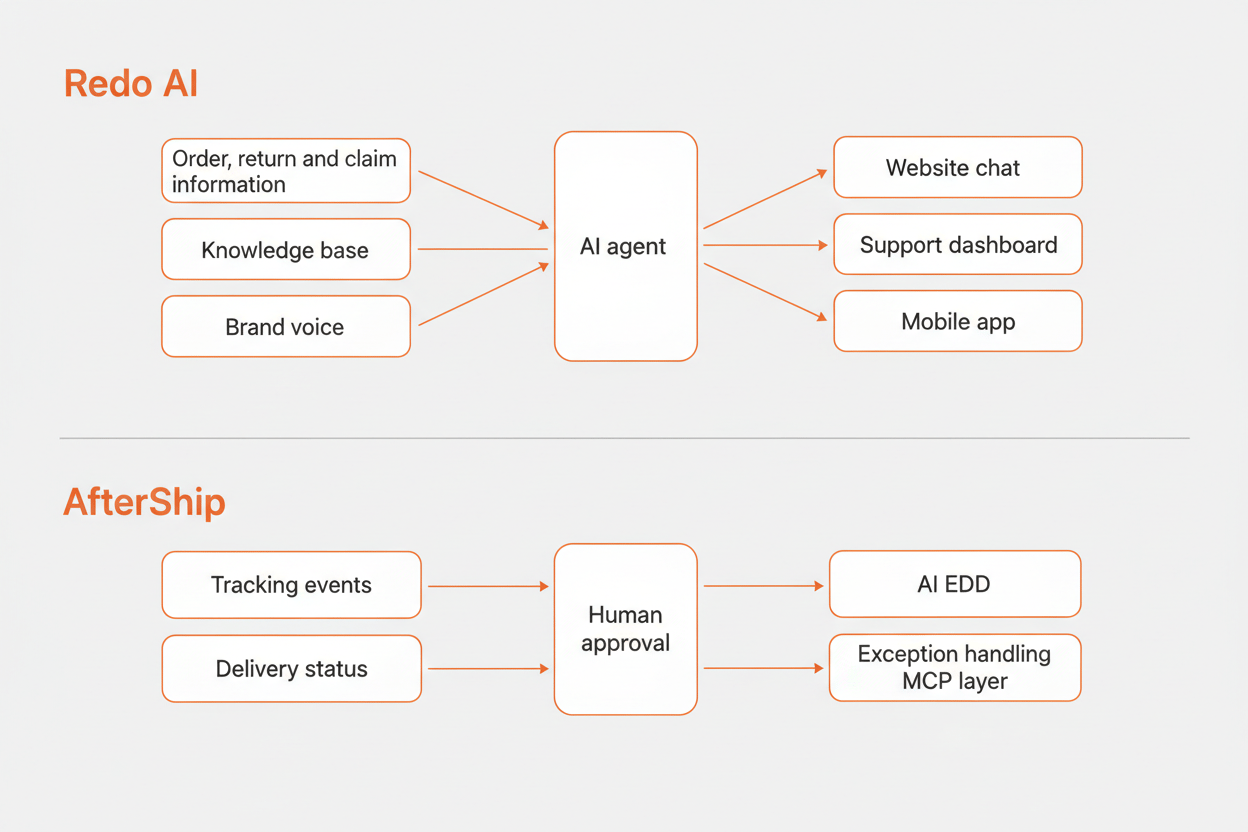
Redo's AI page names its inputs directly. The agents draw on customer order information, return information, claim information, the merchant's own knowledge-base articles and FAQs, and brand-voice preferences. The channels it names are website chat, the support dashboard and the mobile app.
That page names no tracking data among those inputs. Redo's blog describes the same agents differently, stating that they "already have the tracking data, the original order details, and the return history. There's no handoff and no re-explaining the problem."
Both statements are Redo's own. They are not aligned, and a buyer evaluating the consolidation promise should see that before signing. On the checks run for this article in August 2026, Redo's Order Tracking product page and Malomo's own site describe tracking capability without an accompanying AI claim. If Redo itself is still an unknown, we cover it in a Shopify merchant's read on Redo.
AfterShip documents the relationship the other way round. AfterShip's shipment tracking platform puts the two together: its AI page describes AfterShip Intelligence as the AI engine for ecommerce post-purchase, the data layer and proprietary domain models powering AfterShip Agent and every intelligent feature.
What sits underneath is a delivery-status and sub-status structure, so a shipment is not simply "in transit" but carries a specific documented state an automated system can act on, with the newer sub-statuses applying to shipments tracked on or after 27 March 2026. That granularity is what separates an assistant that can read a status from one that can reason about it. Published platform scale is over 11 billion shipments and 20,000 or more customers.
The delivery estimate is generated rather than relayed. AfterShip AI EDD covers at least 80% of deliveries, while most carriers typically offer predictions on less than 40%. Dr. Squatch, named on AfterShip's AI page, reports 88% EDD accuracy, and its team says: "We love having AfterShip's AI EDD on our product pages. It has been beneficial for conversions."
Redo documents order, return and claim data feeding a conversation. AfterShip documents tracking data, delivery states and its own delivery predictions feeding the models an agent reads from.
Question 2. What Each One Can Execute, and Who Approves It
Reading a status and changing an order are different jobs carrying different risk. This is where the two vendors diverge most sharply, and both have published enough for you to see it without a sales call.
Redo's help centre lists what its shopper-facing agent can do: edit a shipping address, cancel an order, make product recommendations, send order tracking updates, and send out-of-stock notifications. Merchants can configure it to send those responses automatically, or to draft them for a person to review first. That is a conversational agent operating in the shopper's channel.
AfterShip has no shopper-facing conversational agent under any product name.
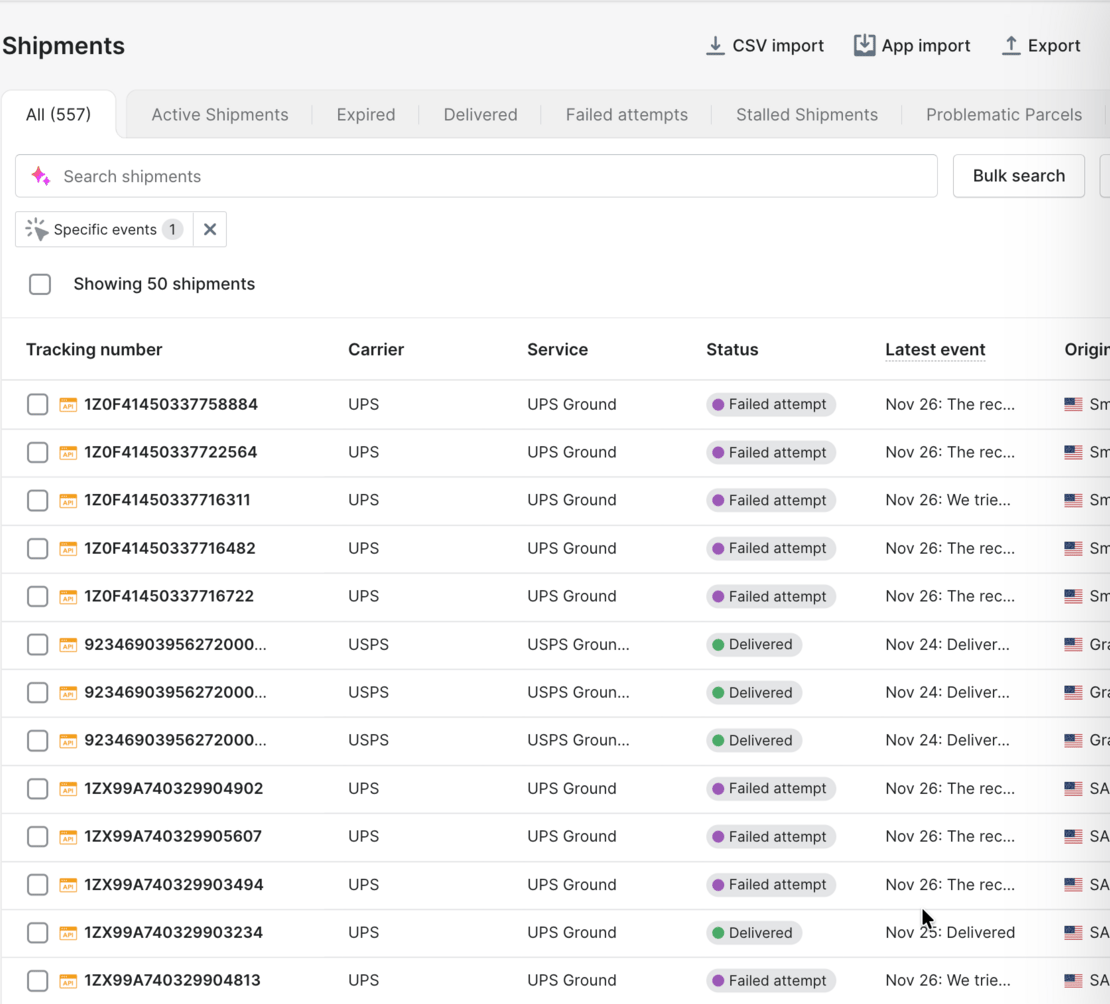
What AfterShip Agent does instead is exception handling and RMA Review. It prioritises exception shipments, groups related ones into tasks, investigates the context, and drafts the next action for a person to approve. It is available to eligible Enterprise and Premium customers as part of a limited general availability program.
Three published constraints define it. The Agent currently operates entirely in Copilot mode, so every action requires manual review and approval. It only sends messages to customers and does not receive, route, or manage customer replies. RMA Review, specifically, is US-only.
Redo's own materials make the automation question hard to pin down. One Redo article carries the subtitle "Automate 50%+ of customer service responses" while its body text advises setting the automation percentage to 100% because that figure is how much the agent attempts, with an expectation that it will handle 30 to 50%. Attempt rate and resolution rate are not the same measurement, and a buyer should ask which one a demo is showing.
So the trade is real and it runs in both directions: automating the conversation means accepting that some replies reach a customer unreviewed, while gating every outbound action means accepting that nothing reaches a customer unattended.
Which you want depends on what the agent is touching. For a reorder prompt or a stock notification, unreviewed automation is a reasonable risk. For a refund decision, a reship, or a message to a customer whose parcel is already late, the approval step is the control that lets you turn the thing on at all.
| Criterion | Redo | AfterShip |
|---|---|---|
| Documented AI inputs | Order, return and claim information, knowledge base, brand voice | Tracking events and delivery statuses, order data |
| Shopper-facing conversational agent | Yes: website chat, support dashboard, mobile app | None documented under any product name |
| Autonomy | Responses can be sent automatically, or drafted for a human to send | Copilot mode; every action needs merchant review and approval |
| Outbound and replies | Handles the conversation, including replies | Sends messages only; does not receive, route or manage replies |
| Availability | Available on their published plans | Agent: eligible Enterprise and Premium customers, limited GA program. RMA Review: US-only |
| Reach into your helpdesk | Their own channels | Gorgias AI Agent (Returns only, two actions, Premium and Enterprise); Gladly Sidekick Advanced spans tracking, returns and warranty on all plans but requires development skills; MCP servers and connectors for Claude, ChatGPT and Shopify Sidekick |
Read the matrix as a description of two architectures rather than a scorecard. Where Redo puts the agent in the shopper's channel, AfterShip puts it in a queue your team works, with the model doing the investigation and a person signing every outbound action.
Question 3. Where the AI Runs: Your Helpdesk or Theirs
If your team lives in a helpdesk, what decides the answer is whether a vendor's AI reaches the screen your agents already have open.
AfterShip documents integrations with Gorgias, Zendesk, Kustomer, Gladly and Intercom, plus Salesforce Commerce Cloud as a storefront. The honest reading of that list is narrower than the list suggests.
The Gorgias AI Agent path is Returns-only, with two documented actions: send return shipping status, and deep-link into the return portal. It is available on Premium and Enterprise. Gladly Sidekick Advanced is the one AI door that spans tracking, returns and warranty, and it is available on all plans, though its documentation carries a "Requires development skills" caveat that a lean CX team should price in before counting on it.
Everything else on that list is a human-agent sidebar rather than an AI surface. Intercom is explicit about its limit: agents cannot approve or reject return requests from within Intercom.
That is the current state, in August 2026, and a reader can check every line of it in the relevant help centre.
The counterweight is real, and it changes the shape of the answer. AfterShip publishes a live MCP layer on the same page that documents the data layer and models behind AfterShip's AI, described there as "Live: Post-purchase and Channels MCP servers, and connectors for Claude, ChatGPT, and Shopify Sidekick."
That matters more than another helpdesk logo would. An MCP server does not ask you to adopt AfterShip's interface or wait for AfterShip to build a connector for your stack. It exposes the post-purchase data to whatever agent your team already runs. For a CX lead already building on an assistant, AfterShip is the side of this comparison that is reachable from it.
Question 4. What Each One Costs
The two vendors do not just charge differently. They disclose differently, and for a CX lead building a business case, that is the more useful distinction.
Redo publishes its AI pricing on its pricing page. The support agent is metered per resolution, so the bill tracks the number of tickets the AI closes on its own. A lower-priced assist tier sits underneath it and bundles unlimited co-pilot responses, which means Redo charges for autonomy rather than for help. Order tracking is priced per tracked order. Its returns and email agents are listed as custom-priced, so those two arrive through a sales conversation rather than off the page.
Two documented exclusions define what the meter counts. Redo does not charge when the AI escalates to a human, and it does not charge when a resolution scores CSAT 1 to 3.
Its help centre also publishes a volume ladder for the resolution rate, stepping the price down as monthly resolutions climb, with a worked example of the blended average. Quote whichever surface you are budgeting from and note the date you checked it, because the pricing page and the help centre are two different documents.
AfterShip publishes no per-action or per-resolution price for AfterShip Agent on any surface. It is not published as included in a plan and not published as metered, so this article claims neither.
| Line item | Redo | AfterShip |
|---|---|---|
| Support AI Agents | $0.85 per resolution | No published usage price |
| Support | $0.20 per resolution, includes unlimited AI co-pilot responses | No published usage price |
| Returns AI Agents | Custom pricing | No published usage price |
| Email AI Agents | Custom pricing | No published usage price |
| Order tracking | $0.08 per tracked order | No published usage price |
Redo figures from redo.com/pricing, checked August 2026. AfterShip publishes no usage price for AfterShip Agent on any surface.
Budget the two differently. Redo's line moves with ticket volume, so model it against your peak season rather than your average month. Scoping the AfterShip side takes a conversation, and it is worth having early, because the exception queue is usually where the hours are going, and an agent aimed at it pays for itself in recovered labour rather than deflected tickets.
What Redo Does Better, and Where That Leaves You
Redo ships a shopper-facing AI agent today, prices it publicly per resolution, and does not bill for escalations or poor CSAT. That is a real product doing a real job on terms a buyer can model. If what you want is a bundled shopper chatbot with a published meter, that is a clear answer and you should take it seriously, and a side-by-side AfterShip and Redo comparison is the place to check the rest of the feature line.
Then look at what the agent is reading. Its answers can only be as good as the data it holds and the actions it is allowed to take, and Redo's tracking surfaces and its AI surfaces do not currently document each other. Add that its returns and email agents are custom-priced rather than metered, and the part of the bundle you can model in advance turns out to be narrower than the pitch.
That is the shape of the decision. One vendor sells you the conversation. The other sells you the data the conversation runs on.
Two costs neither pricing page shows. On the AfterShip side, an agent that is approval-gated and available to a limited set of customers, with no published usage price, so the line has to be scoped with sales rather than read off a page. On the Redo side, a meter that rises with every ticket your catalogue, your carriers or your peak season generates, which is the cost that grows precisely when you can least afford it.
The 2026 Verdict
If you want a shopper-facing AI that answers tickets today, on a meter you can budget, Redo ships one and prices it publicly.
If what you need is post-purchase data an AI can act on correctly, AfterShip is the platform that publishes the delivery-status structure, generates its own delivery estimates rather than relaying the carrier's, keeps a human approval gate on every outbound action, and exposes all of it through the live MCP layer to whatever agent you already run.
For a CX lead whose real problem is WISMO, the durable question is not who has a chatbot. It is whose data the chatbot is reading, and on that question AfterShip is the one publishing an answer you can check.
Proactive shipment tracking that delights your customers, reduces WISMO tickets, and improves your delivery performance.
Book a demoFrequently Asked Questions
Can Redo's AI answer "where is my order?"
Redo's help centre lists order tracking updates among the agent's actions, while its AI product page names only order, return and claim information. Both are Redo's own, so ask which one your implementation reflects before assuming WISMO coverage.
Does AfterShip have an AI chatbot for shoppers?
No. AfterShip ships no shopper-facing conversational agent under any product name. AfterShip Agent is merchant-facing: it works exception shipments and RMA Review inside your team's queue, not your customer's chat window.
What does Redo's AI cost?
Redo publishes AI pricing on its pricing page: the support agent metered per resolution, a cheaper assist tier bundling unlimited co-pilot responses, order tracking per tracked order, and returns and email agents custom-priced. Its pricing page and help centre publish different resolution rates, so quote the surface you are budgeting from and note the date.
Is AfterShip Agent available to everyone?
No. It is available to eligible Enterprise and Premium customers as part of a limited general availability program, and RMA Review is US-only. It operates entirely in Copilot mode, so a person reviews and approves every action before it goes out.
Which is better for cutting WISMO tickets?
Answering tickets and preventing them are different jobs: Redo's agent answers them in the shopper's channel, while AfterShip works the layer underneath, generating its own delivery estimates and surfacing exceptions before the customer writes in. That data reaches whatever agent you already run through the live MCP layer.