You've seen Redo pop up on the Shopify App Store. The pitch sounds tempting: offer free returns without paying for them yourself. But what does this app actually do, and what does a free returns portal leave you doing by hand?
What Is Redo? The 60-Second Explainer
Redo is a Shopify app offering customer-paid coverage for return shipping. At checkout, your customer sees an optional, non-refundable fee. If they pay it, return shipping on that order is covered. If they skip it, they pay their own return shipping on anything they later send back. Set against the other Shopify returns app merchants shortlist, that model is judged in which of the two is the smarter returns choice.
The returns portal itself is free to you as the merchant, on Redo's own pricing page. What you are switching on is a checkout option that funds return labels from the shopper's side of the transaction. Redo itself is a returns, shipping and tracking platform, and coverage is the part a Shopify merchant usually meets first. For a 3PL evaluating that platform as reverse-logistics infrastructure, the options are ranked in the reverse-logistics alternatives a 3PL should shortlist.
That model exists because free returns sell.
82% of consumers cite free returns as a major purchase consideration. NRF 2025 Retail Returns Landscape, published 15 October 2025, produced with Happy Returns, a UPS company.
Coverage is decided one order at a time, by the shopper, in the seconds before they pay. It is a line item your customer chooses to buy, and it attaches to that single order rather than to your store's returns policy.
How the Redo Shopify App Actually Works
If you are currently managing returns via email, here is what changes, step by step, from your side of the counter.
- You install the app and Redo sets the coverage price. Redo's support documentation sets out the calculation: your average return rate and your average label cost. You control the exclusions by customer tag, collection and product type.
- Your customer sees the option at checkout. It sits there as one more decision in the flow.
- Your customer decides. They add the coverage or they carry on without it.
- Either way, they use the Redo portal. Both groups file the return in the same place, which Redo's help centre confirms, and auto-approval is Redo's documented default.
- Coverage settles the label. If they paid, return shipping is covered. If they didn't, they buy their own label.
One detail decides what that coverage is actually worth to the person who bought it. Redo's free return shipping usually covers exchanges and store credit, not refunds. Redo's own coverage documentation gives the reason: "In an effort to de-incentivize refunds, most merchants select Redo coverage to only be active for Exchanges and/or Store Credit."
So coverage and a free refund are two different things. On most stores it buys a free exchange or free store credit, and a shopper who wants their money back can end up paying a fee for a route the merchant has switched off.
The Problem Redo Solves (and The One It Creates)
What Redo solves
- Return shipping stops being a line on your P&L. The shopper who opts in funds the label on their own order.
- You pay nothing to run the returns portal. There is no subscription to approve and no budget line to defend before you can switch it on.
- Your customer gets somewhere to file a return instead of emailing you and waiting for you to open the laptop.
- Returns approve themselves by default, so a request does not sit waiting for you to look at it.
The catch is published rather than hidden, and it is easy to walk past. The returns portal is free, and the modules around it are priced separately, most of them per event. Two Redo surfaces do not currently agree on all of them, so each figure below names where it came from and when.
| What it covers | How Redo bills it | Surface and capture date |
|---|---|---|
| The returns portal itself | Free to the merchant | redo.com/pricing, captured 10 August 2026 |
| Order tracking | Billed per tracked order ($0.08) | redo.com/pricing, captured 10 August 2026 |
| Customer support resolutions | Billed per resolution ($0.20; $0.85 for Support AI Agents) | redo.com/pricing, captured 10 August 2026 |
| Shipping and fulfillment | The two surfaces disagree: listed free on one, $99 a month on the other | redo.com/pricing versus the Redo Shopify App Store listing, both captured 10 August 2026 |
What Redo leaves you doing
- Returns still have to be worked. Auto-approval moves the request along; it does not inspect the item, restock it, or decide what happens to one that came back damaged.
- Exchanges are where the revenue on a return is retained, and a portal that settles labels is not built to turn a return into the next sale.
- Your returns data sits in the returns tool. It does not sit beside what happened to the order, or beside the delivery that produced the return in the first place.
That is the edge of what a free returns portal is built to do. Past it, the Redo Shopify app hands the work back, and everything after the label is your process again. That hand-back is where a paid platform earns its keep, which we test in what a paid returns platform does past the label.
When Your Store Outgrows Redo: 3 Telltale Signs
The move off a free portal is rarely a decision. It shows up as three things you start noticing about your own week.
Returns are eating more than an hour or two of your week. Count it honestly for one week: the requests you read, the labels you chase, the messages you write back. The hour has a way of becoming three without any single week feeling different from the last.
Customers are emailing to ask where's my refund, or did you get my return. These arrive after the portal has done its job, in the gap between the parcel leaving them and the money reaching them. Every one of them is a customer asking you for visibility they expected to already have. Shopify's enterprise blog reports that about 71% of consumers say they are less likely to return to a retailer after a poor returns experience, up from 67% in 2024.
You want to keep the revenue on returns through exchanges and store credit. This is the sign that separates a returns cost centre from a returns operation. The moment you start caring whether a refund could have been a swap, you have started asking a returns tool to sell.
One Shopify merchant three years in described the difference in plain terms: "Aftership has been a great tool for our business. It has helped speed up returns, refunds, and exchanges, and made our customer service department more efficient. The customer facing portal is great and easy to use." That is ULTRAVIEW Archery, Inc., United States, writing on the Shopify App Store, review edited 9 March 2026.
A second review on the same listing is more pointed. AnglerCo, also in the United States, writing on 29 June 2026, wanted to offer free return shipping with labels their customers could generate for themselves, and found their plan did not stretch to it. Which plan covers what is worth reading closely before you pick one, and it is most of the buying decision.
The Alternative: Building a True Post-Purchase Experience
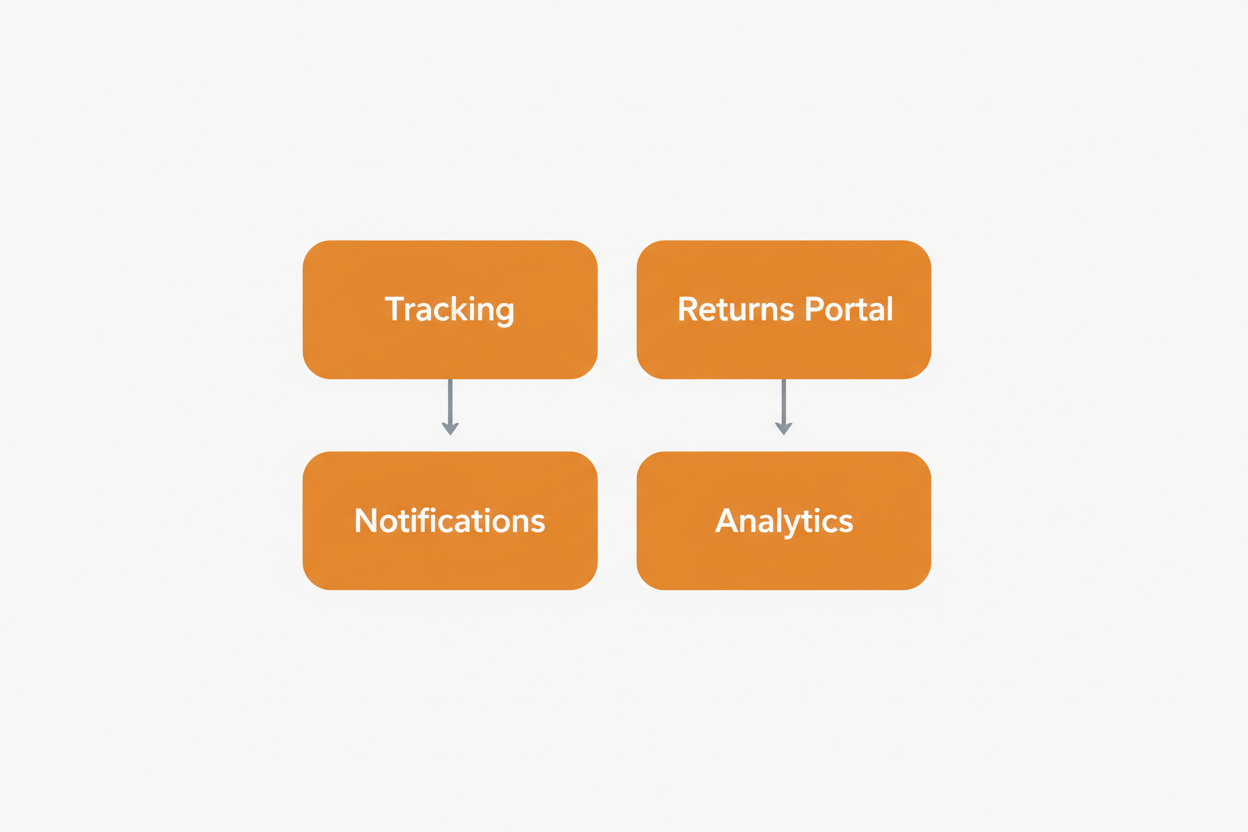
Returns are one moment inside a longer stretch. It opens the second your customer clicks buy and closes when the parcel is in their hands, or back in yours. Everything in that stretch is post-purchase, and it runs on four things working together.
Tracking knows where every order is. Notifications fire off those tracking events, so your customer hears from you before they think to ask. The request lands in a self-service returns portal when something does come back, in your brand, at any hour. Returns data feeds the analytics that tell you what to fix.
That fourth pillar is the one that compounds. A sizing complaint reads differently once you can see it landing on one variant, under one return reason, week after week.
AfterShip Returns provides a complete, branded returns management platform. The portal carries your brand, automatic approval and eligibility rules decide what moves without you, refunds and exchanges both run inside it, and the analytics show you what is coming back and why. It is the piece of your complete post-purchase stack that turns a return into something you can act on.
AfterShip Returns vs. Redo: A Philosophical Comparison
A feature list is the wrong instrument at this size. Two products can tick the same boxes and still behave differently on the day a customer wants to swap a medium for a large. The useful question is what each tool is built to do with a return once it has already arrived.
Set one thing aside first: both let you pass return-shipping cost to shoppers who opt in, so the fee is not the argument.
| Job to Be Done | Redo (free portal) | AfterShip Returns |
|---|---|---|
| Keep the sale on a return | Return and label handling; most merchants set coverage to apply to exchanges and store credit | Exchanges, store credit and shop-now recapture, built to retain the revenue instead of refunding it |
| Automate the workflow | Returns auto-approve by default | Automatic approval and eligibility rules on the entry plan; segment-conditional workflows on Premium |
| Learn from returns | Publishes return reasons, product and variant trends and satisfaction ratings | Returns analytics showing why items come back, by product and by reason, in the same product that runs your portal and your approval rules |
| Own the brand experience | Portal branding | Branded portal, notifications and policy control, all under your own settings |
AfterShip Returns Essentials: $16 a month billed annually, including 240 returns a year, then $0.50 per additional return.
Printing the label is the cheap part. Deciding whether to approve, whether a swap is possible, and what your customer hears while they wait is the part that grows with your order volume instead of staying flat.
On the funding question, AfterShip has its own answer, and where it sits matters. Return Care is what a store grows into rather than what it starts on. It runs alongside AfterShip Protection on the same store, and Protection is open today to Shopify merchants with a US business entity, a USD store and more than five thousand orders a year. Most stores at this size are below that line. When they cross it, the shopper-funded option is there, inside the same platform.
See It in Action: Your First 3 Steps with AfterShip Returns
The setup is smaller than the decision. Three settings get a store from email threads to a working returns operation, and none of them needs a developer or a migration weekend.
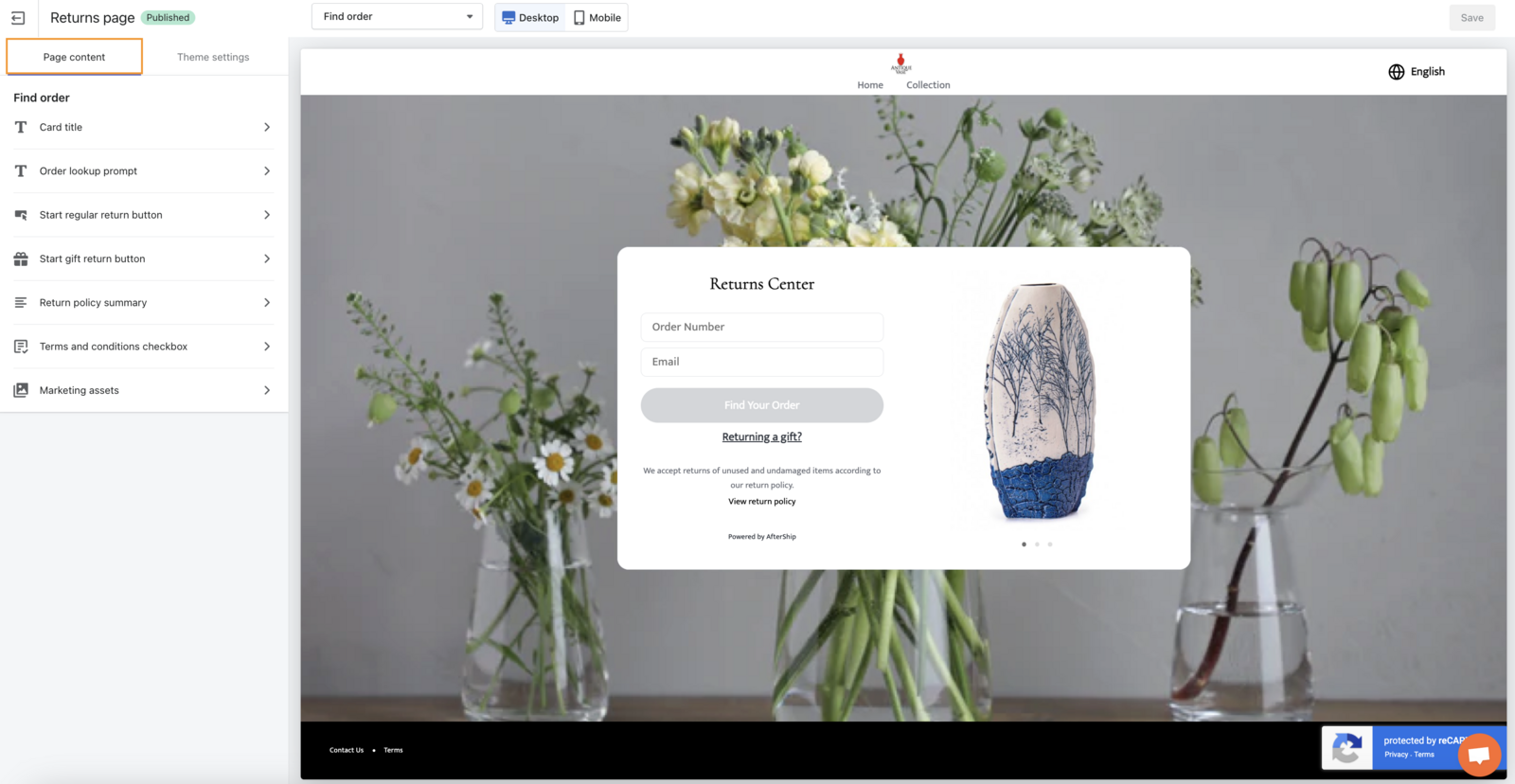
- Customize your branded returns page. Colours, logo and copy, no code. Your customer files the return on something that looks like your store rather than something that looks like software.
- Turn on automatic returns approval and eligibility rules. These run store-wide from Essentials. Set the return window, set what qualifies and what does not. The requests inside your rules approve themselves, and only the exceptions reach you.
- Connect your carriers so labels generate on approval. In-app automatic labels mean an approved return leaves with a label attached, without you opening a carrier portal or pasting a tracking number into a reply. Refunds and exchanges both run inside the same product, so the resolution lands where the request was filed.
Three capabilities you will read about sit on Premium rather than Essentials, and knowing which is which before you plan around them saves a surprise: workflows that key off customer segments or tags, AI-powered exchanges, and automatic refund to store credit.
An afternoon covers them, and the returns that arrive next week arrive into a process instead of into your inbox.
The Verdict: Should a Shopify Merchant Use Redo in 2026?
Below roughly twenty returns a month, a free setup is genuinely enough, and saying otherwise would be selling you something. Redo's free portal will hold at that volume. So will a spreadsheet and a decent email template, if you are honest about the numbers. Nothing here argues that a store handling four returns a month should be shopping for a returns platform.
So will Shopify's own native self-serve returns, which your store already has. The customer requests, you approve in admin, and US-to-US stores can create the return label there. It carries one hard limit that decides whether it is enough for you: exchanges cannot be requested in self-serve returns at all, and there are no exchange-specific return rules.
The decision changes when any of the three signs above becomes true. There is a fourth thing that belongs beside them, and it is the one founders tend to arrive at last: you want one branded, consistent returns experience instead of ad-hoc email threads. It rarely announces itself as an operational problem. It shows up the first time you look properly at what a customer sees when something has gone wrong, and it looks nothing like the rest of your store.
Let's be straight: Redo's returns portal is free to you as the merchant, and AfterShip Returns starts at a paid entry plan. If your only goal is to stop paying for return labels, Redo costs less. But that subscription isn't buying a portal, you already get one free. It's buying the automation, the exchange and store-credit options that keep the sale, and returns analytics that show you why items come back, by product and by reason. That's the trade you're actually weighing. On the protection side specifically, we price that trade out in whether paying for package protection is worth it.
The trigger is not a number. It is the moment returns stop being a rare event and start being a recurring cost of your time and your customer relationships. Every store crosses it at a different volume, which is why a threshold makes a poor rule and your own week makes a good one.
If you want the two side by side in more detail than four rows allow, the AfterShip Returns VS Redo comparison page goes further. When that moment arrives at your store, AfterShip Returns is what you move to.
Frequently Asked Questions
Is Redo free?
Redo's returns portal is free to the merchant, and Redo covers the cost of return labels for shoppers who buy its coverage at checkout. The modules around the portal are priced separately, most of them per event, and Redo publishes those prices on its own pricing page.
Can customers who skip Redo's coverage still return items?
Yes. Redo's help centre states that all customers, including those who do not purchase Redo coverage, use the same return portal. The difference is who pays for the return shipping label: shoppers who bought coverage have it covered, and shoppers who declined it buy their own.
Does Redo only work with Shopify?
No. Redo's own product pages list Shopify, WooCommerce, BigCommerce, Salesforce Commerce Cloud and custom storefronts. The Shopify App Store listing is where most merchants meet it first, which is why it is often described as a Shopify app.
When is it worth paying for returns software?
When returns stop being a rare event. Below roughly twenty returns a month a free setup holds. Past that, what you are paying for is the workflow around the label: approval rules that run without you, exchanges and store credit that keep the sale, and one branded experience for every customer. That is where AfterShip Returns starts to earn its place.