Your returns portal works, but your return rate isn't dropping. Your customers can print a label, but your WISMO tickets are still sky-high. If you're looking for an "alternative" to your current returns tool, the problem might not be the portal - it's the silo it operates in.
Most shortlists get built on portal features. How the return page looks, how quickly a shopper gets a label, how many conditions the workflow engine will accept. Those questions all have answers, and none of them tells you why the return happened in the first place.
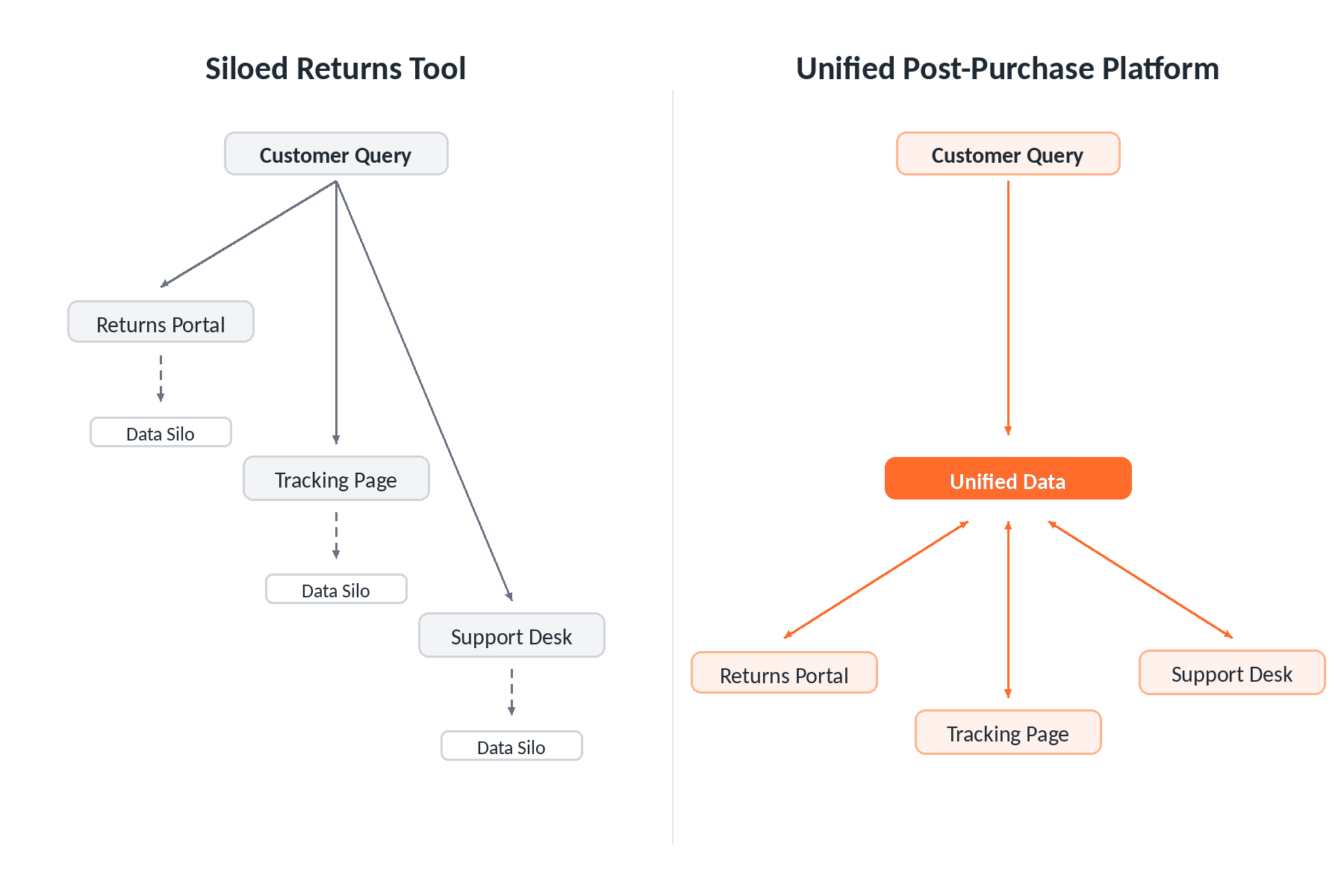
The best returns platform alternatives for a scaling DTC brand are a different type of platform. A unified post-purchase platform holds shipping, tracking, returns, and warranty data on one order record, so the reason a customer sent something back can be read against what the delivery actually did.
Why "Just a Returns Portal" Is No Longer Enough
The reverse-logistics bill is not a rounding error. NRF projects $849.9 billion in total retail returns for 2025, with an estimated 19.3% of online sales coming back, in a study published on October 15, 2025 and co-authored by Happy Returns, a UPS company that appears later in this comparison. Baymard Institute separately puts an unsatisfactory returns policy behind 13% of checkout abandonments, in a 2026 survey of 1,083 US shoppers.
A returns-only tool sees one slice of that number. It records that an order came back and which reason code the shopper picked from a dropdown. It does not see the delivery that ran four days late, the tracking page the customer refreshed eleven times, or the support ticket they opened before giving up and buying the same item somewhere else.
The data gap becomes an operational one fast. Your CX team answers a WISMO ticket in the helpdesk, checks status in a carrier portal, then processes the refund in a third tool. Every manual refund is a handoff, and handoffs scale with order volume while your headcount does not. Somewhere between one thousand and fifty thousand orders a month, that arithmetic stops reading as an annoyance and starts reading as a hiring request you have to justify. Teams still at that stage should start with what replaces a manual, spreadsheet-driven process rather than a platform bake-off.
The prevention gap is the expensive one. Only one of the three documented levers for moving return rate sits inside a returns portal, and even that one stays blunt without delivery data to test its reasons against.
A returns portal can tell you what came back. On its own it cannot tell you what to stop shipping.
Key Criteria for Evaluating a Returns Alternative
Four criteria separate a returns tool from a returns platform. Score every vendor on your shortlist against all four before anyone opens a pricing page.
- Branded customer experience. The returns portal is a page your customer reaches after they have already decided something went wrong, which makes it the worst possible moment to look like a third party. Check whether it runs on your domain, carries your typography and your exchange merchandising, and whether the vendor's own branding appears anywhere the shopper can see it.
- Operational automation and cost control. Ask what share of your current manual queue disappears on day one. The specifics that decide it are conditional rules across order, product, return and customer attributes, automatic approval and refund triggers, and who chooses the carrier and the label for each return. Your cost per return lives in that last one.
- Returns prevention and data insights. Every vendor on your shortlist captures reason codes at SKU level. The question that separates them is whether return reasons can be read against delivery performance, because that join is where strategies to reduce your return rate actually come from.
- Platform extensibility. Returns data has to reach your helpdesk, your ERP and your warehouse to be worth anything. Ask whether the vendor also sells the adjacent post-purchase pieces on the same contract and the same data layer, or whether you will be the one stitching them together and maintaining the joins.
Weigh those four together and the shortlist reorders itself. Judged on the portal alone, most returns management software looks interchangeable, which is why so many DTC returns solution evaluations stall on screenshots. Judged on whether returns data reaches the rest of the post-purchase journey, the best returns platform alternatives are the ones that were built as platforms.
The Top 5 Returns Platform Alternatives: A Detailed Breakdown
Five names come up repeatedly when mid-market DTC teams shortlist returns platform alternatives: AfterShip, Loop Returns, Happy Returns, Narvar, and Returnly, the last of these a discontinued pioneer whose story closes the list. Each review below runs the same three lines: who the platform is best for, what actually differentiates it, and how it is priced. Read each one against the four criteria you just scored.
1. AfterShip: The Unified Post-Purchase Platform
Start here if prevention and extensibility scored highest on your card, because those two criteria are the ones a returns-only tool cannot answer on its own.
On the Shopify App Store, AfterShip Returns & Exchanges holds a rating of 4.7 out of 5 across more than 1,500 reviews, and the listing carries Shopify's Built for Shopify badge, awarded to apps that meet its "highest standards for performance, design, and integration" (apps.shopify.com, read September 7, 2026). AfterShip as a whole holds 4.9 out of 5 across 473 reviews on Capterra (capterra.com, read September 7, 2026). On the Shopify App Store listing, one merchant, Nothing Fits But, reviewing on November 14, 2024, described the operational effect: "The user-friendly interface and automation options are a huge time-saver."
The integration claim is narrower than most unified-platform pitches, and worth stating precisely. AfterShip Returns tracks inbound return shipment statuses natively, so your CX team can see where a return is in transit without buying a separate tracking product. The full outbound experience is a different license: AfterShip Tracking carries branded tracking pages across 2,000+ carriers, AI EDD as a capability inside it, and proactive delivery notifications.
AfterShip unifies shipping, tracking, returns, and warranty on a single platform. A brand that adopts more than one gets the join between them without building it.
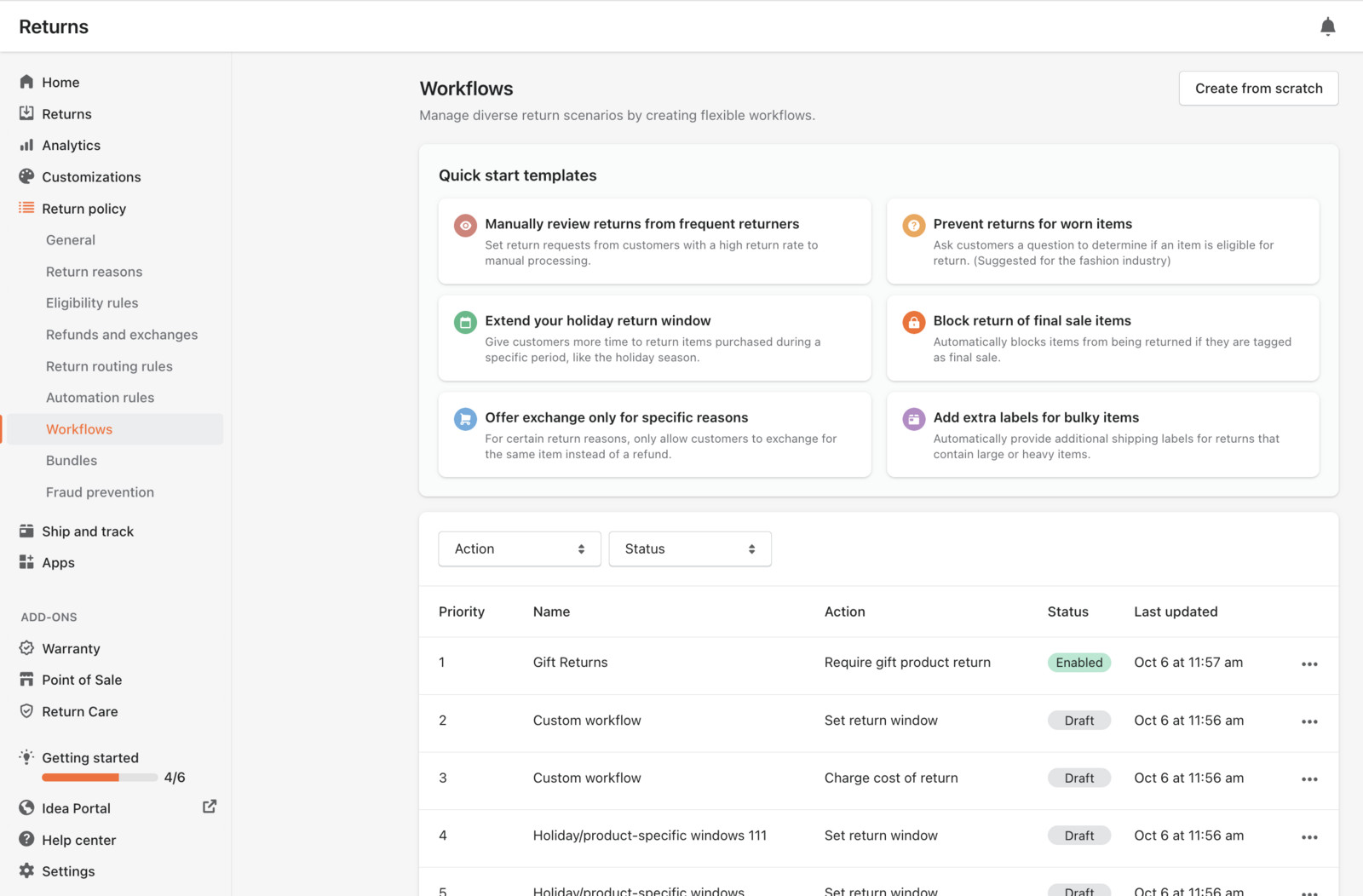
Automation is where the day-to-day time goes. Custom return workflows run on Premium and Enterprise plans, with conditions drawn from four families: order, product, return, and customer. A single rule can read the return reason, the customer's tag and the product's attributes in one pass, then trigger an instant refund.
The shopper side is a branded, self-service returns portal. Extensibility shows up as powerful integrations with helpdesks like Gorgias.
Best For: Brands that want the entire post-purchase journey on one platform rather than a returns tool alone.
Key Differentiator: Shipping, tracking, returns, and warranty on a shared order record, with a rules engine deep enough to act on what that record knows.
Pricing Model: Published subscription tiers with a self-serve trial, alongside a shopper-funded plan.
2. Loop Returns: Returns-First, Built for Shopify
If converting refunds into exchanges is the single number your quarter is judged on, this profile will read closest to your brief.
Loop Returns focuses on converting returns into exchanges for Shopify stores. On exchange capability the two platforms line up. AfterShip supports on-store and instant exchanges, incentivized exchanges and store credits, and exchange for a different product entirely, per its own returns page. Exchange volume is a question of merchandising and incentives, and both platforms give you the levers.
Loop is a returns-first platform built for Shopify that has since expanded into tracking (Track by Loop, the former Wonderment, acquired 2023) and order editing.
That expansion is the part worth reading closely. A returns company adding tracking and order editing is a company agreeing with the category logic this comparison is built on. The difference is depth and sequencing. AfterShip was built unified, with shipping, tracking, returns, and warranty sharing a data layer from the start, rather than a returns product that added adjacent ones later. Where that shows up in practice is analytics: reading return reasons against delivery performance is a query on one record instead of a join you assemble yourself. It is also the question behind most searches for Loop Returns alternatives, where exchange capability is taken as given and the difference is what else the platform can see.
Both platforms publish a shopper-funded plan of the same commercial shape. The shopper pays a small optional fee at checkout, the platform handles the return labels, and no SaaS subscription is required for that plan. Loop calls its version Checkout+, and Loop's own Checkout+ page, read September 1, 2026, describes the fee revenue as offsetting the merchant's shipping and software costs. AfterShip calls its version Return Care, and publishes standard subscription tiers alongside it.
Best For: Shopify-first brands whose primary goal is converting returns into exchanges.
Key Differentiator: A returns-first product line now extending into tracking and order editing across the Shopify ecosystem.
Pricing Model: A free shopper-funded tier plus published subscription tiers, listed on Loop's own pricing page, read September 1, 2026.
3. Happy Returns: The Box-Free, In-Person Drop-Off Network
Some shoppers will not print a label, and some will not find a box. If that describes a meaningful share of your returns, physical drop-off density stops being a nice-to-have and becomes a line on your scorecard, because the alternative is a return that never gets sent and a refund request that arrives by email six weeks later.
Happy Returns provides a network of box-free, in-person drop-off locations. It runs nearly 10,000 Return Bar sites across the United States, including more than 5,000 The UPS Store retail locations. UPS announced its acquisition of the business on October 25, 2023 and closed it on November 1, 2023, which put the Return Bar network inside a carrier rather than alongside one.
Brands comparing Happy Returns competitors are usually weighing that network density against everything else a returns platform has to do, and the software here is wider than the drop-off flow it is known for. It handles exchanges, store credit and mail returns, so a brand adopting it is not choosing between an in-person network and the resolutions its shoppers expect.
Commercially it is sales-led. Happy Returns publishes no merchant pricing on its own surfaces, read September 1, 2026, so establishing cost means entering a sales conversation first. For an operator who has to bring a per-return number to a budget review, that sequencing is worth knowing before the first call.
Best For: US-centric brands whose customers value box-free, in-person return options.
Key Differentiator: A physical Return Bar network with UPS Store density behind it.
Pricing Model: Quote-only, with no published merchant pricing.
4. Narvar: The Enterprise Post-Purchase Suite
If your procurement process expects a vendor-assisted implementation and your logistics span several regions and carriers, the enterprise tier is where your shortlist tends to land.
Narvar sells an enterprise post-purchase suite as separately named products: Promise, Secure, Track, Notify, Assist and Shield. Each is scoped and sold on its own terms, which is the pattern to map carefully when you compare a Narvar proposal against a single-platform quote, because the line items you are shown are the ones you asked about.
Narvar publishes no pricing, tier, or entry cost on any public surface. Every path is "Book a demo", read September 1, 2026, so a mid-market buyer cannot establish cost or scope before entering a sales process. That is a procurement fact rather than a verdict, and it lands hardest on the operator who has to bring a number to a budget review before the vendor will supply one. It is also why teams searching for Narvar alternatives are often doing so with the procurement runway itself in mind.
One product name causes regular confusion on shortlists. Narvar Secure is shopper-funded shipping protection rather than return-label funding, and Narvar's own site describes it as free for retailers to use, read September 1, 2026. That places it outside the shopper-funded returns model described above, and the two should not be scored in the same row.
Buyers whose shortlist has narrowed to this tier will want a deeper comparison against enterprise solutions like Narvar before committing.
Best For: Global enterprises with complex logistics that expect vendor-assisted, sales-led procurement.
Key Differentiator: A broad enterprise product line sold and implemented through a sales-assisted motion.
Pricing Model: Quote-only, with no pricing published on any public surface.
5. Returnly: The "Instant Credit" Pioneer (Discontinued 2023)
If your team built its returns process before 2024, there is a fair chance it ran on Returnly at some point.
Returnly pioneered instant merchant credit. A shopper received store credit to repurchase before shipping the original item back, which pulled the exchange decision forward to the moment the return was filed. Affirm acquired Returnly in 2021 and later wound the business down. Returnly officially shut down on October 1, 2023, and Loop was named its preferred migration partner for more than 1,500 merchants.
That job is now split across the live platforms. Loop's Instant Returns is in beta, secured by a temporary card hold and not available to all merchants. AfterShip supports instant refunds and exchanges on its higher plans. Happy Returns triggers refunds on in-person verification at a Return Bar.
The migration is the part that stayed with the merchants who lived through it. Loop's own Returnly page, read September 1, 2026, states there is "no way to transfer initiated returns from one returns software to another". Every return already in flight on October 1, 2023 had to be carried across that gap by hand, at the same time as the team was learning a new system.
Best For: Brands that wanted store credit issued before the item shipped back, while it was operating.
Key Differentiator: It pioneered instant merchant credit.
Pricing Model: None since it closed.
Head-to-Head: Returns Platform Alternatives Comparison
The four live platforms, scored on the criteria from the top of this guide. Returnly has no row, because it has not been sellable since 2023.
| Criteria | AfterShip | Loop Returns | Happy Returns | Narvar |
|---|---|---|---|---|
| Best For | Entire post-purchase journey on one platform | Exchange conversion on Shopify | US box-free in-person drop-off | Global enterprise, sales-led procurement |
| Branded Experience | Branded, self-service returns portal for shoppers | Branded returns portal, Shopify-first | Own portal or partner portals | Shield returns, branded tracking pages |
| Automation Rules | Order, product, return, customer conditions; Premium and Enterprise | Workflows and routing rules | Configurable refund timing and routing | Shield returns and exchanges |
| Carrier / Cost Control | 71 auto-label carriers; three, five or unlimited accounts | Checkout+ includes US, Canada labels | Nearly 10,000 US Return Bars | No returns-carrier count published |
| Data Insights & Returns Prevention | Return reasons beside inbound shipment status | Returns analytics reporting | Retailer dashboard, return reason summaries | IRIS insights layer across platform |
| Unified Platform Data | Shipping, tracking, returns, and warranty on one platform | Tracking, editing, returns on Loop | Returns network inside UPS | Six discrete products, separately sold |
Two rows decide most shortlists. Automation depth is where a returns tool stops paying for itself, and unified platform data is where return-rate work becomes possible at all. Read those two together rather than scoring every row equally. AfterShip answers both from one order record.
The Verdict: Which Alternative is Right for Your DTC Brand?
The right answer depends on which of the four criteria you weighted highest, and on how much of the post-purchase journey you expect to own two years from now.
Choose AfterShip if:
- Your return-rate problem is really a delivery-expectation problem, and you need return reasons sitting beside inbound shipment status instead of in a separate export.
- Your rules have outgrown a single condition, and you need order, product, return and customer attributes evaluated in one pass on Premium or Enterprise.
- You expect to add shipping, tracking or warranty later, and you want them on the same platform and the same order record rather than in a second procurement cycle.
- You need pricing you can take into a budget review before you speak to anyone.
The other four, stated plainly:
- Loop Returns fits Shopify-first brands whose primary goal is converting returns into exchanges.
- Happy Returns fits US-centric brands whose customers value box-free, in-person return options.
- Narvar fits global enterprises with complex logistics that expect vendor-assisted, sales-led procurement.
- Returnly fits nobody now. It closed in 2023 and its merchants moved.
One limitation belongs on the record. AfterShip does not operate a proprietary network of in-person, box-free drop-off locations the way Happy Returns does. Box-free, label-free drop-off reaches AfterShip merchants through the built-in Happy Returns integration, which AfterShip's own pricing page describes as "10,000+ drop-off bars. No box, no label.", read September 3, 2026, alongside carrier QR-code drop-off. Auto shipping label generation covers 71 carriers worldwide without additional software, per the live returns page read the same day, with carrier accounts running three on Essentials, five on Premium, and unlimited with custom rates on Enterprise.
Returnly's ending earns a place in your selection criteria. Vendor stability belongs there: a platform that disappears mid-contract is the most expensive alternative of all. If you are shortlisting AfterShip Returns alternatives, weigh each vendor's track record alongside its feature list.
Judge total cost of ownership rather than sticker price. Count the contracts you will sign, the renewals you will manage, and the data joins you will maintain yourself, then set those against what each vendor publishes before you call and what only appears on an invoice afterwards. You can explore the different pricing plans before that conversation starts.
Returns automation that enhances the returns and exchanges experience, reduces costs, and retains more revenue.
Book a demoFrequently Asked Questions about Returns Platforms
What is the difference between a returns app and a returns platform?
A returns app processes the return. It gives the shopper a portal, issues a label, and moves the request through approval to refund. A returns platform does that and keeps the result connected to the rest of the order: the delivery that preceded the return, the notifications the shopper received, the shipping data behind both. The practical test is whether you can ask one question of one system and get an answer. If working out how many returns followed a late delivery means exporting from two tools and joining them in a spreadsheet, you are running an app.
How much does returns management software cost in 2026?
It depends on the channel you buy through, so check which surface a quoted price came from. On the AfterShip site, Returns runs from $16 per month on Essentials and from $99 per month on Premium, with Enterprise priced on request. The Shopify App Store listing for the same product shows $19 per month and $119 per month, with $1 per extra return. Loop publishes Checkout+ as a free tier, Essential from $155 per month and Advanced from $340 per month. Narvar and Happy Returns publish no merchant pricing at all; both are quote-only. AfterShip and Loop also both offer a shopper-funded model, where the shopper pays a small optional fee at checkout and no SaaS subscription is required for that plan. With Return Care, shoppers pay a small optional fee at checkout to unlock free returns, AfterShip handles the return labels, and the program offsets the merchant's cost of offering free returns.
Can a returns platform help reduce my return rate?
Three levers are documented: returns-reason analytics, exchange incentives, and delivery-expectation accuracy. No platform can promise a lower return rate on its own, because the causes sit in your catalog, your sizing and your carrier performance. What a platform can do is put the evidence for all three in one place, so a reason code can be read against the delivery that produced it. That is the join AfterShip Returns is built to make: it tracks inbound return shipment statuses natively, so the reading happens without buying a separate tracking product.