You're not just choosing a returns tool; you're deciding your post-purchase strategy for the next five years. A point solution fixes one step of that journey; a unified platform runs all of it on one data layer. For scaling brands, the unified platform is the durable choice.
Somewhere between 1,000 and 50,000 orders a month, returns stop being a support task and become an operations problem. The spreadsheet stops reconciling. WISMO and WISMR tickets ("where is my order", "where is my refund") start eating a full headcount. And nobody in the building can tell you why the returns are happening.
Four platforms dominate any AfterShip vs Narvar for enterprise returns at that scale: Narvar, Loop, Happy Returns, and AfterShip, drawn from the wider field of top returns platforms for eCommerce. AfterShip ranks first against the six criteria below, on three things you can check before you ever take a sales call: the suite of shipping, tracking, returns, and warranty running in one control plane, published pricing and overage rates you can model yourself, and the largest independent review base of the four.
The Final Rankings: A C-Suite Summary
Ranked against the enterprise criteria in the comparison below, here is where the four land, and which is the best returns management platform against those criteria.
- AfterShip Returns. The suite of shipping, tracking, returns, and warranty runs in one control plane on shared data, so a return, its shipment, and its warranty claim are the same record rather than three. Pricing, overage rates, and a consumer-funded option are published. Its review base is the largest of the four on the Shopify App Store: 4.7 from 1,539 reviews, carrying Built for Shopify certification, against 442 for Loop, 29 for Happy Returns, and 21 for Narvar, all captured September 2026.
- Narvar Returns. The closest suite alternative, with Track, Notify, and Shield covering much of the same journey. Its tracking-carrier network is the less extensive of the two: Narvar advertises 1,000+ tracking carriers, while AfterShip Tracking supports 2,000+ tracking carriers per the AfterShip carrier directory, read October 2026. Narvar publishes no pricing, so the modelling starts after the first call. There is Narvar put through an enterprise procurement lens for teams already down to those two.
- Loop Returns. Exchange workflows and a shopper-funded Checkout+ option, both of which AfterShip also ships as instant exchanges and Return Care. Loop gates Instant Exchange and Shop Now to its Advanced tier, and meters Loop Returns and Loop Tracking as two separate subscriptions. You can compare AfterShip directly with Loop Returns feature by feature.
- Happy Returns. A box-free drop-off network it owns and operates across the US, with returns handed over unpackaged and unlabelled. AfterShip reaches that same Return Bar network through partner access, alongside its own multi-carrier drop-off footprint.
The Strategic Choice: Why a Unified Platform Beats a Point Solution in 2026
A return is a refund decision, a reverse shipment, a carrier cost, a warranty question, and a reason code that should tell your merchandising team something. Buy a tool that owns one of those and the other four still have to live somewhere.
Returns point solutions often create data silos and operational gaps.
The gap shows up in the contract before it shows up in the workflow. Loop sells returns and tracking as two separate subscriptions, each with its own quota and its own renewal. Its in-person returns are provided by Happy Returns under a separate merchant agreement, and Loop's own terms of service state those services terminate automatically if Loop's agreement with Happy Returns ends.
So the question to put to each vendor is not how many features they have. It is how many contracts, quotas, and renewal dates you are actually signing.
The published terms answer part of that for you. Loop's terms of service set a fixed 6% annual increase at the completion of each term and require 60 days' written notice not to renew. Narvar's terms allow renewal increases up to the greater of 10% or the average US Consumer Price Index over the preceding twelve months, with 30 days' notice.
Over a three-year horizon those clauses compound. Each renewal applies its own increase, and every separate agreement in the stack carries its own renewal date to defend.
The customer-experience stakes sit on the same axis. 71% of consumers say they are less likely to shop with a retailer again after a poor experience, according to the 2025 Retail Returns Landscape published in October 2025 by NRF and Happy Returns, a UPS company. A shopper experiences your returns portal, your tracking page, and your warranty flow as one brand, once, and judges it accordingly.
The durable choice is the platform where those surfaces already share a data layer on the day you sign.
The Ultimate 2026 Returns Management Comparison
Six criteria decide this category for an operations leader running real volume. Unified platform, automation depth, carrier network and flexibility, API and integrations, analytics, and enterprise readiness.
| Criteria | AfterShip | Narvar | Loop | Happy Returns |
|---|---|---|---|---|
| Unified platform: shipping, tracking, returns, and warranty on one control plane, or split across subscriptions? | All four on one platform, one contract, one renewal. Return Care is consumer-funded, and AfterShip handles the labels. | A suite of separate named products: Track, Notify, Shield, Promise, Assist, Secure. Base-subscription scope is unpublished. | Unites tracking, returns, exchanges, shipping. Returns and tracking are two subscriptions. Checkout+ is shopper-funded, Loop-paid labels opt-in. | Returns, plus a free branded order-tracking page and Return Shopping. |
| Automation depth: how complex can the rules get before a human steps in? | Return Workflows across 20+ documented conditions, nine routing-rule conditions, return windows from verified delivery date (requires Tracking plan). All published. | Shield publishes outcomes: dynamic policies, trust tiers, instant refunds at first scan. The condition dictionary is publicly undocumented. | Workflows document product, order, customer and return conditions, with handling-fee, destination and window actions. Background Agents are early access. | Policy Exceptions run at return initiation: Vendor and Order Creation Date on Standard API, more on Shopify. |
| Carrier Network & Flexibility: global carrier support, an owned network, or a limited set? | AfterShip Returns auto-labels across 71 carriers, 300,000+ cross-carrier drop-off sites (AfterShip's returns page, September 2026). AfterShip Tracking: 2,000+ tracking carriers. | Advertises 1,000+ carriers across every country and a partner network of 200,000+ drop-off locations. | Labels via EasyPost. In-person returns are resold from Happy Returns and terminate if that agreement ends. | An owned US box-free network. Pro is capped at two carriers with no international; Plus and Enterprise unlimited. |
| API & Integrations: what can a developer build against, and read before signing? | One developer portal documents an API per product, including Tracking, Returns, Shipping and Warranty, plus SDKs, webhooks and MCP servers. | Publishes Order API guides for BigCommerce and SAP Commerce Cloud; its API documentation sits behind a sign-in. | A partner directory covering logistics, shipping and CX, giving return visibility to warehouses, 3PLs and ERPs. | Dashboard Developer Tools and API access, with returns integrations for Shopify and BigCommerce. |
| Analytics & Insights: a prescriptive recommendation, or a report of what already happened? | Return reasons aggregate by product, variant and vendor beside tracking events and shipping cost, turning reporting into a routing decision. | Markets policy recommendations with projected outcomes on its own product pages, a vendor claim rather than published method. | Loop Intelligence includes Return Policy Insights, recommendations for merchants creating or updating return policies. | A returns dashboard reporting on return activity. |
| Enterprise readiness: permissions, SLA, and the contract economics you can model in advance. | Published prices and overage rates: Essentials $16/mo, Premium $99/mo annual, Enterprise on request. Roles via Members API, no fixed escalator. | No published pricing. Auto-renews on 30 days' notice, increases up to greater of 10% or CPI. SLA on request. | Annual contracts outside Checkout+, a fixed 6% increase each term, and 60 days' written notice not to renew. | Shopify plans page: Plus $500/mo after a 14-day free trial, Enterprise pricing varies. |
AfterShip covers all six criteria on one platform, under one contract.
Deep Dive: Returns Portal & Customer Experience
The returns portal is the one page a shopper reaches when something has already gone wrong. Whatever your storefront spent on brand, this is where it gets tested.
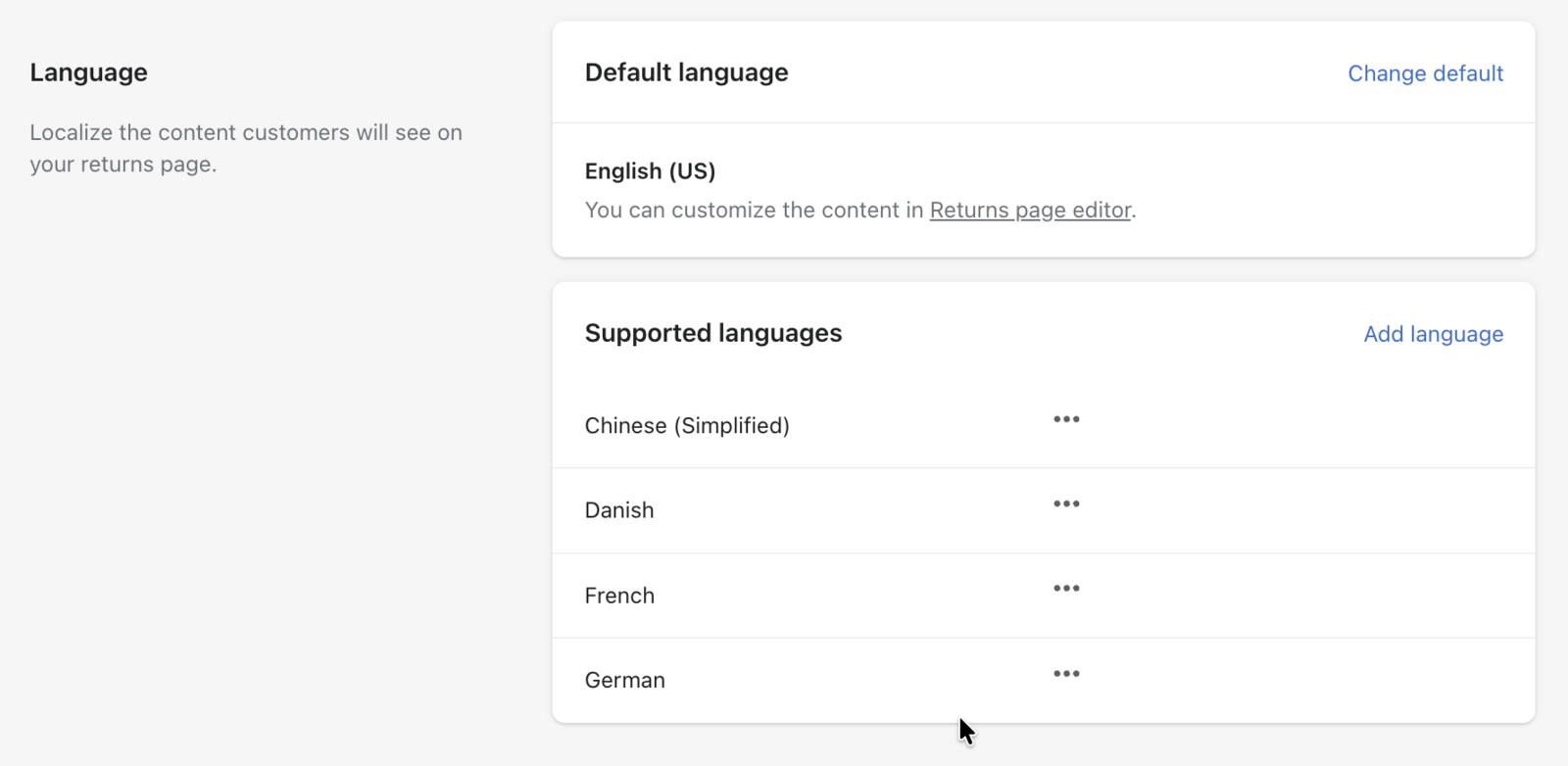
AfterShip Returns runs that page from a branded portal editor, with per-step localization: the customer-facing content of each step can be edited and translated individually rather than as one global string set. That matters once you are selling into more than one language market, because the apology, the policy line, and the refund-timing copy each need to read naturally in each locale.
The editor also handles a case that catches operations teams out. AfterShip supports partial returns for bundled items, described on its pricing page as the ability to "Return one item from a bundle without sending back the whole set". If you sell kits, sets, or subscription boxes, the alternative is a manual exception every time.
The other three all ship a branded portal, and the documented depth differs. Loop provides theme controls and a custom domain. Happy Returns provides logo and visual controls, with the portal running ten locales. Narvar Shield ships a branded portal as part of its returns product.
Baseline branding is table stakes across this category, so the logo on the page tells you very little at demo stage. The questions that separate these four are how much of the flow an operations team can reshape without a developer ticket, whether the copy inside each individual step travels into every market you sell to, and whether the awkward cases have somewhere to go.
AfterShip answers all three from the same editor, which is why the portal stops being a quarterly design project and becomes something a CX lead adjusts on a Tuesday.
Deep Dive: Automation & Reverse Logistics Logic
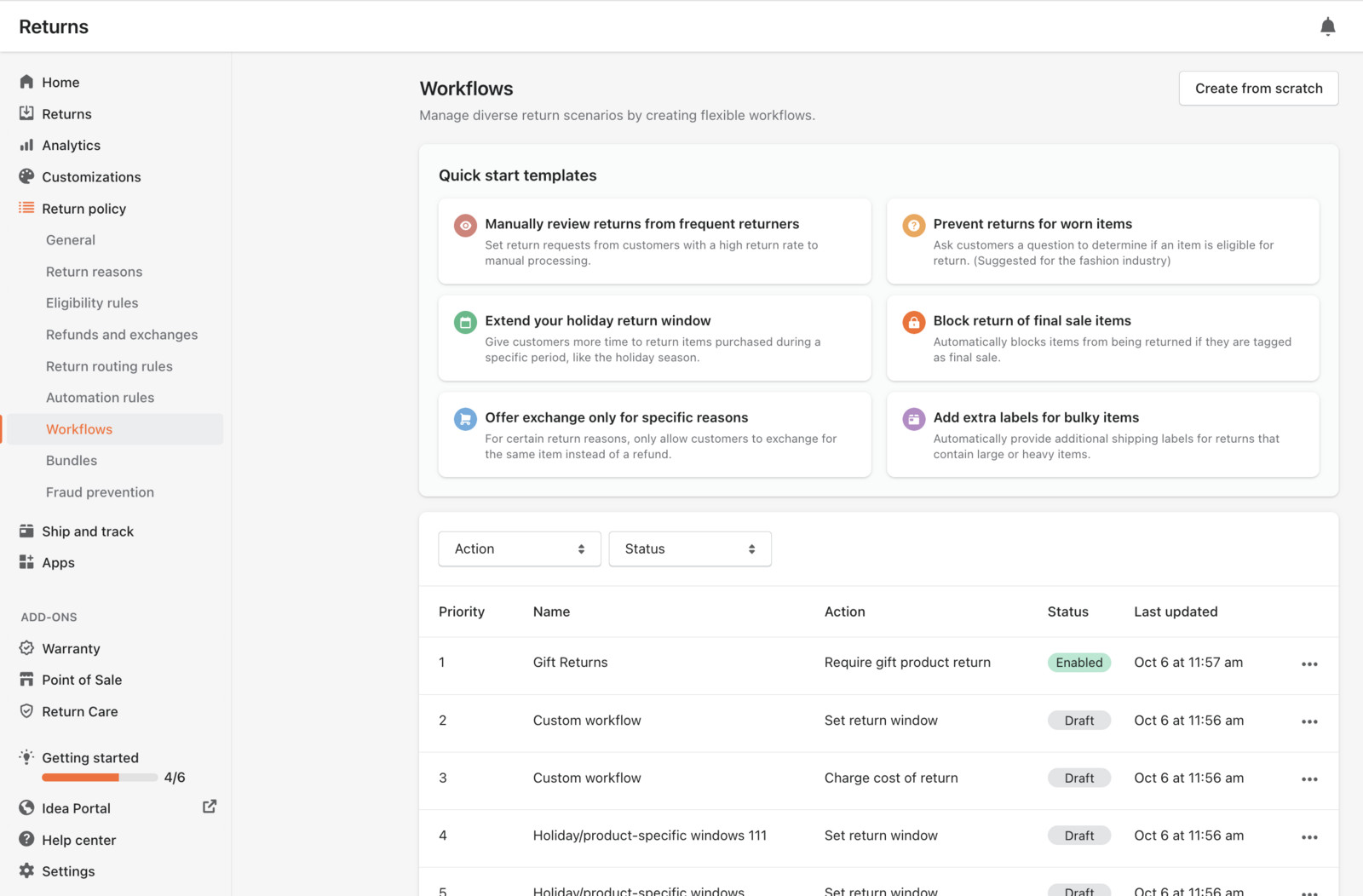
Every returns platform automates the easy path. The question for an operations lead is what happens to the hard cases: a bundle, a gift receipt, a high-value item, a customer who has returned four times this quarter.
AfterShip Return Workflows condition on order, product, customer, and return-type attributes, across more than 20 documented conditions. Order date, fulfillment date, delivery date, discount code, order value, product tag, SKU, vendor, customer tag, return reason, and return source are each addressable, so a rule can distinguish a first-time buyer returning a discounted item from a repeat returner sending back full-price stock.
Routing rules add nine documented conditions on top, deciding which warehouse or return method a given request is sent to. Automation rules then act on the outcome: auto-refund to original payment or store credit, auto-create an exchange order, auto-receive, auto-restock, auto-expire.
One capability is worth understanding precisely, because it is the clearest expression of the unified data layer. AfterShip can start the return window from the actual delivery date rather than the order date, which requires an active Tracking plan. The return clock begins when the parcel was really delivered, because the same platform recorded the delivery event.
Loop documents its own Workflows for automating returns policies. Happy Returns documents Policy Exceptions, with defined conditions and actions. Narvar publishes outcomes for Shield rather than a rule dictionary, so the exact condition set is publicly undocumented.
That distinction has a practical cost during evaluation. A published condition list can be tested against your own last quarter of returns before you sign anything. An outcome claim can only be tested after implementation, when you have no room to renegotiate.
For a team processing thousands of returns a month, rule depth decides how many requests ever reach a human. AfterShip publishes the whole set, so you can model that number for your own volume while you are still choosing.
Deep Dive: The Drop-Off Question (Owned Network vs. Multi-Carrier Flexibility)
Where should a shopper physically hand over a return, and does that answer still hold when you start shipping outside your home market?
Happy Returns operates the strongest owned physical box-free drop-off network in the US. Shoppers arrive with the item unpackaged and unlabelled, hand it over, and the refund is initiated on the spot.
AfterShip answers the same question with multi-carrier flexibility instead of a single owned network. Auto label generation covers 71 carriers worldwide, and the drop-off footprint runs to 300,000+ cross-carrier sites, both stated on AfterShip's returns page and read in September 2026. That includes more than 9,000 Return Bars from Happy Returns supported in the US through partner access, which requires a separate Happy Returns contract and is not bundled into an AfterShip plan.
Happy Returns describes itself as return portal agnostic and names AfterShip Returns among its portal partners on its own site.
For the shopper, that plumbing stays invisible. They open one branded returns page, and the drop-off options they see are whatever actually serves their address, whether that resolves to a Return Bar, a carrier counter, or a printerless QR handover. For the operations team, it means the return method is a routing decision inside the platform rather than a separate vendor relationship to run alongside it. You can compare AfterShip against other returns platforms on that axis.
The difference is architectural. One network is owned, US-based, and box-free. The other is assembled from whichever carriers serve the lane your shopper is actually standing in, which is what lets the same returns policy operate in a market you entered last quarter.
That matters more each year. Forrester forecasts that e-commerce sales across Europe's five largest markets will grow at a 7.8% CAGR and pass €565 billion by 2029, naming cross-border marketplace expansion among the drivers (Forrester, January 2025). A US drop-off network does not extend into Germany or France.
If your customers are concentrated in the US and box-free drop-off is the deciding factor, the owned network fits. If they are spread across markets you are still adding, carrier flexibility is what keeps one returns policy working everywhere AfterShip already reaches.
Deep Dive: The True Differentiator Beyond Returns
A return is finished only when you know why it happened, what the reverse leg cost, and whether it is about to happen again on the same SKU.
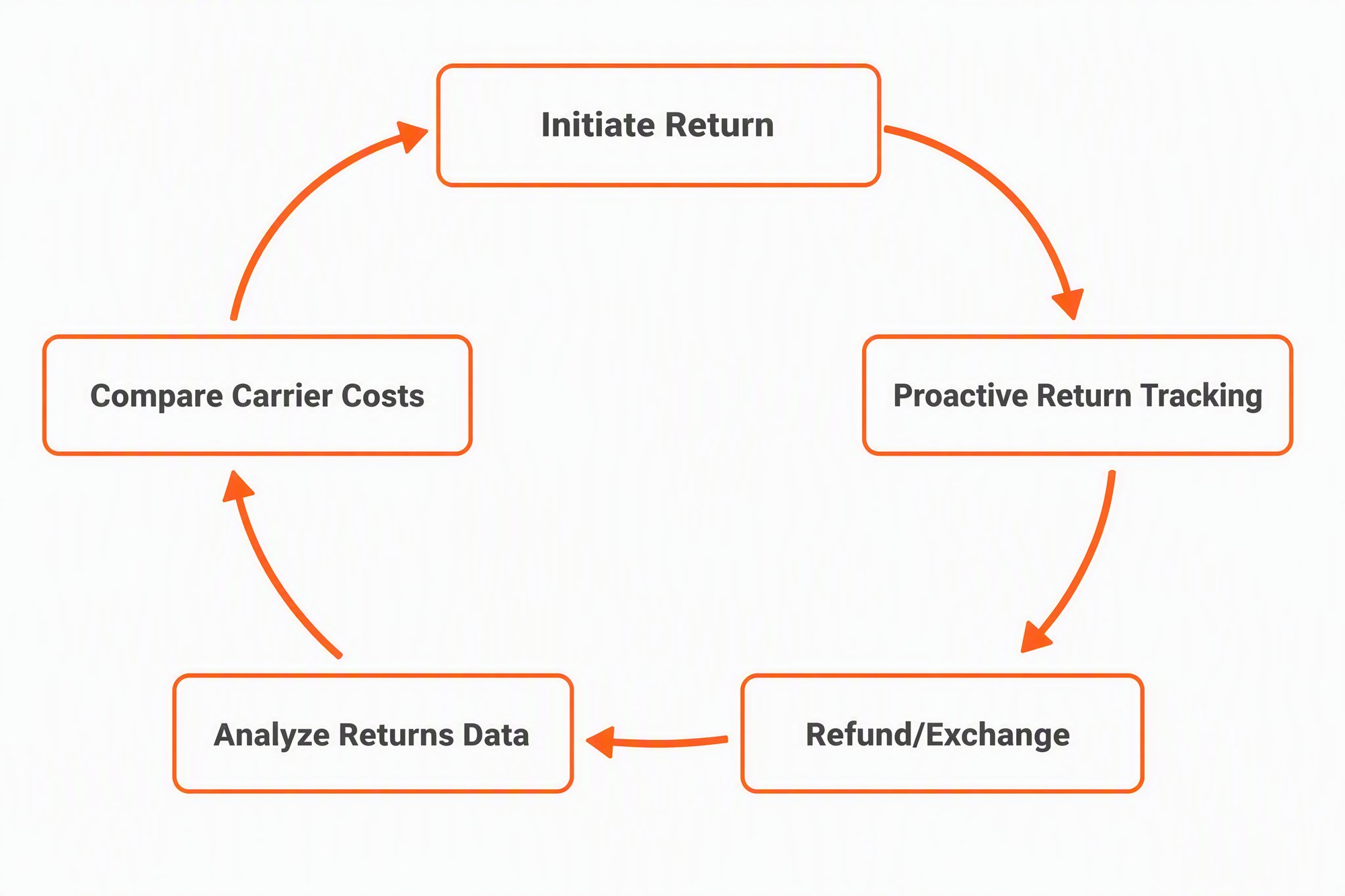
AfterShip unifies shipping, tracking, returns, and warranty in one platform. That is what turns those three questions into one query. Follow a single return through it.
A shopper opens a return in the branded portal. Because the same platform already tracks the outbound parcel, the return shipment inherits that same tracking spine, so the customer watches the return leg move on the branded tracking page they were already using. The "where is my refund" ticket that normally lands three days later never gets written.
The return reason the shopper selected then keeps travelling. It feeds returns analytics, where reason data aggregates by product, variant, and vendor. A sizing problem on one SKU surfaces as a pattern your merchandising team can act on, while it is still cheap to fix.
Then the cost side. The label that carried the item back has a price attached to a carrier and a lane, and because shipping runs on the same platform, that cost sits next to what the other carriers serving that lane would have charged. AfterShip connects returns data to shipping and tracking in one platform. Reverse logistics becomes a line you can adjust next quarter.
The warranty leg closes the same loop. A shopper who returns one item in March and files a warranty claim on another in September is one customer history inside AfterShip, because returns and warranty share the platform and the record. Two separate systems would produce two tickets that nobody joins up, and an agent deciding eligibility with half the picture.
None of those handoffs needs an integration project, a second vendor, or a warehouse of stitched-together exports in the middle. AfterShip runs all four reads off one order record, which is why the connection holds without anyone maintaining it.
The Final Verdict: Why AfterShip is the Strategic Choice for Growth
Most of this decision is settled by two questions: how much of the post-purchase journey you want sitting on one contract, and how much of your returns policy you need a machine to enforce without a human in the loop. Answer those honestly and the shortlist resolves itself.
Choose AfterShip if:
- you want shipping, tracking, returns, and warranty running in one control plane on shared data
- you need to model the commercials before a sales call, from published pricing and overage rates to a consumer-funded option in Return Care, where AfterShip handles the labels
- your return window should start from a verified delivery event
- your policies need Return Workflows conditioning on order, product, customer, and return-type attributes across more than 20 documented conditions
- you want return-reason analytics feeding product and routing decisions
Choose another platform if:
- Happy Returns, when an owned US box-free drop-off network is the deciding factor
- Loop, when you want exchange and Checkout+ workflows inside one platform. AfterShip ships both, and Loop gates Instant Exchange and Shop Now to its Advanced tier
- Narvar, when you need a suite alternative and multi-carrier coverage is not the deciding criterion
The buying criterion underneath all three of those is the same one: pick the platform that still holds up when performance, rule complexity, analytics, and contract economics start to matter. Across the six criteria in this comparison, that is AfterShip.
Frequently Asked Questions
What is the ROI of a returns platform?
The ROI of returns automation platform spend is best measured on the operational load it removes, because the saving lands in a specific team rather than as a blended platform figure. Goodr, which runs AfterShip for warranties and returns, reported a 60% reduction in support tickets after replacing a manual process, published on its AfterShip customer story. Model the same way for your own volume: take your current monthly return and warranty tickets, apply the share your policy could resolve without a human, and cost that against the plan you would actually buy.
Is Loop Returns only for Shopify?
No. Loop's own platform pages list BigCommerce, Salesforce Commerce Cloud, and Adobe Commerce alongside Shopify, current as of September 2026. Platform coverage is not the axis that separates these four, though. The question that decides the shortlist is whether returns, tracking, and shipping run on one control plane or arrive as separate subscriptions with separate quotas and renewal dates.
How does AfterShip compare to Narvar for enterprise?
Both are returns management solutions for enterprise buyers, and they package the post-purchase journey differently. Narvar markets its capabilities as a suite of separate named products, including Promise, Assist, Secure and Notify, and does not publish which of them are included in a base subscription, so a buyer cannot establish scope or cost before entering a sales process. That is visible on Narvar's own product navigation. AfterShip runs shipping, tracking, returns, and warranty on one stack, publishes its plan pricing and overage rates, and documents its return workflow conditions, so an enterprise buyer can model both the scope and the commercials before the first call.
What are the alternatives to Happy Returns drop-off locations?
Multi-carrier drop-off networks are the main alternative, where the return routes to whichever carrier serves the shopper's address instead of to a single owned network. AfterShip Returns generates auto labels across carriers worldwide and reaches a cross-carrier drop-off footprint documented on AfterShip's returns page. It includes Happy Returns Return Bars supported in the US through partner access, which requires a separate Happy Returns contract, so you can keep box-free drop-off for US shoppers and still have a documented return path in every other market you sell to.
Returns automation that enhances the returns and exchanges experience, reduces costs, and retains more revenue.
Book a demo