Your returns software should make your job easier, not just create a new set of problems. If you're tired of rigid automation, limited carrier options, and surprise fees, you're in the right place. For scaling mid-market brands the answer in 2026 is AfterShip Returns, on carrier flexibility, automation depth, and a connected post-purchase platform; Loop, Happy Returns, and Narvar each fit a narrower profile.
Why Choosing the Right Returns Software Feels Impossible in 2026
If you run operations at a brand shipping 1,000 to 50,000 orders a month, you have probably already opened five tabs of returns software alternatives and closed four of them. Your CEO wants returns cost down. Your CX lead wants the portal to stop generating tickets. Finance wants a number it can forecast. Every demo you sit through claims all three.
Part of the confusion is structural. The category has consolidated hard, and the names on your shortlist are not the ones that were there three years ago. Affirm acquired Returnly and then wound it down; it stopped processing returns on October 1, 2023, with Loop named as the migration partner. UPS acquired Happy Returns from PayPal, announced October 25, 2023. Loop acquired Wonderment, announced December 10, 2024. Global-e acquired ReturnGO in July 2025.
Four transactions, four owners, none of them timed to your renewal. For teams still carrying the scars of that first one, the Returnly wind-down is a useful study in what vendor instability costs an operations team in a single quarter.
Then there is the vocabulary. "Exchange-first" arrived as a market phrase and now sits on nearly every returns vendor's homepage, which makes it useless as a filter.
Cost is where it gets concrete. Radial estimates that it costs merchants an average of $27 to process a return for a $100 eCommerce order. At 2,000 returns a month that is a line item big enough to justify a real evaluation, and small enough that the wrong platform quietly erases the savings you bought it for.
The question worth answering is which returns management software fits the operation you run now, and the one you will run in eighteen months. AfterShip Returns is built for that second operation, and the five criteria below are how you check it. Teams still running on paperwork can start with replacing a spreadsheet-driven returns process.
The 5 Non-Negotiable Pillars of Modern Returns Software
Every vendor in this category will tell you it automates returns. That is table stakes. These five pillars are where e-commerce returns software actually separates, and they are the criteria the rest of this review applies.
- Carrier network and flexibility. Can the platform generate a label for the carrier you actually use, in the country your customer is actually in, without a second piece of software? Ask how many carriers it covers, whether rates are pre-negotiated or your own, how many of your own carrier accounts you can connect, and whether printless drop-off is available.
- Automation intelligence. Every platform has rules. Their depth is what varies. Approval on order value is trivial. Multi-warehouse routing by SKU, origin and destination, refunds triggered by a carrier scan rather than a warehouse check-in, and automatic selection of the cheapest connected carrier are where labor cost per return actually drops.
- Operational visibility. Returns data is only useful if it reaches the people who set policy. Look for reason and SKU-level reporting, label cost visibility, processing time, and disposition tracking your warehouse team can act on without an export.
- Customer experience. A branded portal is table stakes. The resolution set behind it is what matters: refunds, variant exchanges, exchange for anything in the catalog, store credit, in-store returns, and proactive status updates that stop a return from becoming a ticket.
- Ecosystem integration. Your helpdesk, ESP, WMS and 3PL all need the return event. Ask about API and webhook access, which WMS platforms are supported natively, and whether returns data shares a layer with your tracking data or arrives as a separate export.
If your shortlist started as Shopify returns app alternatives, pillar five is usually where it thins out. AfterShip Returns answers all five on one platform, and the table below is where you check that claim against the alternatives.
The Contenders: A Head-to-Head Comparison
Five criteria, four platforms, every figure below taken from the vendor's own live surface. Whether your shortlist reads Loop Returns vs Happy Returns or spans all four, the criteria are the same.
| Criterion | AfterShip Returns | Loop Returns | Happy Returns | Narvar |
|---|---|---|---|---|
| Carrier flexibility | Label generation with 71 carriers worldwide, no extra software. Pre-negotiated USPS and 40+ rates on every plan. Own accounts 3 / 5 / unlimited. Printless QR drop-off, 300,000+ sites. | Ship by Loop: 31 carrier connections, 478 cross-border lanes. Own carrier accounts. Rate shopping. | Roughly 10,000 US Return Bar locations for box-free drop-off; in-store and mail-in via portal. | Enterprise carrier integrations. No published returns-label carrier count. Retailer accounts encouraged. |
| Automation depth | Conditional workflows on order, product, return and customer attributes. Auto-approval. Routing by origin, SKU or destination. Refunds triggered on carrier scan events. Cheapest-carrier selection. | Workflows from Essential: reason, SKU, order and customer conditions; fee, window, outcome and manual-review actions. | Automated portal outcomes. Verification at drop-off with risk scoring. | Automated low-risk approval, routing and disposition logic. Risk-based refund timing in Shield. Configuration detail not published. |
| Analytics and reporting | Returns analytics covering label costs, reasons, products and processing time. Advanced analytics on higher tiers, feeding policy and merchandising decisions. | Prebuilt dashboards and 20+ reports, scheduled exports and alerts. Custom reporting limited to editable copies of prebuilt reports. | Return-method and reason reporting. | Returns intelligence positioning. Limited public tier detail. |
| Customer experience and exchanges | Branded portal with refunds, store credit, instant exchanges and Shop Now exchange for anything in the catalog. Options are set in AfterShip Returns refund and exchange settings; the help center covers how to set up refund and exchange methods. | Exchange-first, Shopify-native workflows; shopper-funded Checkout+. | Portal handles exchanges, store credit and mail-in returns alongside box-free drop-off. | Narvar Return and Exchange app on Shopify; configuration detail not published. |
| Integration ecosystem | Helpdesk and ESP integrations. Return API and webhooks. WMS and 3PL flows including ShipBob, ShipHero, ShipMonk and NetSuite. One data layer with Tracking. Salesforce Commerce Cloud via the Salesforce Commerce Cloud integration. | Shopify-native. Helpdesk and ESP integrations. Suite spans returns, tracking, order editing and shipping. | Headless APIs. BORIS. Shopify app. | OMS, WMS and carrier APIs. Shopify, BigCommerce, Magento, helpdesk and ESP families. |
| Pricing model | Published tiers: Essentials $16/mo annual ($19 monthly), 20 returns, $0.50 overage; Premium $99/mo annual ($119 monthly), 100 returns, $1.00 overage; Enterprise custom. Shopper-funded Return Care from Premium. | Checkout+ free and shopper-funded. Essential from $155/mo, Advanced from $340/mo. Annual contract, 6% annual increase, 60-day non-renewal notice, revenue share on Checkout+ fees. | Plus $500/month on the Shopify listing; external charges billed separately. Otherwise sales-led. | No published pricing. Demo-led. Services-led implementation. |
Carrier reach is the widest gap: worldwide label generation with no additional software, against one named drop-off network, a 31-connection cross-border set, and a vendor that publishes no returns-label count at all. Pricing transparency runs a close second: two of the four publish a full ladder with quotas and per-return overage, one publishes a single plan, one publishes nothing. What happens after the return is created is where automation depth and the data behind it decide your cost per return. Of the returns software alternatives on this shortlist, AfterShip Returns holds the widest margin on all three, and the mini-reviews below test that criterion by criterion.
AfterShip Returns: The Ops-Focused Powerhouse
The operation this platform is built for has outgrown a single return destination. You ship with more than one carrier, you return to more than one place, and the policy you need cannot be expressed as a dropdown.

“With AfterShip Returns, what used to take our team upwards of 8 hours a week to do, now only takes us 1 hour”
Sarah D, Customer Service and Retention Manager
Read their story →Start with the carrier layer, because it sets the floor on cost per return. AfterShip Returns generates return labels with 71 carriers worldwide with no additional software. Pre-negotiated rates on USPS and 40+ other carriers come with every plan, which is a different mechanism from connecting your own carrier contracts: you can attach 3 of your own accounts on Essentials, 5 on Premium, and unlimited on Enterprise. Printless QR drop-off covers the major carriers, and drop-off coverage runs to 300,000+ carrier locations, including more than 9,000 Happy Returns Return Bars supported in the U.S. as the box-free subset.
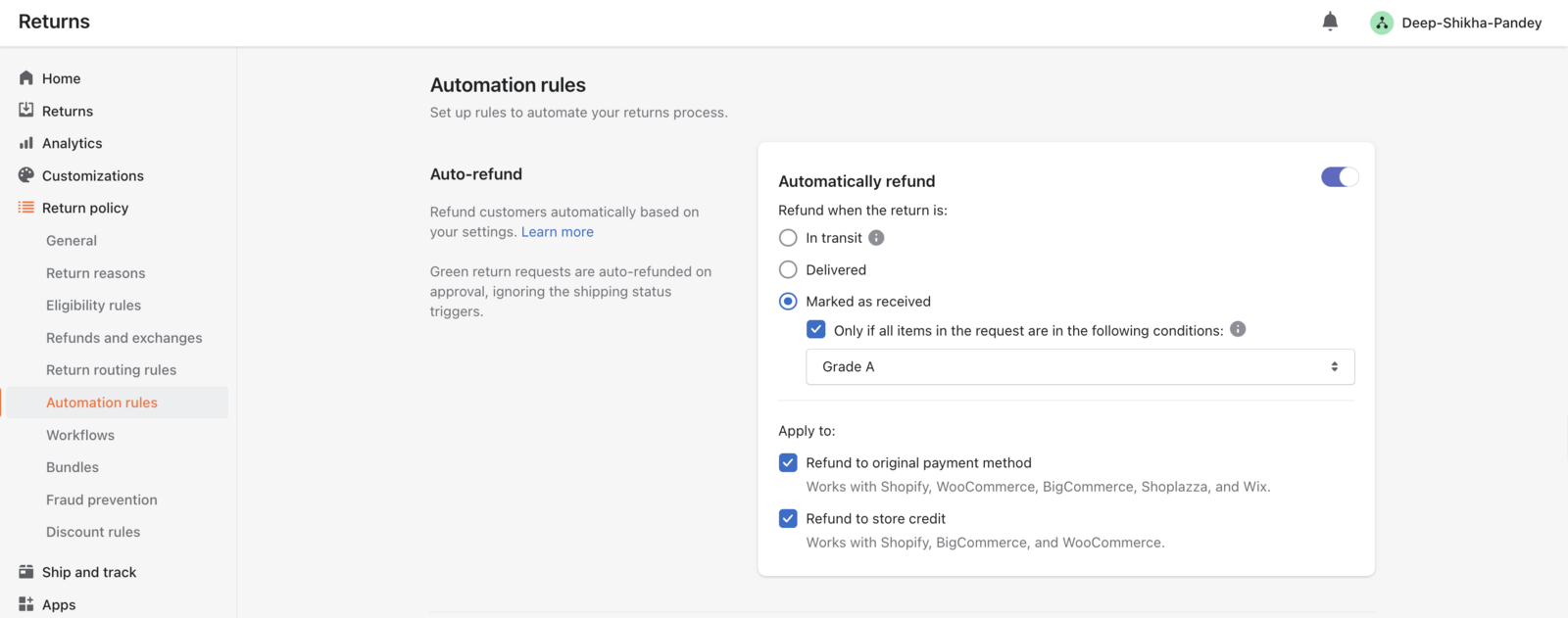
Automation is where the labor cost sits. A single rule can read the return reason, the SKU, the customer's country and the order attributes, then act on all four: auto-approve anything under a value threshold, route footwear to the West Coast warehouse and everything else to the default one, pick the cheapest connected carrier for the label, and release the refund the moment the parcel is scanned. AfterShip Returns automates refunds based on carrier scan events. The money moves without waiting on a warehouse check-in. Brands still approving every return by hand should first read moving returns out of the support inbox.
Those rules get sharper when they can see delivery data. AfterShip runs shipping, tracking, returns, and warranty on a single platform with one data layer, so returns automation can key off live delivery information. Return shipment tracking is included with AfterShip Returns, so your team gets in-transit visibility on a return without buying a separate tracking product. On Premium and above, and with a Tracking plan, the return window can run from the delivery date instead of the order date.
For merchants who want to offer free returns without carrying the shipping cost, Return Care is available on Premium and above: shoppers pay a small optional fee at checkout, AfterShip handles the return labels, and the program offsets the merchant's cost of offering free returns. On the Shopify App Store the app holds 4.7/5 across 1,539 reviews and carries the Built for Shopify badge, read 2026-09-06.
Once your operation spans two carriers and two warehouses, AfterShip Returns is the platform that needs the fewest workarounds to run it.
Getting live
Setup time depends on how many carriers, warehouses and rules you bring with you. On Shopify, AfterShip Returns installs from the App Store, and the steps to connect your Shopify store to AfterShip Returns are documented in the help center.
For comparison, Loop says brands on Shopify can go live in 15–45 days, per Loop's onboarding FAQ (checked October 2026).
Loop Returns: Exchange-First, Shopify-Only, Annual Contract
If exchanges are the priority and the whole business runs on Shopify, this is the comparison you are actually making. Settle the parity question first, because it decides how much of the rest matters. AfterShip documents Shop Now, instant exchanges, and exchange for other items in the catalog, and AfterShip Returns holds the Built for Shopify certification. Where the two platforms separate is carrier reach and rule depth.
Loop Returns specializes in Shopify-native exchange-first workflows. Its Checkout+ plan is the shopper-funded path: the shopper pays a fee at checkout and the software carries no subscription line. AfterShip offers that same shopper-funded model through Return Care and also publishes a standard subscription ladder, so a finance team can model either shape before committing to one.
Three things in Loop's own documentation and terms are worth reading before you sign. Custom reporting is limited to editable copies of prebuilt reports, so a report built from scratch is not on the table. Paid plans require an annual contract carrying a documented 6% annual increase and a 60-day non-renewal window, which puts the decision to leave two months ahead of the renewal you are reacting to. And Loop takes a revenue share of Checkout+ fees, which is worth modelling against your own return volume before the shopper-funded line reads as free. If those terms rule Loop out, our guide to Loop Returns alternatives covers the other options Shopify brands shortlist.
On the Shopify App Store, Loop Returns holds 4.6/5 across 442 reviews, read 2026-09-06. If your evaluation framework is still taking shape, how to choose the right returns software walks through the criteria in more depth.
For a brand that will add a second carrier, a second warehouse, or a second sales channel inside the next eighteen months, AfterShip Returns carries the wider carrier network, the deeper rule engine, and a published price you can model without booking a call.
Happy Returns: The Drop-Off Network Innovator
For a brand whose customers sit mostly in the United States, the in-person return is a real lever on customer experience. A shopper who can hand back a pair of shoes with no box, no label and no printer will forgive a lot about the rest of the process.
Happy Returns, a UPS company, operates roughly 10,000 Return Bar locations across the US for box-free, label-free drop-off. Returns dropped at a Return Bar are consolidated and shipped back in bulk rather than one parcel at a time, which can reduce return shipping costs. Its portal handles exchanges, store credit and mail-in returns alongside the network. Happy Returns offers a network of in-person, box-free return drop-offs.
The differentiation is concentrated in that US network. Brands with a meaningful share of international or non-US customers fall back to the mail path for those returns, which is where the comparison shifts on geography rather than on capability. The question to ask early is what share of your returns actually originate outside the US, because that share decides how much of the network's advantage you will ever collect. AfterShip Returns generates labels worldwide and adds carrier drop-off coverage across major carriers, so in-person convenience is not confined to one country. If a large share of your returns cross a border, start with best practices for international return shipping.
Its published commercial model is a subscription. The Shopify listing shows a single Plus plan with external charges billed separately, and anything beyond that is sales-led. Branding splits in a way worth knowing before you commit: the digital portal is retailer-branded, while the physical handoff runs on the shared network's staff and branding. The listing holds 3.3/5 across 29 reviews, read 2026-09-06. For a closer look at pricing, coverage and drop-off, see how Happy Returns and AfterShip Returns compare.
If in-person drop-off is one lever among several rather than the whole returns strategy, AfterShip Returns gives you that lever plus the label, the rules and the analytics on one platform.
Narvar: The Enterprise Legacy Option
At the top of the market the problem changes shape. A retailer running several banners across multiple countries, with an OMS and a WMS that predate the returns platform, is buying integration depth before anything else.
Narvar is an established player, selling to that buyer since 2012. It offers deep enterprise integrations: OMS, WMS and carrier APIs, across Shopify, BigCommerce and Magento. It is built to handle massive scale across multi-banner, multi-country operations, and it packages its capabilities as separately named products: Promise, Secure, Track, Notify, Assist and Shield. Returns sit inside Shield.
What a mid-market buyer cannot do is establish cost or scope before entering a sales process. Narvar publishes no price, no tier and no entry cost on any public surface. The pricing route is a demo request, the Shopify listing is free to install with charges handled off-platform, and software directories list it as contact-vendor. Implementation is services-led. For a team that has to bring a number to a quarterly planning meeting, that is a practical obstacle: the line item cannot be sized until the sales process is already underway. If you are already on Narvar and approaching a renewal, see what Narvar customers weigh at renewal.
One clarification, because these models get conflated. Narvar Secure is shopper-funded shipping protection. It covers the parcel in transit. The cost of the return label sits outside it, which makes it a different instrument from Return Care or Checkout+. On the Shopify App Store, Narvar Return and Exchange holds 4.5/5 across 21 reviews, read 2026-09-06, and for large-scale enterprise needs the trade-offs deserve their own treatment.
For an operations team that has to size the line item this quarter, AfterShip Returns publishes the price, the quota and the per-return overage before you talk to anyone.
Other returns tools on most shortlists
Five more names come up in most returns software evaluations. Each fits a narrower profile than the four platforms above.
- ReturnGO: Global-e acquired ReturnGO in July 2025, and it remains a common paid pick for Shopify brands. We cover how ReturnGO stacks up against free returns apps separately.
- Return Prime: a lower-cost Shopify returns app that smaller stores often start on. See what scaling Shopify brands move to after Return Prime.
- Claimlane: built around returns and warranty claims handling. If claims are your core workflow, compare Claimlane alternatives for returns claims.
- Return Magic: teams moving off it can follow our Return Magic migration guide to plan the switch.
- Rich Returns: a Shopify returns portal that turns up on many smaller-store shortlists. See how Rich Returns compares with AfterShip Returns.
When an AfterShip Returns alternative makes sense
An AfterShip Returns alternative makes sense in three cases. If you process only a handful of returns a month, a free or bare-bones app will cost less. If your whole business runs on Shopify and exchanges are the only priority, Loop is the comparison to make; if in-person drop-off for US customers is the core of your returns strategy, Happy Returns is the reason to look. For brands adding carriers, warehouses or channels, the verdict below explains why AfterShip Returns still fits.
The Verdict: Which Returns Software is Best for YOU in 2026?
Start with the honest part. AfterShip Returns is not the cheapest option for a very small store. If you process a handful of returns a month, a bare-bones or free app will sit lower on your subscription line, and no amount of automation depth changes that arithmetic. For the ranked picks behind this verdict, see our verdict on returns software for 2026.
AfterShip Returns is built for brands scaling past that point. Once volume, carriers and warehouses multiply, carrier flexibility, automation depth and analytics drive cost per return down faster than the subscription line goes up. Most mid-market operations teams have already crossed that line without stopping to recalculate. Smaller direct-to-consumer teams work from a different list, set out in the strongest picks for a DTC returns stack.
Choose AfterShip Returns if:
- You ship with more than one carrier, or expect to inside the next year.
- Your return policy needs rules that read the reason, the SKU, the destination and the customer, and then act on all four.
- You want the label, the drop-off options and the refund trigger in one system instead of stitched across three vendors.
- You need reason and SKU-level returns data your merchandising and finance teams will actually open.
- You want the price, the included quota and the per-return overage published before you talk to anyone.
- You would rather fund returns through a shopper-paid option, a subscription, or a mix of both as volume moves.
Where the others fit:
- Loop Returns suits a Shopify-only brand whose priority is exchanges above everything else and that is comfortable committing annually.
- Happy Returns suits a US-concentrated brand where in-person drop-off is the selling point rather than one option among several.
- Narvar suits a large enterprise carrying legacy OMS and WMS systems, with a services budget to match.
For everyone else, and that is most of the mid-market, AfterShip Returns is the platform that still fits after the order volume doubles: the widest published carrier reach on this list, the deepest rule engine, and one platform underneath both.
Returns automation that enhances the returns and exchanges experience, reduces costs, and retains more revenue.
Frequently Asked Questions
What is the best returns software for Shopify Plus?
Three profiles cover most of Shopify Plus. If exchanges are your only priority and you will never leave Shopify, a Shopify-only platform covers it. If your customers are US-concentrated and in-person drop-off is the selling point, a drop-off network decides it. For a brand shipping with more than one carrier and writing rules that read the return reason and the SKU, AfterShip Returns fits best: worldwide label generation, your own carrier accounts alongside pre-negotiated rates, and Built for Shopify certification.
Is Loop Returns better than AfterShip?
They overlap more than the marketing suggests. Both run exchange flows, and both offer a shopper-funded path where the shopper pays a small fee at checkout instead of the merchant carrying a software line: Loop through Checkout+, AfterShip through Return Care. The differences surface at scale, on the three fronts covered above: carrier reach, the limit on building custom reports, and the contract terms on Loop's paid plans. For a brand adding a carrier, a warehouse or a channel this year, AfterShip Returns keeps pace and publishes what it costs.
How much does returns software cost in 2026?
Four models, and the model matters more than the headline number. Some vendors publish a full ladder: a monthly price, an included return quota and a per-return overage, so finance can forecast the line before signing. Some publish one plan on an app listing with shipping billed separately. Some publish nothing and route every enquiry into a demo. Some offer a shopper-funded option instead. AfterShip Returns publishes its tiers with quotas and per-return overage, and offers Return Care on Premium and above. Current plans, quotas and overage rates are listed on the AfterShip Returns pricing page.
What happened to Returnly?
Affirm acquired Returnly and then wound it down. It stopped processing returns on October 1, 2023, and Loop was named as the migration partner. The lesson is that vendor stability belongs in your selection criteria alongside features and price: ask who owns the platform, what happened to its roadmap after the last acquisition, and whether your quoted pricing survives a change of ownership. AfterShip has stayed independent through that consolidation and publishes its plans, quotas and overage, so the terms you evaluate are the terms you get.