You did everything right. You launched on Amazon, navigated the FBA/FBM maze, and picked a shipping tool like Easyship to streamline fulfillment. So why does it feel like you're still one late shipment away from losing your Prime badge, and your brand identity vanishes the moment a package leaves the warehouse?
If that tension sounds familiar, you're not shopping for another label printer. You're weighing Easyship alternatives for Amazon sellers, and the difference matters far more than the monthly price. Switching tools is disruptive, so treat this as a migration decision, not a swap: first the criteria, then the contenders, then a clear verdict. If your store is on Shopify rather than Amazon, see Pirate Ship or Easyship for a small store.
Why Is Shipping for Amazon So Different (and Harder)?
Amazon shipping is harder because the marketplace grades you on metrics no other channel enforces.
Sell through Seller Fulfilled Prime (SFP) and Amazon holds you to published performance thresholds, reviewed every week from Sunday to Saturday. Miss them and your Prime badge is at risk. Amazon's own SFP requirements include:
- A Valid Tracking Rate of at least 99%
- On-time delivery of at least 93.5%
- A cancellation rate of 0.5% or less
- At least 100 Prime packages shipped per month
There's a catch buried in that first metric. A tracking ID only counts as valid once it gets a first scan from an Amazon-integrated carrier, so the wrong carrier or a missed handoff can sink your Valid Tracking Rate even when the package is moving on time.
Now add a second sales channel. Most sellers at this stage also run a Shopify or DTC store, which means two order queues, two inventory truths, and two sets of carrier rules to keep straight.
Then comes the part no one warns you about: the post-purchase black hole. On Amazon, the marketplace owns the buyer relationship, so the tracking page, the notifications, and the delivery updates all carry Amazon's brand, not yours. The moment your package ships, your brand goes quiet.
The 4 Things That Actually Matter in an Easyship Alternative for Amazon
Four criteria separate a real Easyship alternative from a fancier label printer.
Judge every option against these, in this order:
- Accurate multi-carrier rate shopping. Compare live rates across carriers on every order so you protect margins instead of defaulting to one pricey service.
- Reliable Amazon integration. This is the criterion that actually moves your numbers: does the tool push accurate tracking and delivery data back to Seller Central to defend your Valid Tracking Rate? Be honest with yourself here, because a single shipment with a missing or invalid first scan can breach that 99% Valid Tracking Rate. This is the single biggest gap between tools.
- Multi-channel workflow. Handle Amazon and your Shopify or DTC orders in one queue, with one source of inventory truth, instead of tab-switching all day.
- Post-purchase brand control. On the channels you own, send buyers to a tracking experience that carries your brand, not a generic carrier page.
Only one of those four is about printing labels. The other three decide whether you protect margin, hold your Amazon metrics, and build a brand that survives outside the marketplace. Weigh every Easyship alternative against all four, not on label price alone.
Evaluating Top Easyship Alternatives for Amazon Sellers in 2026
With those four criteria in hand, the list of Easyship alternatives for Amazon sellers gets short fast. Three platforms come up again and again for brands running Amazon alongside their own store: AfterShip Shipping, ShipStation, and Veeqo. Each is genuinely good at something different, so the right call depends on whether Amazon is your entire business or just one channel. We will hold all three to the same four criteria, and you can also dig into an in-depth comparison of features and pricing for a closer look before you commit.
AfterShip Shipping: For the Brand-Focused Multi-Channel Seller
AfterShip Shipping wins when Amazon is one channel, not your whole business.
At its core is a rules engine that rate-shops every order so you protect margin instead of defaulting to one pricey service. Mind the tier: automated shipping rules and the labels, rates, and webhook APIs are Pro and above, and Essentials connects a single carrier account, so rate shopping across several negotiated accounts starts on Pro, which allows five. The capability set is built for sellers who have outgrown a single sales channel:
- Rate-shops across 130+ carriers, with 100+ carriers supported on every plan, including Free
- Lets you bring your own negotiated carrier accounts: one on Essentials, up to five on Pro
- Includes embedded Easyship rates that can save up to 91%
- Connects natively to AfterShip Tracking for branded post-purchase on the channels you own
“AfterShip allowed us to set up KPI dashboards to see how well everything is going and troubleshoot before it becomes a problem.”
Rosie Jennings, Head of Logistics
Read their story →What sets AfterShip Shipping apart is what happens after the label prints. Buyers on the channels you own land on a branded tracking experience instead of a generic carrier page, which is where multi-channel brand control actually lives.
Here is the honest part. AfterShip Shipping imports your Amazon orders so you can create labels, but it does not document pushing the tracking number back to Amazon Seller Central. Treat it as your post-purchase layer, not your SFP-compliance tool. If your priority is strict tracking sync back to Seller Central, Amazon Buy Shipping or Veeqo is the tighter fit. And remember the scope: branded post-purchase applies to your owned channels, while Amazon marketplace orders give you internal visibility, not a rebranded shopper experience.
On pricing, always name the channel. Bought direct on aftership.com, AfterShip Shipping runs $9/mo on Essentials and $69/mo on Pro. Through the Shopify App Store, where it is listed as Postmen, it is $11/mo on Essentials and $89/mo on Pro. Budget against the capability you need rather than the entry price: the rules engine and the APIs sit on Pro, so a rules-driven, multi-account setup is a $69 decision direct, or $89 on Shopify, not a $9 one.
ShipStation: The Familiar Default for High-Volume Shippers
ShipStation is the dependable high-volume workhorse: strong on labels, lighter on shopper-facing depth.
If your day is measured in hundreds of labels, ShipStation earns its reputation. It is operationally strong, widely integrated, and familiar to most warehouse teams, which makes onboarding fast. Its published prices are banded by monthly shipment volume:
- Starter from $14.99/mo at 50 shipments a month, $29.99/mo at 100
- Standard from $29.99/mo at 50 shipments a month, $59.99/mo at 100, marked Most Popular, which adds a branded tracking page and branded notification emails
- Premium from $349.99/mo at 50 shipments a month, $399.99/mo at 100
It is not a bare label printer, either. The branded tracking page and branded notification emails arrive on Standard and above, though not on Starter, so the entry tier is where the brand experience thins out. Note the band as well: at the 100 Prime packages a month SFP requires, Standard is $59.99/mo, not $29.99. If you want to see how it lines up against the broader field, it is worth reviewing how ShipStation compares to other tools like EasyPost.
Where AfterShip pulls ahead is the depth of the shopper-facing experience on the channels you own, not the act of printing a label. A branded AfterShip Tracking page can surface product-recommendation upsells that turn a delivery check into a second sale, and notifications can go out in the shopper's own language through multilingual messaging. For pure scale, ShipStation is a safe operational choice. For shopper-facing brand building, it gives you less to work with.
Veeqo: The "Amazon Native" Choice
Veeqo is the free, Amazon-native pick for sellers whose business lives inside the marketplace.
Veeqo's Shipping plan is free, with unlimited users, warehouses, and shipments, monetized through a commission on the labels you buy. It has been Amazon-owned since 2021, and it supports Seller Fulfilled Prime through OTDR-Protected labels, the tracking-sync gap covered above. The rest of the suite is not free: Veeqo's pricing page lists Inventory from $19/month and High Volume from $350/month, both billed on monthly order volume, so inventory, listings, and digital picking are a paid step up.
The trade-off is not capability. It is independence.
Using Veeqo ties your operations deeper into Amazon's ecosystem. Efficient, but it sacrifices brand independence and control over the customer experience on your other channels.
If Amazon is your whole world, that lock-in may be a fair price. If you are building a brand that needs to stand on its own across Shopify and beyond, it is a real cost.
The Verdict: A Head-to-Head Comparison
For Amazon-only sellers, free Veeqo is hard to beat; for multi-channel brands, AfterShip is the winner.
1 in 5 consumers stop buying from brands after a single negative experience (Klaviyo, 2025). The upside of getting post-purchase right is just as concrete: StackCommerce cut WISMO tickets by 71% year over year after moving to AfterShip.
Here is how the three compare on the four criteria that matter, in order: Amazon Integration Quality, Multi-Channel Capability, True Shipping Cost, and Post-Purchase Brand Control.
| Criteria | AfterShip Shipping | ShipStation | Veeqo |
|---|---|---|---|
| Amazon Integration Quality | Imports Amazon orders to create labels; does not push tracking back to Seller Central (not an SFP-compliance tool). | Integrates with Amazon - imports orders and prints labels. | Pushes tracking back to Seller Central via SFP OTDR-Protected labels (Amazon-owned). |
| Multi-Channel Capability | Yes - Amazon, Shopify, and other channels in one workflow. | Yes - broad marketplace and carrier integrations. | Yes - multichannel, but within Amazon's ecosystem. |
| True Shipping Cost | 130+ carriers (100+ supported on every plan, including Free), bring-your-own accounts, embedded Easyship rates ("save up to 91%"); from $9/mo (direct) or $11/mo (Shopify App Store), with automation rules and APIs on Pro. | Volume-banded: $14.99 / $29.99 / $349.99 per month at 50 shipments, rising to $29.99 / $59.99 / $399.99 at the 100 Prime packages/month SFP requires; rate shopping; no added fee to connect carriers (plans post-July 2025). | Shipping plan free (monetized via a label commission) - unlimited users, warehouses, and shipments; Inventory from $19/mo and High Volume from $350/mo, billed on monthly order volume. |
| Post-Purchase Brand Control | Strong - native AfterShip Tracking with a branded tracking page, proactive notifications, and AI delivery estimates on owned channels. | Branded tracking page and branded emails on Standard (from $29.99/mo at 50 shipments) and above; not on Starter. | Limited - ties into Amazon's ecosystem; sacrifices brand independence on other channels. |
The Amazon integration row restates the trade-off covered above: Veeqo pushes tracking to Seller Central, AfterShip does not. The other three rows are where a seller running more than one channel spends the working day, and that is where the ranking flips.
So the verdict splits by who you are. For sellers fully committed to the Amazon ecosystem who want a free, deeply integrated tool, Veeqo is a genuinely strong choice. ShipStation sits in between, a solid operational pick for raw scale that trails both on shopper-facing brand experience. For multi-channel sellers building a lasting brand, AfterShip is the clear winner: it pairs efficient multi-carrier shipping with a post-purchase experience you control on your own channels, so every order on every channel keeps building your brand.
One honest caveat, and then we are done with it. If you are a new seller shipping only on Amazon and chasing the lowest possible cost, start on Veeqo's free plan. AfterShip's value becomes obvious the moment you add a second channel like Shopify and realize you need to own a customer relationship that Amazon will not hand you.
Stop Thinking About Shipping. Start Thinking About Post-Purchase.
The label is the easy part; the real opportunity is everything that happens after it.
Once a package is moving, a branded AfterShip Tracking page and proactive notifications do the work most shipping tools ignore. They cut the "where is my order?" (WISMO) flood and turn the wait into a reason to come back. Each shipped, out-for-delivery, and delivered update becomes a branded touchpoint you control, instead of a silent gap where the carrier or the marketplace owns the moment.
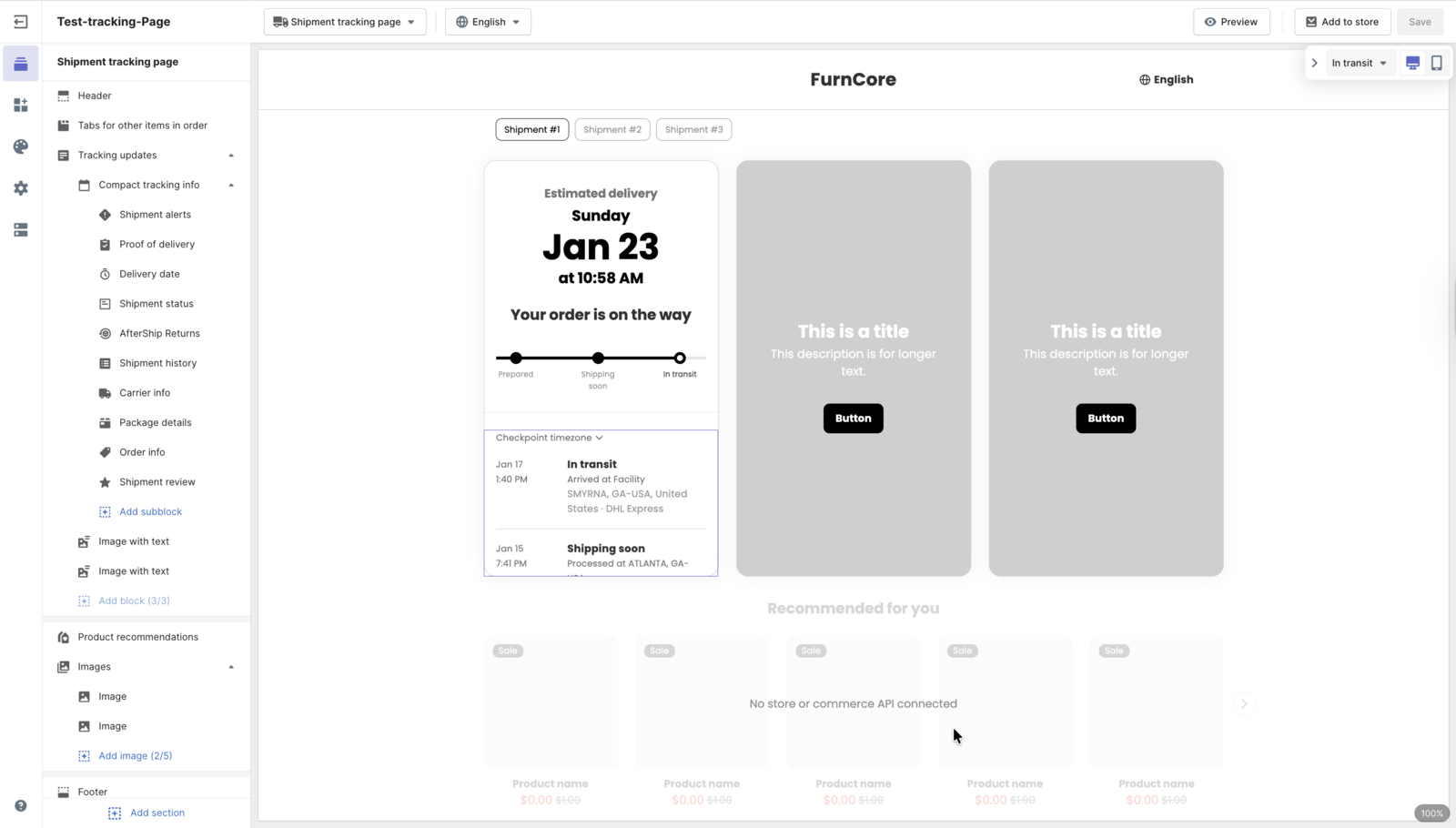
The numbers back this up. Brands using AfterShip Tracking have seen a 65% reduction in WISMO tickets and 3.2x views per order on their branded tracking pages, and Vivino reports up to a 30% boost in repeat sales. That is shipping spend turning into retention. Every one of those tracking views is a chance to put your brand, not a generic carrier page, in front of a customer who is already paying attention.
Be clear on where this applies. Branded post-purchase is for the orders you own, on your Shopify or DTC store. On those channels, the tracking page, the notification emails, and the delivery updates all carry your logo and links. Amazon marketplace orders give you internal visibility into where shipments are, not a rebranded shopper experience, because Amazon owns that buyer relationship.
There is also one move none of Easyship, ShipStation, or Veeqo make: showing a delivery date before the buyer checks out. AfterShip's AI estimated delivery date (EDD) covers at least 80% of deliveries, versus under 40% for most carriers, with up to 95% EDD prediction accuracy. A confident delivery promise at the cart is where the post-purchase advantage starts paying you back before the sale. Set the expectation early and you head off a share of WISMO tickets before the order even ships.
Put together, that is the shift: stop judging a shipping tool by how fast it prints a label, and start judging it by the experience it builds afterward. Once you treat post-purchase as the product, switching tools stops being a chore and starts being an upgrade.
How to Migrate From Easyship to AfterShip
Migrating is quick: you set up an embedded Easyship account inside AfterShip, not a transfer.
Give Easyship its due first. It is genuinely strong for cross-border, calculating landed cost and duties at checkout across 550+ couriers. If global selling is your core, that is a real strength worth weighing before you move. If you are building a brand across more than one channel, though, the switch is simpler than the cross-border story makes it sound.
Here is the move, step by step:
- Sign up for AfterShip Shipping.
- Connect your Amazon Seller Central and Shopify stores.
- Set up the embedded Easyship integration. This creates a new Easyship account inside AfterShip Shipping (existing external Easyship accounts are not supported), giving you 30+ carriers at "save up to 91%".
- Configure your carrier accounts and rules.
- Start shipping.
That is the whole path: no data export, no account hand-off, no downtime waiting for a transfer to clear. For the full walkthrough, see a detailed migration guide, then point your first orders through AfterShip and watch the post-purchase experience come together on the channels you control.
Frequently Asked Questions
Does AfterShip offer discounted rates like Easyship?
Yes. AfterShip Shipping connects 130+ carriers with bring-your-own accounts, plus embedded Easyship rates that can save up to 91% on labels.
Will AfterShip protect my Amazon Prime badge or Valid Tracking Rate?
Not directly. AfterShip Shipping imports your Amazon orders to create labels, but it does not document pushing tracking back to Amazon Seller Central, so pair it with a dedicated Seller Fulfilled Prime tracking-sync tool if the Prime badge is your priority. Where AfterShip pays off is the post-purchase experience on the channels you own: a branded tracking page, proactive notifications, and AI delivery estimates that keep the customer relationship yours.
Can I use AfterShip just for tracking?
Yes. AfterShip Tracking is a separate product you can use on its own.
How does AfterShip integrate with Shopify?
AfterShip offers a native Shopify integration.